

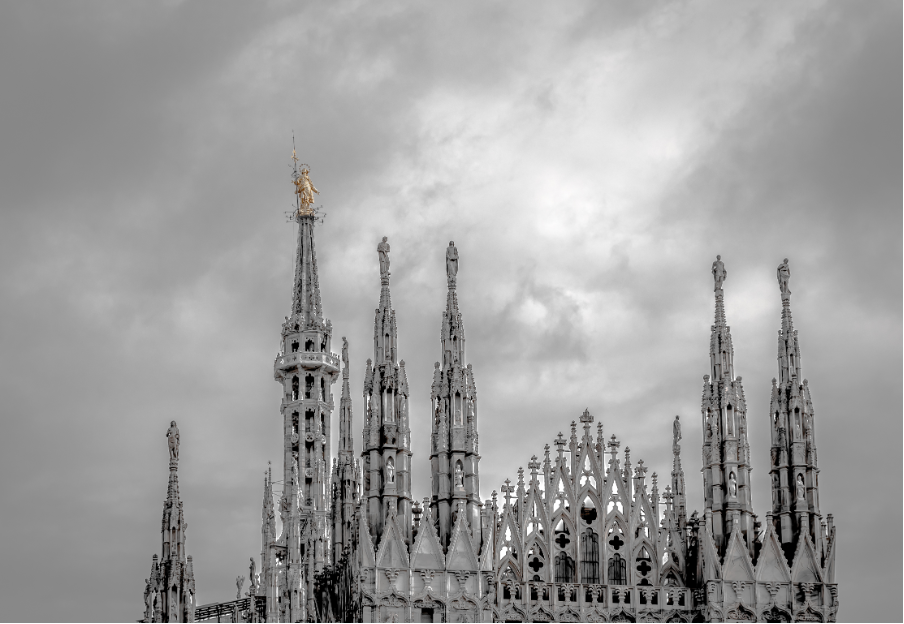
Madonnina over the city, May 20215 (my photo)
With dedication
To my Milanese friends,
who made the middle of Europe
feel like its metaphysical center.
And to all Milanese who died
during the COVID pandemic,
when this essay was initiated.
In the Montmartre cemetery in Paris there is a tombstone that commits an act of quiet treason. It belongs to Henri Beyle, a Frenchman from Grenoble who served Napoleon, survived the retreat from Moscow, and wrote, under the name Stendhal, some of the most French novels in existence. The epitaph he composed for himself reads: “Arrigo Beyle, milanese. Scrisse, amò, visse”, that is Arrigo Beyle, Milanese. He wrote, he loved, he lived. Not a Frenchman, not a novelist, not a consul of France at Civitavecchia, but a Milanese, a citizen of Milan. A nationality that does not exist, claimed by a man like me — who was not born to it, carved in a language that was not his mother-tongue, in a city that was not Milan.
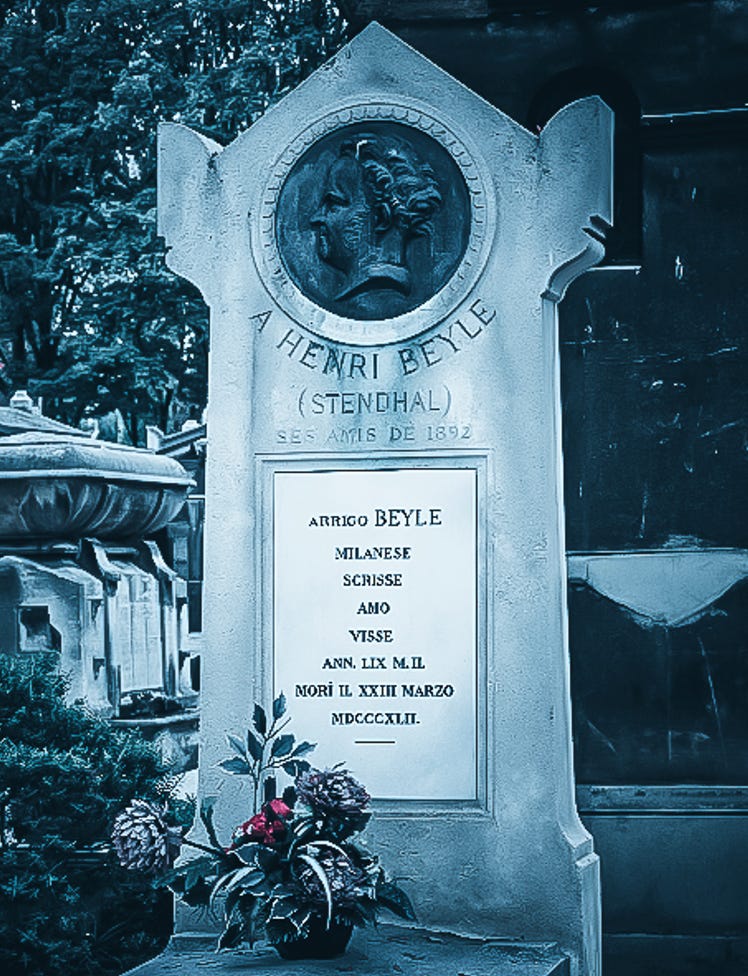
Stendhal’s gravestone (source)

I understand him completely.
I was born in a small town on the Akhtuba River, now called Leninsk, which was once the capital of the Golden Horde, in a country that was so great that it collapsed into non-Being. I grew up in Zaporizhzhia, a steel city on the Dnipro, where I studied medicine and history and learned to breathe through smog. I became a philosopher in Kiev, where my philosophical life began. And now I live in Milan, in the flat middle of the Lombard plain. And when I try to name the three loci that compose me, Milan arrives on the list not as a residence but as something more presumptuous: as my identity. Like Stendhal, I have no right to it. Like Stendhal, I claim it anyway.
Milan, I have come to suspect, is the one great European city that was designed by its history, geography, and its own strange metaphysics to be claimed by people who have no right to it. It is the city of the middle, and the middle belongs to no one, which is why everyone passing through can call it home.
My earlier travelogues were essays of passage. I arrived in Pittsburgh, in Boston, in Gdańsk. Then the city worked on me. Then I departed, meditated, and wrote. This one is different. It is an essay of dwelling, written from within, which entirely changes my epistemology. The visitor risks superficiality, and the resident risks blindness. The visitor sees too much form, and the resident sees only errands. I have tried to correct for this by doing what I always do, walking with a camera, but also by adopting a discipline: every walk in Milan, wherever it begins, ends at the sight of the Duomo. Not because the cathedral is beautiful, which it is. Because the cathedral is unfinished, has been unfinished for six hundred and forty years, and because I have come to believe that its unfinishedness is not a fact about a building but the metaphysical constitution of the city itself. Milan is the capital of the incomplete. Everything I want to say about it — about its middleness, its buried water, its occult dukes, its alchemical modernity, or its persistent families — is a variation on the theme announced by that marble forest in the center: that some things achieve their truth precisely by refusing to end.
Above the highest spire, four meters of gilded copper keep watch. The Milanese call her the Madonnina, our Patroness, with the tenderness this city of the imruttiti, the rude ones, reserves for the very few things it does not ironize. She has been standing there since 1774, supervising the construction site below her, which is to say supervising Milan. This essay is written under her supervision too.
Lungh ’me la Fabrica del Domm
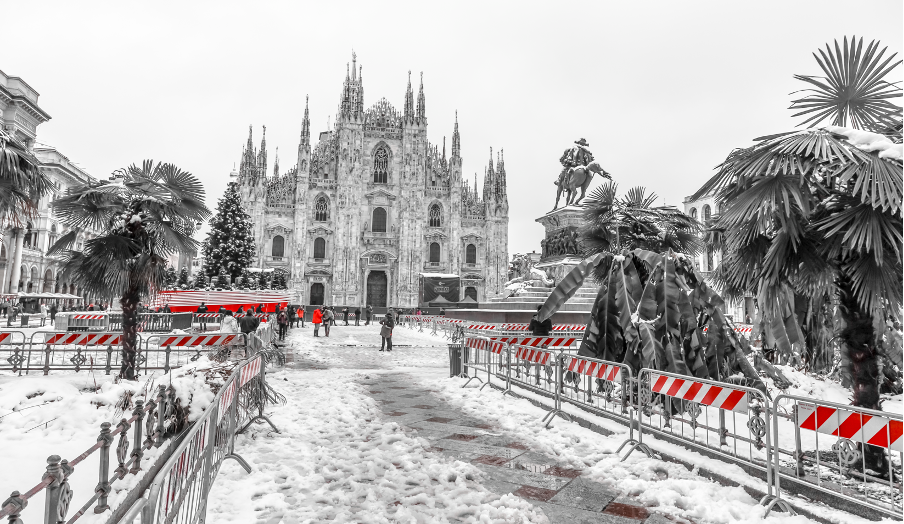
Eternal works, the Duomo, February 2021 (my photo)
The Milanese dialect contains a proverb that functions as the city’s confession: lungh ’me la fabrica del Domm, as long as the building of the Duomo. It is said of any task that will never end: a lawsuit, a renovation, a marriage negotiation, and certainly Italian tax reform. The remarkable thing is not the proverb but its tone, which is not exasperated. It is almost proud: endless construction is the metaphysical action of an ongoing contract with God. If other cities boast of what they have completed, Milan’s most durable idiom boasts of what it has not.
The facts are these. The cathedral was begun in 1386, under Gian Galeazzo Visconti, on a scale that made no sense for the city Milan then was. It was a deliberate act of architectural hubris, Gothic in a peninsula that distrusted Gothic, built in pale Candoglia marble that had to be floated in on canals from Lake Maggiore. The main altar was consecrated in 1418. The façade was completed in 1813. The last (not sure it was actually last!) bronze gate was installed in 1965, which is the date sometimes offered, with a straight face, as the building’s completion. Five hundred and seventy-nine years after the groundbreaking. And even this is a fiction, because the Veneranda Fabbrica del Duomo, the works administration founded in 1387, has never ceased operating for a single year (Veneranda Fabbrica, n.d.). Candoglia marble is beautiful and weak, and it decays in Lombard’s terrible air. So the cathedral consumes itself and must be perpetually regrown. Walk around the apse on any weekday, and you will see the marmisti at permanent work, cutting replacement pinnacles in a marble yard that has been in continuous operation longer than most European states have existed. The Duomo is a building that is being constructed, tense permanently present, a Gothic organism with its own metabolism of eternity.
Philosophy entered this construction site early and violently. Around 1400, the Fabbrica summoned a French master, a real Tampler, Jean Mignot, to advise on the structure. Mignot examined the Lombard masons’ work and pronounced it doomed: they were building by rule of thumb, by ars, without the geometric science that Gothic required. His verdict became one of the most famous sentences in architectural history: ars sine scientia nihil est, art without science is nothing. The Milanese masters, magnificently, replied that scientia sine arte nihil est, dismissed the French Templar, and kept building their way (Ackerman, 1949). The cathedral, which by all Parisian logic should have collapsed, has now stood for six centuries. I do not cite this episode to celebrate Lombard empiricism over French theory, though as a Kievan trained to distrust imported blueprints, I confess a certain pleasure in it. I cite it because it reveals the Duomo’s deeper principle: this is a building that survived by refusing to resolve its own contradictions. It is Gothic and anti-Gothic, scientific and artisanal, French in conception and utterly Lombard in execution, planned and improvised. It never chose. Choosing would have meant finishing, and finishing, the Milanese seem to have understood before any philosopher told them, is a form of dying and the end of the city’s covenant with God.
Which brings me to Napoleon, and to what I think of as his guilt before this city.
In May 1805, Napoleon came to Milan to crown himself King of Italy, and he could not tolerate being crowned in front of an unfinished façade. The incompleteness that Milan had metabolized into identity struck the emperor as disorder, as a task left undone by lesser men. He decreed the façade completed at the expense, he grandly announced, of his own treasury, and the Fabbrica, advancing funds against imperial promises that would be honored as imperial promises are, drove the front to completion by 1813 (Veneranda Fabbrica, n.d.). It is, to be fair, a perfectly presentable façade. It is also, to any eye that has spent time with the rest of the building, subtly wrong: hurried, committee-flavored, neoclassical detailing smuggled into Gothic dress, the architectural equivalent of a sentence finished by an impatient listener. The nineteenth century spent decades quietly correcting it. Milan, with its genius for converting injury into ornament, took its revenge in the gentlest possible way: the debt office of the Napoleonic kingdom, the Monte Napoleone, gave its name to the street where it stood, and that street — Via Monte Napoleone — is today the most expensive shopping street in Europe, the golden spine of the fashion quarter. The emperor who forced the cathedral to a false completion is remembered in Milan chiefly as the name of a place where the city sells the world its unfinished, endlessly revised, seasonally recommenced idea of beauty. Napoleon tried to end something incompletable, and Milan turned his name into a subscription.
I call this his guilt because the completion of the façade was a category error, a violation of the city’s ontology. Milan is not a city that finishes things; it is a city that continues them. And hovering above the whole argument, then as now, was the Madonnina, raised in 1774, thirty-one years before the coronation. As though the Fabbrica had sensed that someone would soon try to declare the work done and had installed, in advance, a permanent supervisor to the city’s covenant to ensure it never would be. She is the guarantee that the site remains open. Under her, everything in this essay takes place.
The Middle Land
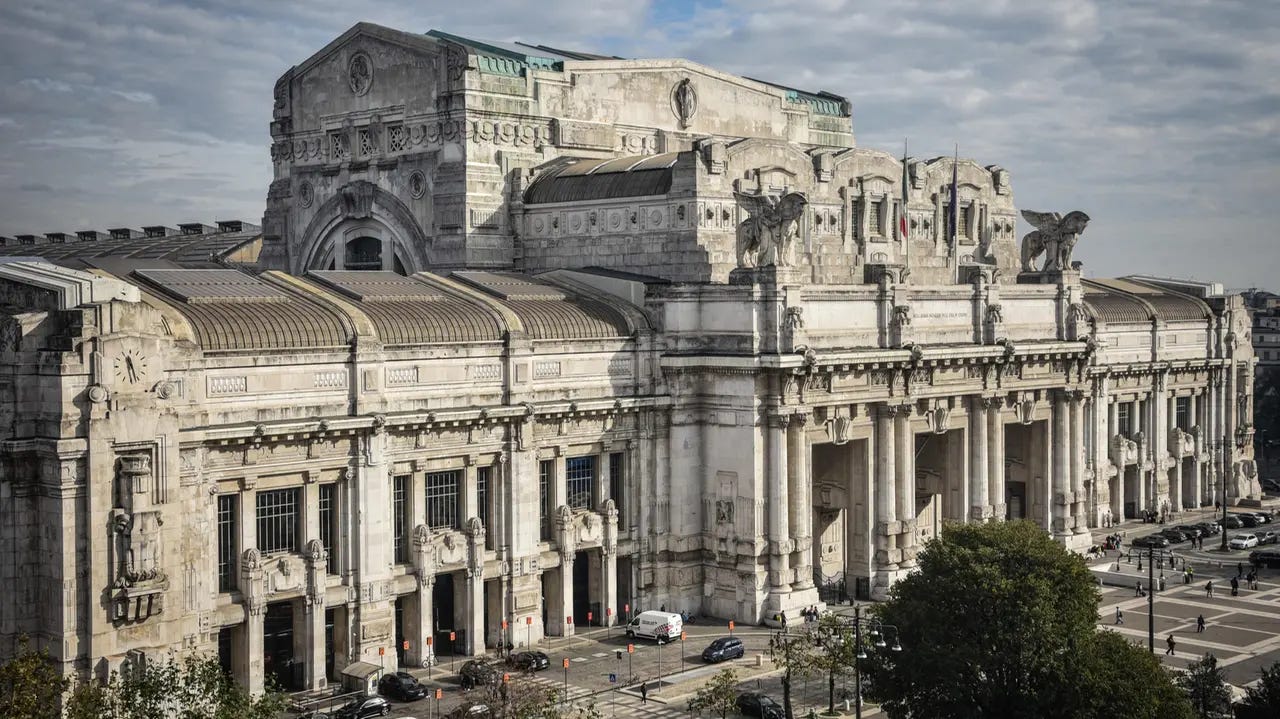
The Temple of Departure, mistakenly called Milano Centrale (source)
Begin, as one should, with the name. Mediolanum: the Romans heard in it medio and planum, the place in the middle of the plain, and that reading is respectable. The Celtic ear hears something stranger, older, and truer: medhelanon, a sanctuary of the middle, a sacred center. Thus, the city’s name is not a description but a program. Milan announced, before it had done anything, that it would be the middle. And then it spent twenty-six centuries discovering what a terrible and magnificent vocation that is.
Consider what the middle has meant here. In 286, when the Roman Empire had grown too large to be governed from its own mythology, the emperor Maximian moved the capital of the West to Mediolanum, where it remained until 402, that is, more than a century during which Rome was a museum, and Milan was the State. It was in Milan, on February 313, that Constantine and Licinius agreed on the policy of toleration we call the Edict of Milan, the document that ended the persecution of Christians and began, though no one present could know it, the conversion of an empire. I find it philosophically exact that this happened here and not in Rome. Rome was a terminus, a place where roads ended in triumph. Milan was a junction, a place where things met that had not yet decided what they were: armies and bishops, Latin order and Celtic ground, a dying paganism and an unlicensed monotheism. The Edict of Milan is what a middle produces: a mediation, an agreement that two incompatible worlds would, for now, share the public space.
The vocation persists with almost comic literalness. I live forty minutes’ walk from Milano Centrale, that fascist-Assyrian temple of departure, and from its platforms I can reach Paris, Zurich, Munich, Vienna, Barcelona, or Naples without touching an airport. For a nomadic academic, this is not a convenience, but a cosmology. Milan is the only city I have lived in from which all of Europe is a one-day ground trip, which means it is the only city where staying and leaving are the same gesture. The medieval merchants knew this. So did the Habsburg bureaucrats, the Napoleonic engineers, the migrants from Puglia in the 1950s and from Cairo, Lima, and Kiev now. One comes to Milan because it is on the way to everywhere, at least in Europe.
Yes, I know. Philosophers have never been kind to the middle. Our tradition loves origins and ends, foundations and summits, the arche and the telos. The middle is where arguments sag, and epics insert their digressions. Milan is the great counterexample. Here, the middle is not the weak point between two strengths but the strong point between two weaknesses: the mountains that would isolate and the sea that would dissipate. The middle is where exchange becomes possible, where the currency changes hands, where the treaty is signed, and where the ore from the north meets the grain from the south and both become money, which is the middle’s native element. A city of the middle cannot have Rome’s self-sufficiency or Venice’s insular perfection. What it can have is throughput of goods, armies, heresies, styles, and souls, and the peculiar doctrine that this throughput teaches: that identity is not what you keep but what you convert.
And a middle, note it, is never finished. It cannot be finished, because it exists only so long as things continue to pass through it. A terminus can be completed, but a junction is structurally open. The name Mediolanum and the proverb about the Domm are saying the same thing in different millennia. The sanctuary of the middle is a construction site by definition.
The Half-Woolly Sow
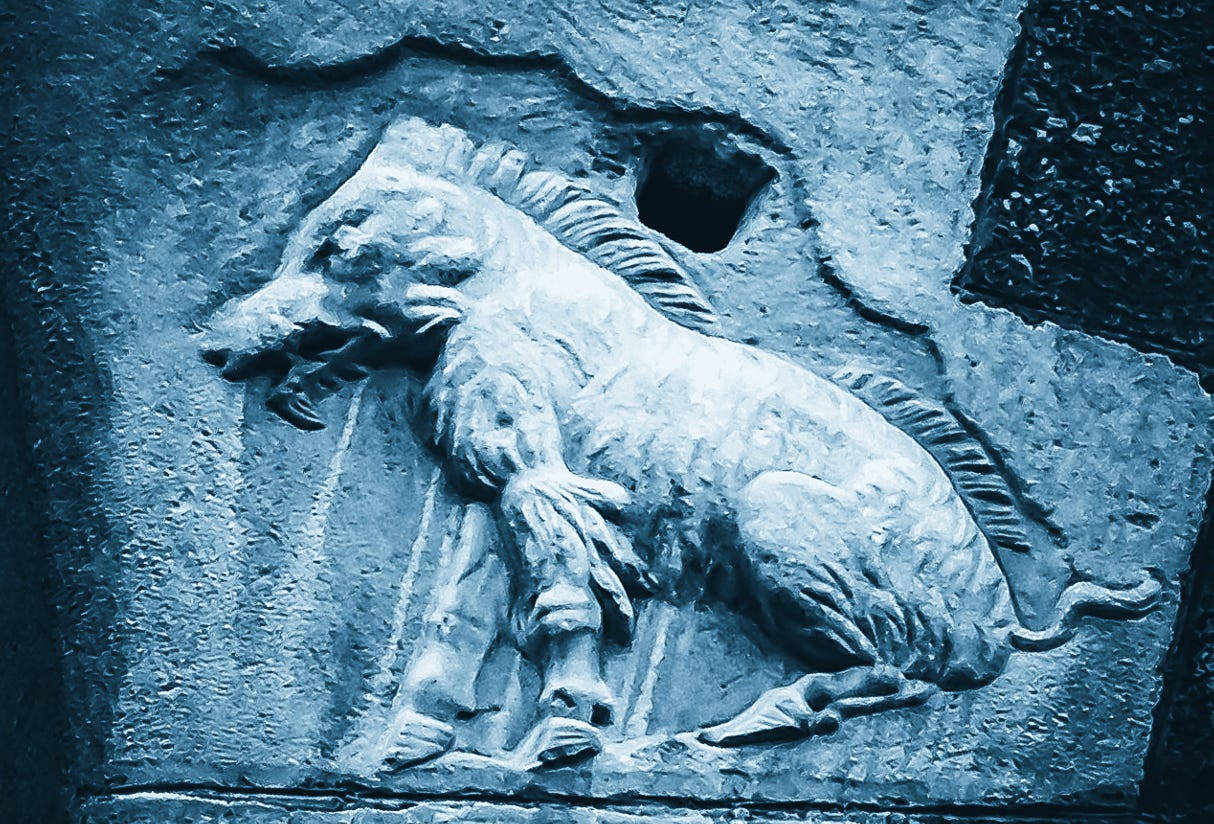
The scrofa semilanuta relief on Palazzo della Ragione (source)

On a pillar of the Palazzo della Ragione, in the old broletto where medieval Milan held its courts, there is a Romanesque relief of a pig. Not an ordinary pig: a sow covered in wool along half her body, the scrofa semilanuta, the half-woolly sow. According to the legend the Milanese have polished for centuries, when the Celtic prince Belloveso led his people over the Alps around 600 BC (Livy tells the migration story with a Roman’s condescending care; see Livy, trans. 2006, 5.34), he was instructed to found his city where he found a sow half-covered in wool, and did, and some even derive the city’s name from it: medio-lanum, half-woolly. This etymology is certainly false. But the legend is more valuable than the etymology because it preserves, in the only form available to the conquered, the memory that this city is older than Rome’s version of it.
Rome conquered Mediolanum in 222 BC and did to its Celtic past what empires always did: absorbed the useful, erased the rest, and rewrote the founding so thoroughly that the Insubres, the Celtic people whose capital this was, survive mainly as a name in Latin histories and a haplotype in Lombard blood. Pre-Roman Milan has almost no ruins, no texts, and no voice. It has a pig on a pillar. As a child of the Soviet Union, I know this genre of memory intimately: the suppressed founding that survives as local folklore, the older name that persists under the official one, and the local saint quietly continuing the local god. Zaporozhye, too, is a city built on erased predecessors: the Scythians, Kipchaks, Nogays, Cossacks, and multiethnic colonists drowned, quite literally, first, under, first, Soviet and then Ukrainian national reservoirs. Cities hold grudges longer than nations do, because cities are where the grudge has a real, not imagined, address.
And Milan’s grudge against Rome is the longest-running quarrel in Italy, a country of towns’ quarrels. Milan’s resentment against Rome has never really closed, it has only changed costume. When the empire needed saving, the capital came north, and Milan governed while Rome postured, a division of labor the Milanese have never allowed anyone to forget. When the Church centralized, Milan kept its own liturgy, the Ambrosian rite, a pocket of ecclesiastical sovereignty that Rome tolerates to this day, with gritted teeth. When united Italy placed its parliament in Rome, Milan promptly invented a title for itself: capitale morale, the moral capital. Which is perhaps the source of the most passive-aggressive municipal slogan ever existed: you may have the government, it says, but we have the economy, the newspapers, the publishing houses, the opera, and the work ethic; you have the state, we have the country (Foot, 2001). In the 1990s, the quarrel turned openly political, and a party built its early fortunes on the fantasy of detaching the productive north from “parasitic Rome.” The fantasy was stupid and crude, but the sentiment it mined was twenty-two centuries old. Even now, at any Milanese dinner, the word Roma can be pronounced with a particular falling intonation — affectionate, despairing, at times superior — that requires no further predicate. And yes, you must never travel to Rome with the Milanese if you really want to enjoy Urbs Aeterna.
What interests the philosopher in all this is the structure: Milan is Europe’s great counter-capital, the city that defines itself against the center while endlessly performing the center’s functions, often better than the center does. It is the anti-Rome that keeps becoming Rome, imperial capital in the fourth century, moral capital in the nineteenth, financial and media capital in the twentieth. Without ever accepting the title, because accepting it would end the quarrel, and the quarrel is constitutive.
Here again, beneath the politics, the fundamental Milanese principle: do not finish. A settled score is a dead score. The half-woolly sow is half-woolly; she is the emblem of a city that is permanently half: half Celtic and half Roman, half capital and half province, and half of (German) Europe and half of Italy. And that has converted its halfness into a source of energy rather than a trauma. Wholeness is for cities that have stopped.
Ambrose’s Calendar
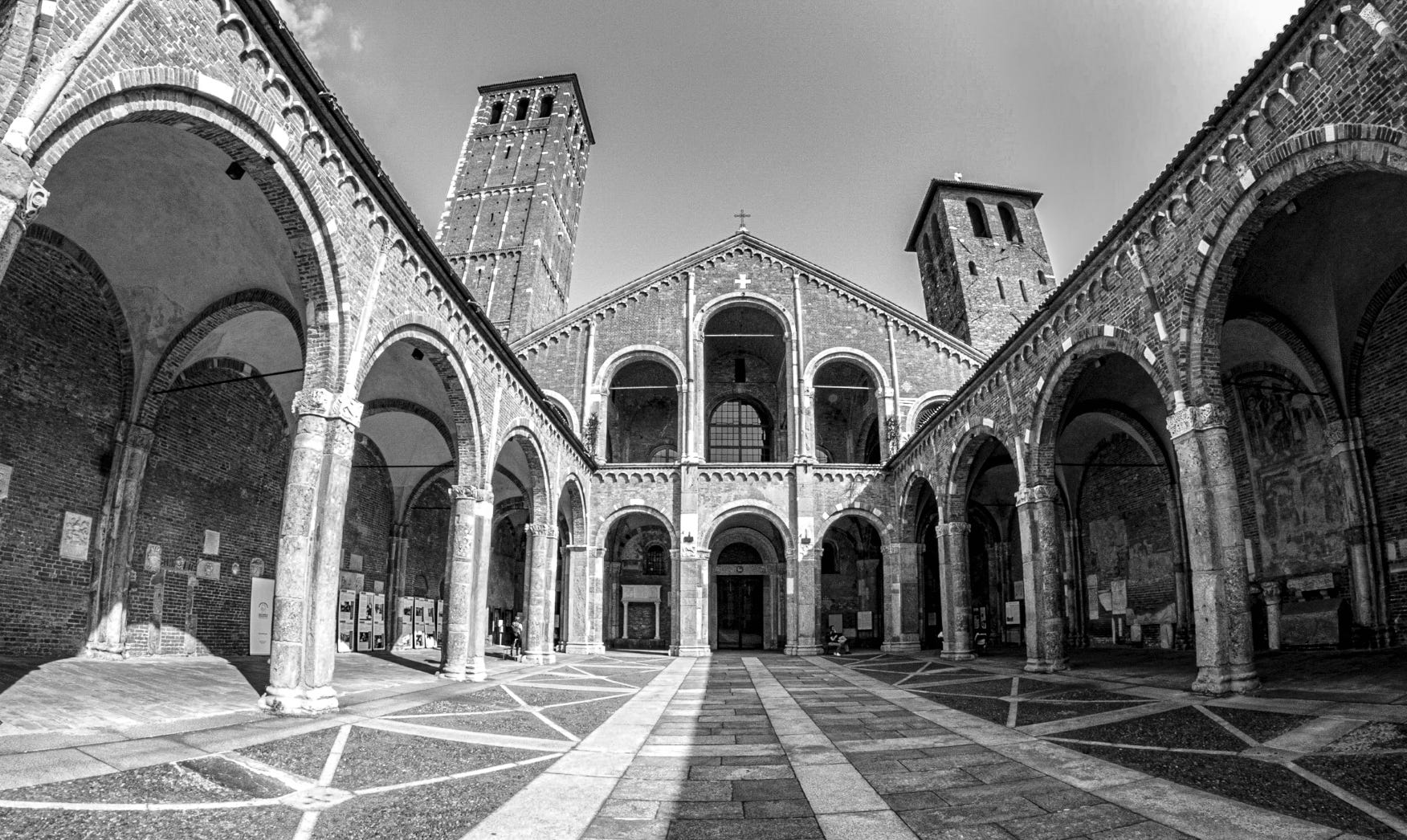
The Sant’Ambrogio Cathedral (my photo)
In December 374, the imperial governor of Aemilia-Liguria, a young administrator named Aurelius Ambrosius, entered a Milanese basilica to supervise a dangerously contested episcopal election, and left it, by acclamation of the crowd and against his own strenuous objections, bishop of Milan. Imagine: he was not yet baptized. Within a week, however, he was catechumen, baptized, ordained, and enthroned, a career trajectory that would be comic if its consequences had not organized a millennium (McLynn, 1994). We know him as Saint Ambrose, Sant’Ambrogio, and Milan is, in a sense that no other great city can claim of its patron, still his diocese. The city’s dialect calls itself ambrosiano. The airport duty-free shop sells panettone ambrosiano (you don’t know la dolce vita if you haven’t tasted it). The stock exchange, the football derby, and the Christmas fair all live inside his adjective.
Two scenes from his episcopate bear on this metaphysical reflection on Mediolanum. The first is known by everyone. In 390, the emperor Theodosius, in a fury, ordered a massacre in Thessalonica: thousands were killed in the circus in an afternoon. Ambrose wrote to the emperor and told him, in effect, that he would not be admitted to communion in Milan until he did public penance. And Theodosius, master of the Roman world, the last man to rule the whole empire, submitted. He put off the purple and stood among the penitents. Historians have complicated the scene (as historians always do, in our philosophers’ unhumble opinion), but the medieval and modern imagination was right about its essence: this was the first time in European history that spiritual authority visibly and publicly judged imperial power and won. Every later drama of conscience against sovereignty, like Canossa, Becket, More, the Confessing Church, and the chaplains of every dissident movement, including Molokans, the ones I descend from, replays a scene first staged in Milan. It could only have been staged here, in moral capital. In Rome, the Church was becoming the empire’s heir and had no interest in judging it. In Milan, the middle city, church and empire were neighbors, rivals, and tenants of the same streets, close enough for one to excommunicate the other across a doorway.
The second scene is quieter. In the summer of 386, in a garden in Milan, a North African professor of rhetoric heard a child’s voice chanting tolle lege, take and read, opened St. Paul’s epistles, and became Augustine. He was baptized by Ambrose in the cathedral baptistery. Its octagonal foundations now sit, with perfect Milanese matter-of-factness, beneath the Duomo’s front steps, visible through a grate, an unfinished basement under an unfinished church. Western interiority, the whole tradition of the examined self that runs from the Confessions through Petrarch and Montaigne and Rousseau to every diary and every therapy session, has a Milanese address. The city that would become the world capital of the exterior — of fashion, design, and the surface — is where the West learned to have an interior. I do not think these are unrelated. A city that hosted the discovery of inwardness knows exactly how much a surface can carry.
But Ambrose’s most Milanese legacy is neither of these scenes. It is the calendar. The Ambrosian rite, the liturgy he organized, with its own chants, lectionary, and rhythm, survived every Roman attempt at standardization, from Charlemagne to the Council of Trent, and is celebrated in Milanese churches this morning. Its most visible eccentricity is that Ambrosian Lent begins later: there is no Ash Wednesday here, and so Carnival, which everywhere else in Catholic Europe dies on Tuesday night, continues in Milan through the week and expires only on Saturday. The children of Milan get four more days of costumes than the children of Rome, by episcopal privilege sixteen centuries old. I find this small fact unbearably significant. Milan keeps its own time. It runs a private calendar inside the universal one, extending, characteristically, not the fasting but the feast, not the ending but the before-the-ending. Even the liturgical year, in this city, resists being finished on schedule. The Madonnina, one feels, approves: she too stands for a sacred order that has agreed, permanently, to postpone its own completion.
The Unbuilt City
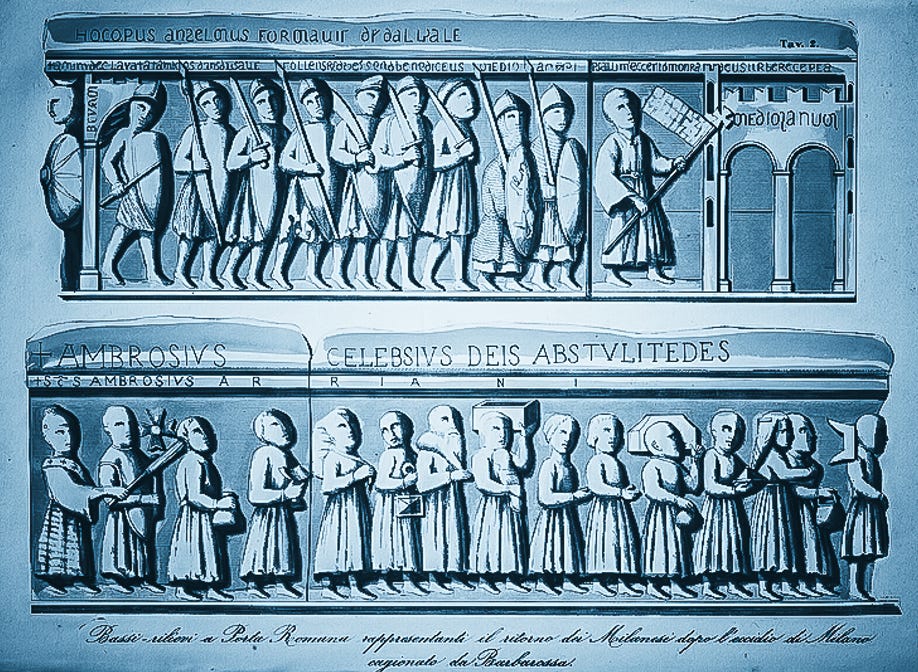
The Milanese returning from the Battle of Legnano,
the relief on Porta Romana (source)

Every city has a founding myth. Milan, like Kiev, is one of the very few that also has an unfounding story, a documented date on which it ceased to exist.
In March 1162, after two sieges, Frederick Barbarossa took Milan and ordered that it not be punished but abolished. The population was expelled and dispersed into four open villages. The walls were thrown down, the moat filled, the buildings systematically demolished. And here history supplies a detail so pointed that no novelist would dare invent it: the demolition was carried out, district by district, by the armies of Milan’s neighbor cities. Lodi, Cremona, Pavia, Como — each was assigned a quarter of Milan to destroy, and each set to work with the enthusiasm of a sibling finally permitted to say everything (Raccagni, 2010). The emperor provided the sentence, and the neighbors provided the joy.
To understand that joy, one must see the Lombard plain as its cities saw it: not as a region with a capital but as a constellation of jealous equals, each with its walls, its saints, its patriciate, and its precise memory of every insult. Milan’s oldest rivals were not distant empires but towns an afternoon’s ride away. Pavia had been the capital of the Lombard kings when Milan was a demoted has-been. Pavia’s basilicas had crowned monarchs while Milan’s archbishops fumed. Monza, a few miles north, held — holds — the Iron Crown, that strange little diadem containing, legend insists, a nail of the Crucifixion, with which kings of Lombardy were made from the early Middle Ages onward. Milan, the biggest and richest of the three, possessed neither the royal capital nor the royal crown, a deprivation it experienced as a permanent injustice and its neighbors as a permanent delight. The micro-geography of Lombardy is a study in what I have elsewhere called durable adjacency. Except that where, let’s say, Pittsburgh’s neighborhoods achieved adjacency through bridges, the Lombard cities achieved it through siege engines. Relation preceded totality here too: the relation was simply war.
And then the resurrection, which is the part that formed the city’s soul. Five years after the demolition, the Lombard cities, including several that had swung the hammers, formed the Lombard League, rebuilt Milan’s walls, and in 1176, at Legnano, broke Barbarossa’s army around the Carroccio, the ox-drawn war-wagon that carried the city’s banner and altar into battle (Raccagni, 2010). The Peace of Constance in 1183 confirmed the communes’ liberties. Milan had been erased and had returned, larger and freer, within a generation.
I know of no other major European city with this experience so early and so completely: not decline and revival, but annihilation and immediate return. It changes a city’s relationship to its own existence. A city that has already died once holds its being differently: less as a possession, more as a practice. Existence, for post-1162 Milan, is not a foundation laid once but a construction resumed daily. The city is not a fact but a fabbrica. When, two centuries later, the Milanese began a cathedral designed never to be finished, they were only translating their civic ontology into marble.
The Iron Crown thread, meanwhile, waited seven centuries for its punchline. On May 26, 1805, in the Duomo, before the façade he had ordered completed, Napoleon took the little crown of Monza from the altar and placed it on his own head, pronouncing the formula: Dio me l’ha data, guai a chi la tocca, God gave it to me; woe to him who touches it. Woe, including some of my Cossack ancestors, came, with its usual punctuality, within a decade. But observe what the scene had accomplished: the crown of Monza, the royal dignity of Pavia, and the cathedral of Milan were finally united in a single Napoleonic ceremony — by a foreigner, for himself, in a building he tried to falsify. The Lombard triangle was resolved only in farce. Milan absorbed the lesson and returned to what it does best: remaining, productively, unresolved.
The Serpent and the Library
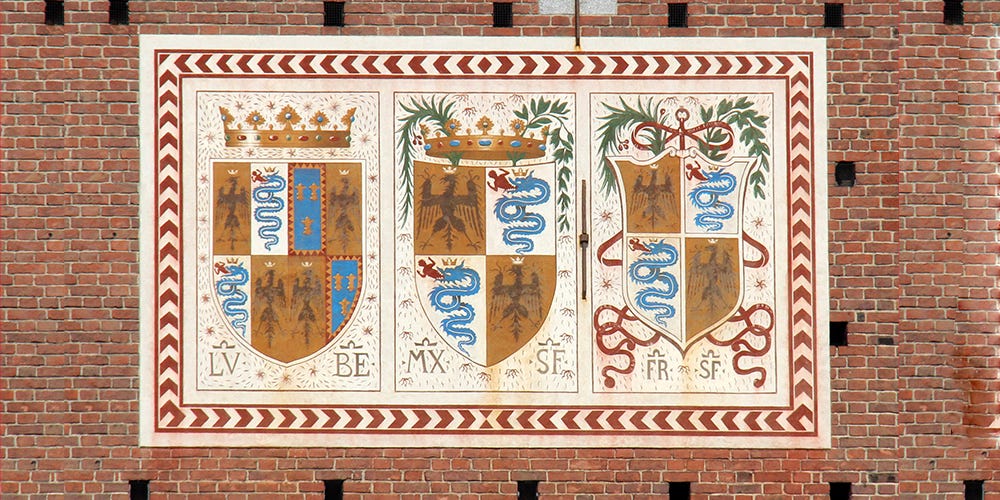
The biscione on a gate of the Castello Sforzesco (source)
The heraldic emblem of Milan’s ducal age is a large blue serpent in the act of swallowing a human being. The biscione, which you can see it on the Castello’s gates, on manhole covers, on the badge of Alfa Romeo and the crest of Inter and, until recently, on the logo of a television empire, shows a man, usually rendered as a Saracen, halfway down the serpent’s throat, arms raised in what the optimistic describe as emergence and everyone else recognizes as the opposite.
The more I study it, the more I am sure: cities choose their emblems more honestly than they know. Florence chose a lily. Venice picked a winged lion with a book. Milan took ingestion, the image of one being becoming another by being consumed. It is the most nakedly metabolic coat of arms in Europe, and it belonged to the Visconti, the Crusade dynasty under which Milan became a duchy and the duchy became something stranger: Europe’s first great experiment in the occult state.
The Visconti came to power in the classic Milanese way, through the archbishopric — Ottone Visconti took the city in 1277 by winning a battle, which tells you what kind of archbishop he was — and ruled, then as dukes after 1395, when Gian Galeazzo simply purchased the ducal title from a cash-poor emperor, a transaction so Milanese it deserves a plaque. But it is the texture of their court that concerns me. Filippo Maria Visconti, the last of the line, governed from inside a web of astrology so thick that his humanist biographer, Pier Candido Decembrio, records it with fascinated embarrassment: a prince who scheduled councils by the stars, kept astrologers as other princes kept falcons, and hid from thunder as from a personal enemy (Decembrio, trans. 2019). It was for this duke that a scholar named Marziano da Tortona devised, around 1420, a deck of cards depicting gods and virtues for a game of triumphs. And it was at this court, in the 1440s, that the painter Bonifacio Bembo produced the gilded decks — commissioned by Filippo Maria and then by his Sforza successors — that are the oldest surviving tarot cards in the world (Dummett, 1980).
Let the reader absorb this: the tarot, the West’s favorite machine for consulting Fate, is a Milanese invention, born not in gypsy caravans or Egyptian temples of the occultist imagination but as a luxury good of the Lombard ducal court, painted for a prince who could not decide anything without the sky’s permission. Divination, in Milan, began as design.
The Sforza, who succeeded the Visconti through the usual mixture of marriage and mercenary force, perfected the type. Ludovico il Moro, regent and then duke, ran his court as a laboratory of wonders: he hired a thirty-year-old Florentine who advertised himself as a military engineer and kept him for eighteen years as painter, hydraulician, pageant-master, and resident magus. Under Ludovico, Milan became the place where magic knowledge and real power fused so completely that they could no longer be told apart — and then demonstrated, for the instruction of Europe, what happens next. In 1499, the French came over the Alps; Ludovico’s alliances, elegant as a horoscope, dissolved. The duke of the wonder-court died a prisoner in a French castle, scratching magic schemes on the walls of his cell. The duchy that had turned itself into a library lost itself like a place in a book.
Which is, of course, exactly where it ended up. A century later, in London, Shakespeare wrote a play about a Duke of Milan who lost his state because he was “transported and rapt in secret studies,” who let his brother govern while he perfected himself in the liberal arts, and who confesses, without repentance, that “my library was dukedom large enough” (Shakespeare, 1611/2011). Scholars debate what Shakespeare knew of Milanese history. I think the debate misses the point: by 1610, “Milan” had become a European byword, a compressed cautionary tale of the duchy where power dissolved into knowledge and magic, where the prince read while the state was stolen. Prospero is not a portrait of any Visconti or Sforza, but he is the concept of Milan as Europe had learned it. And note the ending Shakespeare gives him. Prospero regains Milan only by drowning his book — by renouncing his magic, finishing the studies, and ending the mystic project. It is the most un-Milanese gesture imaginable, which is perhaps why it can happen only on an island in a romance, three thousand miles from the Lombard plain. The real Milan never drowned its book. It kept the serpent, kept the cards, kept the appetite for secret knowledge, and simply changed the secret: from astrology to engineering, from engineering to finance, from finance to the algorithms of desire we now call branding. The biscione goes on swallowing. What emerges from it each century is Milan.
Water by Artifice
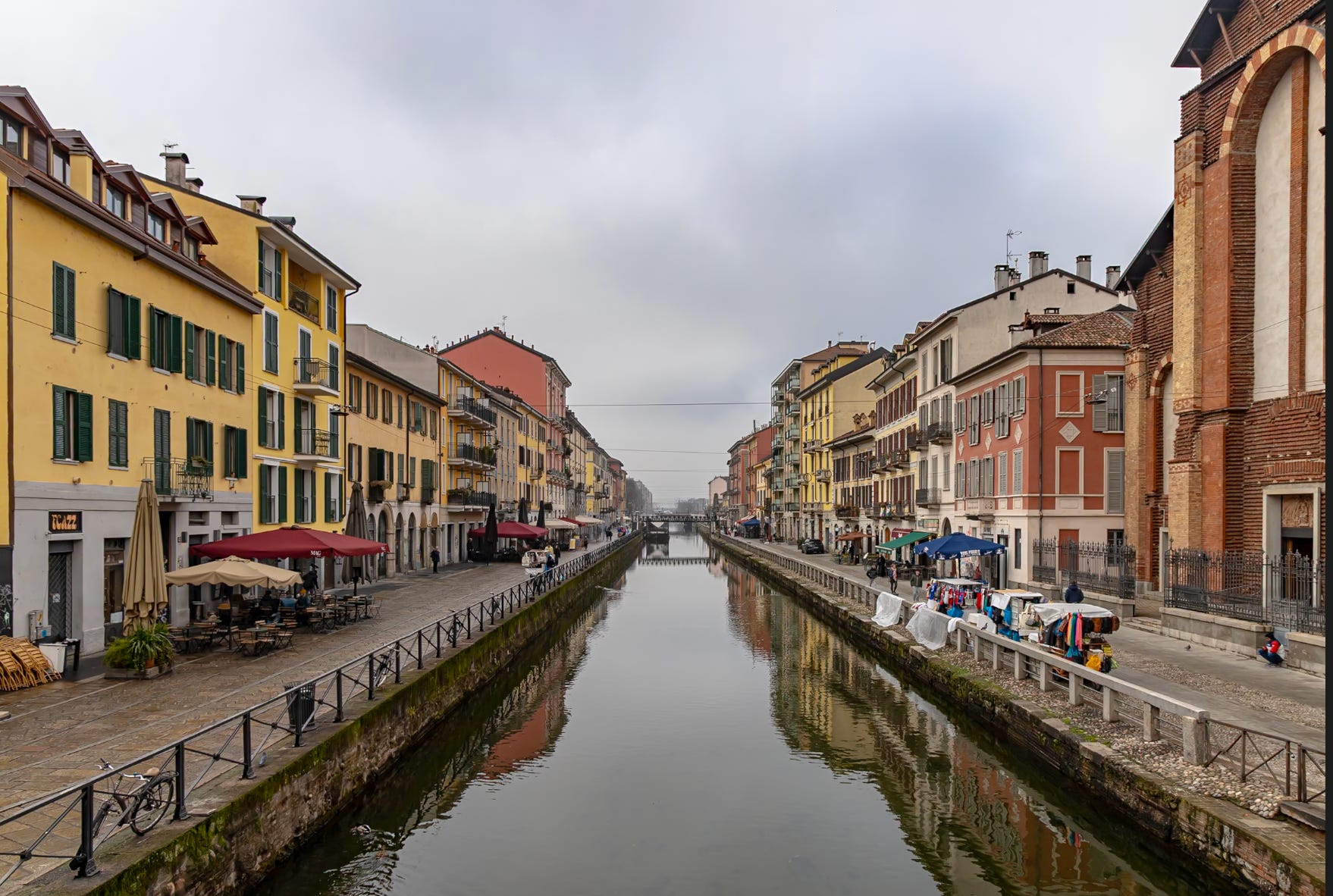
Naviglio Grande at dusk, March 2021 (my photo)
Here is a geographical fact so basic that it takes years of residence to notice its strangeness: Milan, one of the great cities of Europe, has no river. No Tiber, no Arno, no Seine, no Dnipro. The Po passes well to the south, indifferent. The Alpine rivers, Ticino and Adda, run past on either side like aunts who send gifts but do not visit. Every other major city of the pre-modern world sits on water because water was transport, power, and defense. Milan sits on a dry plain in the middle of everything, hydrologically entitled to be a market town of ten thousand souls maximum.
Its answer to this deficiency is, to my mind, the single most revealing act in its history: Milan manufactured its own hydrology. Beginning in the twelfth century, the Naviglio Grande, drawing from the Ticino, was underway within fifteen years of the Barbarossa destruction, as though the unbuilt city had decided that if it must rebuild, it would rebuild nature too. The Milanese dug a system of navigable canals that eventually ringed the city, connected it to two lakes and three rivers, watered the Lombard rice fields, and turned a landlocked town into a port. Not a metaphorical port: into the twentieth century, Milan’s Darsena ranked among the busiest “ports” in Italy by tonnage, a statistic that sounds like a joke until you have seen the old photographs of barge convoys queuing in the fog.
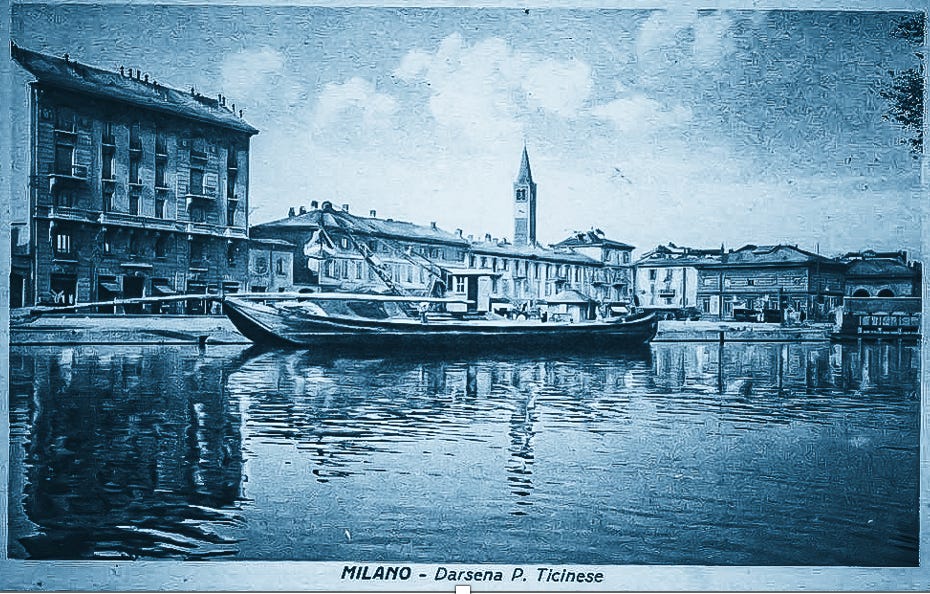
Darsena barge, 1920 (source)
The Candoglia marble for the Duomo came down these canals from Lake Maggiore. The barges were marked AUF — ad usum fabricae, for the use of the works, and therefore toll-exempt, an abbreviation from which the Milanese, who can extract irony from a customs stamp, claim to derive the expression a UFO, to get something for free. The cathedral, in other words, floated into the city on water the city had invented, duty-free. The unfinished church and the artificial river are one system.
And then, naturalmente, Leonardo. He arrived in 1482 and stayed, on and off, for nearly twenty years, and while the world remembers the Milan years for the Last Supper, Leonardo’s notebooks suggest he devoted at least as much passion to the water as to the wall. He studied the canals obsessively and addressed the system’s great problem, the joining of waterways at different levels, designing the miter lock, the paired angled gates whose geometry uses the water’s own pressure to seal them, sketched in the Codex Atlanticus and realized at the Conca dell’Incoronata, whose wooden gates you can still visit on Via San Marco (Isaacson, 2017). Every canal lock on earth, from Panama to my native Volga-Don, descends from that Milanese solution.
I want to insist on what this means philosophically. The Last Supper and the lock gate are the same intelligence applied to the same problem: how to hold, for a moment, what is in motion. That is, how to hold twelve agitated men around a table and twelve thousand tons of restless water without pretending the motion has stopped.
Leonardo, the most famously unfinishing artist in history, the man who left half his projects as sketches and his masterpiece as an experiment in unstable pigments that began decaying within his lifetime, found in Milan the one city whose metaphysics matched his temperament. Of course, the Last Supper is a ruin, not without British-American involvement, that must be perpetually restored. Of course, it is maintained today the way the Duomo is maintained, by a permanent institution managing a permanent incompleteness. In Milan, this is not an issue, but our mode of existence.
The twentieth century did try to revoke it. Between 1929 and the early thirties, the fascist administration covered the inner ring of canals, the Cerchia dei Navigli, entombing the medieval water under asphalt. Milan became the only city I know that built and buried its own river system, and the burial reads, now, like a textbook illustration of the return of the repressed. The water still runs under Via Senato and Via Francesco Sforza. Local houses’ cellars still flood. Every decade, a referendum or an architect proposes reopening the canals, and the proposal fails, and returns, unfinished business in the most literal sense. The two surviving Navigli, meanwhile, have been converted into the city’s evening stage set, lined with aperitivo bars and fighting teenagers, where the spritz and knives glow as if Leonardo would have wanted to analyze them in still motion. Tourists photograph the water without knowing it is an artifact older than most cathedrals. Ans as it happens, I photograph the tourists. The canal, patient, continues its work, which is the city’s artwork: artifice so old it has become nature, nature that was always artifice, a middle term between the two that refuses, on principle, to resolve.
The Column and the Book
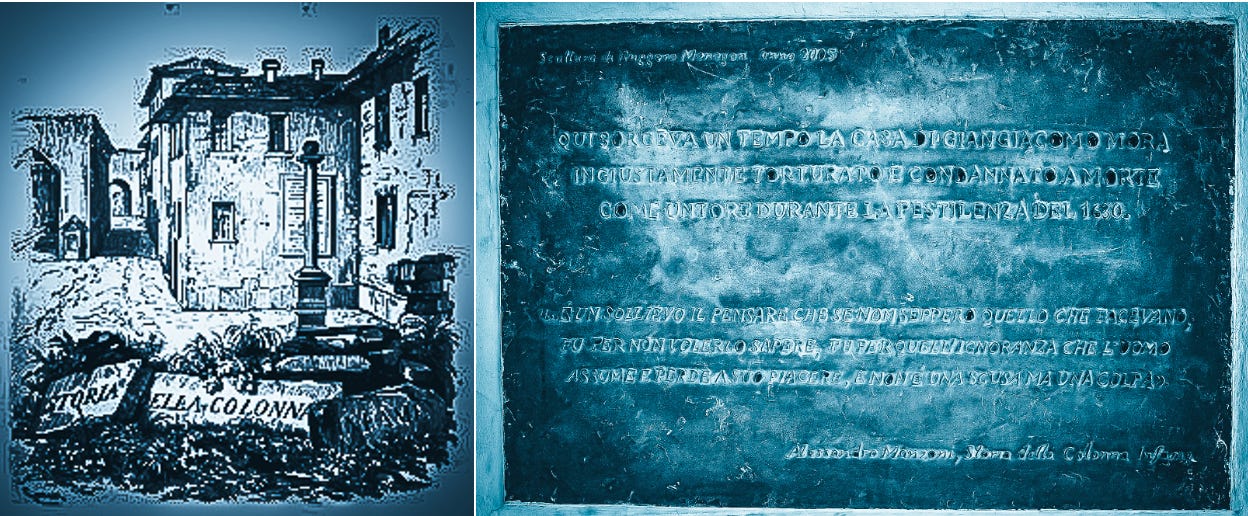
Via Gian Giacomo Mora (source)

There is a street in the Ticinese district named after a barber. Gian Giacomo Mora kept his shop there in 1630, the year the plague came down with the German armies and killed, in a few months, something like half of Milan’s population. In the delirium of that summer, the city convinced itself that the plague was being spread deliberately: smeared onto walls and door handles by anointers, untori, agents of the devil or of foreign powers (the distinction hardly mattered). A commissioner of health named Guglielmo Piazza was seen once touching a wall. Under torture, he named the barber Mora, who, also under torture, confirmed everything and invented more untori sins. And in August 1630, both men, after further refinements of judicial cruelty, were broken on the wheel before a crowd that believed it was witnessing justice. Mora’s house was razed, and on the vacant lot the Senate erected the colonna infame, the column of infamy, with an inscription in magnificent lapidary Latin informing eternity of the anointers’ crime, so that the guilt would never be forgotten.
What happened next is why this episode belongs in Milan’s metaphysical inventory rather than merely in its chronicle of horrors. The column stood for a hundred and forty-eight years, and slowly, silently, its meaning inverted. The Latin did not change, but the readers did. By the time the column was demolished in 1778, it had become an embarrassment — a monument no longer to the anointers’ guilt but to the judges’. And Milan, alone among European cities, produced the men who performed the inversion in print. Pietro Verri, patrician, economist, co-founder of the journal Il Caffè, around whose actual coffee table the Milanese Enlightenment convened in the 1760s, went into the trial records and wrote the Osservazioni sulla tortura, a forensic demonstration that torture had manufactured the confessions, the crime, and the column itself (Verri, 1777/1804). And Verri’s young friend from the same circle, a shy twenty-six-year-old named Cesare Beccaria, distilled the milieu’s outrage into a short book, Dei delitti e delle pene, published in 1764, which within a decade had been read by Voltaire, Catherine the Great, and the future authors of several constitutions, and which argued for the first time systematically in European letters that torture proves nothing. That punishment must be proportionate, public, and mild. And that the death penalty is neither right nor useful (Beccaria, 1764/1995). Modern criminal law, in the precise sense of the law that protects the accused from the state, was born in Milan, in visible recoil from a Milanese crime.
The genealogy then performs a flourish that no novelist would risk. Beccaria’s daughter Giulia had a son, born in Milan in 1785, named Alessandro Manzoni. The grandson of the man who refuted torture grew up to write I promessi sposi, the novel of Spanish Milan and the plague of 1630, the book every Italian reads at school; and appended to it, as a kind of moral engine room, the Storia della colonna infame, his own re-examination of the Mora trial, in which he refuses the comfortable conclusion that the judges were creatures of their ignorant age and insists, unforgivingly, that they had every means to know better and chose not to (Manzoni, 1842/1964). Grandfather and grandson, the treatise and the tragedy, the argument and the memory: a single Milanese family, in two generations, converted the city’s terrible hour into Europe’s legal conscience.
I walk down Via Gian Giacomo Mora sometimes on my way to the Ticinese basilicas. There is a small modern memorial, easily missed, as well as bicycles, a design showroom, and a bar with good wine. The column is gone, which is correct, and remembered, which is even more correct. This, I have come to think, is Milan’s distinctive operation upon its own guilt. Milan litigates, reopens the closed case: the 1630 verdict was final; Verri appealed it in 1777; Manzoni appealed Verri’s mitigations in 1842; historians still appeal Manzoni. The infamous column turned out to be the one Milanese monument that could not be allowed to mean the same thing forever: the trial, like the Duomo, permanently under construction. A city that will not finish its buildings will not finish its judgments either. And in the second refusal lies something like the origin of humane law: the past remains answerable because nothing here is ever, mercifully, closed.
The Moral Capital and Its Shadows
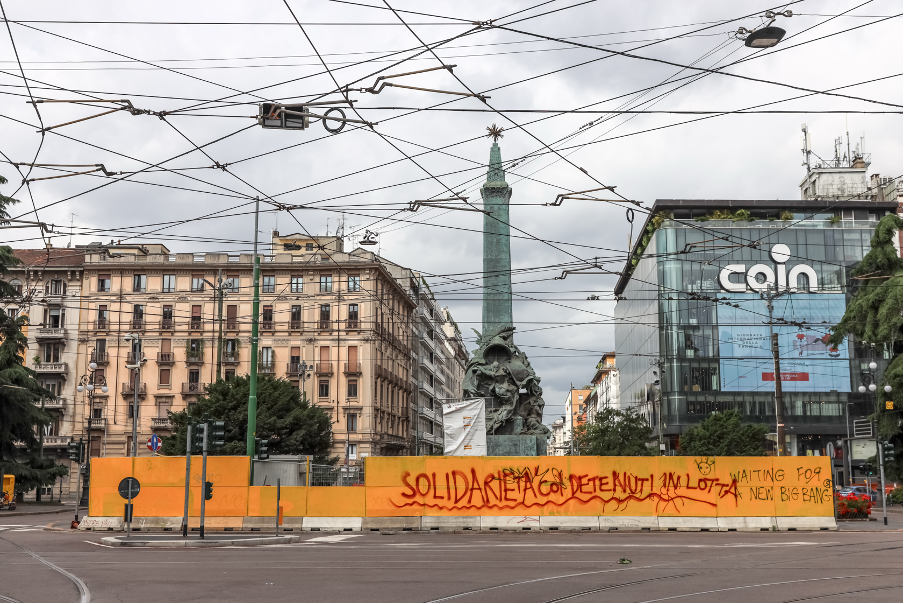
The monument of the Cinque Giornate, March 2020 (my photo)
In March 1848, the year of revolutions, Milan produced the purest specimen. In five days — the Cinque Giornate, March 18 to 22, now the name of a square — an unarmed city expelled a garrison of fourteen thousand professional soldiers under Field Marshal Radetzky, the most respected commander in Europe. The Milanese fought with hunting rifles, paving stones, furniture dropped from windows, and barricades built with a speed that suggested the city had been rehearsing in its sleep. Tobacco played a role: the revolt had warmed up in January with a boycott of the Austrian tobacco monopoly, during which smoking in public became collaboration. This is a detail I cherish because it shows Milan converting even insurrection into a matter of consumption and style. Radetzky withdrew into the Quadrilateral fortresses; the revolution was, in the fullness of time, betrayed, defeated, and absorbed, as 1848 was everywhere. And yet the Five Days entered the national mythology as proof that Italians could rise and unite. When the Kingdom of Italy finally assembled itself and placed its capital, after detours, in Rome, Milan compensated itself with the title I have already mentioned: capitale morale. Rome would have the ministries, while Milan would have the virtue.
The claim deserves both respect and suspicion, and I want to give it precisely calibrated doses of each. Respect, because the title named something real: Milan was where Italy’s publishing, journalism, industry, and civic philanthropy concentrated, where the country’s bourgeoisie came closest to the northern-European ideal of itself: sober, productive, reformist, and allergic to Roman theatricality. The city’s sound was La Scala, and La Scala’s sound was Verdi, whose choruses the Risorgimento adopted as its unofficial anthems. The story that audiences heard “Va, Pensiero” from the beginning as a coded national lament is, historians tell us, partly a retrospective myth. But Milan is a city that understands better than any other that a retrospective myth, properly maintained, is a public utility. And the moral capital could, at its best moments, be genuinely moving. In May 1946, in a Milan still smelling of rubble — the bombs of August 1943 had gutted the historic center and torn open La Scala’s roof — the theater was rebuilt before almost anything else, and Toscanini, returned from his American exile after seventeen years of refusing to conduct for fascists, raised his baton over the reopened hall. A city announcing, through an opera house, that its soul had survived its buildings: even a philosopher from the cynical east finds his eyes stinging at that one.
Suspicion, because “moral capital” is also an ideology, and ideologies are best judged by their shadows. And Milan’s twentieth-century shadows gathered with terrible precision in two dates.
December 12, 1969: a bomb in the Banca Nazionale dell’Agricoltura on Piazza Fontana, seventeen dead, the opening shot of the anni di piombo, the years of lead, followed within days by the death of the anarchist Giuseppe Pinelli, fallen from a fourth-floor window of the Milan police headquarters while in custody, a fall around which Italy’s divided memory still circles without landing (Foot, 2009). The massacre was the work of neo-fascists abetted by portions of the state. For years, the state investigated anarchists instead. The moral capital discovered that the state whose moral capital it was could bomb its own citizens and lie about it structurally.
And February 17, 1992: an official named Mario Chiesa was arrested taking a bribe at the Pio Albergo Trivulzio, a charitable home for the elderly founded by a Milanese patrician family whose name we will meet again shortly, and from that single arrest unspooled Mani Pulite, Clean Hands process, the investigation that revealed the entire Italian political class as a machine for the collection of bribes, with Milan as its most efficient hub. The newspapers renamed the moral capital into Tangentopoli, Bribesville, and the First Republic dissolved (Ginsborg, 2001).
Here is what I make of the pattern. Milan is not, pace its own slogan, the place where Italy is most virtuous. It is the place where Italy’s moral condition becomes visible first and most sharply. The Five Days made courage visible. Piazza Fontana made the state’s rot visible. Mani Pulite made everyday corruption visible precisely because Milanese magistrates, heirs of Verri and Beccaria, reopened the case everyone had agreed to consider closed. The moral capital is not a treasury of virtue. It is a lens, the middle city as the point where the national light converges, sometimes into illumination, sometimes into fire. A lens, too, is a thing one looks through rather than at, unfinished by function; and above this one, as above everything else here, the Madonnina keeps her counsel, gilded, four meters tall, having seen the barricades, the bombers, and the bribes from the same fixed point of supervision.
The Alembic
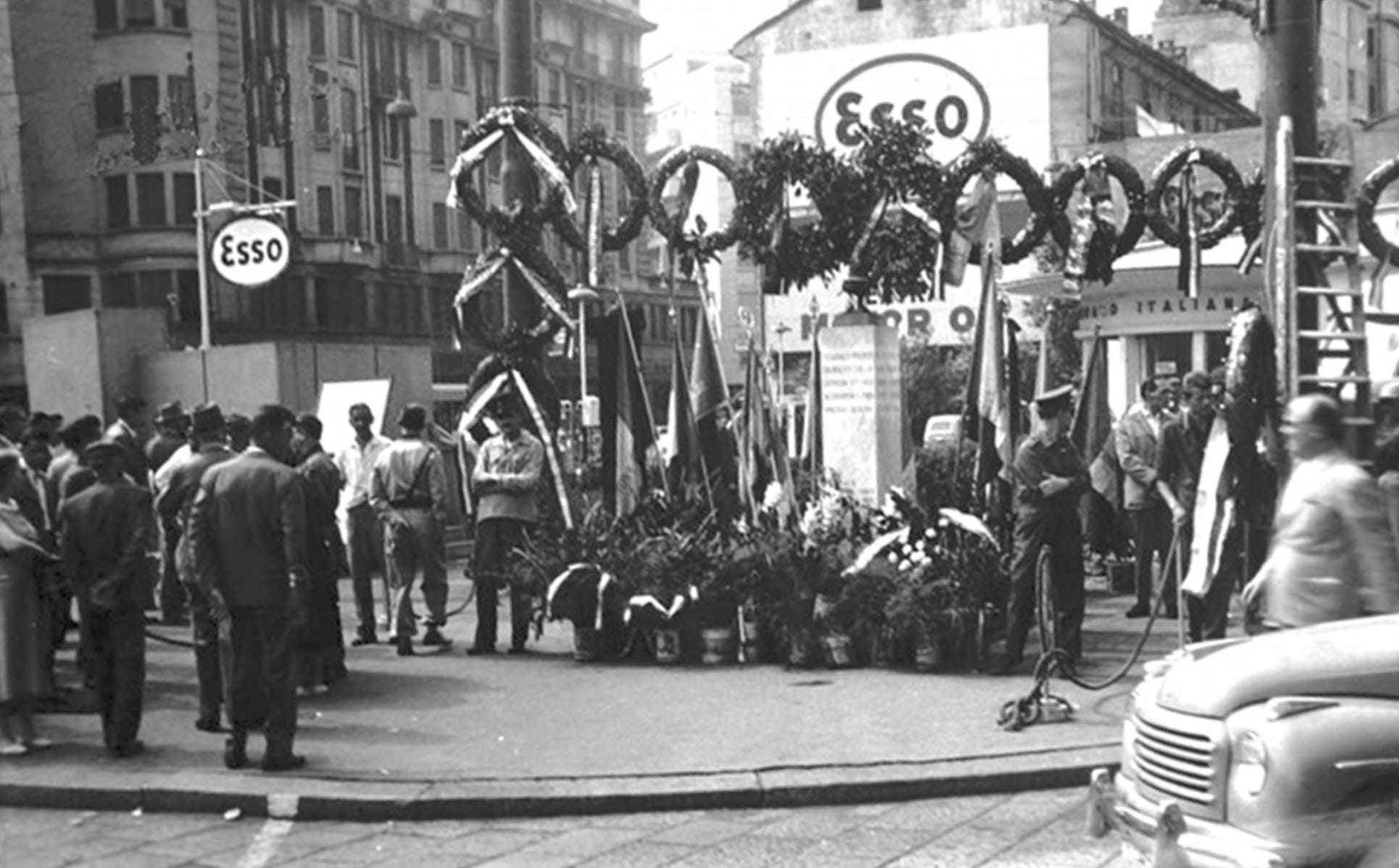
Piazzale Loreto, 1919 (source)]

Every city I have loved has had a furnace. Zaporozhye’s was literal, a horizon of blast furnaces that taught me what the sublime smells like. Milan’s furnace was no less real: Pirelli’s rubber from 1872, Breda’s locomotives, Falck’s steel in Sesto San Giovanni (a suburb so red it was called the Stalingrad of Italy), Alfa Romeo at Portello. But Milan’s twentieth century was distinguished less by what its industry produced than by what its politics transmuted. Milan was an alembic city: the sealed vessel in which European modernity performed its most catastrophic alchemical experiment, the transmutation of red into black.
Consider the laboratory record. In 1909, a wealthy Milanese poet named Filippo Tommaso Marinetti published, in a Paris newspaper for maximum effect, the founding manifesto of Futurism, announcing that a roaring motorcar was more beautiful than the Victory of Samothrace and that war was the world’s only hygiene (Marinetti, 1909). The manifesto was written in Milan, and could only have been: Futurism is what happens when the ancient city of the middle looks at its own tramlines, turbines, and advertising and decides to worship them. Three years later, a young socialist firebrand from the Romagna arrived to edit Avanti!, the national socialist daily, headquartered in Milan. His name was Benito Mussolini, and by 1914 he was the most electric orator of the Italian left. Then the war question split him from the party. In November 1914, he founded his own Milanese paper, Il Popolo d’Italia, sliding from class to nation between one editorial and the next. And on March 23, 1919, in a hall on Piazza San Sepolcro, five minutes’ walk from the Ambrosiana library, where Leonardo’s codices sleep, he convened perhaps a hundred veterans, futurists, syndicalists, and adventurers and founded the Fasci di Combattimento, fighting units (Bosworth, 2002). Fascism was not born in Rome. Rome was where it marched to, in 1922, with Mussolini characteristically waiting in Milan near his newspaper’s offices until success was certain, then taking the night train south in a sleeping car. Just another revolution of the century arriving by wagon-lit. This time, however, not to Petrograd but Rome.
The transmutation of Mussolini from socialist editor into fascist Duce, within the same city, some of the same rhetoric, many of the same enemies-turned-comrades, is the alchemical event I mean, and it has never stopped disturbing me, because it suggests that the political elements are not elements at all but states of a single energy, convertible under pressure. Milan supplied the pressure: the veterans, the futurist cult of speed and violence, the industrialists’ money, the socialist organizational know-how, all sealed in one urban vessel. In Milan in 1919, the vocabulary of revolution had exhausted its socialist content and stood empty, and Mussolini, a connoisseur of empty vessels, moved in.
The experiment ran twenty-six years and returned its residue to the same vessel. In August 1944, at Piazzale Loreto, a wide traffic junction northeast of the center, the occupying fascists shot fifteen partisans and left the bodies on display as a warning. Mussolini is reported to have said that the blood of Piazzale Loreto would be paid for dearly, a sentence that proved accurate in one way he did not intend. On April 29, 1945, his own corpse, and Claretta Petacci’s, and those of his last hierarchs, were brought to the same square and hung by the feet from the canopy of an Esso petrol station, before a crowd whose behavior no one who describes it can render decent. The alembic closed its cycle: the ideology born five kilometers away in San Sepolcro was exhibited, as chemical residue, at Loreto — displayed. I cannot avoid noting, it was at a petrol station, the futurists’ own shrine, the altar of the motorcar that was more beautiful than the Victory of Samothrace. History’s sense of form and humor is merciless.
Piazzale Loreto today is an unlovable roundabout ringed by fast fashion and kebab shops, perpetually about to be redeveloped: the renovation project is announced, delayed, redesigned, announced again, and lungh ’me la fabrica del Domm. Milan has never quite decided how to remember the square, and I have come to respect the indecision. Some completions indeed should be withheld. A finished monument would close the case, and this is the one case the city litigates by leaving the file open on the desk, in the traffic, unresolved, under the distant supervision of the Madonnina, who from her spire can see the square perfectly well and says, as always, nothing.
The Persistent Names and the Ascending Virgin
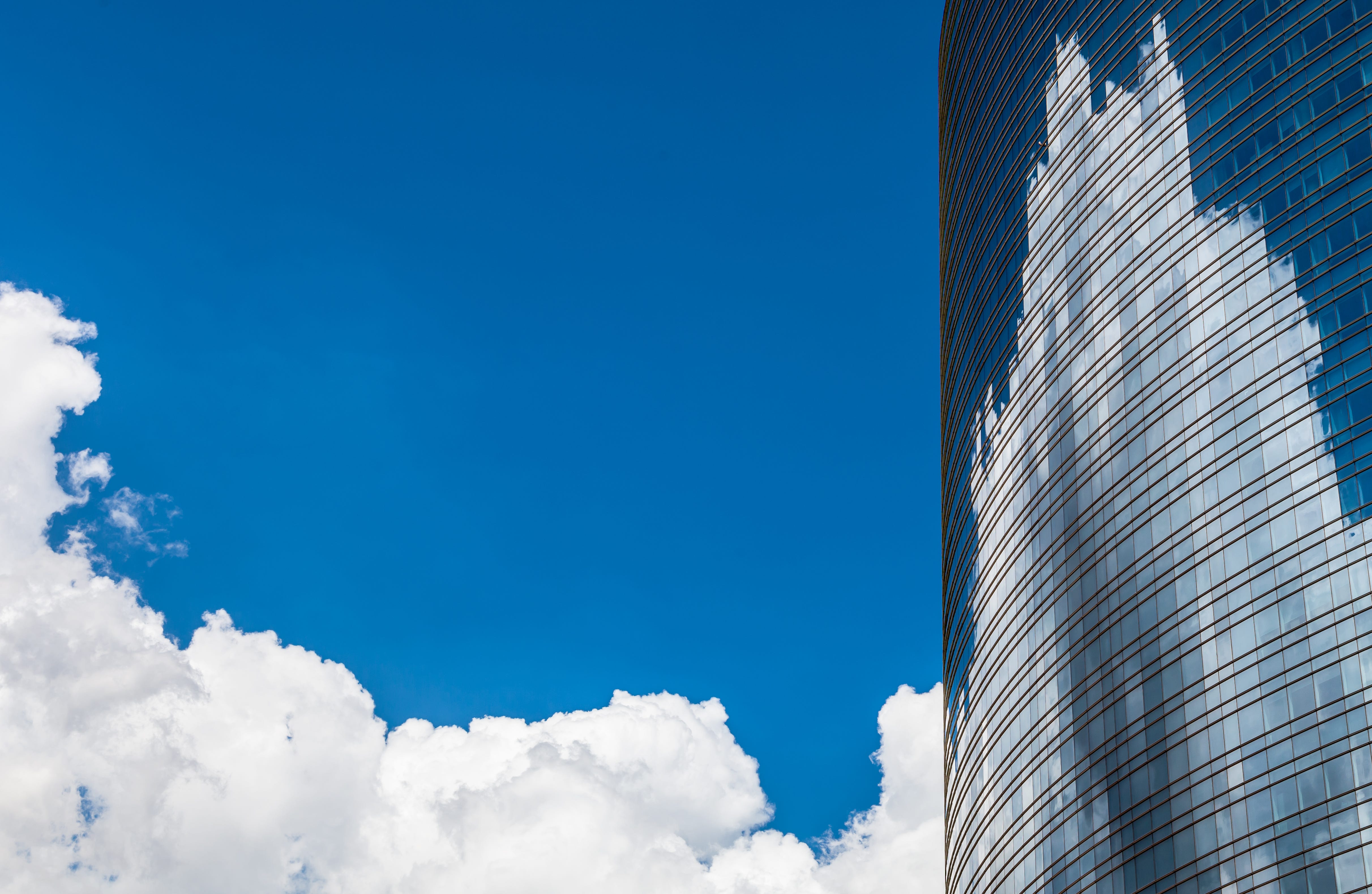
The Milanese surface (my photo)
In 2016, two economists at the Bank of Italy, Guglielmo Barone and Sauro Mocetti, published a study that briefly made the historians of Europe feel cold. Exploiting a fiscal miracle — the catasto of 1427, the first great tax census of a European city, compiled by Florence in a moment of financial desperation — they linked the surnames of Renaissance taxpayers to their descendants in the tax rolls of 2011 and found that, across six centuries and some twenty generations, the advantage had not dissolved. The families at the top of the distribution in 1427 were disproportionately still near the top; earnings elasticity across six hundred years remained positive and significant; certain elite professions showed dynastic persistence that traditional mobility models declare impossible (Barone & Mocetti, 2021). The study concerned Florence. But it belongs in an essay on Milan for two reasons, one ironic and one substantive.
The irony: the catasto of 1427 exists because Florence had bankrupted itself in its long wars against Milan, and the great archive of European family persistence was compiled to pay for the privilege of fighting this city. Milan generated the document as an army generates a fossil record: by pressure.
The substance is that what the economists proved for Florence, any Milanese notary could confirm for Milan without regression analysis. This city’s patriciate is a study in the longue durée wearing excellent tailoring.
The Borromeo, bankers ennobled in the fourteenth century, gave the city its Counter-Reformation saint (Carlo, the plague archbishop) and its first great public library (Federico’s Ambrosiana, 1609); they still hold their islands on Lake Maggiore, and their name is on half the institutions of Lombardy.
The Trivulzio, condottieri and collectors, endowed the charitable home for the elderly where, in 1992, the arrest of a bribe-taking administrator detonated the Italian republic — the patrician foundation as fuse.
The Falck steel dynasty outlived its own steel. When the Sesto San Giovanni mills closed, the family name migrated from production to real estate, the furnaces becoming development sites, matter into position.
And the Visconti themselves never quite left. The branch of the Visconti di Modrone persisted into the twentieth century long enough to produce Luchino Visconti, the Marxist duke of the cinema, who spent his career filming, in The Leopard and Ludwig and Death in Venice, the exquisite decomposition of aristocracies, the last of the serpent’s line, aiming the camera at his own class’s beautiful dying. Which is the most Milanese form of family business I can imagine.
None of this persistence is unique to Milan. What is unique is the surface under which it persists. Because the city’s present-day face, which it turns to the world every February and September, is fashion. And fashion advertises itself as the very opposite of the longue durée: the regime of the season, the six-month cycle, the perpetual now. Milan hosts the paradox without strain. In the quadrilatero della moda, dynastic capital and seasonal surface share the same few streets. The palazzi belong to the old names, the vitrines to the new ones, and the street that binds them is Via Monte Napoleone — named, as we have seen, for Napoleon’s debt office, the emperor’s unpaid bill to the Duomo transubstantiated into the most expensive retail frontage in Europe.
Roland Barthes taught us that fashion is a language, a system in which garments signify (Barthes, 1983). Milan is where the language has its academy. And I want to defend, against easy condescension, the metaphysical seriousness of this. A city that hosted the invention of Western interiority (Augustine’s introspection in the garden) earned the right to become the world capital of the exterior. Because it knows, as Ambrose knew, that the vestment is never mere covering: it is the visible form of an invisible claim. Fashion is Milan’s current occult science, its tarot — a system of images for divining what we are about to desire — designed, like the cards of Filippo Maria’s court, as luxury goods with metaphysical ambitions. The biscione swallows, the silhouette changes, and the house remains.
And the surface, in this century, turned vertical. For generations, an unwritten law governed the Milanese sky: no building might rise above the Madonnina, 108.5 meters, the golden Virgin as municipal ceiling. When the Pirelli Tower, Gio Ponti’s slender miracle and the headquarters of the rubber dynasty, broke the ceiling in 1960, the city did not repeal the law, but forked it: a small replica of the Madonnina was placed on the skyscraper’s roof, so that the Virgin would still, technically, crown the city’s highest point. In 2010, the Palazzo Lombardia rose higher and received its replica. In 2015, the Isozaki tower at CityLife rose higher still, and the little Madonna ascended again. This is now settled custom: whatever building tops Milan must carry her.
I know of no more perfect civic ritual anywhere. The rule is preserved by being endlessly violated. The tradition survives as its own reproduction. And the original supervises from the Duomo while her copies colonize the towers. This is the seriality in gilded copper, an Andy Warhol procedure executed by a cathedral works administration founded in 1387. The Virgin of the unfinished church has become the city’s crowning logo, migrating upward with the skyline, guaranteeing from every summit that the summit is provisional. Completion postponed again, this time vertically.
The Third City
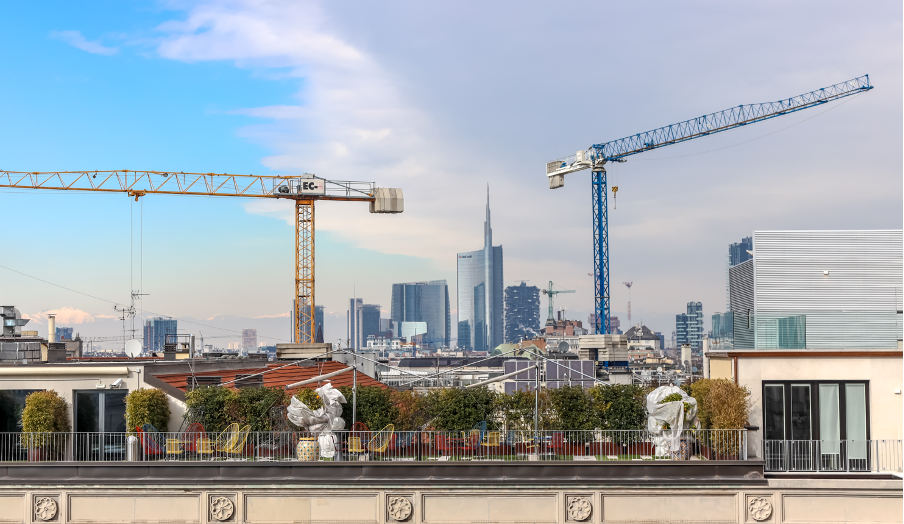
Milan from the Duomo terraces at closing time, August 2022 (my photo)
I listed Milan among the cities, like Pittsburgh, that cling to the mythology of industry after industry has left, museums of their own self-image. The resident must now file an appeal against the visitor. I was not entirely wrong, but I mistook the genre. Milan does not curate its past the way a museum does, under glass, finished. It keeps its past the way the Fabbrica keeps the Duomo: as an open work order. The Celtic sow, the Ambrosian calendar, the razed and rebuilt walls, the buried canals, the reopened trials, the unresolved piazzale, and the ascending Virgin — none of these is an exhibit. Each is a file still on the desk, a case the city has declined to close. Milan has an unusual temporal signature: it continues its history in the present progressive and calls this continuation identity.
I said at the beginning that three cities compose me, and I have been asked what business a Zaporozhian Kievite has claiming the third. The honest answer runs through the two others. Zaporozhye taught me the furnace: the anthropology of cities organized by heavy matter, the dignity and the damage of it. And Zaporozhye today, under missiles, is learning what Milan learned in 1162, that a city can be unbuilt by its neighbors and that existence afterward becomes a daily practice rather than a possession. When I stand before the Cinque Giornate monument, it is not only Milanese barricades that I see. Kiev taught me the middle: the city between empires, on the road from the Varangians to the Greeks, where every universal arrives already translated and slightly worn, and where I first understood that a place can be a crossing without being a periphery. Milan is where these two educations turned out to have prepared me for a third: the city that took furnace and middle and added the discipline of the unfinished, that is, the refusal to let any project, guilt, quarrel, or God reach the terminal state where it stops generating obligations.
So: what, finally, is Milan? The middle that makes exchange possible and belongs to no one. The counter-capital that keeps the oldest quarrel in Europe productively open. The diocese that runs its own calendar and extends the feast. The city that was unbuilt by its neighbors and concluded that existence is a practice. The duchy that dissolved into its library and was redeemed only in a play. The dry plain that manufactured its own water and then buried it, keeping the repressed on retainer. The birthplace of humane law, extracted from the record of its own cruelty by a grandfather and a grandson. The moral capital that functions as a lens, not a treasury. The alembic where red transmuted into black and the residue was displayed at a petrol station. The catwalk under which twenty generations of surnames hold their positions. Ten formulations, and every one of them a variation on the single Milanese theorem: that truth, in this city, is not what survives completion but what survives by declining it.
On winter evenings, I sometimes take the elevator to the Duomo terraces just before closing, when the tourists thin and the marble goes the color of the sky. From up there you can see the whole argument at once: the spires and the cranes, indistinguishable at dusk; the towers of Porta Nuova with their tiny golden Virgins; the Alps, on clear days, holding the northern horizon like a clause held in reserve; and directly above, on the highest pinnacle, the original Madonnina, arms slightly open, supervising a construction site that has outlasted empires, plagues, emperors, ideologies, and will outlast me. She has watched this city refuse to finish anything for two hundred and fifty years, and her expression, as far as gilded copper has one, is not impatience. It is something closer to the tenderness of a foreman who long ago stopped asking for the completion date, having understood that the site is the city, the scaffolding is the architecture, and the work — scrisse, amò, visse — is the point.
The world has not ended. Neither has the Duomo. And for that lesson, I am grateful to Milan.
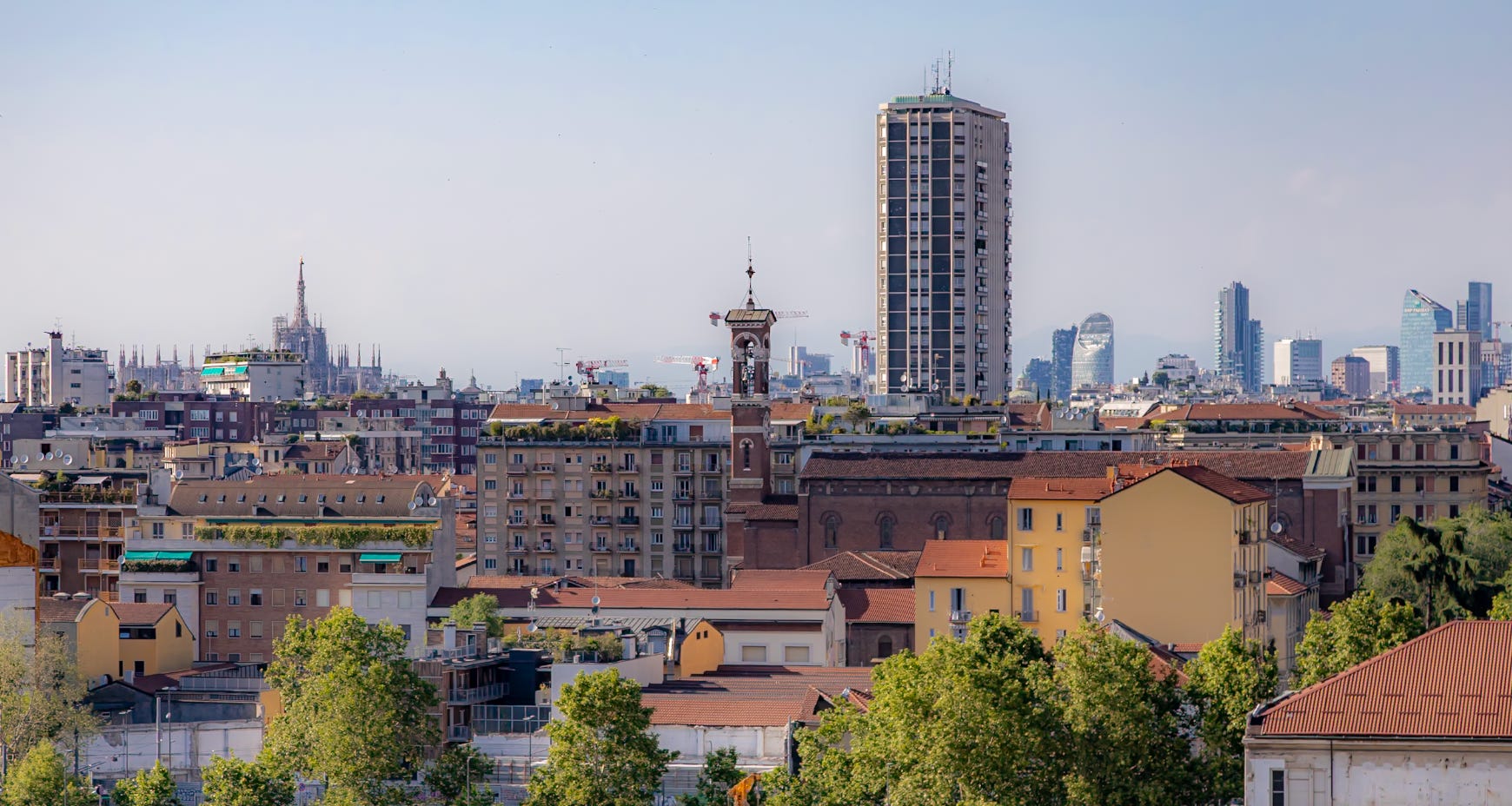
Milano skyline, August 2025 (my photo)
References
Ackerman, J. S. (1949). “Ars sine scientia nihil est”: Gothic theory of architecture at the Cathedral of Milan. The Art Bulletin, 31(2), 84–111.
Augustine. (1991 [398]). Confessions (H. Chadwick, Trans.). Oxford University Press.
Barone, G., & Mocetti, S. (2021). Intergenerational mobility in the very long run: Florence 1427–2011. The Review of Economic Studies, 88(4), 1863–1891.
Barthes, R. (1983). The fashion system (M. Ward & R. Howard, Trans.). Hill and Wang.
Beccaria, C. (1995 [1764]). On crimes and punishments and other writings (R. Bellamy, Ed.; R. Davies, Trans.). Cambridge University Press.
Bosworth, R. J. B. (2002). Mussolini. Arnold.
Decembrio, P. C. (2019 [1447]). Lives of the Milanese tyrants (G. Ianziti, Trans.; M. Zaggia, Ed.). Harvard University Press.
Dummett, M. (1980). The game of tarot: From Ferrara to Salt Lake City. Duckworth.
Foot, J. (2001). Milan since the miracle: City, culture and identity. Berg.
Foot, J. (2009). Italy’s divided memory. Palgrave Macmillan.
Ginsborg, P. (2001). Italy and its discontents: Family, civil society, state, 1980–2001. Penguin.
Isaacson, W. (2017). Leonardo da Vinci. Simon & Schuster.
Lactantius. (1984 [313]). De mortibus persecutorum (J. L. Creed, Ed. & Trans.). Oxford University Press.
Livy. (2006 [27–9 BC]). The history of Rome, Books 1–5 (V. M. Warrior, Trans.). Hackett.
Manzoni, A. (1964 [1842]). The column of infamy (K. Foster, Trans.). Oxford University Press.
Marinetti, F. T. (1909, February 20). Le Futurisme [The founding and manifesto of Futurism]. Le Figaro. [InternetArchive replica]
McLynn, N. B. (1994). Ambrose of Milan: Church and court in a Christian capital. University of California Press.
Raccagni, G. (2010). The Lombard League, 1167–1225. Oxford University Press.
Shakespeare, W. (2011 [1611]). The Tempest (V. M. Vaughan & A. T. Vaughan, Eds.). Arden Shakespeare.
Stendhal. (1995 [1836]). The life of Henry Brulard (J. Sturrock, Trans.). New York Review Books.
Veneranda Fabbrica del Duomo di Milano. (n.d.). The history of the Duomo. https://www.duomomilano.it/
I should report two typos and a photo error. The first photo was taken in 2021. One of the sentences starts with "Ans ..." which should be "And ..."
The photo of Loreto Square is wrong.
I am thankful to the colleagues who reported these errors.