

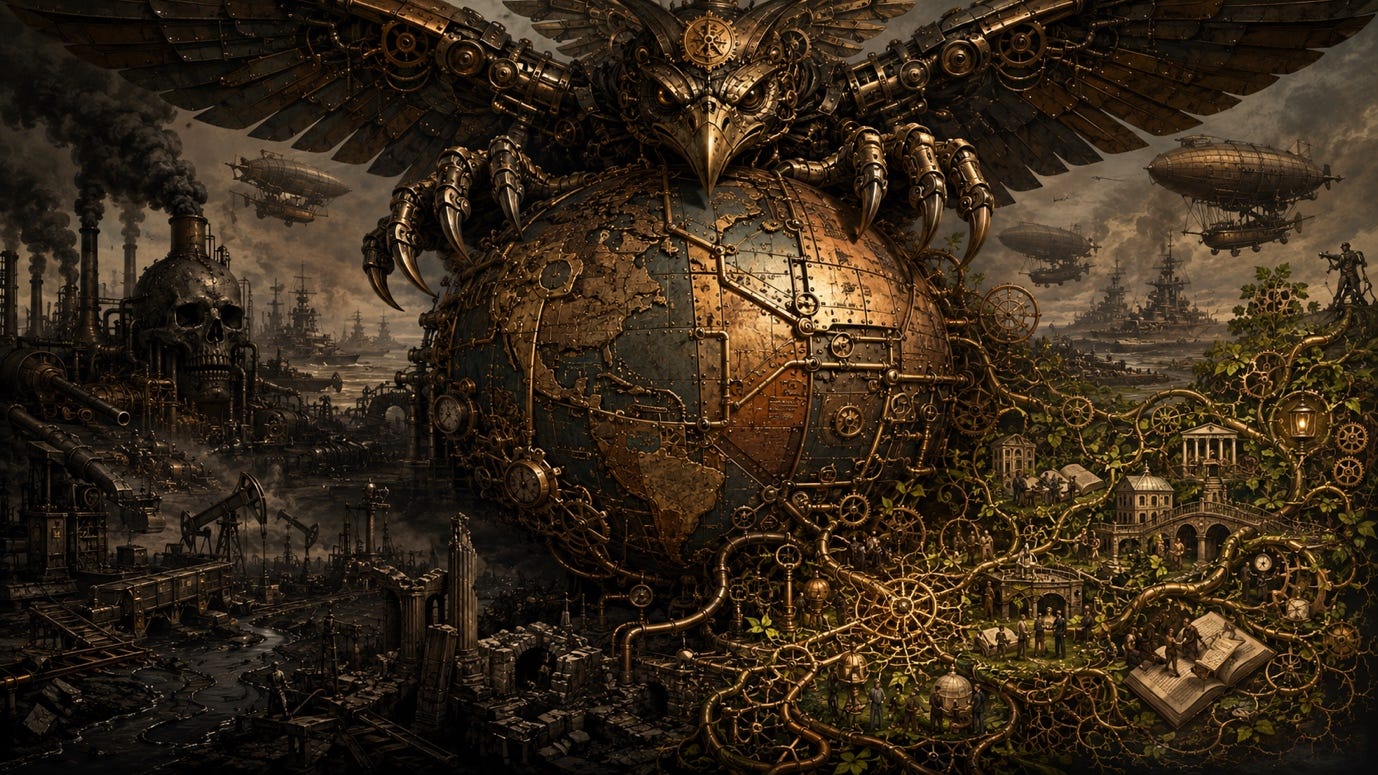
“The philosophers have only interpreted the world, in various ways; the point, however, is to change it.” K. Marx, Thesis on Feuerbach
“[M]aybe the time has come to turn around Marx’s thesis 11: in the twentieth century, we tried to change the world without really understanding it; now it’s time to interpret it.” S. Zizek, European Union, Seventy Years Later
On March 4, 2026, the United States Secretary of War addressed a press briefing on the opening days of the campaign against Iran. Pete Hegseth said:
“We have only just begun to hunt, dismantle, demoralize, destroy and defeat their capabilities. Our rules of engagement are bold, precise and designed to unleash American power, not shackle it. This was never meant to be a fair fight, and it is not a fair fight. We are punching them while they’re down, which is exactly how it should be.” (U.S. Department of War, 2026a)
Six days later, the Kremlin press secretary Dmitry Peskov, asked to comment on the same events, offered a different register.
“Sadly, we have all lost what we call international law. To be honest, I don’t even know how to call on anyone to adhere to the norms and principles of international law. It no longer exists. It exists de jure, but de facto it no longer exists. What kind of law has replaced international law? It’s unlikely anyone can tell at this point.” (cited in Žižek, 2026)
Three weeks after that, in Rome, Slavoj Žižek delivered the speech that frames the present essay.
“What we are approaching now, gradually but inexorably, is nothing less than the end of the world.” (Žižek, 2026)
For Žižek, the end of the world is not the obliteration of human life but the suspension of the coordinates within which political life had become legible: a moment in which, as in the old GDR joke he retells, God himself turns away and weeps.
Three voices, three positions, one diagnostic. The argument of what follows is that these voices are not describing the collapse of an order but the early consolidation of a new one. The post-1945 settlement is not in interregnum; it has been succeeded. The succession is incomplete, contested, and internally unstable, but it has a recognizable shape. To some extent, it has a charter document — the 2026 National Defense Strategy of the United States Department of War. It has a constitutive political subject — the predator. It has an economic substrate — necrocapitalism. And it has a spatial logic that recovers, in altered form, what Carl Schmitt named the nomos of the earth. The task of this essay is to describe the newly established nomos, to identify the form of life its predator-subject instantiates, and to ask through which institutional resources it might still be resisted without reproducing its singular structure.
The essay engages two interlocutors whose recent interventions have framed the public discussion. Robert Kagan’s “Checkmate in Iran” (2026) describes the tactical defeat of the American campaign and reads it as a strategic catastrophe for the postwar order. Slavoj Žižek’s “European Union, Seventy Years Later” (2026) reads the same conjuncture as a moment of multi-civilizational erasure, leaving Europe alone as the possible bearer of emancipatory universalism. Both intuitions are correct, and both are insufficient. Kagan diagnoses the symptom and misses the constitutive shift; Žižek diagnoses the metaphysical stakes and resolves them through a singular Eurocentric inversion that mirrors the structure it opposes. The polyrhizic counter-proposal advanced here aims to do better on both counts.
