

The Doctrine Returns
On December 2, 2025, two hundred and two years to the day after James Monroe sent his seventh annual message to Congress, the White House marked the anniversary by announcing a “Trump Corollary” to the Monroe Doctrine. The National Security Strategy released at nearly the same moment was more specific. The United States would “reassert and enforce” the doctrine, restore its preeminence in the Western Hemisphere, keep outside powers from acquiring strategic positions there, and protect American access to vital geography (The White House, 2025a, 2025b). The following January, the National Defense Strategy supplied the military grammar: the homeland first, the hemisphere next, China as the principal great-power problem, and allies increasingly left to look after their own regions (U.S. Department of War, 2026).
The vocabulary was contemporary, but the map was suddenly antique. After thirty years of strategy drawn on the scale of the planet, Washington was talking about the hemisphere again.
It is tempting to file this under the familiar swing between engagement and retrenchment. But that would miss how strange the recurrence is. In 1823, Monroe’s young republic claimed a hemisphere it could not defend; the Royal Navy did much of the work that American rhetoric attributed to American sovereignty (Sexton, 2011). The doctrine was imperial before there was an empire capable of enforcing it. Two centuries later, the paradox runs the other way. The country invoking Monroe in 2025 was the state that had come out of the twentieth century with an unmatched network of alliances, bases, financial institutions, and technological platforms, whose currency still anchors world finance and whose armed forces have operated in nearly every region of the earth. The doctrine has come home after the empire went around the world.
In my earlier essay, “Olive Branch and Restless Arrows,” I argued that the United States is best understood as the cohabitation of two political forms, republic and empire (Minakov, 2026). The Republic moves inward and backward, toward a founding act: the Constitution, consent, and the national habit of returning to first principles to correct the present. The Empire moves outward, toward a frontier: expansion, markets, bases, financial infrastructure, and cultural radiation. The Republic asks who we are; the Empire asks how far we can reach. The first lives in a promise, the second in a horizon. Neither is the authentic America with the other as its parasite. They grew up and may decline together; their destiny is one. Universalism gave expansion its moral vocabulary, and expansion gave the Republic resources, security, room, and a mission. The contradiction was real, and so was the intimacy.
I finished that essay with a question: What happens to this marriage when the world that sustained it changes? This essay begins there. Its subject is not American decline, a word too blunt for what is happening, but what happens to political power when it stops meeting an effective outside.
For most of American history, expansion ran into resistance: European empires, Native nations, Mexico, Imperial Japan and Nazi Germany, anti-colonial movements, and finally the Soviet Union. These frictions did not make the United States virtuous. But they forced American power to tell the difference between what it wanted and what it could get.
Then, for a historically exceptional interval, the difference blurred. The Soviet Union’s collapse removed the main organized contradiction to the American-centered order. What followed has been called the unipolar moment, though “moment” is a modest word for three decades of latitude without modern precedent. NATO enlarged, markets opened, and liberal constitutionalism came to present itself less as one tradition among others than as the destination of political development itself. It was the great wager of the age: that power and universality might finally coincide.
Here the philosophical trouble starts. Power ordinarily learns that the world exists because the world pushes back. Resistance may be wise or foolish, democratic or despotic, but before any such judgment it establishes a fact: someone else is there. A world incapable of consequential refusal teaches a different lesson. Preference begins to resemble possibility; possibility, legitimacy; and legitimacy, universality. Opposition looks less like another political will than like a defect awaiting diagnosis: nationalism, backwardness, corruption. Sometimes the diagnosis is right. The trouble begins when explaining why someone refuses becomes a substitute for taking the refusal seriously.
My question, then, is not whether American power has been benevolent or malign. It has plainly been both, or more, sometimes through the same institution in the same year. Nor do I welcome the return of great-power rivalry; the twentieth century should have cured us of that nostalgia. The question is about the limit. What made American power capable, at its best moments, of building durable arrangements was never good intention alone. It was also constraint: rival power, allied bargaining, constitutional checks, public opposition, and the stubborn capacity of other societies to remain other. Limits forced power back into politics. They demanded persuasion where command would have been easier.
The dialectic of the American Republic and Empire therefore needs a third term. Republic, Empire, and now Limit. The Republic tries to bind power from within; the world binds it from without; the Empire lives in the unstable space between them.
My proposition is that the erosion of American unipolarity brings real dangers, up to and including great-power war. Yet the return of external limits may also restore something that an empire without an outside gradually loses, namely the experience of other political subjects as subjects. No empire can certify its own benevolence. Benevolence exists politically only where those on the receiving end of power keep some capacity to answer back. Only where another can say no does yes mean anything.
The American Empire has not simply grown weaker. It has rediscovered that there is an outside. The question is whether it can learn to live with one.
The Two Americas
The United States has always had trouble seeing its empire, because it rarely looked like the empires Americans were taught to recognize. Rome had emperors and provinces; Britain colored a quarter of the globe pink using army and corporations. The American case is less obliging. Its armies crossed oceans, its corporations and its currency went where the flag did not, and still the country could describe itself, with considerable sincerity, as something other than an empire.
Let’s see what language we can use to describe this situation. Unipolarity describes a distribution of capabilities; primacy, a position within it; hegemony, the capacity to organize an order that others join, willingly or because the alternatives are costly. Empire is more intimate. Daniel Nexon and Thomas Wright define it by a particular architecture of hierarchy rather than by annexation: a network of unequal relationships, run through local intermediaries and separate bargains with each periphery (Nexon & Wright, 2007). That lets us speak of an American empire without pretending that Washington is London in 1890 with aircraft carriers. The relationship has been territorial (Puerto Rico, the Philippines, Guam), military (bases, guarantees), and monetary or institutional (dollars, markets, standards). These arrangements differ enormously in legitimacy and benefit, and they belong in no single moral category. What links them is a recurring disparity in the power to set the terms.
Daniel Immerwahr begins How to Hide an Empire with a map, the familiar silhouette of the continental United States with Alaska and Hawaii tucked into little boxes: the nation’s preferred self-portrait. It leaves much of the historical United States out of the frame. On December 7, 1941, Japan struck not only Hawaii but the Philippines, Guam, and other American territories across the Pacific. Some sixteen million Filipinos were then U.S. nationals. American memory condensed that sprawling imperial catastrophe into two words: Pearl Harbor (Immerwahr, 2019). A country had forgotten part of itself.
After 1945, forgetting became easier. The United States let go of most of its formal colonies, but its power did not retreat to the continent. It changed shape. Immerwahr calls the result a “pointillist empire”: instead of great swaths of territory, a scatter of points (bases, airfields, logistics hubs) augmented by technologies and standards that allowed influence to travel without annexation. This also solved an old ideological problem. A colony makes the republican contradiction visible, because a government founded on consent must explain why the people it rules have none. A base leased by treaty, an alliance signed by a sovereign government, or an institution of formally equal members creates no such embarrassment. Hierarchy can persist while sovereignty survives in legal form. The empire became easier to deny because it had grown more abstract, whether or not it had grown more sinister.
Amy Kaplan and Donald Pease made a related point three decades ago: empire does not begin where America ends; it helps produce the meaning of “America” itself (Kaplan & Pease, 1993, p. 3ff). The Republic lends the Empire its most powerful words (freedom, rights, opportunity, self-determination), and the Empire gives the Republic security, markets, prestige, and sometimes an external mission around which domestic quarrels can be reorganized. The Empire generates contradictions abroad; the Republic supplies the vocabulary with which to criticize, and occasionally correct, them. The relationship is neither simple hypocrisy nor ingenuous harmony. It is a productive tension.
For most of American history, though, there was always a third party in the room: rival empires, allies able to bargain, societies able to refuse. Something stood beyond American intention and did not vanish because Washington wished it would. The Republic and the Empire conducted their long quarrel in a world that could interrupt them.
Then, for a brief and extraordinary interval, the third party seemed to disappear. The Republic remained. The Empire remained. What vanished was the Limit.
Learning to Be Limited: 1823–1898
The Monroe Doctrine is remembered as an assertion of power. It began as an admission that power was missing. In 1823, Britain ruled the seas, Russia held territory on the Pacific coast, and the young republic could announce principles far more easily than it could enforce them. Its sovereignty over the hemisphere existed mainly in the air. Twenty years later, Heinrich Heine, the genius ironist of German poetry, described the same predicament from the other side of the Atlantic, on behalf of his own divided and powerless nation:
Franzosen und Russen gehört das Land,
Das Meer gehört den Britten,
Wir aber besitzen im Luftreich’ des Traums
Die Herrschaft unbestritten.
The land belongs to the Russians and French,
In the British the ocean is vested,
But we in dream’s airy regions possess
The mastery uncontested.
Heine was mocking his fellow Germans, who had neither land nor sea and consoled themselves with an empire of dreams. The Americans of 1823 were in much the same position, and as the Germans, they meant to wake up. The American airy dominion was a declaration waiting for power to catch up with it, and in the meantime it rested on somebody else’s navy. British ministers opposed a restoration of Spanish rule for commercial reasons of their own, and the Royal Navy supplied the deterrent Washington lacked. Monroe’s administration nevertheless declined London’s offer of a joint declaration and issued its own. Sexton sees in this a characteristically American move: dependence translated rhetorically into independence (Sexton, 2011). The dream would not stay in the air for long.
An imperial possibility already lay inside the anti-imperial language. Sexton borrows William Appleman Williams’s phrase “imperial anticolonialism” for it: resistance to someone else’s empire could become the premise for building one’s own. At first, circumstance contained the contradiction. Britain had to be reckoned with, and Mexico, the Native nations, and the new Latin American republics had purposes of their own. This is the first meaning of limit in the American imperial experience. It was not moral restraint, since nineteenth-century expansion was capable of terrible violence, and it was not modesty. It was something more elementary: between desire and accomplishment stood another will, another power, and another fact.
That began to change as the Republic itself changed. Walter LaFeber traces the decisive shift to the decades after the Civil War. Railroads stitched the continent together, industry and finance grew in scale, and the output of farms and factories increasingly sought markets abroad. A country that had spent most of the century acquiring land was becoming one whose economic interests land could no longer contain (LaFeber, 1963). The frontier was translated more than it was closed. The oceans stopped being moats and became highways to European and Asian markets, and the old geography of land touching land gave way to one of ports, islands, cables, and coaling stations. America was made the America of two shores, Eastern and Western.
By 1898 the pieces converged. Stephen Kinzer treats that year as the moment Americans were forced to argue openly about what kind of power they meant to be (Kinzer, 2017). The war with Spain began in sympathy for Cubans fighting Spanish colonial rule. Within months the country faced a different question: whether liberation from one empire would end in subordination to another. Hawaii, Puerto Rico, Guam, and above all the Philippines turned a war fought in humanitarian language into a quarrel about empire itself.
What makes the debate so revealing is that both sides spoke the language of American principle. The expansionists never said that the United States should conquer weaker peoples because it could. They said that industry needed markets, that commerce carried civilization, and that superior institutions brought obligations. Interest became necessity; necessity became mission; and mission became universality.
The anti-imperialists attacked precisely this sequence. At Faneuil Hall, in June of 1898, men who had supported a war for Cuban independence warned against letting it become an instrument of conquest. Their deepest fear, as Kinzer reconstructs it, was constitutional: once Americans accepted that they could govern other peoples without consent, they would have changed the principle by which they governed themselves. Mark Twain, who had seen European colonialism up close on his travels around the world, went further. He had set out, he admitted, “a red-hot imperialist,” and he came home in 1900 having read the Treaty of Paris: “We have gone there to conquer, not to redeem… I am opposed to having the eagle put its talons on any other land” (cited from Zwick, 1992). For Twain, the danger lay less in what Americans would do to Filipinos than in what empire would do to Americans: normalize standing armies, breed enemies, fatten oligarchies, and make domination abroad compatible with shrinking freedom at home.
Here the contradiction between Republic and Empire surfaced in plain language almost before the overseas empire existed. The Republic said: legitimate government begins with consent. The Empire replied: circumstances have changed. Imperial argument rarely repudiates the universal. It claims that the universal requires an exception: self-government remains sacred, but some peoples are not ready for it. The exception is always presented as provisional. The structures it creates can last for generations.
In 1823, most limits on American ambition were external. By 1898 the burden of limitation had begun shifting inward. Could the Republic say no to its own Empire? Not fully. Hawaii was annexed; Puerto Rico, Guam, and the Philippines came under American rule; Cuba received a fenced-in independence; and the Supreme Court, in the Insular Cases, had to decide whether the Constitution followed the flag. Its answer amounted to “only partly.” But the anti-imperialist argument did not die with its political defeat. It became part of the machinery by which American power would henceforth understand, and occasionally restrain, itself.
Between Monroe and Manila, then, the American Empire learned to expand in a world that still had edges: British ships, rival empires, resisting societies, and, sometimes, the Republic’s own language turned against the Empire’s practice. None of these constraints made American power benevolent. They humbled it to be finite.
The Bounded Colossus: 1945–1991
In 1945, the United States acquired something close to the power its nineteenth-century expansionists had dreamed of. The European empires that had once disciplined American ambition were exhausted; Germany and Japan lay in ruins. America had an intact industrial base, roughly half of the world’s manufacturing output, unmatched naval and air power, and, briefly, a monopoly on the atomic bomb. If empire were simply a function of material superiority, this should have been the moment it escaped all limits. Instead, the postwar order was built around them.
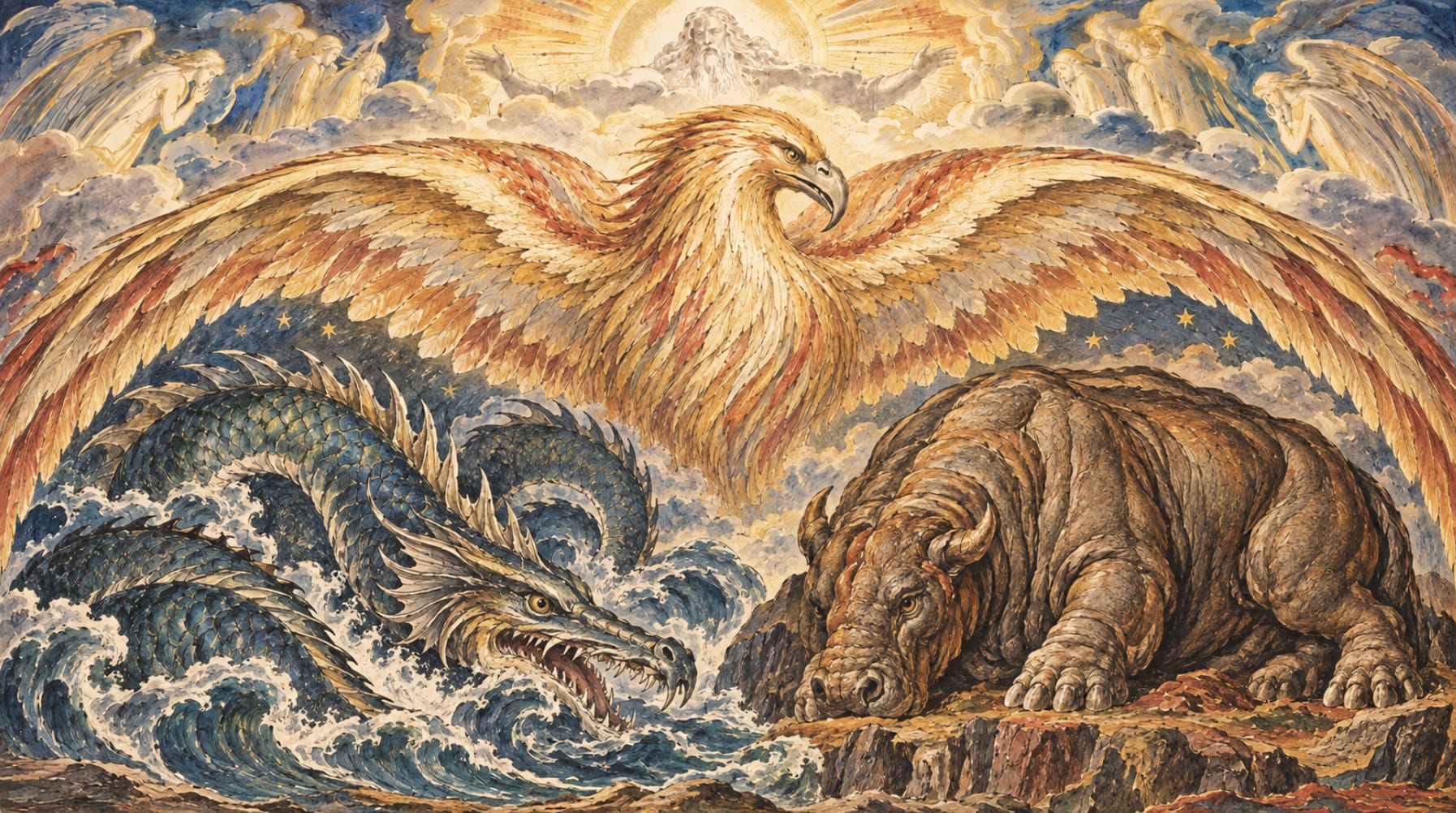
The first limit was external, and an old image helps describe its shape. Hobbes gave modern political thought two beasts from the Book of Job: Leviathan, the sovereign state producing terrible civil peace, and Behemoth, the civil war that forever threatens to dissolve the republic itself. The rabbinic tradition from which he borrowed the pair knew a third beast. Ziz is the great bird that rules the air as Leviathan rules the sea and Behemoth the land; when it spreads its wings, the midrash says, it darkens the sun. In my lectures on political philosophy, Between Leviathan and Behemoth, I read Ziz as the figure of the universal empire (Минаков, 2026). Such a power does more than hold territory or command the sea lanes. It claims the sky above all of them, the one element in which every land and every sea is equally included. A Leviathan says: this is my domain. A Ziz says: this is how the world should be. Its wingspan is an ideology that claims validity everywhere.
The twentieth century produced two such birds. The Soviet Union was a Ziz of communist universalism. It spoke for the laboring humanity of every nation and claimed to know the direction in which history was moving. The United States was a Ziz of liberal universalism. It spoke for free individuals, open markets, and self-government, and it too believed that history was on its side. Both were empires in Nexon and Wright’s sense, hubs with unequal spokes. What made them Zizes was the scale of the claim. Neither thought of itself as one power among many. Each believed, with more or less ideologized belief, in itself as the future.
The decisive fact about the Cold War, for my argument, is that there were two of them in the same sky. For each Ziz, the other was living proof that its universality was not yet universal. Those of us who grew up under the Soviet wing knew this from the other side. The American bird was always somewhere on the horizon, as threat, temptation, or rumor, and its mere presence told us that the Soviet future was one version of the future rather than the only one. From what my Western mentors and friends tell me, Americans were taught the same lesson in reverse.
This lesson had teeth, even fangs. Moscow could retaliate. Beijing, after 1949, could refuse. European allies could bargain. Decolonization multiplied actors whose aims fit neither bird’s categories and who learned to play one against the other. Nuclear weapons added the most brutal limit of all: past a certain threshold, superiority stopped meaning usable power. The adversary did not make American policy too wiser, but it showed that error can be more expensive.
The second limit was much stranger, because Washington built it itself. G. John Ikenberry describes the postwar settlement as an effort to convert overwhelming advantage into durable order by embedding power in institutions: NATO, Bretton Woods, the United Nations, the GATT (Ikenberry, 1998, 2001). By binding itself, the hegemon made its predominance less frightening and its commitments more credible, while keeping outsized weight in most of these bodies. Power accepted procedure, and this difference was crucial for the US future. A rule that restrains only the weak is domination in legal dress. A rule becomes politically meaningful when the strong also pay a price for observing it. The system came closest to that condition inside the Western alliance, and there, in a limited but important sense, the United States built a bounded primacy: the international counterpart of the republican intuition that power lasts longer when it accepts forms it cannot change at every moment of convenience.
To this, Reinhold Niebuhr supplied the moral vocabulary. The brilliant Irony of American History, published in 1952, refused to treat Soviet communism and American democracy as morally equivalent, yet it was equally suspicious of the idea that superior American principles guarantee virtuous conduct (Finstuen, 2021; Niebuhr, 1952). Niebuhr’s target, in my opinion, was American innocence, the tendency of a successful nation to read its success as proof of moral exemption. Where cynicism sees moral language as a mask and celebration sees it as a purifier, irony lets both be true. America could build institutions that enlarged the zones of prosperity and freedom while using coercion that contradicted its creed.
The Cold War furnished ample evidence. Washington championed decolonization in principle and feared it in practice. It read nationalist movements as instruments of communist expansion and backed coups or military regimes, in Iran, Guatemala, Brazil, Indonesia, and elsewhere, when alignment seemed more urgent than liberty. And then there was Vietnam, which makes it impossible to romanticize bipolarity. Limits are not the same as peace. A rival can moderate ambition by raising its cost; it can also inflame fear, justify secrecy, and swell military establishments. The Cold War bounded American power and militarized it at the same time.
American power in those decades operated inside two concentric disciplines. From outside came deterrence, rivalry, allied bargaining, and decolonization. From inside came treaties, Congress, the courts, public argument, and the republican suspicion, often violated but never extinguished, that legitimate power must answer for itself. Both disciplines failed, sometimes spectacularly. Yet they kept forcing Washington to ask what allies would accept, what escalation might provoke, and what the gap between its principles and its conduct would cost in a world where another Ziz was keeping score. When the new states of Africa and Asia filled the U.N. General Assembly, the Republic’s language returned from abroad as an accusation: if self-government was universal, others could demand that America take universality seriously.
Constraint compelled translation. Interests had to be translated into alliance bargains, power into institutions, ideology into claims that others could accept or resist. Even when the translations were dishonest, the need to make them acknowledged another audience. Constraint did not make the Empire innocent. It made omnipotence implausible.
When the Soviet Union disappeared, then, America lost more than an enemy. It lost the other bird in the sky, and the source of its alleged moral superiority.
The Empire Without an Outside: 1991–2014
In 1991 the United States entered the unusual condition of having no comparable power able to teach it where the world began. The Soviet Union did not merely lose the Cold War; it dissolved. Russia, the Soviet core, entered the decade weakened and consumed by its own upheaval, and it watched Western institutions advance toward borders that Moscow had long treated as a protective belt and now began to experience as encirclement. The institutions America had built during the Cold War, by contrast, survived victory intact, including the military infrastructure of containment, though the power it had been built to contain did not. Scholars still argue about how long the unipolar moment lasted and how much freedom it actually gave Washington (see Krauthammer, 1990; Layne, 2012; Monteiro, 2014). Few dispute, however, that the Soviet collapse removed many of the constraints of great-power competition and left the United States with extraordinary latitude (Brooks & Wohlforth, 2016).
In the terms I have proposed, the sky now held a single Ziz. A Ziz alone in the sky faces a peculiar temptation, which is to mistake its wingspan for the sky itself. Communist universalism had been defeated, for the time being, and liberal universalism no longer had a rival against which to measure itself. In a sense, Locke had won out over Hegel. A modest universalism, one that promised individuals their rights and asked governments for their subjects’ consent, had outlasted an absolute one that claimed to know where History was going. The irony is that the victory was announced in Hegel’s own language, as the “end of history” (Fukuyama, 1989). The weak universal began to speak like the strong one it had beaten. Its shadow now fell everywhere, and it became easy to confuse that shadow with daylight.
This was a triumph of interpretation as much as of power. Institutions that had grown up on one side of the Cold War could now be imagined as the architecture of the world. NATO could enlarge; the European Union could turn east; China could be drawn into the world economy, and Russia, eventually, socialized into its rules. A bounded Western order was reconceived as a potentially universal one (Mearsheimer, 2019). The consequences, particularly for Russia and European security, remain fiercely contested. What matters here is how the ambition blurred the line between a successful political order and the natural form of political order.
William Appleman Williams had anticipated the danger. His history of the Open Door describes how a policy on access to China grew into a Weltanschauung in which openness, commerce, and a climate congenial to American institutions seemed simply the order of things. For Williams, the tragedy began when a policy stopped experiencing itself as a policy and became common sense (Williams, 2009).
No conspiracy is needed to explain what followed. Patrick Porter’s account of post–Cold War strategy is illuminating precisely because it is untheatrical. Primacy endured, he argues, through capacity and habit. American power made a global strategy possible; decades of institutional routine made it seem normal. Alternatives looked eccentric before anyone debated them, and the argument concerned how American leadership should be exercised, never whether its inherited scale was still necessary (Porter, 2018). Institutions do remember. Failure provokes revision; victory converts contingency into evidence.
The Clinton years displayed the pattern in its most benign form, and their master metaphor was enlargement. If an empire of territory takes possession, an empire of norms invites admission. And the US invitation had real appeal. Poles, Czechs, Balts, and others sought membership in NATO and the European Union for reasons rooted in their own histories and fears, and any fair account must credit their agency. But precisely because the order was attractive, it became harder to see that some societies might reject parts of it for reasons that could not be reduced to misunderstanding.
This is where I would introduce the term administrative universalism. If philosophical universalism makes a claim about principles, administrative universalism assumes that the main normative question has been settled and that what remains is implementation. Its vocabulary is familiar: democratization, transition, conditionality, governance, capacity-building, structural adjustment, and nation-state-building. Some states were consolidated democracies, others “in transition”; some economies were mature, others “emerging.” Countries appeared to stand at different points on the same road. The danger was less in liberalism than in the loss of the conditional mood: the moment when our conception of order became order, when an American-supported arrangement became “the international community,” and when a strategy began to look like history, or like unnecessary capacity.
September 11th did not destroy this confidence. At first, it radicalized it. The 2002 National Security Strategy claimed a right to act against threats before they fully formed, and declared that American military strength should remain beyond challenge (The White House, 2002). Afghanistan began as a war on al-Qaeda and grew into an enterprise of reconstruction. In Iraq, after Saddam Hussein’s fall, Washington committed itself explicitly to building a sovereign, constitutional, democratic order (Grossman, 2004; The White House, 2005). Military victory opened onto administrative transformation. The Empire no longer needed to annex territory in order to imagine that it could reshape another society’s political time.
Williams had a phrase for this: the “vision of omnipotence.” He did not mean the childish belief that anything is possible. He meant the more consequential conviction that enough American leverage can keep reopening outcomes that other societies regard as settled. Resistance produces frustration, frustration calls forth more pressure, and power is trapped by the expectations of its own success (Williams, 2009).
I am sure: this is less the psychology of hubris or chutzpah than the metaphysics of a disappearing outside. An outside is more than faraway foreign. It is a place from which a meaningful refusal can come. Refusal never actually disappeared: Serbia, Iraq, Iran, North Korea, Cuba, Venezuela until recently, and, more and more, Russia refused, and China never accepted the political premises of the liberal order. But the distribution of power made it easy to treat resistance as a problem to be overcome rather than a fact around which order might have to be negotiated.
A hegemon hears “no” and asks: What will it cost to change that answer? A bounded power must sometimes ask: What order is possible if the answer stays no? Between those two questions lies the difference between administration and politics.
By the end of the two-thousands, the gap was hard to ignore. Afghanistan and Iraq proved longer and more intractable than the early confidence had suggested; the financial crisis of 2008 shook faith in the American economic model, and China kept rising. Primacy did not end in 2008, and even years later America’s advantages remained vast (Brooks & Wohlforth, 2016), but unipolarity became contestable. Then came 2014, when Russia annexed Crimea and intervened in eastern Ukraine, tearing up the assumptions on which European security had rested since the end of the Cold War (Allison, 2014).
The last lesson came from the place where the unipolar war on terror had begun. The chaotic withdrawal from Kabul in August 2021 produced what I called at the time an “Afghanistan syndrome” (Minakov, 2021). At home, it meant a loss of trust in military and political leaders, and a feeling that the war had no just basis. Abroad, it meant sudden doubt about American competence and reliability as an ally. In Beijing, Moscow, Tehran, and New Delhi, the scenes at Kabul airport read as evidence of the West’s shrinking global presence. In Kyiv, trust in the American alliance was badly damaged, only months before it would be tested as never before. The name carried its own irony: “Afghan syndrome” had first been a Soviet diagnosis, coined for the veterans of Moscow’s failed war of 1979–1989. Both Zizes, it turned out, had flown into the same mountains and come back diminished. The outside had never vanished. Now it was beginning to insist on its existence.
Thus, the tragedy of unipolarity was not that America became omnipotent. It was that for a time it became possible to behave as if the distance between the world as it was and the world as America believed it should become were mainly a problem of means. The lone Ziz, having lost the company, began to mistake the reach of its own horizon for the horizon of the world.
Benevolence Without Resistance
The liberal order was not an illusion, and criticism of unipolarity becomes too easy if the order is reduced to camouflage. The postwar system opened markets, bound former enemies into cooperation, and made interstate life more predictable than the great-power diplomacy of earlier centuries (and thus diplomacy as art began to perish in the West). After 1991, many states chose to join its institutions because membership brought security, capital, and, for some, reinforcement of their own democratic transformations. Niall Ferguson presses the point from an openly imperial direction: the United States is an empire, he argues, and an empire can deliver goods well beyond its own center (Ferguson, 2005). Ikenberry makes a gentler version of the case. American power produced an unusually open, loosely rule-based order that also constrained and regularized the uses of that power (Ikenberry, 2005).
Any serious critique has to start there, or the real puzzle disappears: real benefits and real asymmetries lived in the same house. Security guarantees protected small states and deepened their dependence. Open markets generated prosperity and exposed societies to financial discipline set elsewhere. Empire and benevolence were never logical opposites. The harder question was who gets to decide what counts as benevolence.
During the Cold War that question stayed open, because the liberal order was nested inside a larger system it did not control. After 1989, in Ikenberry’s economic formulation, the inside became the outside. An order centered on the Western democracies expanded geographically and deepened institutionally, and it presented its rules as the principles of world order rather than the rules of one coalition (Ikenberry & Trubowitz, 2025). Democracy, human rights, and good governance, principles with powerful claims of their own, also became accession criteria, lending conditions, and rankings. The universal migrated from philosophy into administration.
That migration changed the experience of disagreement. A philosophical universal still has to argue with the particular. An administrative universal is tempted to classify the particular by its distance from the norm. Gregorio Bettiza, Derek Bolton, and David Lewis describe the result as an informal liberal “standard of civilization,” a set of mechanisms of socialization and stigma that could leave outsiders feeling that their political identities were being graded as incomplete, deviant, or belated. They explain, not endorse, the “civilizational” ideologies that grew up in response (Bettiza et al., 2023).
The distinction is essential. To acknowledge resistance is not to vindicate what resists. An authoritarian government does not become democratic by denouncing Western hypocrisy. What is required is harder than flipping the moral signs: recognizing agency without conceding legitimacy. An actor can be wrong and still be an actor; a government can violate human rights and still have interests that will not evaporate under condemnation. Unipolarity made this unusually hard, because the administrative imagination had so rich a vocabulary for explaining refusal: corruption, disinformation, elite capture, backwardness. Often the explanation was partly right. But diagnosis carries a temptation. Once you have explained why someone says no, you may start to believe that the no need not shape the settlement.
This is where benevolence turns dangerous, and this danger begins when benevolence becomes self-certifying rather than when it is fraudulent. A state convinced that its power is beneficial easily concludes that resisting it harms the resisters, and resistance becomes evidence of the very pathology that justified intervention. Williams opened Empire as a Way of Life with two epigraphs that amount to a small theory of imperial self-knowledge. One warns that Americans have failed to hear themselves as an enemy might hear them; the other observes that an empire that refuses to acknowledge itself escapes “moral supervision” (Williams, 1980). Enemies do not see the truth; they lie and misunderstand. The point is that power cannot supervise itself from its own point of view alone. It needs contradiction.
That is why the fate of democracy after the unipolar moment is so unsettling. The nineteen-nineties opened under the sign of what Samuel Huntington called the “third wave” of democratization (Huntington, 1991). Thirty-five years later, V-Dem’s Democracy Report 2026 counts a hundred and five episodes of autocratization in seventy-five countries over the past quarter century, and finds that the number of liberal democracies fell from forty-five in 2009 to thirty-one in 2025 (Nord et al., 2026). The wave metaphor is itself disputed (e.g., Tomini, 2021), and a global aggregate is not a causal explanation. I am not claiming that American hegemony during the unipolar moment caused autocratization; that would mean ignoring too many other factors like domestic institutions, economic shocks, technology, war, and the choices of political actors themselves. But the irony is hard to miss. An order that expected convergence met proliferating divergence.
Perhaps universality itself changes character when it stops meeting effective limits. A principle offered to another can be accepted; a principle negotiated with another can become common; a principle imposed on another may remain a good one, but the relationship around it has changed. Benevolent intention can be declared unilaterally; political benevolence cannot. It exists only where the object of benevolence remains a subject, with enough agency to negotiate the terms, to alter them, and in the end to refuse. An empire cannot know that it is benevolent by examining its own heart. It needs an answer from outside itself.
During the unipolar moment, America had unprecedented means of speaking. What it gradually lost was the need to listen.
The Return of the Outside
The outside did not return all at once. It came back first as inconvenience, then as resistance, and finally as structure.
Through the nineteen-nineties, China could still be described in the grammar of integration. WTO membership, foreign investment, and global supply chains seemed to support the wager that commerce would dissolve political difference and perhaps liberalize the regime. What happened later was indeed more interesting. China entered the international system without disappearing into it. Integration produced capabilities that could be converted into technological, diplomatic, and military power, and by the twenty-twenties American policy had begun to reverse its own premises. Maria Ryan and Stephen Burman show how openness in sensitive technologies came to be seen in Washington as a gift to a competitor able to erode American primacy; trade, once an American instrument of integration, became an object of security policy (Ryan & Burman, 2025). The Open Door had met a power that could walk through it without becoming what the architect expected.
How strong is China, exactly? Stephen Brooks and William Wohlforth argue that talk of multipolarity is premature and that America’s advantages remain unusually broad (Brooks & Wohlforth, 2016, 2023). Jennifer Lind counters that China’s rise has already restored bipolarity (Lind, 2024). We need not settle the dispute. Polarity measures a system; limit describes a relationship. China does not have to match the United States in every dimension in order to limit it. It needs only to make some American choices costly, some prohibitions unenforceable, some demands negotiable. By that standard, the change is already large. Washington once began by asking how an American preference would be implemented. Now it must increasingly ask a prior question: What will the other side let us accomplish? The difference is enormous politically.
Russia represents another, narrower version of the same return. Its economy is no match for China’s, but its nuclear arsenal, geography, and appetite for prolonged confrontation give it leverage that economic statistics miss, and its military alignment with Beijing, Oriana Skylar Mastro finds, is growing, though it remains short of an alliance (Mastro, 2024). The war against Ukraine has shown the dark face of the returning outside. The rediscovery of limits is no seminar in reciprocity. It arrives through mobilization, ruined cities, nuclear threats, and whole societies organized around survival. Great-power limitation can restrain. It can also kill.
Nothing here, then, should be read as nostalgia for the Cold War. An adversary is not the same thing as a limit. The friend–enemy distinction can produce the opposite of the correction I am describing: secrecy, executive power, militarization, and the demand that everyone choose a side. The real question is whether the existence of actors beyond American control can restore the practice of reciprocity.
Here the middle and smaller powers are more revealing than the giants, and less obedient to Cold War geometry. Sheena Chestnut Greitens and Isaac Kardon describe what they call security hybridization: states such as Vietnam and the United Arab Emirates build security ties with both Washington and Beijing, because each supplies different goods: the United States external defense and China help with internal or regime security, and neither can impose exclusivity (Greitens & Kardon, 2025). Apparent ambiguity can be strategic agency. The map is made less of blocs than of overlapping dependencies.
Alexander Cooley and Daniel Nexon explain what this does to hegemony. Hegemonic orders unravel not only when a rival rises but when the dominant power loses its “patronage monopoly”: alternative providers give weaker states options, and options create leverage (Cooley & Nexon, 2020). This is the politics of exit. Consent keeps its form but changes its quality when there is nowhere else to go. A railway financed elsewhere, a payment system that bypasses the usual channel, an arms supplier without conditions: none of these alone makes a new world order. Together, they change the price of saying no.
That is why “multipolarity” may still be the wrong word, since no one else reproduces America’s combination of military reach, alliances, and financial advantage (Brooks & Wohlforth, 2023). Yet “unipolarity” no longer describes the political experience either. The better term may be contested primacy: primacy, because American power remains extraordinary; contested, because it increasingly meets actors able to deny it outcomes, build alternatives, impose costs, and offer third parties options they did not have before. The world has recovered its vetoes.
This is a dangerous development. More actors able to refuse means more stalemates, more arms races, and more chances for catastrophic miscalculation. Power checked by counter-power may become more prudent; it may also become more frightened. But a world that cannot be administered from one center also requires translation again. Allies must be persuaded rather than counted, and middle powers courted rather than assigned. Universal principles must compete for allegiance instead of relying on the absence of an organized alternative. Politics returns because the outcome is no longer settled in advance. America and the wider West will have to relearn diplomacy, and soon.
None of this makes the new outside good. China is not yet valuable outside because it is too restrained, nor Russia because it defies Washington; to think so would merely invert the moral simplifications of unipolarity. Whether Beijing means to become a Ziz in its own right, offering the world a universal claim, or remains a vast Leviathan with a global supply chain, is still an open question. Russia is a Leviathan on the verge of becoming Behemoth again. The importance of the outside lies elsewhere. It makes incorporation incomplete. It forces a distinction between influence and obedience, leadership and command, universality and reach. The world did not become freer when it stopped being unipolar. It became external again, and with externality came the oldest fact of politics: another actor who cannot simply be made into oneself.
When the Empire Returns Home
Empires do not always end by disappearing. Sometimes they change scale. A state that can no longer organize the world may try to organize its neighborhood more tightly, and what looks like retrenchment from one angle looks like concentration from another.
This brings us back to 1898 from the opposite direction. The anti-imperialists feared that empire abroad would come home: that a people accustomed to ruling others, maintaining large military establishments, and treating foreigners as objects of administration would acquire new expectations about authority itself (Kinzer, 2017). Their question was: What will the Empire do to the Republic? The question of the twenty-twenties is inverted: What will the Republic do with an Empire whose freedom of movement is shrinking?
The answer need not be withdrawal. The wise New-Yorker economist Richard Wolff has offered a deliberately stark hypothesis: that declining global predominance could produce a more concentrated hierarchy in the Western Hemisphere, a “fortress” in which the United States reproduces on a smaller scale the privileges it once exercised globally (Diesen, 2026). It is an interpretation that needs testing, but the conceptual possibility matters. Empire, on this reading, does not vanish as its range contracts. It thickens near the center.
The new strategy documents give the hypothesis enough resonance to deserve attention, if not enough to prove it. Under the heading “The Trump Corollary to the Monroe Doctrine,” the 2025 National Security Strategy promises to restore American preeminence in the hemisphere and to deny outside competitors control of assets deemed vital there (The White House, 2025b). The 2026 National Defense Strategy puts homeland and hemisphere first, keeps deterrence of China central, and asks allies to carry more of the load elsewhere (U.S. Department of War, 2026). Analysts at the Center for Strategic and International Studies counted the hemispheric emphasis among the document’s most significant departures (Cancian & Park, 2026). None of this is isolationism. What has changed is the hierarchy among spaces. An empire that once reached toward universality is rediscovering geography (yes, also through renaming streams, gulfs, and lakes!). The circle has not closed. It has narrowed.
What matters is how an imperial imagination responds to narrowing. One possibility is republican retrenchment: recalibrating interests, accepting limits, and recognizing that leadership does not require supervision. Another is a contraction of range combined with an intensification of hierarchy within what remains. A state may do less globally while demanding more locally. The official rationale speaks of homeland defense, migration, supply chains, and China; critics hear a revival of spheres of influence. That argument is not settled.
The deeper question I think is whether an empire can learn finitude without turning it into resentment. Privilege is easiest to mistake for normality while it lasts. The freedom to set agendas, write standards, and sanction adversaries can become so familiar that losing some of it feels like dispossession rather than the return of ordinary politics. Decline, in this sense, is the discovery that what seemed natural was contingent. Williams’s phrase “empire as a way of life” names the risk. Empire is also a habit of expectation: that disorder elsewhere will eventually need American management, that markets should stay open on congenial terms, that foreign alignments are legitimate insofar as they do not obstruct the architecture Washington prefers (Williams, 1980).
When power contracts, the temptation is to read every lost privilege as betrayal: allies free-riding, trading partners cheating, and institutions unfairly constraining. Some grievances have merit. But once a hegemonic order is understood mainly in the vocabulary of being taken advantage of, reciprocity itself begins to look like a con. What the empire once provided as its side of a bargain is reclassified as tribute paid to others.
At this point the crisis of the Empire becomes a crisis of the Republic. Daniel Deudney’s republican security theory is useful because it refuses the choice between unrestrained hierarchy and unrestrained anarchy. Durable security, he argues, depends on arrangements that bound power through reciprocal restraint (Deudney, 2007). The insight applies inward as well. Limits imposed only by rivals breed fear and militarization. The more lasting and indeed benevolent limit must be republican: constitutional authority, congressional scrutiny, public argument, allied consent, controlled corruption in the public sector, the commonwealth’s supremacy over transnational elite networks’ interests, and the recognition that security policy itself needs boundaries.
The real alternative is not empire or no empire. It is the choice between an Empire that experiences limitation as humiliation and a Republic able to translate humiliation into self-government. The American Empire went abroad and found the world. Its next problem is what happens when the limits of that world come home.
Three Futures of American Empire
Political orders rarely announce their final form in advance, and the United States of the late twenty-twenties contains several logics at once. If rationality is a proper tool, I can envisage three possible futures. They are ideal types, not predictions, and the real future will likely borrow from all three.
The first is restored liberal hegemony. Its premise is that the trouble lay in how Western hegemony was exercised rather than in hegemony itself, and that the lesson of 1945 still holds: superior power lasts longer when it is embedded in institutions that give weaker partners voice, predictability, and protection against abandonment or marginalization (Ikenberry, 2001). The difficulty is historical. Europe and Japan are no longer devastated dependents; China is not the Soviet Union; non-great powers have more options; and the domestic coalition for internationalism has frayed. Restoration would mean preserving an old principle under new conditions. The old world itself will not come back.
The second is transactional, or concentrated, hegemony. Universal language recedes; hierarchy remains. American resources are used more openly as leverage in discrete bargains; guarantees become conditional, and regions are ranked by proximity and utility, with the hemisphere on top. Elements of this logic are explicit in current strategy. Wolff imagines it as a fortress hemisphere; Stephen Walt, writing from a very different tradition, speaks of a “predatory hegemon” that uses inherited leverage to extract concessions even from close partners (Walt, 2026), an evaluative judgment rather than a neutral description. What separates this future from isolationism is that it does not renounce power abroad. It changes the expected return on power.
The third is the finite empire. It assumes neither the disappearance of American primacy nor an equal multipolar balance. It starts from what contested primacy already imposes: American power operates among actors who can resist it, build alternatives to it, and sometimes refuse it outright. Its defining trait would be the normalization of limits, external ones from competitors and hedging middle powers, internal ones from treaties, legislatures, courts, and public scrutiny. This is not another name for decline. Decline is relative loss; finitude is recognized limitation. An empire can decline and remain imperial in imagination; a very powerful state can accept that some outcomes lie beyond its legitimate or practical reach. Bounded hegemony promises no harmony. A world of reciprocal constraints may be more plural and also harsher, more fragmented, and more heavily armed.
The three futures differ less in the quantity of American power than in its relation to limit. The first binds predominance through institutions; the second wields it openly as leverage; the third begins from the permanence of constraint and asks what kind of relationship is possible when no one can turn their own horizon into everyone else’s. Under unipolarity, the Empire could imagine the world as an unfinished American order. Under contested primacy, it must meet the world as something that remains outside it. The decisive question may be less whether America remains first than whether being first can still be distinguished from being alone.
The Right to Say No
The eagle of the Great Seal still carries both its burdens: arrows in one claw, an olive branch in the other. Neither has ever been dropped. What changes from age to age is the world toward which they are held out, and whether that world has the power to answer.
The first essay argued that the American experiment contains two principles that can be neither reconciled nor separated: the Republic, which returns to the promise of self-government, and the Empire, which moves toward the horizon of reach (Minakov, 2026). In this essay, I have added a third term. Limit is what keeps power from becoming a closed metaphysics. It is the moment when intention meets something it did not make: another interest, another memory, another idea of order. At bottom, it is the existence of another subject.
For three decades after the Cold War, the danger was that resistance came to look like a technical problem rather than a political fact. Williams warned that an empire unable to recognize itself escapes moral supervision, because its own categories define both the action and the judgment of it. Niebuhr warned that a successful nation may confuse its power with innocence and its interests with providence. The irony is sharpest when good intentions make that confusion easier.
This is why the end of unipolarity need not be told only as a story of loss, though it may bring rivalries and wars even worse than the unipolar years produced. But the return of limits restores the elementary condition of politics, which is having to deal with actors who cannot be absorbed into one’s own purposes. The crucial distinction is between an enemy and an Other. An enemy invites defeat. An Other, whether rival, ally, or small state, demands recognition of its separateness. Recognizing it means neither agreement nor moral equivalence. It means accepting that its refusal is part of the reality from which any order must be built.
Benevolence, then, cannot be a certificate that an empire writes for itself. Without others’ capacity to answer, benevolence remains intention. With it, benevolence can become reciprocity. And reciprocity begins with an austere right: the right to say no. A treaty means something because its parties could refuse it. An alliance is political because allies can disagree. Consent matters because rejection remains possible. Even an olive branch takes its meaning from a hand that is free not to accept it.
The second half of the twentieth century had two Zizes in its sky, and each kept the other from mistaking its wings for the heavens. The one that remains now shares the air with others who fly by different rules. That does not abolish the Empire per se, but will make it finite. And finitude is not impotence. It is the condition in which power rediscovers judgment: the difference between what can be done and what should be done, between leadership and command, between agreement and submission, between a universal principle and the universal jurisdiction of the state that proclaims it.
The young Republic learned these distinctions because other empires stood in its way; the Cold War imposed them through deterrence and fear; unipolarity let them fade; the emerging world is imposing them again. Whether the Republic can turn that external limitation into self-limitation is still an open question. The arrows remain. The question is whether the olive branch can once again become an offer rather than an instruction (and a birch).
References
Allison, R. (2014). Russian “deniable” intervention in Ukraine: How and why Russia broke the rules. International Affairs, 90(6), 1255–1297. DOI: 10.1111/1468-2346.12170.
Bettiza, G., Bolton, D., & Lewis, D. (2023). Civilizationism and the ideological contestation of the liberal international order. International Studies Review, 25(2), Article viad006. DOI: 10.1093/isr/viad006.
Brooks, S. G., & Wohlforth, W. C. (2016). The rise and fall of the great powers in the twenty-first century: China’s rise and the fate of America’s global position. International Security, 40(3), 7–53. DOI: 10.1162/ISEC_a_00225.
Brooks, S. G., & Wohlforth, W. C. (2023). The myth of multipolarity: American power’s staying power. Foreign Affairs, 102(3), 76–91.
Cancian, M. F., & Park, C. H. (2026, January 27). The 2026 National Defense Strategy by the numbers: Radical changes, moderate changes, and some continuities. Center for Strategic and International Studies. https://www.csis.org/analysis/2026-national-defense-strategy-numbers-radical-changes-moderate-changes-and-some
Cooley, A., & Nexon, D. H. (2020). Exit from hegemony: The unraveling of the American global order. Oxford University Press.
Deudney, D. H. (2007). Bounding power: Republican security theory from the polis to the global village. Princeton University Press.
Diesen, G. (2026, September 5). Richard Wolff: The new phase of American colonialism [Video]. YouTube.
Ferguson, N. (2005). Colossus: The rise and fall of the American empire. Penguin Books.
Finstuen, A. (2021). The 1950s: The ironies of American power. In R. Lovin & J. Mauldin (Eds.), The Oxford handbook of Reinhold Niebuhr (pp. 59–74). Oxford University Press. DOI: 10.1093/oxfordhb/9780198813569.013.4.
Fukuyama, F. (1989). The end of history? The National Interest, 16, 3–18.
Greitens, S. C., & Kardon, I. B. (2025). Security without exclusivity: Hybrid alignment under U.S.-China competition. International Security, 49(3), 122–163. DOI: 10.1162/isec_a_00504.
Grossman, M. (2004, April 20). U.S. policy and military operations in Iraq and Afghanistan [Testimony before the Senate Armed Services Committee]. U.S. Department of State.
https://2001-2009.state.gov/p/us/rm/31679.htm
Huntington, S. P. (1991). The third wave: Democratization in the late twentieth century. University of Oklahoma Press.
Ikenberry, G. J. (1998). Institutions, strategic restraint, and the persistence of American postwar order. International Security, 23(3), 43–78. DOI: 10.2307/2539338.
Ikenberry, G. J. (2001). After victory: Institutions, strategic restraint, and the rebuilding of order after major wars. Princeton University Press.
Ikenberry, G. J. (2005). Power and liberal order: America’s postwar world order in transition. International Relations of the Asia-Pacific, 5(2), 133–152. DOI: 10.1093/irap/lci112.
Ikenberry, G. J., & Trubowitz, P. (Eds.). (2025). Rethinking the 1990s: Liberal world order-building in the aftermath of the Cold War. Oxford University Press.
Immerwahr, D. (2019). How to hide an empire: A history of the Greater United States. Farrar, Straus and Giroux.
Kaplan, A., & Pease, D. E. (Eds.). (1993). Cultures of United States imperialism. Duke University Press.
Kinzer, S. (2017). The true flag: Theodore Roosevelt, Mark Twain, and the birth of American empire. Henry Holt and Company.
Krauthammer, C. (1990). The unipolar moment. Foreign Affairs, 70(1), 23–33.
LaFeber, W. (1963). The new empire: An interpretation of American expansion, 1860–1898. Cornell University Press.
Layne, C. (2012). This time it’s real: The end of unipolarity and the Pax Americana. International Studies Quarterly, 56(1), 203–213.
Lind, J. (2024). Back to bipolarity: How China’s rise transformed the balance of power. International Security, 49(2), 7–55. DOI: 10.1162/isec_a_00494.
Mastro, O. S. (2024). Sino-Russian military alignment and its implications for global security. Security Studies, 33(2), 254–290. DOI: 10.1080/09636412.2024.2319587.
Mearsheimer, J. J. (2019). Bound to fail: The rise and fall of the liberal international order. International Security, 43(4), 7–50. DOI: 10.1162/isec_a_00342.
Minakov, M. (2021, September 27). The Afghanistan syndrome and U.S.–Ukraine relations. Wilson Center, Kennan Institute. https://www.wilsoncenter.org/blog-post/afghanistan-syndrome-and-us-ukraine-relations
Minakov, M. (2026, June 13). Olive branch and restless arrows: The metaphysics of the American experiment. Minakov’s Substack. https://mikhailminakov.substack.com/p/olive-branch-and-restless-arrows?r=4931k5&utm_campaign=post-expanded-share&utm_medium=web
Monteiro, N. P. (2014). Theory of unipolar politics. Cambridge University Press.
Nexon, D. H., & Wright, T. (2007). What’s at stake in the American empire debate. American Political Science Review, 101(2), 253–271. DOI: 10.1017/S0003055407070220.
Niebuhr, R. (1952). The irony of American history. Charles Scribner’s Sons.
Nord, M., Altman, D., Fernandes, T., Good God, A., & Lindberg, S. I. (2026). Democracy report 2026: Unraveling the democratic era? V-Dem Institute, University of Gothenburg. https://www.v-dem.net/documents/75/V-Dem_Institute_Democracy_Report_2026_lowres.pdf
Porter, P. (2018). Why America’s grand strategy has not changed: Power, habit, and the U.S. foreign policy establishment. International Security, 42(4), 9–46. DOI: 10.1162/isec_a_00311.
Ryan, M., & Burman, S. (2025). Globalization, primacy, and the US–China tech war in “emerging and foundational technologies.” The Chinese Journal of International Politics, 18(4), 406–429. DOI: 10.1093/cjip/poaf011.
Sexton, J. (2011). The Monroe Doctrine: Empire and nation in nineteenth-century America. Hill and Wang.
The White House. (2002, September). The national security strategy of the United States of America. https://2009-2017.state.gov/documents/organization/63562.pdf
The White House. (2005, December 12). Democracy in Iraq [Fact sheet]. https://georgewbush-whitehouse.archives.gov/news/releases/2005/12/20051212-1.html
The White House. (2025a, December 2). America 250: Presidential message on the anniversary of the Monroe Doctrine. https://www.whitehouse.gov/presidential-actions/2025/12/america-250-presidential-message-on-the-anniversary-of-the-monroe-doctrine/
The White House. (2025b, November). National security strategy of the United States of America. https://www.whitehouse.gov/wp-content/uploads/2025/12/2025-National-Security-Strategy.pdf
Tomini, L. (2021). Don’t think of a wave! A research note about the current autocratization debate. Democratization, 28(6), 1191–1201. DOI: 10.1080/13510347.2021.1874933.
U.S. Department of War. (2026, January). 2026 national defense strategy. https://media.defense.gov/2026/Jan/23/2003864773/-1/-1/0/2026-NATIONAL-DEFENSE-STRATEGY.PDF
Walt, S. M. (2026, March 26). The United States has become a rogue state: Here’s what the rest of the world can do about it. Foreign Policy. https://foreignpolicy.com/2026/03/26/united-states-trump-rogue-state-iran/
Williams, W. A. (1980). Empire as a way of life: An essay on the causes and character of America’s present predicament, along with a few thoughts about an alternative. Oxford University Press.
Williams, W. A. (2009). The tragedy of American diplomacy. W. W. Norton & Company.
Zwick, J. (Ed.). (1992). Mark Twain’s weapons of satire: Anti-imperialist writings on the Philippine-American War. Syracuse University Press.
Минаков, М. (2026). Между Левиафаном и Бегемотом. Лекции по политической философии. Прага: Мысль (forthcoming).