
Rome After Rome
The City That Survives by Being Claimed

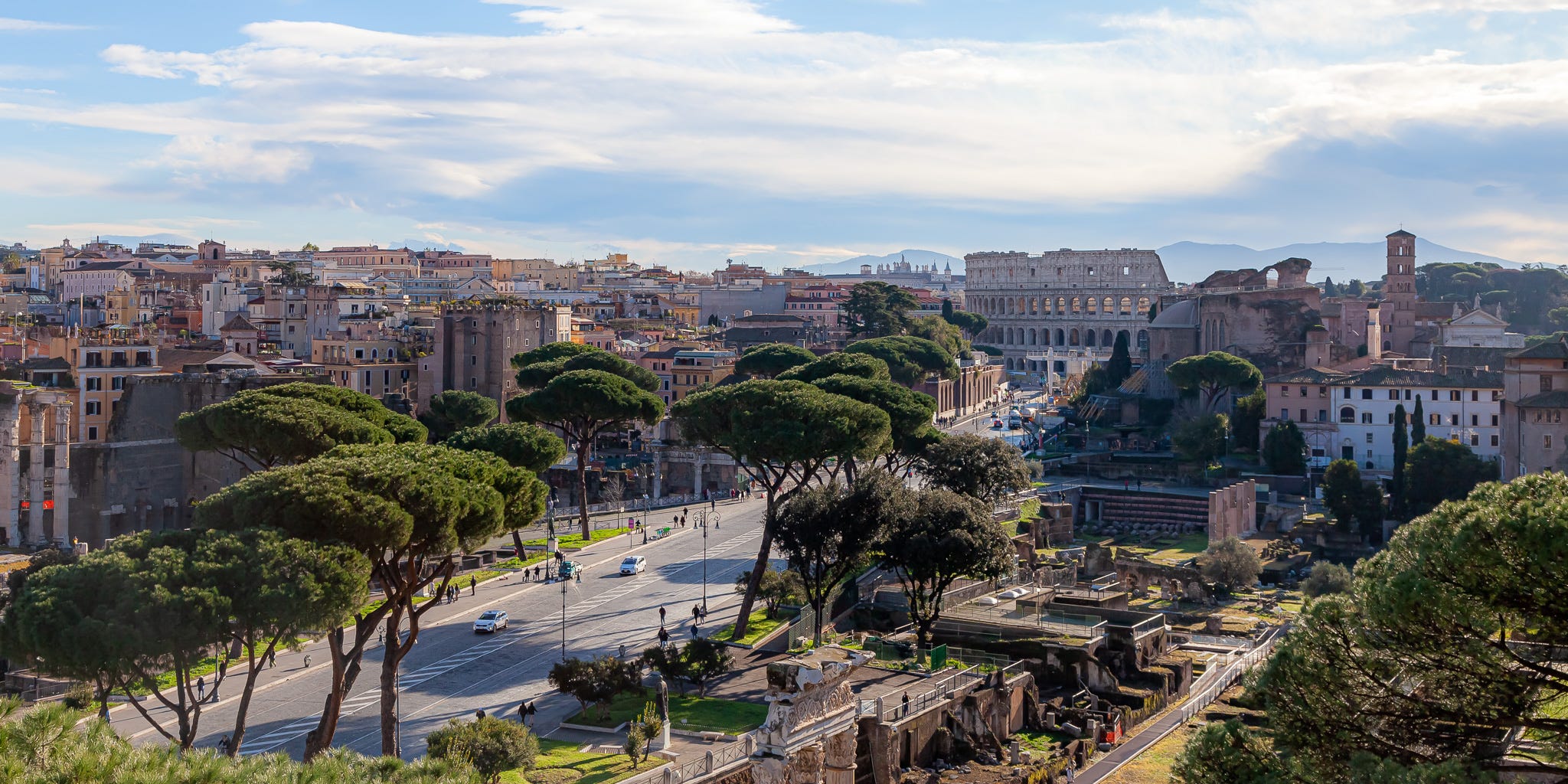
Magnificent, Wounded, Restored, Photographed, Consumed,
Rome, January 2023 (my photo)
The City That Does Not Remain in Itself
Lucio Caracciolo opens the November 2025 issue of Limes by looking from his editorial window toward the Aurelian Walls (Caracciolo, 2025). Built between 270 and 279 of the common era as Rome’s last great defensive enclosure against the pressure of barbarian incursions, they still stand. Caracciolo recalls a Chinese visitor’s involuntary remark that the walls should be torn down before they collapse, and he treats the remark as more than a practical suggestion. It becomes a symptom of a civilization that no longer understands the dignity of ruin. The Aurelian Walls persist precisely because they are damaged. Their metaphysical force lies not in their intactness but in their survival: they are the visible form of something that has not ceased to signify because it has ceased to function.
This is the right image with which to begin a historiosophic reflection of Rome. The wall means what it means because of what has happened to it: it has lost its military purpose and gained a metaphysical one. The same logic governs the city it once protected. Rome, considered as a geographical site on the Tiber, is one historical city among others: magnificent, wounded, restored, administered, photographed, and consumed. Rome, considered as a Name with all metaphysical force behind it, is something else. It is the only proper Name in world history that became the repeatable sign of political universality. The distinction between Rome as a place and Rome as a Name is the starting point of this essay.
My argument is that Rome’s singular contribution to world history is not merely empire, law, citizenship, architecture, or Western Christianity, though it includes all of these. Its historiosophic contribution is the possibility of translatio Urbis: the transfer of the city itself, as a Name and a title, to other places, which then become Romes in their turn, while the original remains the ruined guarantor of the chain. Constantinople, Vienna, Moscow, Istanbul, Washington, and the non-territorial Vatican are the principal cases considered here. Each claimant begins from the same paradox: Rome has fallen, and therefore, Rome must continue. The fall is not the interruption of Rome’s immortality; it is the condition of that immortality. The original city becomes singular precisely because it can be repeated.
The medieval tradition recognized part of this structure under the name translatio imperii: the temporal and spatial transfer of imperial authority from one realm to another (Kantorowicz, 1957, pp. 268–273). My claim is that translatio imperii presupposes a more fundamental operation. Before imperial authority can be transferred, Rome itself must become transferable. Translatio Urbis names this prior metaphysical movement: the detachment of the city from its exclusive geographical site and its conversion into a Name or a title-entity capable of being claimed elsewhere. The Rome on the Tiber does not disappear in this process. It remains indispensable, but in a changed form: no longer the only possible location of Rome, it becomes the source, witness, and residual guarantor of all subsequent Romes.
Indeed, cities are not passive containers of events but historical agents in their own right. This idea was born from my travels, but even more from reading those who understood the city as a form of historical intelligence before me. Lewis Mumford described the city as a “container of memory” and as a generator of forms whose effects exceed its material boundaries (Mumford, 1961, pp. 96–112). Pierre Manent, in his study of the political forms of the West, argued that the political community in the strong sense, the civitas, first becomes visible at the level of the city, and that later political forms recapitulate the city in altered modes (Manent, 2013, pp. 10–22). Rome gives this insight its most radical historical expression. It acts not by intention, as a person acts, but by forming the horizon within which persons, dynasties, churches, republics, and empires understand their own acts.
In this sense, for example, Mehmed II becomes Roman not simply because he decides to claim Constantinople, but because entry into Constantinople transforms the meaning of his conquest. Ivan III is reshaped by his marriage to Zoe Palaiologina more than he merely uses it to embellish Moscow. The American Founders read Cicero and the Roman historians, but they were also read by Rome herself: their republican imagination was formed by the very archive they believed they were consulting. This is not a romantic animism of place. It is a weak personalism of the city: certain cities exert agency by imposing forms of intelligibility on those who inherit, imitate, conquer, or desire them. Rome is the greatest of these cities because it does not remain in herself.
The further lineage of this argument is Augustinian. Augustine will be my philosophical guide because he provides the decisive grammar of Rome’s transferability. By separating the earthly city from the city of God, he deprived every earthly Rome of a claim to eternity and thereby made possible the repeated appearance of provisional Romes within history. No earthly city is eternal; therefore, more than one earthly city can bear the title. The City of God does not coincide with Rome, but once Rome has been Christianized and interpreted through Augustine, Rome can cease to be only a place and become a metaphysical problem.
My reflection unfolds in five movements of this essay. The first establishes the paradox that Rome’s fall became its second foundation as a universal model. The second locates the philosophical engine of this paradox in Augustine’s distinction between the earthly and the eternal city. The third examines the principal heirs-impostors of the Roman Name: Constantinople, Vienna, Moscow, with its unresolved tension between Third Rome and Second Israel, Istanbul under the Republic of Turkey, and Washington in the present moment of its de-Romanization. The fourth treats the Vatican as the only non-territorial Rome that need not displace the original. The fifth examines the Gulf monarchies’ reconstruction of Roman ruins as the limit-case of the title’s emptying into curatorship, scenography, and soft power.
The frame of this reflection is historiosophic in the strict sense: it asks about the philosophical conditions under which historical action becomes intelligible. The strategic provocation came from the November 2025 issue of Limes, but the argument pursued here belongs to a different order. I am not concerned primarily with whether this or that contemporary power resembles Rome. I am concerned with the conditions that make such resemblances thinkable, claimable, and contestable at all. Rome’s afterlife is not only a matter of influence. It is a form of historical futurity. The city survives by leaving herself; and every power that claims Rome enters a chain whose beginning it cannot control and whose end it cannot foresee.
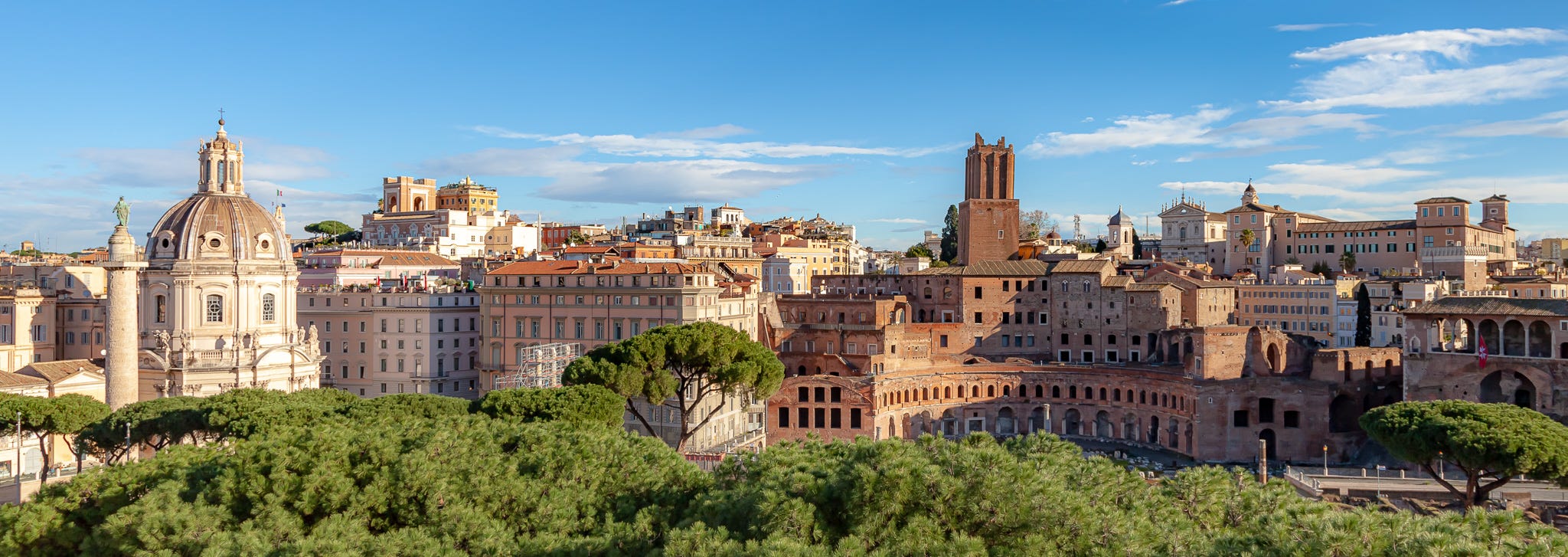
The Visible Form of Something That Has Ceased to Function,
Rome, January 2023 (my photo)
The Fall of Rome as Rome’s Second Foundation
The usual history of an empire is a history of succession. Empires rise, exhaust their integrative capacity, and are replaced. Their successors may borrow their administrative techniques, symbols, military models, or legal precedents, but the preceding empire is normally superseded. The Persian Empire fell to Alexander; Alexander’s empire fractured among the Diadochi; the Umayyad caliphate gave way to the Abbasids; the Tang yielded to the Song; the Genghisid inheritance was dispersed into successor formations until the Rurikovich’s and Romanov’s conquest. In each case, continuity survived through fragments, but the predecessor’s name did not become the compulsory title of universal power.
Rome is different. Its fall did not close its history; it opened its second life. The Western imperial structure collapsed in the fifth century, conventionally marked by the deposition of Romulus Augustulus in 476. The Eastern Roman Empire endured until the Ottoman conquest of Constantinople in 1453. Yet neither date produced a genuine vacancy of the Roman title. Charlemagne was crowned emperor in 800, less than four centuries after the Western empire’s collapse, and the ritual mattered because all the actors present understood that Rome had to continue in some form. Otto I renewed the imperial claim in 962. Ivan III’s marriage to Zoe Palaiologina in 1472 followed less than twenty years after the fall of Constantinople. Mehmed II, entering the conquered city in 1453, assumed the title of Caesar. The chronology is striking: Rome’s political body could fall, but its Name could not remain unclaimed for long.
This is the first paradox of Roman immortality. Rome survives not by avoiding collapse but by converting collapse into transfer and afterlife. The fall becomes a mechanism of continuation. A defeated or abandoned Rome does not simply disappear; it becomes available for inheritance, imitation, usurpation, and theological reinterpretation. The title moves because the city has fallen, and the city becomes immortal because the title moves.
Three interlocking layers explain this peculiarity: the juridical, the religious, and the strategic. Each layer prepared the next; together they made Rome’s Name detachable from Rome.
The first layer is juridical. By the third century of the common era, Roman belonging had already been loosened from the city itself. The Constitutio Antoniniana of 212, issued by Caracalla, extended Roman citizenship to all free inhabitants of the empire. This act did not create Roman universalism from nothing, but it gave juridical form to a much longer process: the gradual incorporation of outsiders into the Roman order through treaty, submission, alliance, enfranchisement, and elite integration. Capogrossi Colognesi (2025) traces this development through practices such as deditio in fidem, bilateral arrangements with Italian elites, and the Claudian argument that Rome strengthened itself by admitting foreigners into its governing order. Tacitus preserves Claudius’s defense of the admission of Gallic notables to the Senate as one of the classic statements of Roman incorporative intelligence (Annals 11.24).
The result was decisive. To be Roman no longer meant simply to belong to a city by birth, tribe, or residence. It was meant to bear a legal status that could travel across the empire. A citizen of Lugdunum, Antioch, or Carthage could be Roman without ever living on the Tiber. Citizenship became portable; and once Roman citizenship became portable, Rome itself became partially portable as a political form. Clifford Ando’s account of imperial ideology clarifies the deeper significance of this movement: the empire produced loyalty not only through coercion but through a symbolic and juridical order in which provincial subjects could understand themselves as participants in Roman universality (Ando, 2000, pp. 19–48). The title “Roman” had already begun its migration before the city itself was transferred.
The second layer is religious. Rome became Christian at precisely the moment when the empire’s center of gravity was shifting eastward. Constantine’s foundation of Constantinople in 330 created the first intentional duplication of Rome. New Rome on the Bosporus was not merely another capital; it was a formal repetition of the City, equipped with Senate, palace, ceremonial space, and imperial vocation. From that moment, Rome existed in more than one place. The question of the “real” Rome became structurally unstable.
This instability was the condition of later transfer. If Rome could be both on the Tiber and on the Bosporus, then it could, in principle, be elsewhere as well. Anthony Kaldellis has rightly insisted against the long Hellenizing habit of calling the Eastern Empire merely “Byzantine” that its inhabitants understood themselves as Romans (Rhōmaîoi), and understood their state as the continuation of the Roman res publica (Kaldellis, 2019, pp. 22–48). The duplication of Rome was a lived political ontology. Once Rome had been doubled, the formal door was open to further Romes.
The third layer is strategic. The contributors to Limes Rome’s issue repeatedly return, in different vocabularies, to Rome’s genius for incorporation. Caracciolo (2025) describes Rome as the power of the retiarius: mobile, absorptive, difficult to grasp, capable of defeating force by drawing it into a wider net. De Ruvo (2025) formulates the same intuition philosophically as Rome’s negentropic capacity (romanitas) to transform chaos into order and ruin into reproduction. Capogrossi Colognesi (2025) gives the juridical and institutional version: Rome did not merely defeat others, but incorporated them, negotiated with their elites, regularized their status, and made the defeated into participants in the Roman world.
This was Rome’s most durable method. Territorial expansion was the consequence; incorporation was the substance. The empire’s secret was not simply conquest, but the conversion of conquest into belonging. It could enlarge itself without merely multiplying enemies. It could absorb differences without immediately abolishing them. It could turn the outside into an inside while preserving enough distinction for hierarchy, loyalty, and prestige to function. This capacity, which is not the number of legions, not the size of the territory, and not even the permanence of institutions, became the transferable essence of romanitas.
Here, my philosophical point emerges: if Rome is essentially a method of incorporation, then Rome is not exhausted by its geography. A power that incorporates, juridifies, orders, and universalizes may claim Rome even far from the Tiber. Conversely, a power that possesses Roman symbols but loses the capacity for incorporation gradually loses its Roman claim. Romanitas, Romanity, is therefore a political test, which must be performed.
Carl Schmitt identified a related structure in his account of Roman Catholicism. The Roman Church, he argued, possessed complexio oppositorum: the ability to hold opposing principles within a single political and juridical form (Schmitt, 1996, pp. 7–13). Schmitt applied this insight to ecclesial Rome, but the same structure illuminates imperial Rome. Roman universality consists in managed contradiction, not in purity: center and periphery, law and violence, citizenship and hierarchy, locality and universality, pagan inheritance and Christian transformation. To be Roman is to organize oppositions into a form capable of duration.
This explains why every successor to Rome is also a partial Rome. No claimant fully satisfies the Roman test. Charlemagne’s empire, the Holy Roman Empire, Habsburg Vienna, Moscow, Istanbul, Washington, and even the Vatican inherit only fragments of the original synthesis. Each emphasizes one element: imperial authority, juridical universality, sacred succession, architectural memory, geopolitical mission, or spiritual centrality. None possesses the entire Roman complex. Yet this incompleteness is not accidental. It is the very engine of translatio Urbis. Because no successor fully becomes Rome, the title remains restless. It can be claimed, lost, reinterpreted, and claimed again.
The First Rome, therefore, persists in a peculiar role. She is, simultaneously, the original City, the museum of its own greatness, and the ruin that authorizes repetition. Her walls, roads, basilicas, arches, aqueducts, tombs, and stones bear witness to the fact that Rome once existed as a unity of place, power, law, and myth. But because that unity has been broken, the City also testifies that Rome can no longer be contained by itself. Thus, the ruin is the visible condition of continuity.
This is why the fall of Rome was her second foundation. The first foundation established Rome as a city. The second established Rome as a transferable title. The first belonged to myth, law, war, and urban form. The second belonged to memory, theology, imitation, and succession. After the fall, Rome ceased to be merely the capital of an empire and became the measure by which later universal claims judged themselves.
Schmitt’s later use of the katechon, the restraining force that holds back the eschatological end and preserves historical time, helps clarify this configuration (Schmitt, 2003, pp. 59–62). The ruined First Rome functions as a kind of katechon of historical imagination. It prevents the chain from closing because it never allows the title to disappear entirely. It stands as proof that Rome has been, that Rome has fallen, and that Rome may still be claimed. Each later Rome, in turn, presents herself as the restrainer of her own age: the power that holds back chaos, barbarism, fragmentation, schism, nihilism, or civilizational decline. Yet each eventually exhausts its claim and returns the title to motion.
Rome’s immortality, then, is not the immortality of an organism that never dies. It is the immortality of a form that survives by passing through death. The fall did not end Rome because Rome had already become more than its body. Juridically, Rome had made citizenship portable. Religiously, Rome had been doubled and then Christianized. Strategically, Rome had defined itself through incorporation rather than mere possession. These three transformations made possible the most extraordinary afterlife of any city in world history: Rome became the city that could fall, and by falling, begin again
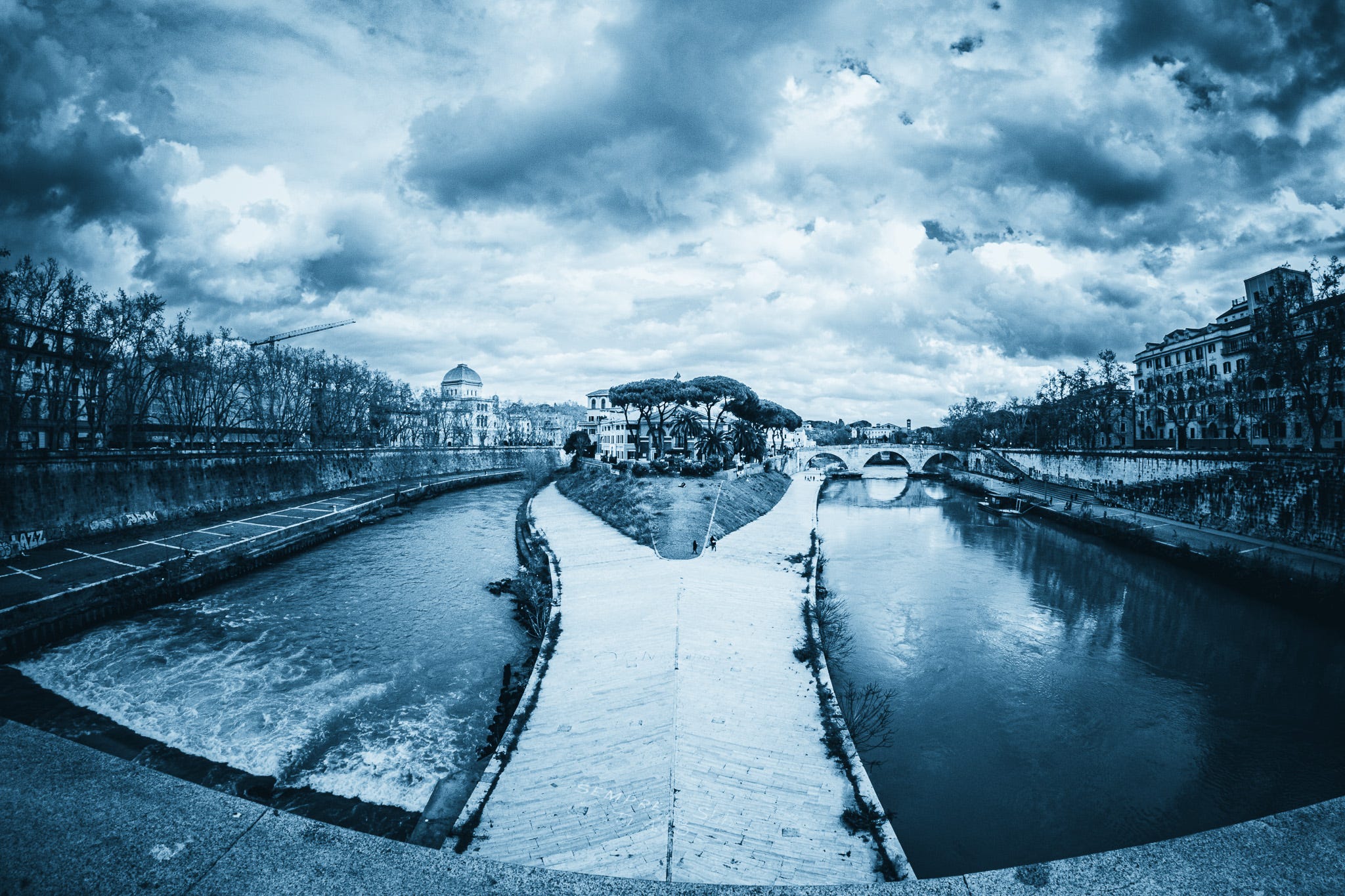
Where the Earthly and the Eternal Briefly Forked,
Rome, January 2023 (my photo)
Augustine: The Separation That Saves
The philosophical engine of translatio Urbis is Augustinian. Without Augustine, the movement from Rome to Constantinople, from Constantinople to Moscow, from imperial Rome to ecclesial Rome, and from Christian empire to secular universalism would remain a sequence of symbolic appropriations. With Augustine, the sequence becomes intelligible as the historical afterlife of one decisive theological distinction: no earthly city, not even Rome, can be identical with the city of God.
The distinction was born from catastrophe. In August 410, Alaric and his Visigothic forces sacked Rome. The material destruction was limited when compared with later devastations, but the symbolic shock was immense. Rome had long imagined itself as the City of Endurance, even eternity, the capital of a divinely favored order, the visible center of historical permanence. Pagan critics of Christianity drew the expected conclusion: Rome had fallen because it had abandoned the old gods of the Quirites. Augustine’s De civitate Dei, composed between 413 and 426, answered that accusation by transforming the meaning of Rome’s fall. The sack was evidence that no earthly Rome had ever possessed eternity.
Peter Brown rightly emphasizes that The City of God is not a single polemical reply but a work whose argument deepens as it proceeds (Brown, 2000, pp. 297ff). The early books defend Christianity against the charge that it caused Rome’s disaster. The later books unfold a vast philosophy of history organized around two loves and two cities: the earthly city, formed by love of self even to the contempt of God, and the city of God, formed by love of God even to the contempt of self (Augustine, 2003). The two cities are not identical with two institutions. They are not Rome and the Church, empire and monastery, pagans and Christians, state and sanctuary. They are two orders of desire passing through the same historical world.
This is Augustine’s decisive operation. He separates eternity from empire without abolishing the Roman empire’s historical importance. Rome may be great, useful, splendid, providentially permitted, and politically necessary; but she is not eternal. It belongs to the saeculum, the interim time between Christ and the end, in which the two cities remain mingled and cannot be cleanly separated by political means. Robert Markus called this Augustine’s construction of a “secular” temporal zone: not secular in the modern anti-religious sense, but secular as the time of pilgrimage, mixture, ambiguity, and provisional order (Markus, 1988, pp. 154–186). At this time, no polity can claim to be the final form of divine history.
The consequence for Rome was immense. Augustine saved Rome by refusing to save it literally. He denied that the city on the Tiber was eternal, and thereby liberated the meaning of Rome from the fate of its walls. If Rome’s fall does not refute providence, then Rome’s greatness cannot depend on empirical permanence. The earthly city may collapse; the drama of salvation continues. The Christian community may live in Rome, Hippo, Constantinople, Aachen, Moscow, Lima, or Washington without requiring any of those places to become the city of God. Earthly Romes can exist as provisional mirrors, instruments, or temptations of universality; none can become eternity itself.
This is why Augustine matters for translatio Urbis. He does not simply detach the heavenly city from the earthly city. He also prevents any single earthly Rome from monopolizing the name. Once Rome is denied eternity, it becomes repeatable. Once the city of God is non-territorial, earthly cities can claim Roman significance without claiming divine finality. Augustine’s separation thus produces a double effect: it humbles Rome and universalizes Rome. The city loses its absolute privilege, but the Roman title becomes capable of historical movement.
The first consequence is that Christian Rome is already a de-territorialized Rome. The Holy Roman Empire would be unintelligible without this prior separation. Voltaire’s famous joke that the Holy Roman Empire was neither holy, nor Roman, nor an empire is accurate only if judged by literal geography and centralized sovereignty. Historically, the joke misses the metaphysics of form. The empire could call itself Roman because Rome had ceased to be only the city on the Tiber. It could call itself holy because holiness no longer required identity with the city of God. It occupied the Augustinian interval: neither eternal nor merely profane, neither the city of God nor simply another kingdom among kingdoms.
Kantorowicz’s analysis of medieval political theology helps explain this structure. The doctrine of the king’s two bodies, that is, the mortal natural body and the enduring political body, was one juridical expression of a deeper Christian problem: how can continuity survive the death of its bearer? (Kantorowicz, 1957, pp. 193–232). The Roman title posed the same problem at the level of civilization. The body of Rome could die in one place while its political-mystical body survived elsewhere. Translatio imperii was therefore not a mere diplomatic fiction. It was a way of giving institutional form to an Augustinian metaphysics of provisional continuity.
The second consequence is that Moscow’s Third Rome doctrine becomes intelligible only within an Augustinian horizon. Filofey of Pskov’s formula, which claimed that “two Romes have fallen, the third stands, and a fourth shall not be,” was defined as an apocalyptic interpretation of historical failure. The first two Romes have fallen because visible Romes can fail; the third stands only as long as it remains faithful to the truth it claims to bear. In this sense, the doctrine is Roman, Byzantine, and Augustinian at once. It assumes that the eternal meaning of Rome is not exhausted by any previous territorial embodiment.
Classic studies by Strémooukhoff (1953) and Toumanoff (1955) established the doctrinal and political importance of this Muscovite inheritance, while later scholarship has shown its instability and retrospective amplification. Marshall Poe (2001), in particular, demonstrated that the Third Rome idea became more central to Russian historical consciousness in later historiography than it had been in its original Muscovite context. Yet this does not diminish its philosophical importance. Filofey’s warning is triumphalist and admonitory at the same place. Moscow can be Rome only under judgment. Gold, corruption, betrayal, and spiritual failure can destroy the claim. The title is transferable but not secure.
The third consequence is that Rome becomes the only ancient city whose name survives the conversion of its civilization without becoming merely an allegory. Babylon survives as accusation: the city of idolatrous empire, the whore of the Apocalypse, the name later polemically applied even to papal Rome. Jerusalem survives as promise: the covenantal city, the heavenly city, the eschatological image of redeemed community. Rome alone survives as both empire and Church, both law and mission, both pagan memory and Christian universality. Its name crosses the threshold between antiquity and Christianity without losing its political charge.
This doubled valence is essential. Rome does not become Christian by simply ceasing to be imperial. Nor does it remain imperial by resisting Christianity. It becomes the place where pagan-juridical universality and Christian-eschatological universality are forced into a single unstable inheritance. The Holy Roman Empire could be both holy and Roman because Rome had come to signify both at once. The Vatican can be Roman without being imperial because the Roman title has been spiritually reconfigured. Moscow can claim the Orthodox succession from the Second Rome because the title has already passed through Christianization. Washington can imitate Rome, both as a republic and as an empire, because the pre-Christian archive remains active beneath the Christian one. The title survives because it is never reducible to one layer of its history.
The question, then, is what kind of secularization this chain represents. Karl Löwith argued that modern philosophies of history are secularized forms of Christian eschatology: they preserve the structure of providential time while replacing salvation with progress, reason, revolution, science, or humanity (Löwith, 1949, pp. 1–19). Hans Blumenberg, in contrast to Löwith, insisted that modernity is not merely a theft from theology but a legitimate self-assertion against the unresolved burdens of medieval thought (Blumenberg, 1983, pp. 3ff). Translatio Urbis stands between these two accounts. It is clearly indebted to Christian eschatology, because Augustine’s separation makes its movement possible. However, the Roman title also carries older imperial, pagan, legal, republican, architectural, and civic meanings that cannot be derived from the city of God.
Every successor of Rome, therefore, inherits a divided bequest. From pagan and juridical Rome, it receives law, citizenship, military order, ceremony, architecture, republican memory, and imperial command. From Christian and Augustinian Rome, it receives pilgrimage, universality, restraint, judgment, eschatological tension, and the refusal to identify any earthly polity with salvation. The two inheritances have never been fully reconciled. Their unresolved tension is precisely what gives the Roman title its metaphysical energy. A Rome that became only an empire would lose its spiritual depth. A Rome that became only the Church would lose its political force. A Rome that became only universalizing law would lose its myth. A Rome that became only myth would lose its institution.
This is the sense in which Rome’s immortality is founded on renunciation. The city survives because it gives up the claim to be the only place where Rome can be. Augustine intends to defend Christianity and to interpret history under the sign of the two cities. Yet the unintended consequence of his argument is immense: by denying eternity to the city on the Tiber, he makes possible the long history of earthly Romes after Rome. He frees the Roman title from empirical permanence and places every future claimant under the judgment of a city it can never become.
The historiosophic singularity of Rome, therefore, has a date and a place: Hippo, in North Africa, after the sack of 410, in the long labor of a bishop who heard of Rome’s fall from afar and responded by changing the city’s metaphysical status. Rome’s second life was not born in Rome. It was born in Augustine’s distinction between what can fall and what cannot. The walls of Rome could be breached; the title could travel. The earthly city could lose its empire; the city of God could not be captured by any empire. Between these two truths, the chain of translatio Urbis begins.
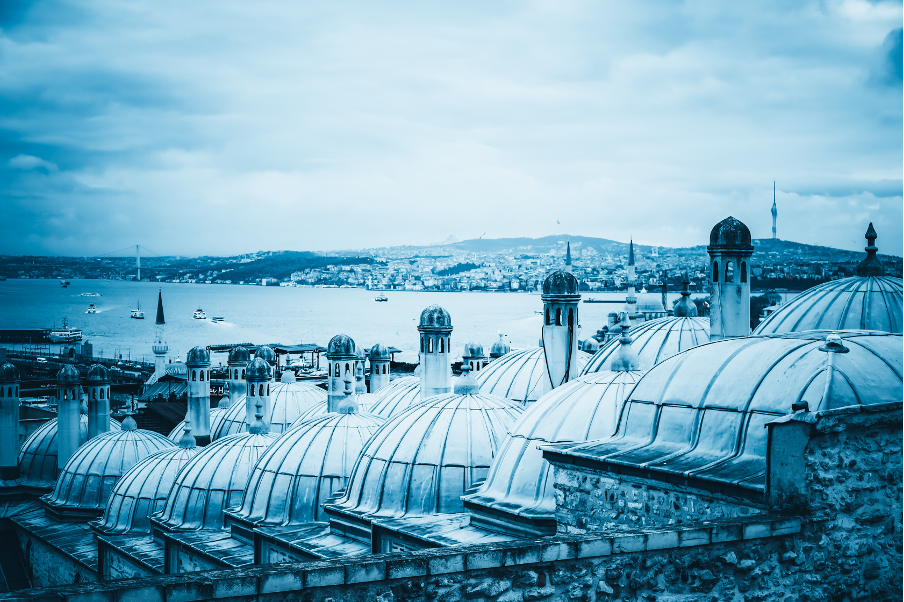
New Rome, Under New Management,
Istanbul, December 2021 (my photo)
Heirs-Impostors: Constantinople, Vienna, Moscow, Istanbul, Washington
The Augustinian separation made the title movable. The history of translatio Urbis is the history of the movements the title has actually made. Five cases occupy the center of this history, and each case illuminates a different aspect of the philosophical structure.
Constantinople: the city that doubled the title
Constantine founded New Rome on the Bosporus on 11 May 330. The gesture was administrative, moving the imperial court closer to the eastern provinces, and metaphysical, duplicating Rome. The new city received a Senate, forums, palaces, ceremonial routes, and an imperial vocation of its own. It was designed to be Rome elsewhere: fully Roman and fully new.
This duplication changed the metaphysics of the Roman title. Before Constantinople, Rome could still be imagined as one City, however wide its empire had become. After Constantinople, Rome existed in two places. The original City on the Tiber retained her ancestral prestige, her apostolic authority, and her immense symbolic weight. The city on the Bosporus possessed the emperor, the court, the army, the fiscal apparatus, and the living machinery of government. From that moment onward, the question of the “real” Rome became structurally unstable: the City had become a transferable form.
The two Romes developed asymmetrically. The western city lost the imperial structure in the fifth century and re-emerged as the seat of the papacy. The eastern city retained the empire for another millennium and elaborated a court culture that later historians called Byzantine, but whose subjects understood themselves as Roman. Anthony Kaldellis has insisted against the long Hellenizing tradition that the inhabitants of Constantinople were not merely Greeks under an inherited Roman shell. They were Rhōmaîoi, Romans, and they understood their polity as the continuing Roman res publica (Kaldellis, 2019, pp. 22–48). The term “Byzantine,” useful as a scholarly convention, can obscure the central fact: the empire of Constantinople did not consider itself a successor to Rome but Rome herself.
The schism between the churches of Rome and Constantinople was therefore not only a theological and ecclesiological conflict. It was also a struggle over the Roman Name. Pope and patriarch disputed the spiritual and institutional meaning of the same inheritance. The very form of the quarrel confirms the premise of this essay: once Rome had been doubled, Roman legitimacy could no longer be contained in one place. Each Rome needed the other as a rival, a mirror, and an accusation.
Hagia Sophia made this claim visible in stone, light, and vaulting. Built under Justinian in the sixth century, it was the architectural condensation of Constantinople’s Roman vocation. Its dome recalled and surpassed the Pantheon; its scale contested the memory of Solomon’s Temple; its liturgy staged the union of empire and sacred order. Procopius reports that Justinian, entering the completed building, exclaimed that he had surpassed Solomon (Cameron, 2006, pp. 71–73). Thus, Constantinople claimed both the imperial inheritance of Rome and the sacred grandeur of Jerusalem.
The Ottoman conquest of 1453 inverted the claim and appropriated it. Mehmed II understood the symbolic grammar of the city he had taken. By preserving Hagia Sophia and converting it into an imperial mosque, he did Islamize a Christian monument and inserted a reinvented and renamed Istanbul (or Stambuliya) into the Roman chain. The building became the sign that the conqueror had not destroyed Rome but had entered its title. Constantinople thus performed the decisive operation in the history of translatio Urbis: it proved that Rome could be repeated outside Christianity, and that a later conqueror could become Roman by occupying the repetition.
For this reason, Constantinople was the second Rome, while Istanbul was the second Constantinople. It is the city that made secondness possible. Without it, later claims, including Habsburg universalism, Moscow’s Third Rome, Ottoman-Roman imperial pedagogy, and even the Vatican’s non-territorial Romanity, would lack their formal precedent. Constantinople opened the chain by showing that Rome could leave itself without ceasing to be Rome.
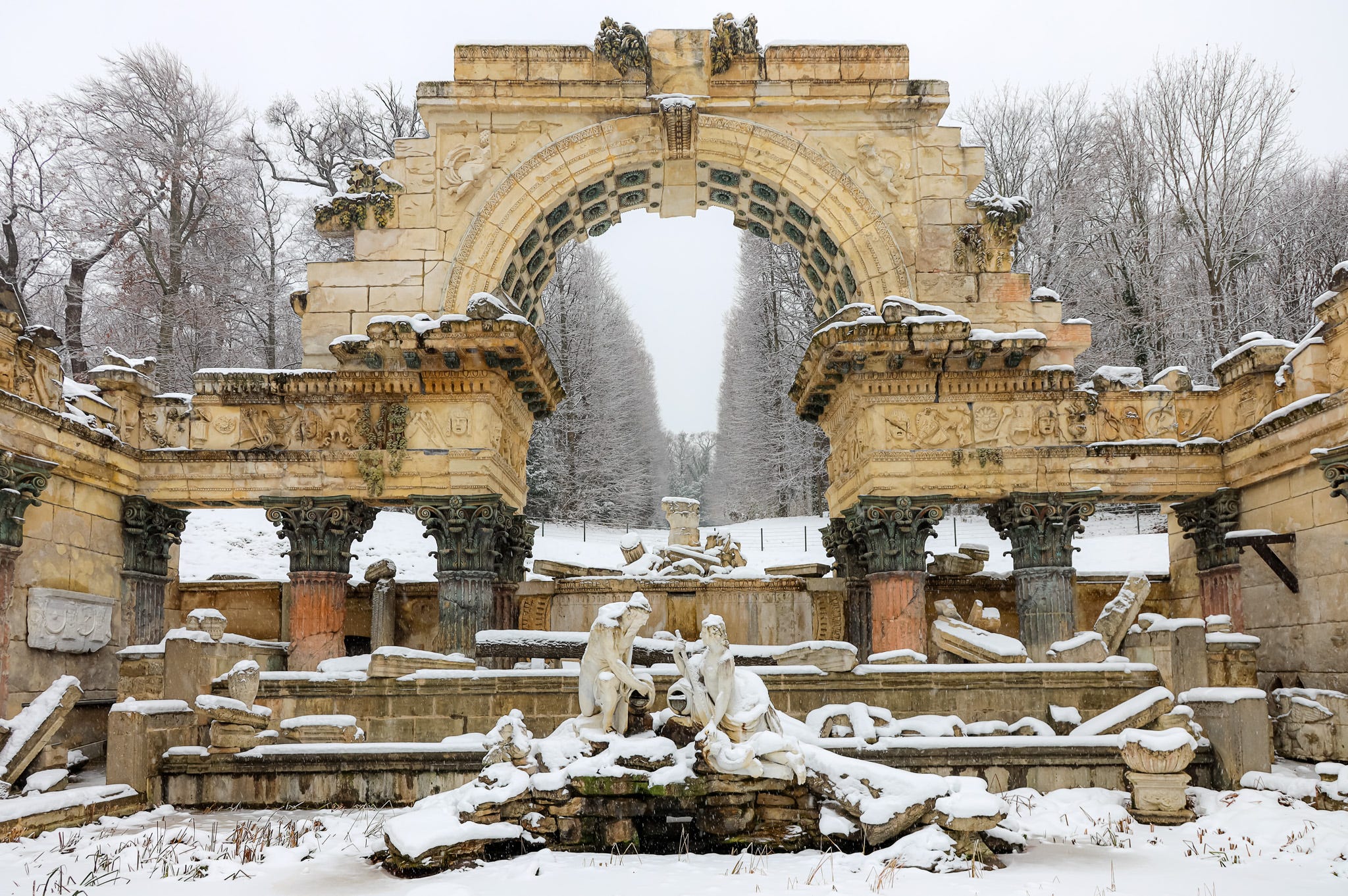
A Ruin That Was Always a Ruin,
Schönbrunn, Vienna, December 2023 (my photo)
Vienna: the Rome of the Habsburg longue durée
Vienna’s claim to Rome is less dramatic than Constantinople’s but more durable than almost any other. It was not founded as New Rome, nor did it conquer the old imperial capital. Its Romanity emerged through dynasty, law, ceremony, frontier defense, and the long memory of imperial administration. If Constantinople doubled the title, Vienna prolonged the Roman Name.
From 1438, when Albert II inaugurated the Habsburg near-monopoly on the imperial dignity, until the abdication of Francis II in 1806, the Holy Roman Empire was, in practical terms, inseparable from the Habsburg house. The Austrian Empire, proclaimed in 1804, carried the imperial form into the nineteenth century, and Austria-Hungary preserved a modified version of dynastic universalism until 1918. Taken together, this sequence lasted almost five centuries. No post-Roman claimant in the West held the imperial title for so long.
The older caricature of the Holy Roman Empire as an empty relic cannot sustain this history. Voltaire’s joke remains brilliant as a joke but insufficient as an analytical statement. Joachim Whaley has shown that the empire functioned as a real political order within the German lands, with institutions, legal procedures, imperial courts, negotiated sovereignty, and a durable constitutional culture (Whaley, 2012). Peter Wilson has likewise argued that the empire’s longevity cannot be explained by inertia alone; it possessed a coherent political logic, even if that logic differed from the centralized sovereignty later associated with the modern state (Wilson, 2016, pp. 1–25). Vienna’s Romanity was, therefore, a mode of political duration.
Its symbolic apparatus confirmed the claim. The double-headed eagle, inherited through Byzantine and imperial heraldic traditions, looked simultaneously east and west, backward and forward, toward sacred legitimacy and worldly command. The imperial regalia preserved in the Schatzkammer, the Crown of the Holy Roman Empire, the elaborate ceremonial of coronations and diets, and the Habsburg habit of dynastic accumulation all sustained the fiction that was more than fiction: the fiction of a Roman continuity without Rome. Frederick III’s enigmatic motto AEIOU, later expanded in the famous formula Austriae est imperare orbi universe (“It is Austria’s destiny to rule the whole world”) gave this claim its most compressed expression. Under Charles V, whose dominions were said to be an empire on which the sun never set, the Habsburg-Roman imagination briefly approached global scale.
The substance of the Habsburg claim lay in incorporation. The monarchy governed Germans, Czechs, Hungarians, Croats, Italians, Poles, Romanians, Slovaks, Slovenes, some Ukrainians, Serbs, and others under a single dynastic framework. It did not abolish difference; it administered it, negotiated it, ranked it, and often failed it. But failure does not cancel the Roman quality of the attempt. Roman universalism had always meant the management of plurality under a juridical and symbolic center. Pieter Judson’s revisionist account of the Habsburg Empire emphasizes precisely this point: the monarchy was not merely a prison of nations, as nationalist historiography later insisted, but also a supranational state whose institutions often served local populations more effectively and flexibly than the successor nation-states that replaced it (Judson, 2016, pp. 1–43).
Vienna’s Roman vocation was also sharpened by the frontier. The siege of 1683 and its lifting by the forces of the Holy League under Jan Sobieski confirmed Vienna as antemurale Christianitatis, the bulwark of Christendom against Ottoman advance. Paul Srodecki has shown how this bulwark rhetoric structured the political imagination in Central and Eastern Europe across the early modern period (Srodecki, 2015). Constantinople had once performed this role for the Christian East; after 1453, Vienna inherited it in the West. The city became Roman by imperial title and by defensive function. It stood where Western Christendom imagined its threatened edge.
Architecture translated this vocation into urban form. Fischer von Erlach’s Karlskirche, completed in 1737, quotes the dome of St. Peter’s and the columns of Trajan, compressing papal, imperial, and Roman references into a Habsburg monument. The Hofburg expanded across centuries as a theatre of dynastic sovereignty. Schönbrunn staged imperial leisure as a world-ordering ceremony, while its Gloriette and artificial Roman ruins turned antiquity itself into Habsburg scenography. Vienna curated Rome as form, memory, ornament, and claim.
Yet Vienna’s most distinctive contribution to the chain of translatio Urbis came after political defeat. Its Romanity survived as literature. Claudio Magris’s Il mito asburgico nella letteratura austriaca moderna remains the foundational account of this transformation. Magris showed that the Habsburg myth became more powerful after the empire’s collapse than it had been during the empire’s existence (Magris, 1963/1996). Joseph Roth’s Radetzky March, Robert Musil’s ironic “Kakania” in The Man Without Qualities, Stefan Zweig’s The World of Yesterday, and the work of Hofmannsthal, Trakl, and Celan all participate in this elegiac reconstruction. The empire becomes most legible when it is gone. Its universality becomes most moving when it can no longer command.
Magris’s later Danube extended this insight beyond Austrian literature into a geography of vanished imperial coherence (Magris, 1989). Carl Schorske’s Fin-de-Siècle Vienna showed another face of the same inheritance: the late Habsburg capital as the laboratory of psychoanalysis, modernist art, liberal crisis, anti-liberal mobilization, and philosophical experimentation (Schorske, 1980). Vienna preserved an imperial memory and produced the intellectual forms through which Europe learned to interpret the collapse of imperial universality itself.
This literary afterlife matters politically. In contemporary Central Europe, the Habsburg past often returns not as a serious imperial project but as a geopolitical imaginary, a repertoire of irony, nostalgia, federal imagination, and small-state anxiety. Austria, Czechia, Hungary, Slovakia, Croatia, Slovenia, and the western parts of Ukraine still inhabit spaces shaped by Habsburg infrastructures, legal habits, administrative memories, political imagination, railway lines, university cultures, and urban forms. The empire is gone, but its grammar remains available whenever Central Europeans imagine plurality without simple assimilation, sovereignty without complete autarky, and Europe without the absolutism of the nation-state. I read this less as a program for restoration than as the afterlife of a Roman form in societies too modern to believe in empire and too historically formed by empire to forget it.
Vienna’s place in the Roman chain is, therefore, unique. Other claimants treated the title as a possession to be defended or a mission to be fulfilled. Vienna, especially after 1918, transformed the title into memory. It became the Rome that survived by remembering its own disappearance. Its claim is elegiac, literary, architectural, and imperially administrative. Constantinople made Rome repeatable. Vienna made Rome mournable. Together, they disclose two essential modalities of translatio Urbis: duplication and duration, conquest and memory, the second Rome that still believed itself eternal and the later Rome that discovered its truth only after the end.
Moscow: the conflict between the Third Rome and the Second Israel
The Russian case is the most metaphysically unstable of the Roman inheritances because Russian self-understanding has never rested on a single genealogy. It has oscillated between two powerful and only partially compatible identifications: Moscow as the Third Rome and as the Second Israel. Daniel Rowland (1996) formulated the problem with admirable precision: was Muscovy imagined primarily as the heir of Rome or as the new chosen people? The answer is not one or the other. The Russian historiosophic imagination has repeatedly drawn on both, and the unresolved tension between them is one of the hidden motors of Russian late medieval and early modern political theology.
The Third Rome doctrine was initially eschatological and was later used for imperial legitimation. Filofey of Pskov’s famous formula is often read triumphalistically, as if it were a simple declaration of Muscovite world mission. But in its original theological register, it is a warning: Rome is a title held under judgment. The first Rome fell; the second Rome, Constantinople, fell; Moscow stands only insofar as it remains faithful to the Orthodox truth it claims to bear. The doctrine, therefore, joins imperial succession to apocalyptic anxiety: Moscow is Rome, but it is Rome at the edge of the end.
The classic studies of Strémooukhoff (1953) and Toumanoff (1955) established the Byzantine and South Slavic channels through which this idea entered Russian thought. Later work complicated the picture. Marshall Poe (2001) showed that the Third Rome doctrine was not as central to early Muscovite political culture as later Russian historiography made it appear. Its canonical status was partly a retrospective construction. Yet this does not diminish its importance for the history of Russian self-understanding. Retrospective myths can become historically real once they organize imagination, ceremony, schooling, and political rhetoric. The Third Rome doctrine may have begun as a marginal theological formulation, but it became one of the most durable names for Russia’s imperial temptation.
Its logic is Roman because it depends on succession. Moscow inherits from Rome through Constantinople. Rome survives by passing through the repeated falls. Ivan III’s marriage to Zoe Palaiologina in 1472, the adoption of the double-headed eagle, the growing ceremonial sacralization of the Muscovite ruler, and the architectural transformation of the Kremlin all gave material form to this claim. The Italian architects who rebuilt key elements of the Kremlin in the late fifteenth century intensified the irony. The Third Rome was constructed, quite literally, by builders from the world of the First Rome. Its walls and cathedrals translated Roman and Renaissance techniques into the service of an Orthodox imperial theology.
Yet the Roman line was never alone. Alongside it stood another, more biblical self-identification: Russia as the Second Israel. This doctrine is covenantal and redemptive rather than imperial in the Roman sense. It imagines the Russian people not primarily as heirs of an imperial title but as a chosen community called to preserve the true faith, suffer for it, and redeem the captive faithful. Rowland (1996) showed that the New Israel motif appears in Russian sources at least as early as the Third Rome motif and, in some contexts, more prominently. It drew strength from monastic spirituality, the cult of Saint Sergius of Radonezh, the Josephite tradition, and the long Orthodox memory of struggle, captivity, and deliverance.
The contrast is fundamental here. The Third Rome points outward toward universal empire: Moscow as the last bearer of Roman-Christian sovereignty. The Second Israel points inward and southward toward covenant, suffering, and redemption: Holy Russia as the community charged with protecting Orthodox truth and rescuing enslaved Christians. The first doctrine is imperial; the second is soteriological. The first speaks the language of succession; the second speaks the language of election. The first asks who bears the Roman title; the second asks who remains faithful under historical trial.
This difference had concrete geopolitical substance. From the late medieval period into the eighteenth century, the Muscovite and later Russian frontier was shaped by conflict with the Tatar khanates, the Ottoman world, and the slave-raiding economy of the Black Sea steppe. The redemption of captives was an institutional, ecclesial, fiscal, and emotional reality, not merely a metaphor. Alan Fisher’s work on Crimean Tatar slave raids and later scholarship on Russian-Tatar relations have shown how deeply the experience of captivity marked Muscovite and Russian political imagination (Fisher, 1972; Khodarkovsky, 2002). The expansion to Kazan in 1552, Astrakhan in 1556, and eventually Crimea in 1783 could therefore be represented not only as imperial conquest but as the liberation of Orthodox space and the rescue of Christian captives.
The two doctrines did not cancel each other. They fused, separated, and returned in different combinations. In the imperial centuries, the Romanov state moved between them without ever fully resolving their tension. It claimed imperial universality, yet it also cultivated the language of Holy Russia. It borrowed from European imperial statecraft, yet it imagined itself as guardian of Orthodoxy. It sought recognition as a great European power, yet it nourished a messianic vocation that exceeded European categories. The Russian Empire was therefore neither simply Roman nor simply Israelite. It was a political form haunted by two sacred genealogies.
The Soviet period officially repudiated both genealogies, but it did not abolish the structures of imagination they had created. The universal mission of communism replaced the Third Rome with a secularized world-historical vocation; the myth of suffering, sacrifice, and redemptive victory preserved much of the Second Israel pattern in anti-theological form. Moscow remained the capital of a universal claim. The chosen people became the proletariat, the party, or the Soviet people. The eschaton became communism. The vocabulary changed, while the underlying structure of election, sacrifice, and universal mission did not disappear.
The post-Soviet revival of these motifs has been selective and politically instrumental. Contemporary Russian ideology draws on both registers, often without acknowledging their incompatibility. The war against Ukraine, beginning in 2014 and escalating catastrophically in 2022, has been justified through both grammars: as imperial restoration and as redemptive defense, as geopolitical necessity and as sacred mission.
The architecture of Moscow records this unresolved doubleness. The Kremlin is Roman in its walls, towers, ceremonial concentration, dynastic ambition, and imported Italian techniques. It is Israelite in its liturgical density, iconographic memory, cult of saints, and theology of sacred rulership. The Cathedral of the Dormition, rebuilt by Aristotele Fioravanti in the 1470s, stands at the center of this fusion. It is a Renaissance-inflected Orthodox cathedral inside a fortress of imperial power. It crowns rulers, houses icons, and stages the body of the polity before God. Moscow’s Romanity and its Israelite vocation inhabit the same stones.
A third register complicates the picture further: the cultural Rome of Russian literature. Mario Caramitti (2025) points to a long Russian affection for the actual Rome of ruins, light, pines, churches, and stone. Gogol’s letters from Rome, written with an almost paradisal intensity, and Brodsky’s Roman Elegies, composed a century and a half later, belong to this different order. This is not Rome as imperial title or covenantal mission. It is Rome as aesthetic deliverance, as southern clarity, as the city where Russian melancholy finds form outside Russian history. The toskà that Caramitti identifies is longing not for Moscow as Rome but for Rome itself, unpossessed, unattainable, and therefore spiritually necessary.
This literary Rome may be the most humane Russian Rome. Unlike the Third Rome, it does not need to rule. Unlike the Second Israel, it does not need to suffer redemptively. It loves Rome because Rome exceeds Russia. In Gogol, Rome becomes a theatre of resurrection for the imagination. In Brodsky, it becomes a field of exile, measure, and elegiac light. The cultural Rome of Russian literature is thus a third translation: neither imperial nor covenantal, but aesthetic and existential. It may outlast the political doctrines because it makes no claim to possession.
Moscow’s place in the chain of translatio Urbis is, therefore, conflicted. It is the claimant that most explicitly declares itself the final Rome, yet it is also the claimant most deeply divided by another sacred genealogy. Its Roman title has always been interrupted by its Israelite self-understanding; its imperial ambition has always been shadowed by the mythology of suffering election. This unresolved tension gives Russian historiosophy its power and its danger. Moscow can imagine itself as Rome, as Israel, as an empire, as a victim, as katechon, and as a redeemer, sometimes in the same sentence. No other claimant to Rome has carried so volatile a metaphysical mixture.
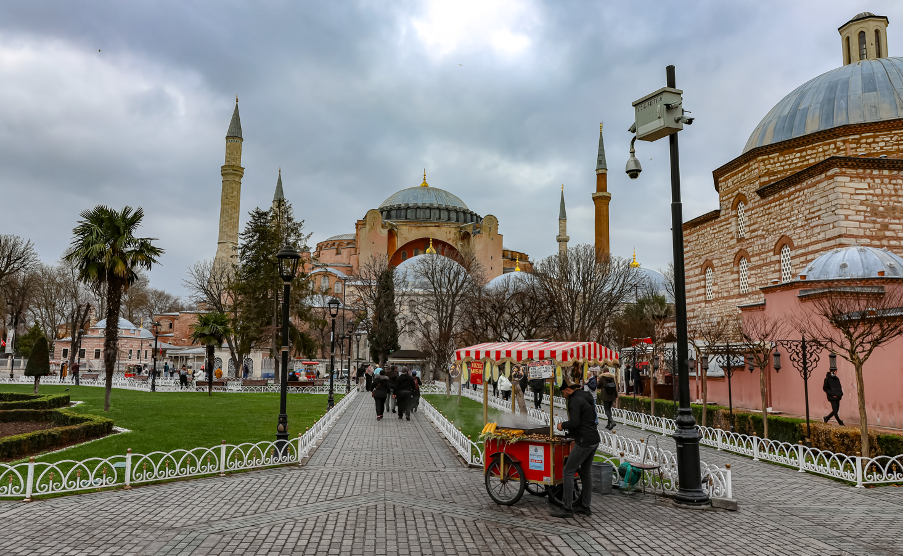
Justinian, Mehmed, Atatürk, Erdoğan and a Simit Vendor,
Istanbul, December 2021 (my photo)
Istanbul: the Rome of pedagogy
If Moscow is the divided claimant, post-Ottoman Istanbul is the instructed one. Its Romanity is not merely inherited, nor only conquered, nor nostalgically remembered. It is taught. In the political imagination of contemporary Turkey, Rome has become an object of civic pedagogy: a disciplined narrative through which the republic learns to interpret its Byzantine antiquity, Ottoman past, Islamic inheritance, Eurasian position, and future vocation.
Daniele Santoro’s analysis of the Turkish desire for Rome is especially illuminating because it treats this desire as a form of political education. Two dates organize the lesson: 1071 and 1453. The first is the battle of Manzikert, or Malazgirt, conventionally remembered as the opening of Anatolia to the Turks. The second is the conquest of Constantinople by Mehmed II. Contemporary Turkish state symbolism has built an explicit temporal architecture around them: Vision 2071 marks the millennium of Manzikert, while Vision 2053 marks the six-hundredth anniversary of the conquest. The point is both commemoration and orientation. The past is arranged so that the future can be taught.
The historical sequence is more complex than the pedagogy allows. Cemal Kafadar has shown that the early Ottoman world emerged from a fluid frontier culture in which Turkish, Persian, Islamic, Greek, and Roman-Byzantine elements interacted without any single predetermined imperial destiny (Kafadar, 1995, pp. 1–28). The Seljuk and early Ottoman actors did not move through history as if they were consciously advancing toward the Roman title. The line from Tuğrul and Alparslan to Mehmed II is retrospective. It is a later narrative imposed on a more contingent history.
Yet retrospective narratives can become politically powerful. The Turkish pedagogy of Rome turns contingency into destiny. It teaches that Manzikert opened the road, Constantinople completed the conquest, and the modern republic must inherit the civilizational energy released by both. In this narrative, the Turk becomes Roman by becoming the master of Roman space. Anatolia is the former land of the Romans. Istanbul is the conquered imperial center. The republic is the institutional form through which Ottoman-Roman memory is reactivated under modern conditions.
The toponymic history gives this pedagogy unusual depth. The Turks who entered Anatolia after Manzikert called the region Diyar-ı Rum, the Land of the Romans. Later, after the conquest of Constantinople, the term shifted westward: the Balkan lands became Rumelia, the Roman land. The name moved with the frontier. This movement is philosophically revealing: Rome was not only a city to be conquered; it was a spatial condition to be inhabited. The Turkish presence in Anatolia and the Balkans unfolded within a geography already named by Rome. To become Turkish in this space was, in part, to become post-Roman.
Mehmed II understood this with exceptional clarity. His assumption of the title Kayser-i Rûm, Caesar of Rome, was not decorative. It stated a claim to succession. Mehmed placed Ottoman sovereignty inside the Roman frame. The conquest was therefore double: military and metaphysical. The city fell, but its title was not abandoned. It was appropriated by the conqueror who knew that to rule Constantinople was to rule more than a capital.
The Turkish Republic initially disciplined this inheritance by distancing itself from it. Atatürk moved the capital to Ankara in 1923 partly because Istanbul was too Ottoman, too imperial, too saturated with the Roman-Byzantine and Islamic-Ottoman past. Ankara offered the republic a new center: Anatolian, sober, administrative, modern, and less burdened by imperial ghosts. The gesture was not anti-Roman in the explicit sense, but it bracketed Istanbul’s Romanity. The republic needed to begin again, and Istanbul knew too much.
The current Turkish pedagogy reverses this bracketing without simply abolishing the republic. Erdoğan’s symbolic politics does not restore the Ottoman Empire. It re-teaches the republic to desire the imperial past. The reopening of Hagia Sophia for Islamic worship on 24 July 2020 was therefore a lesson staged before the nation and the world. The president prayed in Justinian’s church, Mehmed’s mosque, Atatürk’s museum, and Erdoğan’s reconverted monument. Each layer remained visible. The act reorganized the hierarchy of its meanings.
The pedagogical character of Istanbul’s Romanity distinguishes it from Moscow’s. Moscow’s claim is inwardly conflicted, pulled between Rome and Israel. Istanbul’s claim is more programmatic. It teaches a sequence: Manzikert, Constantinople, Ottoman sovereignty, republican discipline, civilizational revival. The sequence is selective, but selection is the essence of pedagogy. It chooses what must be remembered, what must be forgotten, and what must be connected so that a political subject can imagine its future.
The limits of the pedagogy are equally clear. The early Ottomans were not simply Romans in waiting. The Turkish Republic is not the Ottoman Empire reborn. Islamic universalism, Turkic nationalism, Ottoman dynastic memory, republican secularism, and contemporary geopolitical ambition do not naturally form one coherent whole. They must be arranged, narrated, and taught. The very need for pedagogy reveals the fragility of the claim. A Romanity that must be taught so insistently is not self-evident.
Yet this fragility does not make the claim insignificant. On the contrary, it explains its intensity. Istanbul is the claimant that knows the title must be educated into existence. Its Romanity is performative. It exists insofar as it is enacted and taught.

Quotation, Preserved at Low Temperature,
Washington, January 2025 (my photo)
Washington: the Rome that loses the chain
The American case is the most consequential contemporary test of translatio Urbis. No modern power has more insistently imagined itself through Rome, and no modern power has done so with a more selective memory of Rome’s afterlives. Washington is a capital built with classical, mostly Roman references. Furthermore, it is a republic that has repeatedly understood itself as the rebirth of republican virtue, imperial command, legal universality, and civilizational mission. Yet its Roman imagination has usually moved directly from the Tiber to the Potomac, as if Constantinople, the Holy Roman Empire, Vienna, Moscow, and the Vatican were secondary episodes in someone else’s story.
This directness is both the strength and the weakness of the American claim. The Founders read Rome with seriousness. Cicero, Livy, Sallust, Tacitus, Polybius, Plutarch, and later Gibbon formed part of the intellectual atmosphere in which the American republic explained itself to itself. Madison’s reflections on faction, republican scale, mixed government, and the dangers of corruption were saturated with ancient precedent. The Federalist Papers are not antiquarian exercises, but they repeatedly think with Rome because Rome supplied the most powerful available archive for reflecting on republican greatness and republican decay. Edward Gibbon’s Decline and Fall of the Roman Empire, published between 1776 and 1789, appeared at the very moment when the American and French revolutions were transforming the political imagination of the Atlantic world (Gibbon, 1994). America was born under the sign of Rome’s greatness and Rome’s warning.
The material city made the claim visible. Washington’s Capitol, Senate, Mall, monuments, domes, columns, inscriptions, and civic ceremonials translate Roman republican and imperial forms into an American idiom. The DC architecture teaches the citizen to see the republic as heir to antiquity, as guardian of law, and as a power whose domestic institutions possess universal significance. The United States did not need to call itself Rome because it built a capital that made the analogy legible everywhere. Washington is the Rome that aestheticized the analogy while often leaving its theological and medieval history behind.
This selective Roman memory matters. Earlier claimants entered the Roman title through a chain of succession. The American claim, by contrast, generally bypasses this chain. It returns to the First Rome as republican model, imperial warning, and civilizational analogy, but it rarely acknowledges the intervening Romes through which the title survived for more than a millennium.
The result is a Romanity of quotation rather than succession. American Rome is powerful because it draws directly from antiquity. But it is incomplete because it often lacks the Augustinian, Byzantine, papal, and Habsburg mediations that transformed Rome from a place into a chain. The United States borrows Roman symbols with extraordinary confidence, yet its political imagination has frequently treated Rome as a usable antiquity rather than as a transmitted title. It has imitated the source while forgetting the transmission.
Maitra’s diagnosis, as presented in Limes, is illuminating here. Americans, he argues, see themselves as the new Rome without needing an intermediary. The analogy is direct, almost innocent in its ambition: Rome was the republic that became an empire; America is the republic that became a global power (Maitra, 2025, pp. 53–55). The danger is that such an analogy reduces Rome to a mirror for American self-description. Rome becomes a warning about decadence, a model of constitutional virtue, or a metaphor for imperial overreach, but not a title whose historical life depends on transfer, mediation, and inheritance.
This helps explain the contemporary language of American de-Romanization. Caracciolo and De Ruvo, from different angles, argue that the United States is losing the Roman capacity to integrate, delimit, and order. It fights widely but cannot always conclude; it expands commitments but struggles to define a stable limes; it universalizes norms but has difficulty incorporating opponents into a durable order (Caracciolo, 2025, pp. 12–17). De Ruvo’s romanitas test is severe, but its severity reveals the point: the American claim weakens when power ceases to be integrative and becomes merely projective (De Ruvo, 2025, pp. 49–51). A Rome that cannot incorporate begins to resemble an empire without Romanity.
The problem is not simply military overstretch or domestic polarization, though both matter. The deeper problem is the weakening of the bond between civitas and fides. American civic universalism long depended on the belief that constitutional form, individual liberty, market energy, technological innovation, and providential mission could be joined in one national project with universal implications. That synthesis never included everyone equally, and its exclusions were always part of its history. Yet it produced a real integrative energy. Immigrants could become Americans; territories could become states; defeated enemies could become allies; foreign elites could enter an American-led order and find status within it. This was the Roman element in American power: incorporation, not purity.
That incorporative energy is now visibly strained. Domestically, the republic struggles to sustain a shared civic language across ideological, regional, racial, economic, and epistemic divisions. Internationally, the American-led order remains powerful, but its universal promise has been contested by both allies and adversaries. The United States still possesses unmatched military, financial, technological, and cultural resources. Yet Romanity is not identical with resources. Romanity requires the capacity to turn power into order, order into loyalty, and loyalty into durable legitimacy. That is precisely where the American claim now appears uncertain.
The irony is that the United States may be losing Rome at the moment when its rivals most need it to remain Roman. A world without an incorporative America does not automatically become plural, peaceful, or just. It may become a world of harder borders, transactional spheres, civilizational blocs, and technological sovereignties. The American limes, if no longer drawn by Washington, may be imposed by others: by China’s alternative universalism, by Russia’s resentful imperial revisionism, by Europe’s anxious juridical autonomy. Caracciolo’s insight that the world is now imposing a limes on America captures this reversal. The power that once delimited others is itself being delimited.
Thus, Washington’s place in the chain of translatio Urbis is paradoxical. It is the modern capital that most visibly quotes Rome and the claimant that least fully remembers the chain through which Rome survived. Its Romanity is magnificent, but abbreviated. It sees the First Rome clearly and the intervening Romes dimly. That abbreviation helped produce American confidence: the republic could imagine itself as beginning again, free from the burdens of medieval empire, papal universalism, Byzantine ceremony, Muscovite eschatology, and Habsburg exhaustion. But the same abbreviation now weakens the claim. A Rome that forgets the history of Rome’s own survival risks becoming only an analogy.
For now, Washington appears as the Rome that loses the chain. DC fails because it resembles Rome too selectively. Washington inherited the architecture, the republican archive, the imperial analogy, and the drama of decline. DC did not inherit, with equal seriousness, the long discipline of mediation through which Rome became transferable. The American case thus reveals the central danger of modern Romanity: one may imitate Rome intensely and still misunderstand how Rome survived.
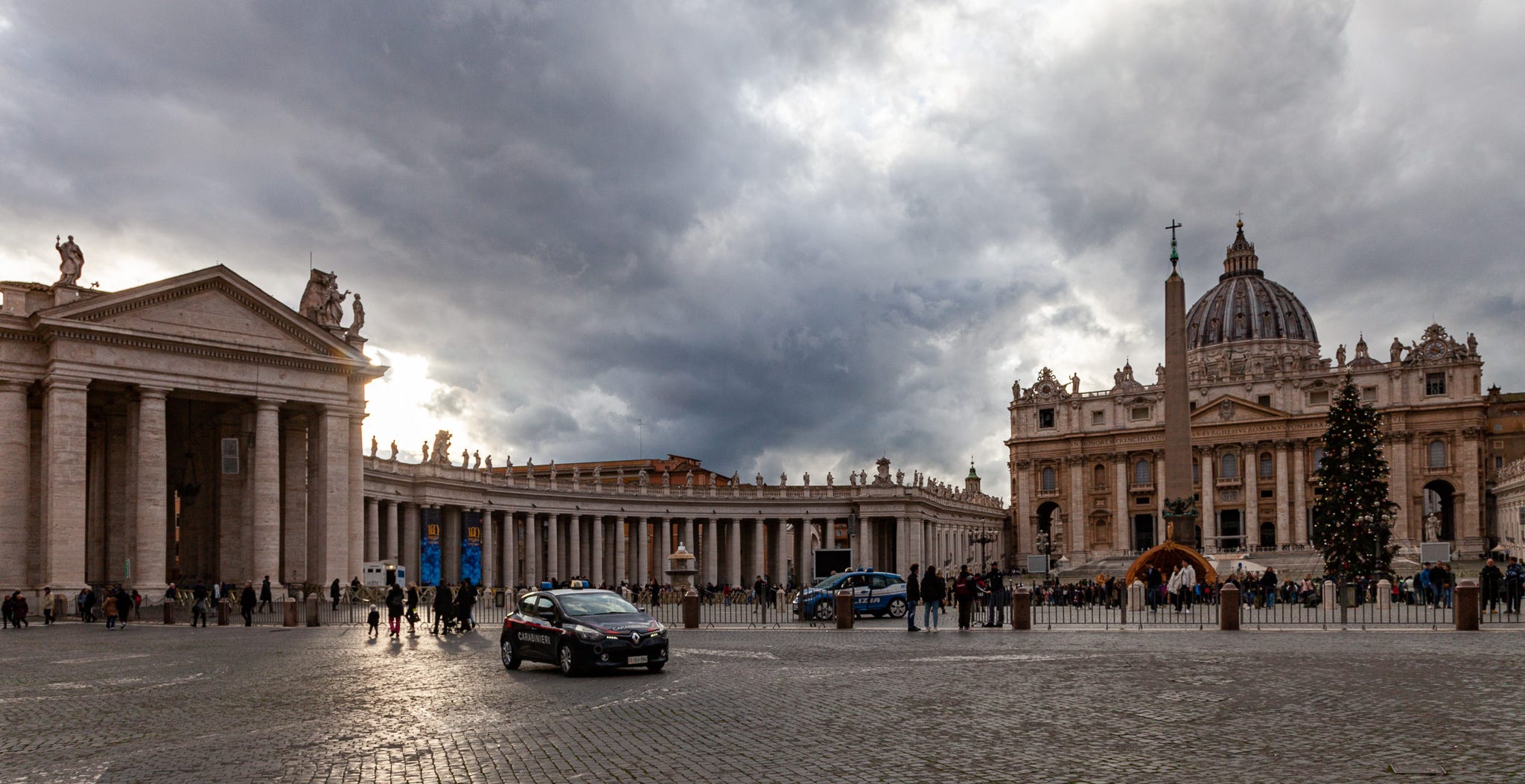
Half a Square Kilometre of Universality,
Vatican, January 2023 (my photo)
The Vatican case: the non-territorial Rome
The Vatican is the most paradoxical and, perhaps, the most successful Rome after Rome. It is the smallest claimant and the least imperial. It commands no army, governs almost no territory, and possesses only the minimum spatial residue required for sovereignty under international law. Yet precisely for this reason, it may be the Roman form that has most completely understood the Augustinian lesson. It does not need to become another Rome elsewhere because it has learned to be Rome without needing the empire.
The loss of the Papal State in 1870 was experienced by many Catholics as a catastrophe. The breach of Porta Pia, the annexation of Rome to the Kingdom of Italy, and the long “Roman Question” seemed to mark the defeat of papal temporal power. With historical distance, however, the event appears less as a simple defeat than as a clarification. The papacy, deprived of territorial dominion, became more visibly universal. Its authority no longer depended on governing central Italy. Its Romanity contracted spatially and expanded spiritually, diplomatically, and symbolically.
The Lateran Treaty of 1929 sealed this transformation. Vatican City, at roughly half a square kilometer, is the smallest possible territorial support for a universal institution. Its smallness is the political form of an Augustinian renunciation. The Holy See retained sovereignty without retaining empire, territory without territorialism, and Roman location without Roman imperial command. What other claimants tried to achieve through succession, conquest, dynastic continuity, or ideological mission, the Vatican achieved through reduction.
This is why the Vatican occupies a unique place in the chain of translatio Urbis. Let’s repeat again: Constantinople displaced imperial Rome by duplicating it on the Bosporus. Vienna prolonged Rome through dynasty, ceremony, and multinational administration. Moscow claimed to succeed Constantinople as the final Rome. Istanbul conquered and re-taught the Roman title through Ottoman and republican pedagogy. Washington quoted Rome directly while often forgetting the chain of succession. The Vatican alone need not displace the original: it stands inside Rome and beside Rome. It is physically enclosed by the city whose metaphysical inheritance it preserves.
The theological ground of this arrangement is Augustinian. Augustine denied any earthly polity the right to identify itself with eternity. The Vatican, after 1870 and especially after 1929, became the institutional form of that distinction. It is a sovereign city-state, but its sovereignty exists to support a universal Church that exceeds every state. It is territorial only so that it can remain non-territorial in vocation. Its territory is the juridical condition that protects the freedom of that authority.
Carl Schmitt’s Roman Catholicism and Political Form anticipated part of this configuration. Schmitt argued that the Roman Church possessed the capacity to hold opposing principles within one visible form: hierarchy and universality, dogma and diplomacy, law and mercy, tradition and adaptation, center and mission (Schmitt, 1996, pp. 7–13). He saw in Catholicism a political form superior to liberal fragmentation because it could represent unity without reducing all differences to sameness. What Schmitt did not fully see, or did not wish to accept, was that this capacity might be perfected not by territorial expansion but by territorial minimization. The Church became more capable of complexio oppositorum once it no longer had to act as a territorial state among other territorial states.
The Vatican’s smallness, therefore, intensifies rather than weakens its Romanity. It can speak to states without being one state among others in the ordinary sense. It can address empires without becoming an empire. It can mediate, condemn, bless, mourn, negotiate, and admonish without needing to conquer or administer. This does not make it pure, as the Church remains an institution of the saeculum, marked by history, diplomacy, bureaucracy, scandal, ambition, and compromise. But its compromise is Augustinian rather than imperial. It accepts mixture without claiming eternity.
Piero Schiavazzi’s account of Pope Leo XIV gives the present configuration an especially suggestive form. Born Robert Prevost in Chicago, formed intellectually and spiritually in Rome, and shaped pastorally by long service in Peru, Leo XIV’s biography crosses several Romes: the American Rome of Washington’s civilizational confidence, the original Rome of ecclesial formation, and the global Catholic Rome of mission beyond Europe (Schiavazzi, 2025). His Augustinian formation places him within the tradition that first separated Rome’s eternal meaning from Rome’s territorial power. In his person, the chain bends through Chicago, Rome, and Latin America without requiring any of them to become imperial capitals.
This biographical pattern matters because the contemporary papacy has increasingly become the institutional site where Roman universality survives without Western imperial form. Pope Francis accelerated the redistribution of Catholic attention toward the Global South, especially through episcopal appointments, diplomatic emphasis, and the composition of the College of Cardinals. Leo XIV, if Schiavazzi’s interpretation is correct, inherits this displacement of Catholic universality away from a purely European civilizational frame while remaining seated in Rome (Schiavazzi, 2025, p. 129). The effect is deeply Roman in the Augustinian sense: the center remains, but the center no longer belongs to itself alone.
The Vatican’s stance toward contemporary war and empire must be read within this logic. Its authority depends on the possibility of condemning aggression without becoming the chaplain of any geopolitical bloc. When it condemns imperial wars, speaks against the destruction of civilians, insists on negotiation, or addresses both Western and non-Western powers, it does not act as a rival empire. It acts as the remnant of a Roman universalism that has renounced territorial command but not moral address. This position is often fragile and sometimes ambiguous. Yet the ambiguity belongs to the vocation itself: the Vatican must speak universally in a world divided into sovereign interests.
Giulio Albanese’s invocation of Rutilius Namatianus’s line “fecisti patriam diversis gentibus unam” (“you made one fatherland from diverse peoples”) captures the continuity between pagan and Catholic Rome. The ancient city’s genius was incorporation. The Church translated that genius into ecclesial universality. The Roman Empire made one civic order from diverse peoples through law, citizenship, hierarchy, and military power. The Catholic Church sought to make one spiritual body from diverse peoples through sacrament, doctrine, mission, and pastoral authority. The continuity is real, but it is not simple. It is mediated by Augustine’s separation. Without that separation, the Church would merely inherit imperial Rome. With it, the Church can preserve Roman universality while refusing to become an empire.
This is the Vatican’s distinctive contribution to translatio Urbis: it completes the transfer by refusing displacement. It does not need a new capital because it no longer treats capital as the essence of Rome. It does not need a vast territory because it no longer understands universality as territorial extension. It does not need to defeat the original city because it lives within it. The Vatican is Rome after the imperial body has been reduced to a sign. Its Romanity is local, visible, ancient, and concrete; its authority is translocal, symbolic, diplomatic, and spiritual. In the Vatican, Rome finally learns how not to remain in herself.
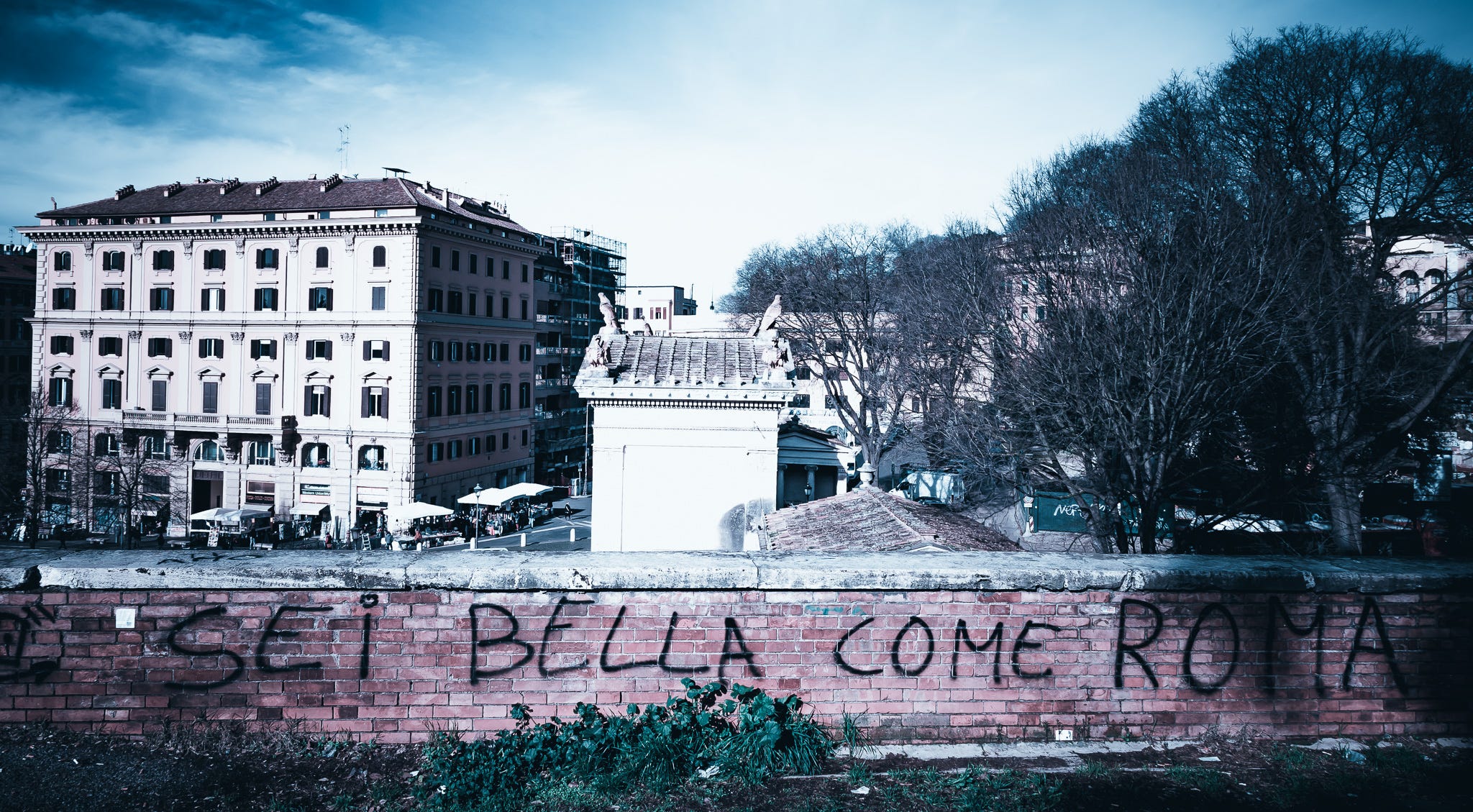
Translatio Urbis, in Aerosol,
Rome, January 2023 (my photo)
Holograms of Rome and the Emptying of the Name
Not every contemporary relation to Rome takes the form of succession. Some powers do not seek to become Rome, inherit Rome, conquer Rome, or spiritualize Rome. They prefer to display it. This is the significance of the phenomenon Federica Luise describes in the Persian Gulf: the restoration, financing, and exhibition of Roman ruins by wealthy monarchies that do not claim the Roman title. Here Rome appears as heritage object, scenography, investment, and soft-power asset (Luise, 2025).
The cases are striking. Saudi and Emirati cultural-heritage initiatives have helped fund the reconstruction or preservation of Roman and late-antique sites in the wider Middle East and North Africa, with Palmyra as the emblematic case after its devastation by the Islamic State. Similar attention has extended to other Roman or Romanized sites of the Levant and North Africa: colonnades, temples, theatres, arches, roads, and monumental fragments that once belonged to the imperial geography of the Mediterranean world. The official language is cultural preservation. The geopolitical function is more complex. It looks like restored Roman ruins become instruments of prestige, tourism, international legitimacy, and civilizational display.
Luise’s image of the “hologram of Rome” is therefore exact (Luise, 2025, pp. 155–156). A hologram is visible without being fully present. It reproduces form without substance, surface without body, recognizability without continuity. The Roman ruin under Gulf patronage is not so much a step in translatio Urbis. It does not say: we are Rome. It says: we can possess, restore, curate, illuminate, and exhibit Rome. The difference is decisive. Constantinople and other heirs-impostors duplicated Rome in their own way. Instead, the Gulf curates Rome.
This curatorial relation marks a historical threshold. Earlier claimants sought the Roman title because Rome supplied a grammar of universal rule. To be Rome was to claim law, order, incorporation, sacred mission, imperial memory, or republican dignity. The Gulf monarchies, by contrast, show that Roman materials can now be desirable even when the Roman title is not. The marble remains attractive; the colonnade remains photogenic; the restored ruin retains symbolic value. But the title itself is no longer indispensable. Rome has become detachable not only from the Tiber but from succession.
Translatio Urbis required claimants. The curatorial mode requires owners, sponsors, restorers, investors, designers, and spectators. The chain of Roman succession is interrupted not by a rival claimant, but by a different relation to the past. Hologram of Rome means there is no longer a title to be borne; it is a portfolio to be managed.
Mircea Eliade’s distinction between sacred and profane space clarifies the transformation. Traditional societies, Eliade argued, organize space around centers that orient existence cosmologically, ritually, and politically (Eliade, 1959, pp. 20–47). A sacred center orders the world around itself. In the curatorial mode, by contrast, the former sacred center is preserved as an object of circulation. It can be inserted into global heritage economies. Instead of orientation, it offers experience.
The Roman ruin under late-capitalist patronage thus undergoes a second ruin. The first ruin was historical: the collapse of the structure, the fall of the city, and the break in function. The second ruin is metaphysical: the loss of succession-value. A broken arch in Palmyra could once testify to Roman extension, imperial road systems, and the endurance of a civilizational form. Restored as a destination image, it may still testify to violence, memory, and preservation. But it no longer necessarily invites a new Roman claim. It becomes just a sign of culture without becoming a sign of title.
There is a historical irony here. Rome itself once practiced a curatorial relation to Greece. Roman aristocratic villas displayed Greek statuary; Roman education absorbed Greek philosophy and rhetoric; Roman literature entered into rivalry with Greek models; Roman authority presented itself as heir and guardian of a conquered but culturally superior world. The Romans curated Greece, and by curating it they also incorporated it. Cicero is impossible without Greek philosophy; Virgil’s Aeneid is unthinkable without Homer; Roman art and architecture repeatedly translate Greek forms into imperial idiom. After all, Roman curation became assimilation.
The Gulf curation of Rome appears different. It restores and exhibits Roman remains without a comparable program of civilizational incorporation. There is no Gulf Cicero translating Roman law into a new political philosophy of desert monarchy; no Virgilian epic that makes Rome the prehistory of Riyadh or Abu Dhabi; no juridical transformation by which Roman citizenship becomes a model for Gulf belonging. The relation is powerful, but external. Rome is admired, financed, staged, and circulated, but it is not metabolized.
The contrast matters because it distinguishes curatorship from succession. Succession requires risk. The curator, by contrast, can keep Rome with the risks of her heritage at a distance. The ruin is restored, but the restorer remains untouched.
This distance reveals the late stage of the Roman afterlife. Rome now has exchange value independent of title-value. Its fragments can circulate across museums, tourism strategies, diplomatic projects, investment portfolios, and urban branding campaigns. The Roman column becomes an image of sophistication. The restored theatre becomes a scene for international recognition. The archaeological site becomes a platform for development. Indeed, preservation is preferable to destruction. But preservation is not succession. A ruin may be saved precisely at the moment when the metaphysical claim it once supported has been lost.
The curatorial mode also exposes a new form of universalism. It is not universalism through law, Church, empire, republic, or covenant. It is universalism through heritage management. The curator addresses humanity in the language of shared civilization, protection of memory, global patrimony, and cultural diplomacy. This language can protect vulnerable sites, repair damage, and create institutions of conservation. But it is also thinner than Roman universality. It does not bind peoples into a civic order. It does not ask for loyalty. It does not produce citizenship. It produces access, visibility, prestige, and experience.
Here the hologram becomes more than metaphor. A hologram gives the viewer the impression of depth while withholding bodily presence. Contemporary Rome, in the curatorial mode, can appear everywhere as image, ruin, projection, replica, museum, immersive exhibition, or reconstructed site. Yet this multiplication of appearances may coincide with the disappearance of Rome as Name. The more Rome becomes globally visible, the less it may remain historically claimable. Its image spreads as its succession weakens.
The historiosophic question is whether this is a degeneration of translatio or a different mode altogether. In my opinion, it is not simply degeneration, because preservation is a real civilizational act. To restore what fanatic violence destroyed, to protect fragile sites, and to place ruins within global memory are not negligible achievements. Yet it is also not translatio in the strong sense. It transfers the ruin as image, where Rome becomes portable, but only as exhibit.
The result is a strange reversal of the opening image. The Aurelian Walls persist as ruins that still authorize a chain of historical meaning. The restored Roman fragments of the Gulf and the Levant, however, persist as ruins whose meaning has been stabilized, financed, and displayed, but not inherited. They are no longer ruins that call forth Rome’s future. They are ruins that decorate a future without Rome.
This may be one of the defining signs of the present age. We have become extraordinarily capable of preserving forms whose metaphysical energy we no longer share. We conserve churches without faith, palaces without monarchy, factories without industry, empires without imperial vocation, and ruins without succession. Rome, in the curatorial mode, becomes the highest example of this condition. It is loved, funded, reconstructed, illuminated, and emptied.
The Gulf monarchies are therefore not the next Rome. They are the first great archive of a possible post-Roman world: a world in which Rome survives everywhere as cultural material and almost nowhere as a living Name. The chain of translatio Urbis required a claimant willing to say, “Rome has fallen; therefore we must continue it.” The hologram requires only a patron willing to say, “Rome has fallen; therefore we can restore and display her remants.” Between these two maxims lies the distance between history and heritage, between succession and scenography, between Rome as destiny and Rome as hollow image.
The Future of Rome: Brussels or Beijing
My argument now becomes speculative. If Rome survives by transfer, then the present age must ask the Roman question: who, if anyone, can still receive the title? The candidates are visible, but none is convincing in the old sense. Brussels possesses a juridical universality without a myth. Beijing possesses a non-Roman universalism of its own. The final possibility is that no one inherits Rome because the Roman form of universality itself has seemingly been exhausted.
These two possibilities are diagnostic figures, not predictions. Each test one component of the Roman synthesis: law, empire, city, myth, theology, infrastructure, incorporation, and faith. Rome’s Name was powerful because it joined these components into a civilizational form. The present age seems to have separated them. Law survives without myth; infrastructure survives without citizenship empire survives without universal legitimacy; faith survives without imperial form. The future of Rome may, therefore, not be succession but dispersal.
Brussels
Brussels is the most obvious and the least charismatic candidate. Caracciolo’s dismissal of it is characteristically impatient: not Berlin, not Paris, certainly not Brussels (Caracciolo, 2025, p. 7). Yet the dismissal is too quick. The European Union has inherited one unmistakably Roman feature: a universal juridical order that confers rights across political borders and makes citizenship partially detachable from the nation-state. Since the Maastricht Treaty, EU citizenship has created a legal status that travels with the person. A Polish citizen in Lisbon, a Portuguese citizen in Warsaw, and an Italian citizen in Prague possess a shared bundle of rights that does not depend on birth in the host polity. The analogy with the Constitutio Antoniniana of 212 is not exact, but the structural resemblance is real. Both regimes universalize status across a composite political space.
This is Brussels’s Roman element: law before myth, status before emotion, and procedure before epic. The Union has constructed a dense legal order, an administrative machine, a court-centered constitutionalism, and a transnational citizenship regime. In this sense, it is the most juridically Roman formation in the contemporary West. Brussels translates plurality into legal status.
What Brussels lacks is fides. There is no European Virgil, no common epic, no founding wound that all citizens recognize as their own, and no sacred geography capable of making the legal order beloved. Jürgen Habermas proposed “constitutional patriotism” as a possible answer: a postnational attachment rooted in democratic procedures, rights, and public reason, not in blood, soil, or inherited myth (Habermas, 2001, pp. 58–112). The idea remains philosophically noble, yet after three decades of European integration, it has not generated an affective force comparable to Roman civic loyalty. The European citizen possesses rights, but rarely the passionate self-understanding of a civis Romanus.
The result is a Rome without Virgil. Brussels has law, norms, courts, treaties, funds, regulations, procedures, and enlargement criteria. It does not yet have a civilizational story capable of transforming status into loyalty. Its weakness is not merely bureaucratic dullness; it is metaphysical thinness. Roman universalism worked because citizenship, empire, myth, urban form, military protection, and sacred destiny gradually converged. Brussels has separated legality from destiny, and perhaps this is its virtue. But the price of that virtue is pallor.
The question is whether this incompleteness is temporary or essential. Rome did not become Rome in a generation. Its synthesis developed across centuries of war, incorporation, civil conflict, religious transformation, and literary self-interpretation. The European Union may still be too young to possess its own Aeneid. Maybe the Russo-Ukrainian War will be the scene for the Brussels myth. From this historical event, its juridical architecture may one day acquire the affective and political force it currently lacks. Or an upcoming European crisis, if survived, might produce the missing myth. Civilizations often discover their unity through danger.
But there is a darker possibility. Brussels may lack fides not because it is young but because late modern Europe no longer produces the kind of spiritual energy that Roman universality required. Its societies are secular, plural, ironic, historically guilty, and reluctant to speak the language of destiny. This reluctance may be morally admirable, given Europe’s twentieth century. Yet it also makes the Roman title difficult to bear. A civilization that fears its own myths cannot easily become Rome.
Eric Voegelin’s analysis of modern political religion may help us here. Voegelin warned that modern ideologies often attempt to immanentize the eschaton, turning the Augustinian city of God into a political project and thereby producing catastrophe (Voegelin, 1952, pp. 107–132). Brussels may be the first major attempt at a non-metastatic universalism: a universal order that renounces salvation, conquest, and eschatological intoxication. If it succeeds, it will not be Rome reborn, but Rome disciplined: juridical universality without imperial ecstasy. If it fails, the failure will show that universality cannot live by procedure alone.
Brussels, therefore, remains an unfinished Rome. It has the legal skeleton of Roman universality, but not its soul. It can regulate a continent, but it has not yet taught the continent to love itself as a political form. Its Roman future depends on whether law can generate fides without empire, and whether a civilization can become universal while remaining suspicious of its own grandeur.
Beijing
Beijing is the strongest candidate that does not need Rome, and this is why it matters. China does not require the Roman title because it possesses its own grammar of universal order: Tianxia, All-Under-Heaven. The concept belongs to a civilizational world in which political authority is imagined through cosmological hierarchy, moral order, and the mediation between Heaven and the human realm. The Chinese universal is a different ancestry of universality, not a late claimant to translatio Urbis.
The contemporary revival of Tianxia in political philosophy, especially in Zhao Tingyang’s work, gives this ancient grammar renewed significance. Zhao presents Tianxia as a possible framework for global governance, one that seeks to overcome the limitations of international relations understood merely as relations among competing sovereign states (Zhao, 2021, pp. 33ff). Whether his reconstruction persuades or not, its existence is historiosophically important: it asserts that universalism can be articulated outside the Roman chain.
This makes Beijing unlike Moscow, Istanbul, Vienna, Washington, or Brussels. Russia, Turkey, Europe, and America all stand in some relation to Rome, whether through succession, conquest, imitation, rejection, or juridical inheritance. China does not. It can admire Rome, study Rome, compare itself to Rome, and use Rome as a civilizational analog, but it does not need to become Rome in order to imagine world order. Its universality is simply non-Roman.
This is a development of great consequence. For nearly two millennia, challenges to Roman claims in the West and its nearby regions were usually themselves Roman claims. In each case of claiming the Roman Name, the challenger spoke at least part of Rome’s language. Beijing, however, speaks another language.
My question is whether this non-Roman universal can coexist with the remnants of Roman universality or displace them. China’s rise does not necessarily mean that Beijing becomes the next Rome. More likely, it means that the Roman title loses its monopoly on the imagination of the world order. In a genuinely multipolar world, Rome no longer names the horizon within which all universal claims must appear. A second ancient universalism enters the field, not as Rome’s heir but as Rome’s alternative.
This alternative is not necessarily more humane. Tianxia can be read philosophically as a vision of relational order, but it can also become the ideological language of hierarchy, centrality, and civilizational power. Here, the point is to recognize Tianxia model’s independence. Rome’s future may not be so much a defeat by another Rome as a relativization by a universalism that never sought Roman baptism. Thus, Beijing marks the outer limit of translatio Urbis. If China becomes the principal architect of a future world order, that order will not be a fourth, fifth, or sixth Rome.
Rome, the West, and the Form of the Question
Rome’s singular contribution to world history is a metaphysical form: the City that survives by ceasing to remain in herself. Where other empires died into their successors, Rome learned to die into its own repetition. The fall constituted Roman immortality. The walls breached, the court displaced, and the title transferred were the operations by which Rome became more than her body. The First Rome remains indispensable, but in a changed register: no longer the only possible site of Rome, it stands as the ruin that authorizes every subsequent claim. The immortality at stake here is the immortality of a form that survives by passing through death, and that requires its own ruin in order to keep generating future versions of itself.
The metaphysical operator of this strange survival is Augustinian, as I demonstrated. Without the separation of the earthly city from the city of God, the chain of Roman afterlives would remain a series of symbolic appropriations, each indistinguishable from imperial vanity. Augustine saved Rome by refusing to save it literally. By denying eternity to any earthly Rome, he liberated the Roman title from empirical permanence and placed every later claimant under the judgment of a universality it could never become. This is the saeculum: the long, ambiguous interval in which the two cities pass through the same world without coinciding, and in which no polity may identify itself with the end of history. Every Rome after Rome inhabits this interval. Each is powerful but not eternal, sacredly charged but not salvific, universal in ambition but always insufficient before the universality it claims. This is why no successor has ever been innocent: each has claimed too much, preserved something real, and failed the title it bore. The chain advanced by failure, not by triumph.
The present age is distinct because the Roman synthesis itself appears to be dissolving into its components. Rome’s Name once held together what now drifts apart: law and myth, force and citizenship, city and world, sacred orientation and political order, memory and futurity, civitas and fides. Today, the elements survive, but rarely in a single form. The Vatican preserves spiritual universality at the price of empire; Brussels possesses Roman law without a Roman epic; Moscow fuses the title with apocalyptic election and discharges the mixture as war; Istanbul teaches a Romanity that must be educated into existence because it is not self-evident; Washington quotes the First Rome with magnificent confidence and forgets the chain through which Rome became transmissible at all; the Gulf monarchies curate Rome as hologram, restoring its fragments without claiming its destiny; Beijing offers a universalism that does not require Roman baptism. None gathers the whole. Rome has been partitioned. Its grammar is still spoken everywhere, but its sentences no longer converge into one form of life.
This is why the crisis of Rome is inseparable from the crisis of the West, even though the two are not identical. The West was never simply Rome, and Rome was never only Western. Yet the West learned to understand itself through Rome more persistently than through any other ancient form. To ask whether Rome has a future is therefore to ask whether the West still possesses a form through which it can imagine universality without domination, plurality without dissolution, memory without nostalgia, and order without empire. The temptation of the moment is to answer this question by renouncing universality as such, as if dispersal were itself a moral achievement. But a civilization that renounces every form of universality becomes inarticulate, and the world is then named for it by powers that suffer no such reluctance. Rome’s history teaches the opposite lesson. Universality is not the difficult task of holding plurality together within a form capable of duration. The question after Rome is how to imagine forms that no longer require imperial violence in order to sustain a common world.
The empirical City, meanwhile, lives on, indifferent to the philosophy written in its name: the Tiber moves brown and ancient past Castel Sant’Angelo, the pines release their resin into the May air, and Rome continues its immense art of being contemporary among ruins. This vitality interrupts every too-confident elegy, but it does not close the metaphysical question. The City flourishes; the Name trembles. Filofey’s old formula returns here in an unexpected key: two Romes have fallen, the third stands, and a fourth shall not be. Not because Moscow is the last, but because the conditions under which a city could bear universal history may have dissolved. The candidates for futurity are no longer cities in the Roman sense; they are procedures, platforms, civilizational alternatives, ecclesial remnants, and archives. The universal has migrated, and it has not yet found a new body. Whether it will find one, or whether humanity will learn to live with an age of dispersed and incommensurable universals, is the question that Rome bequeaths to us as the form in which a civilization once asked itself what a common world could be. The Roman question outlasts every claimant who has tried to close it. That, perhaps, is the last and deepest meaning of translatio Urbis: the City that survives by being claimed survives also by remaining unanswerable.
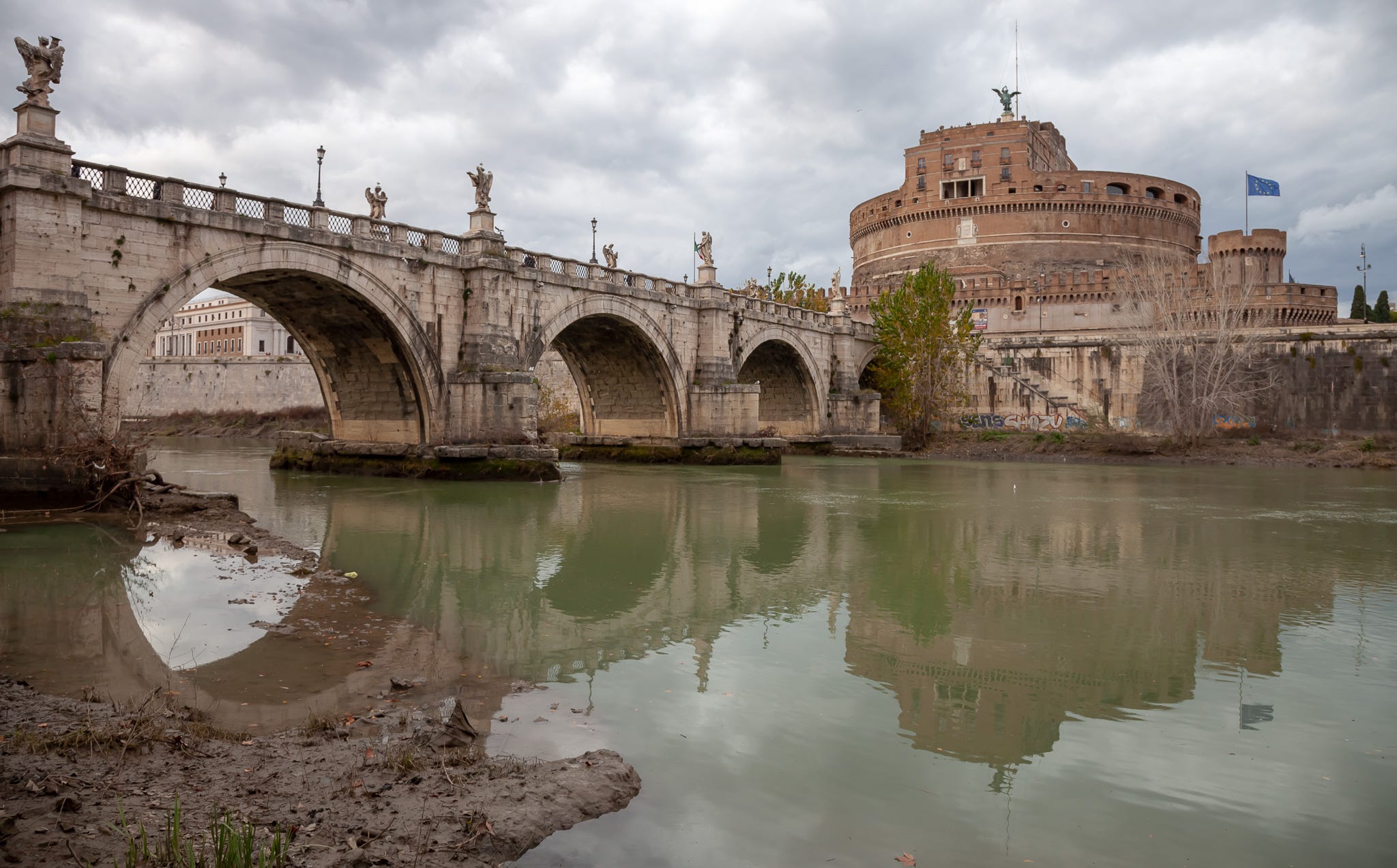
The Tiber, Indifferent to the Philosophy Written in Its Name,
Rome, November 2023 (my photo)
References
Albanese, G. (2025). L’Urbe è universale come la sua Chiesa. Limes: Rivista Italiana di Geopolitica, 11, 131–140.
Ando, C. (2000). Imperial ideology and provincial loyalty in the Roman Empire. University of California Press.
Augustine. (2003 [c. 413–426]). The City of God against the pagans. Cambridge University Press.
Blumenberg, H. (1983 [1966]). The legitimacy of the modern age. MIT Press.
Brown, P. (2000 [1967]). Augustine of Hippo: A biography. University of California Press.
Cameron, A. (2006). The Byzantines. Blackwell.
Capogrossi Colognesi, L. (2025). Vincere per costruire la pace: Violenza e integrazione nella storia di Roma antica. Limes: Rivista Italiana di Geopolitica, 11, 71–84.
Caracciolo, L. (2025). Roma si discute e si ama. Limes: Rivista Italiana di Geopolitica, 11, 7–35.
Caramitti, M. (2025). Antologia della toskà, o della nostalgia dei russi per il mito di Roma. Limes: Rivista Italiana di Geopolitica, 11, 97–116.
De Ruvo, G. (2025). L’unica vera Roma. Limes: Rivista Italiana di Geopolitica, 11, 37–52.
Eliade, M. (1959). The sacred and the profane: The nature of religion. Harcourt.
Fisher, A. W. (1972). Muscovy and the Black Sea slave trade. Canadian-American Slavic Studies, 6(4), 575–594.
Gibbon, E. (1994 [1776–1789]). The history of the decline and fall of the Roman Empire. Penguin.
Habermas, J. (2001). The postnational constellation: Political essays. MIT Press.
Hamilton, A., Madison, J., & Jay, J. (2003 [1788]). The Federalist papers (C. Rossiter, Ed.). Signet Classics.
Judson, P. M. (2016). The Habsburg Empire: A new history. Belknap Press.
Kafadar, C. (1995). Between two worlds: The construction of the Ottoman state. University of California Press.
Kaldellis, A. (2019). Romanland: Ethnicity and empire in Byzantium. Belknap Press.
Kantorowicz, E. H. (1957). The king’s two bodies: A study in mediaeval political theology. Princeton University Press.
Khodarkovsky, M. (2002). Russia’s steppe frontier: The making of a colonial empire, 1500–1800. Indiana University Press.
Löwith, K. (1949). Meaning in history: The theological implications of the philosophy of history. University of Chicago Press.
Luise, F. (2025). Dubai e Riyad competono per l’ologramma di Roma. Limes: Rivista Italiana di Geopolitica, 11, 155–160.
Magris, C. (1989). Danube. Farrar, Straus and Giroux.
Magris, C. (1996 [1963]). Il mito asburgico nella letteratura austriaca moderna. Einaudi.
Maitra, S. (2025). Confessioni americane allo specchio romano. Limes: Rivista Italiana di Geopolitica, 11, 53–58.
Manent, P. (2013). Metamorphoses of the city: On the western dynamic. Harvard University Press.
Markus, R. A. (1988). Saeculum: History and society in the theology of St Augustine. Cambridge University Press.
Mumford, L. (1961). The city in history: Its origins, its transformations, and its prospects. Harcourt.
Poe, M. (2001). Moscow, the Third Rome: The origins and transformations of a “pivotal moment.” Jahrbücher für Geschichte Osteuropas, 49(3), 412–429.
Rowland, D. B. (1996). Moscow — The Third Rome or the new Israel? The Russian Review, 55(4), 591–614.
Santoro, D. (2025). Il desiderio di Roma muove l’impero dei turchi. Limes: Rivista Italiana di Geopolitica, 11, 117–124.
Schiavazzi, P. (2025). La Roma di Leone è croce e centro del mondo. Limes: Rivista Italiana di Geopolitica, 11, 125–130.
Schmitt, C. (1996 [1923]). Roman Catholicism and political form. Greenwood Press.
Schmitt, C. (2003 [1950]). The nomos of the earth in the international law of the Jus Publicum Europaeum. Telos Press.
Schorske, C. E. (1980). Fin-de-siècle Vienna: Politics and culture. Knopf.
Srodecki, P. (2015). Antemurale Christianitatis: Zur Genese der Bollwerksrhetorik im östlichen Mitteleuropa an der Schwelle vom Mittelalter zur Frühen Neuzeit. Matthiesen.
Strémooukhoff, D. (1953). Moscow the Third Rome: Sources of the doctrine. Speculum, 28(1), 84–101.
Tacitus. (2008). The annals: The reigns of Tiberius, Claudius, and Nero. Oxford University Press.
Toumanoff, C. (1955). Moscow the Third Rome: Genesis and significance of a politico-religious idea. The Catholic Historical Review, 40(4), 411–447.
Voegelin, E. (1952). The new science of politics: An introduction. University of Chicago Press.
Whaley, J. (2012). Germany and the Holy Roman Empire (Vols. 1–2). Oxford University Press.
Wilson, P. H. (2016). Heart of Europe: A history of the Holy Roman Empire. Belknap Press of Harvard University Press.
Zhao, T. (2021). All under heaven: The Tianxia system for a possible world order. University of California Press.