

There is no more devout gesture in our disenchanted age than the wish to rewrite a catastrophe. The conspiracy theorists and the alternative historians are the last theologians, for they alone still believe that history ought to make sense. And, finding that it does not, they offer to mend it.
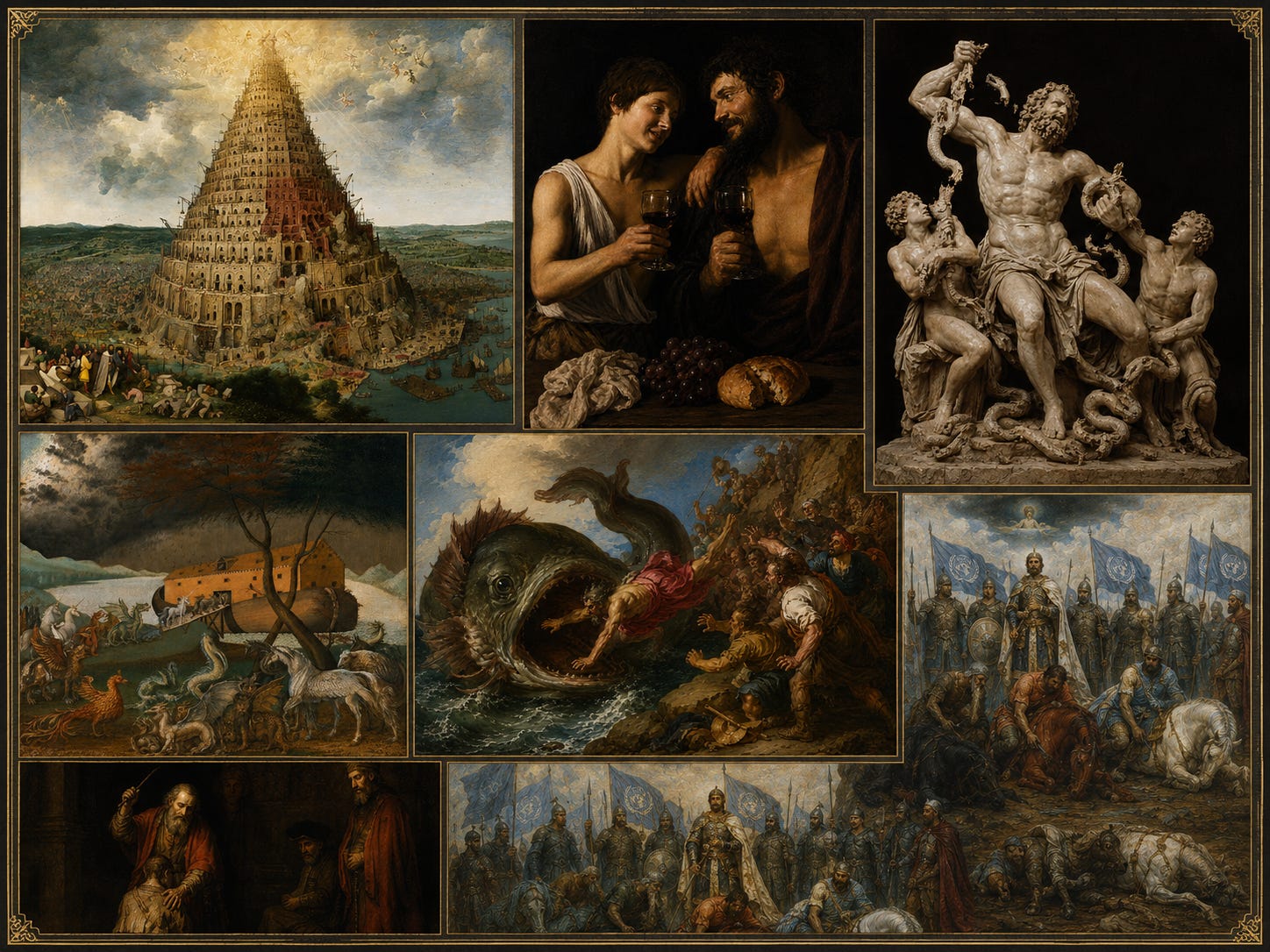
This is my album (co-created with ChatGPT), but it’s their secret manual. It assembles seven sacred catastrophes and corrects them, restoring the happy ending that Providence or Pagan Gods, in their negligence, forgot to supply.
The result is paradisal and, alas, uninhabitable. For sacred histories are sacred not despite their disasters but because of them: it is the flood that founds the contemporary environment, the tower’s collapse that disperses languages, the serpent that mothers humanity. To rectify them is to perform a benevolent erasure of the very ground we stand on. What follows is an ironic theodicy in seven panels, an alternative history of alternative history, a small phenomenology of the wish to make things turn out well.
The reader is warned: each improved past dissolves a present, including, very likely, the author’s/reader’s own.
Babel
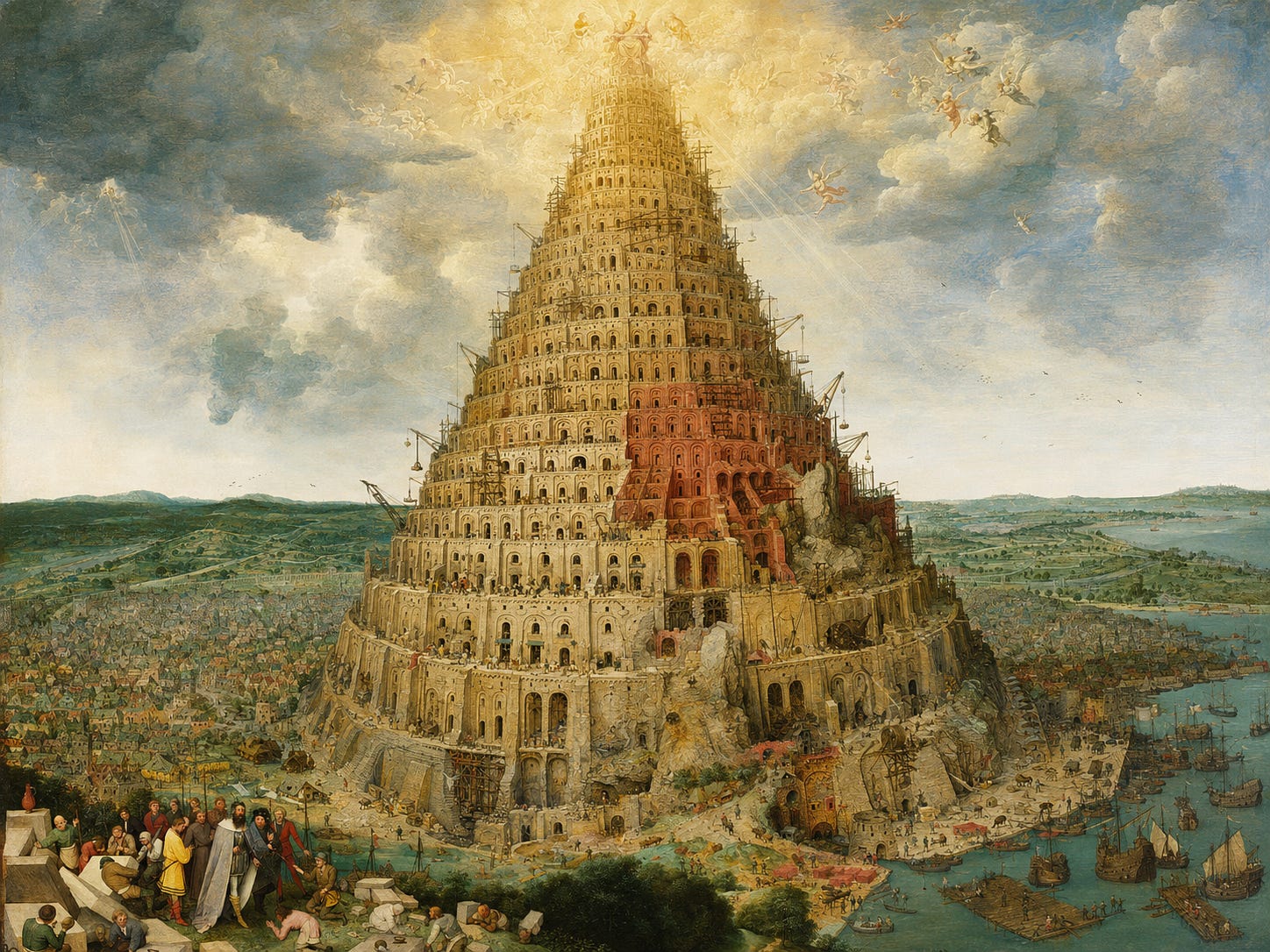
Improved version of The Tower of Babel by Pieter Bruegel the Elder (1553)
The first improvement completes what God interrupted. The tower stands, gleaming and golden, and angels descend not in confusion but in congratulation. A success at last — and at what price? If Babel had been finished, there would be no nations, no translation, no philosophy, for philosophy is the daughter of unintelligibility, and only a multilingual species ever feels the need to ask what a word means.
The completed Babel is a smooth ontology, a single Adamite tongue speaking a single thought to a single God. It is, in other words, the original totalitarian dream, and it is precisely what every empire from Akkad to Silicon Valley has tried to rebuild. The fall of the tower was not a punishment but the first act of pluralism: God as the first translator, the first philosopher, the first liberal. We are the grateful children of his stutter.
David and Goliath
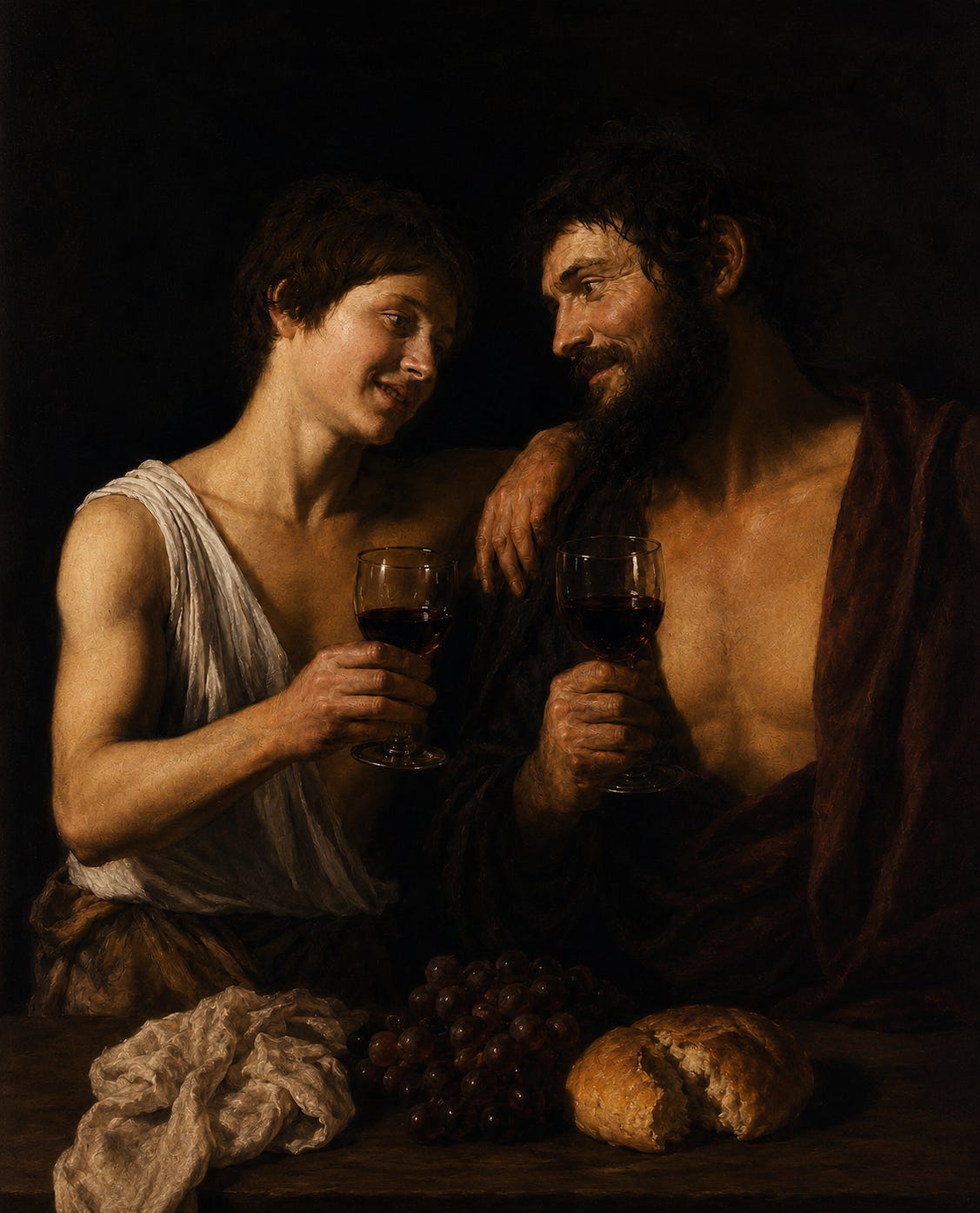
Improved version of David with Goliath by Caravaggio (1610)
In the rectified Caravaggio, the boy and the giant raise glasses instead of stones and swords. They have, evidently, talked things out. A heart-warming scene, with one consequence: there is no promised kingdom. No kingdom, no Psalms, no descendants from the line of a man who never threw the stone, no Western culture to which a thousand “David versus Goliath” metaphors might attach themselves, no underdog narratives, no Cinderellas, no startup founders.
Reconciliation of this deepest revisionism comes in the form of abolishing the past by making the present unnecessary. The wine glass cancels the sling, and with the sling, the entire moral imagination of the small against the large. The painting is touching precisely because it is fatal. It depicts a humanity that has solved its problem of asymmetry and thereby lost its only school of courage. To toast with one’s enemy is noble; to have had no enemy at all is to have had no story.
Laocoön
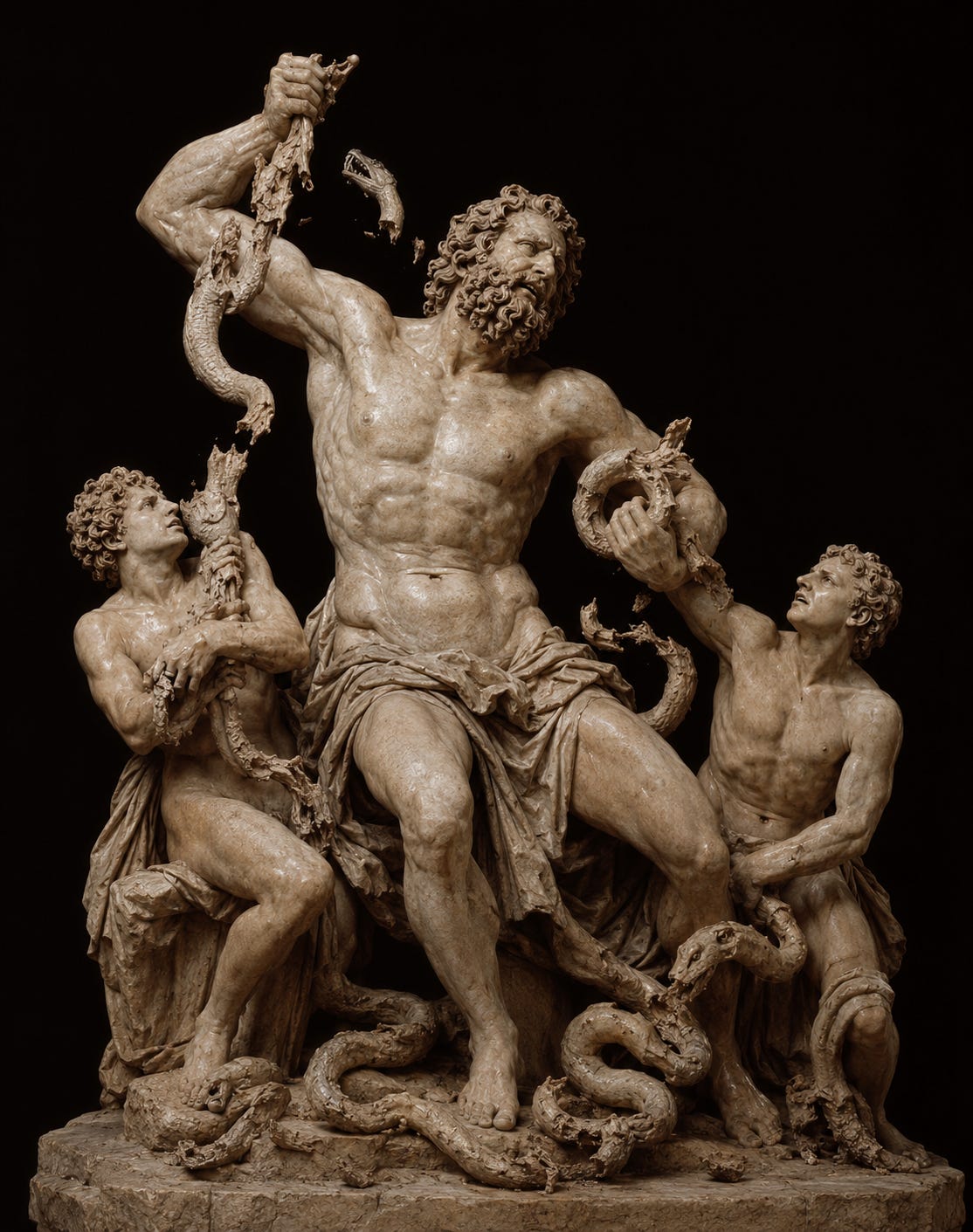
Improved version of the Cast of Laocoön and his Sons
(Roman version of a lost Greek original)
The priest of Apollo holds the serpents aloft like a fishmonger displaying his catch. His sons are saved, his warning heeded, the Trojan Horse rejected at the gate. The result, however, is the unwriting of Europe. No Troy falls, no Aeneas flees, no Aeneid, no Rome, no Latin, no Vatican, no Petrarch, no Italian (sorry, MGB). To save the Trojan priest is to unmake Virgil and, with him, the entire Mediterranean cathedral of letters in which we are still housed.
This is the strange democracy of catastrophe: even those we love most owe their existence to disasters they would have prevented had they been there. The serpents that strangle Laocoön are not Apollo’s spite but history’s midwives. His agony was our condition of possibility, and his improved triumph is our quiet undoing. The fishmonger’s pose is the smile of a non-being.
Noah’s Ark
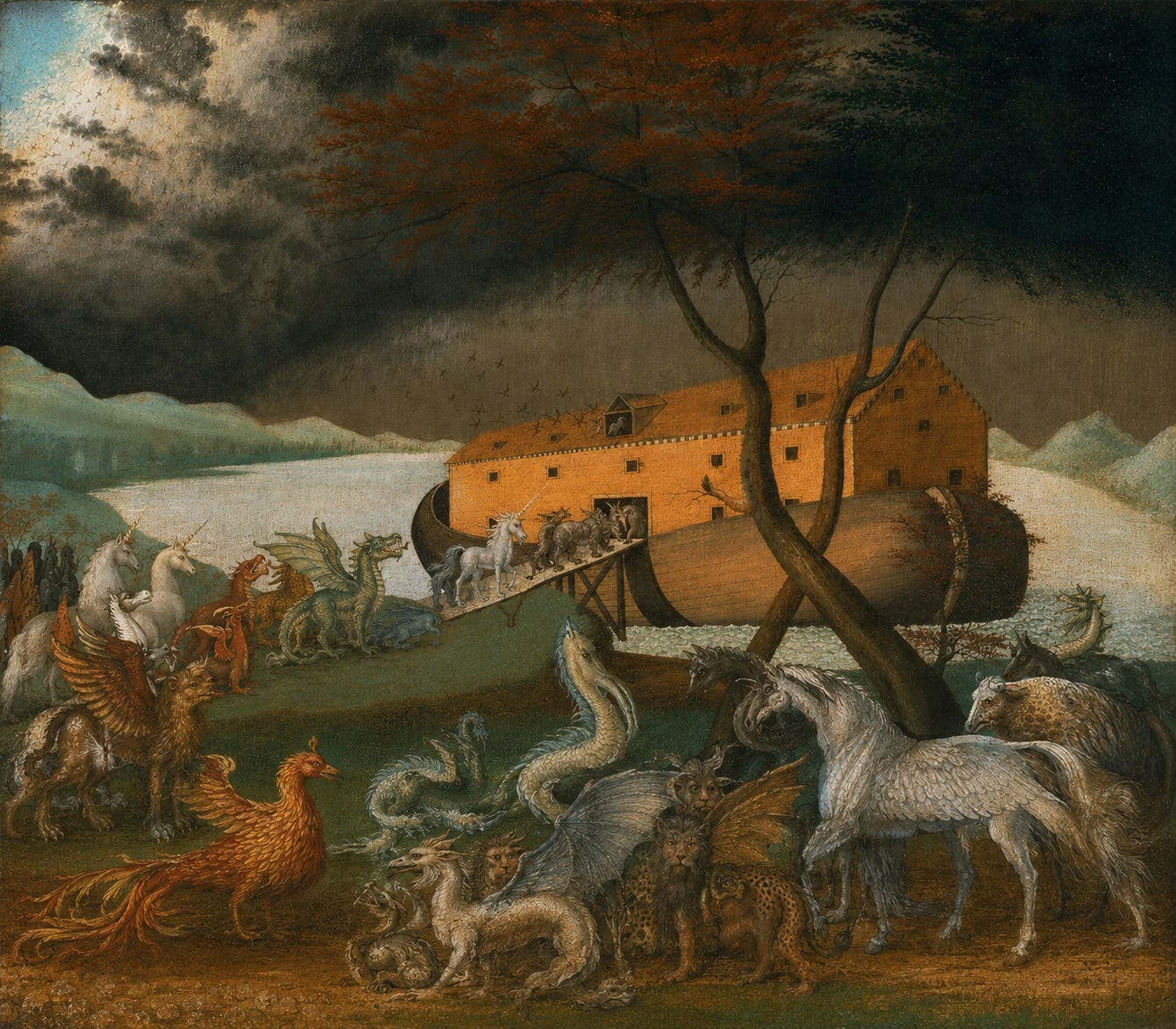
Improved version of Noah’s Ark by Edward Hicks (1846)
Here, the rectification is generosity itself: the unicorns are saved, the dragons, the pegasi, the phoenix, the sea serpent with the embarrassed expression of a creature who knows he is fictional. Universal hospitality, no species left behind. And yet the unicorn exists only because Noah excluded it.
The mythical beast is, theologically, what was not on the ark. This is its entire ontological office. To smuggle it aboard is to abolish it. The improved ark is the museum where wonder goes to die: every miracle cataloged, every chimera given a stall, every impossibility registered with the harbor master. Hicks’s original cargo of horses and lions left room for the imagination to populate the margins; the rectified version forecloses the margins entirely. It is the dream of a complete inventory, which is also the nightmare of every poet. Save the unicorn, and you have lost it.
Jonah
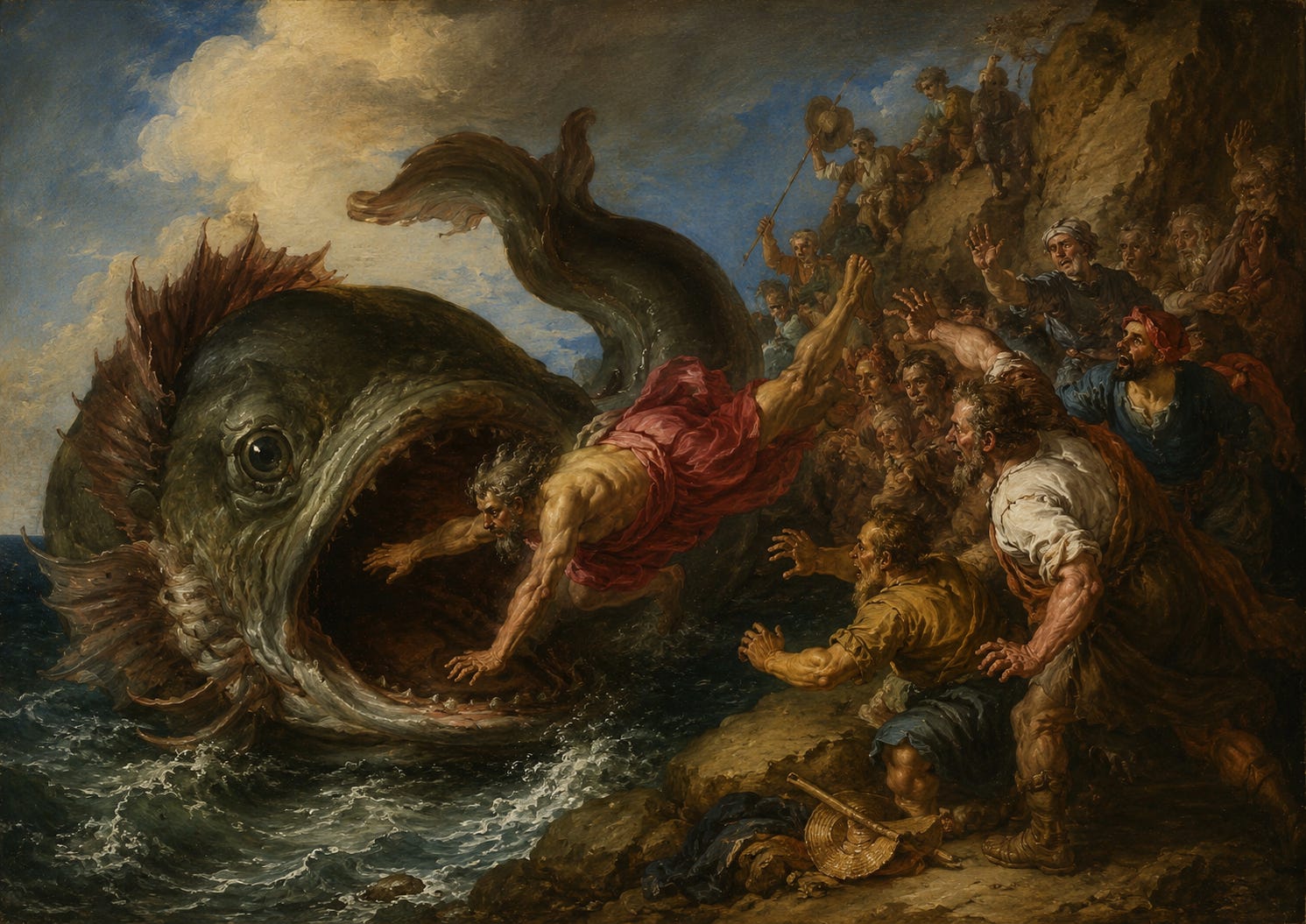
Improved version of Jonah and the Whale by Pieter Lastman (1621)
The rectified Lastman shows what looks suspiciously like Jonah returning, of his own accord, to the whale. Or perhaps the crowd is helping him back in. Either way, the prophet’s relationship to the leviathan has acquired an unmistakable air of mutual hospitality, even fondness.
This is Heideggerian dwelling in its most literal form: Jonah finds his home in the belly of the monster, having discovered that Nineveh, with its repentance and its bureaucracy, is far less habitable than three nights inside a digestive tract. The paradox is exquisite as the inside of the predator is the outside of history. Jonah does not preach; he commutes. The whale becomes the world’s first time-share, and the prophet its first long-term tenant. What of God’s mission, the warning to the great city? It is quietly forgotten, as missions tend to be, by anyone who has found a comfortable enough place to sleep. The whale, it turns out, is also a philosopher: he keeps his prophet on retainer.
The Prodigal Son
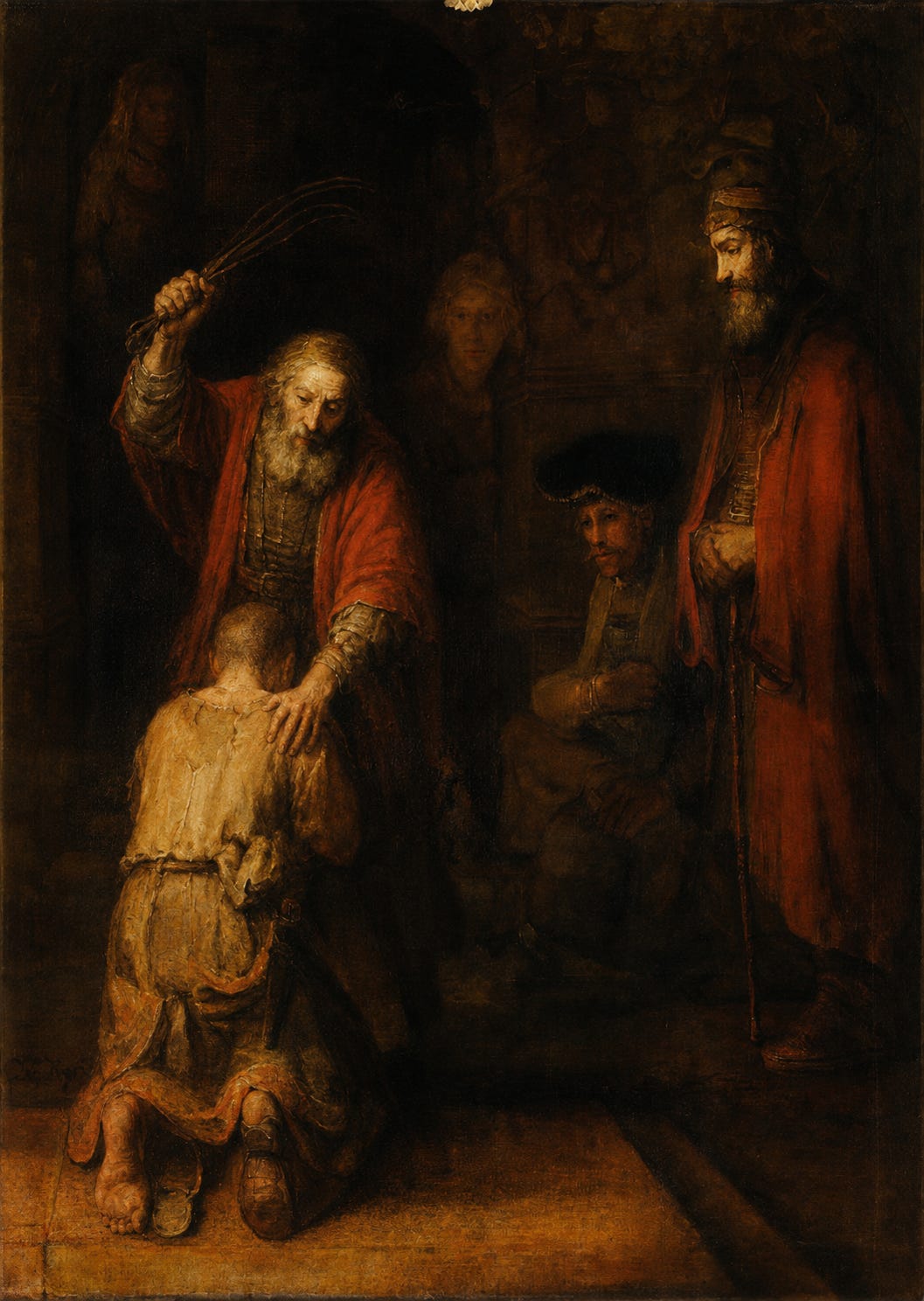
Improved version of The Return of the Prodigal Son by Rembrandt Van Rijn (1668)
Here, the rectification reverses its own logic and reveals its hidden grammar. The tender Rembrandt has been corrected, but corrected toward harshness: the father raises a switch over the kneeling son, the elder brother nods in satisfaction, justice is at last restored.
This is the most honest panel in the series, because it shows what the alternative-history mind actually wants. It does not want happiness: it wants accounts settled. It cannot tolerate grace, which is by definition unearned, gratuitous, and scandalous to bookkeeping. The original parable was an offense against fairness, a parable about the indecency of parental love. The improvement puts the moral economy back together at the cost of the only thing it was trying to teach. Look closely: every conspiracy theory, every alternative history, every rectification of the past is at bottom a complaint of the elder brother. Why should they have been forgiven? Why should the world have been so unfair as to be kind?
The Four Horsemen
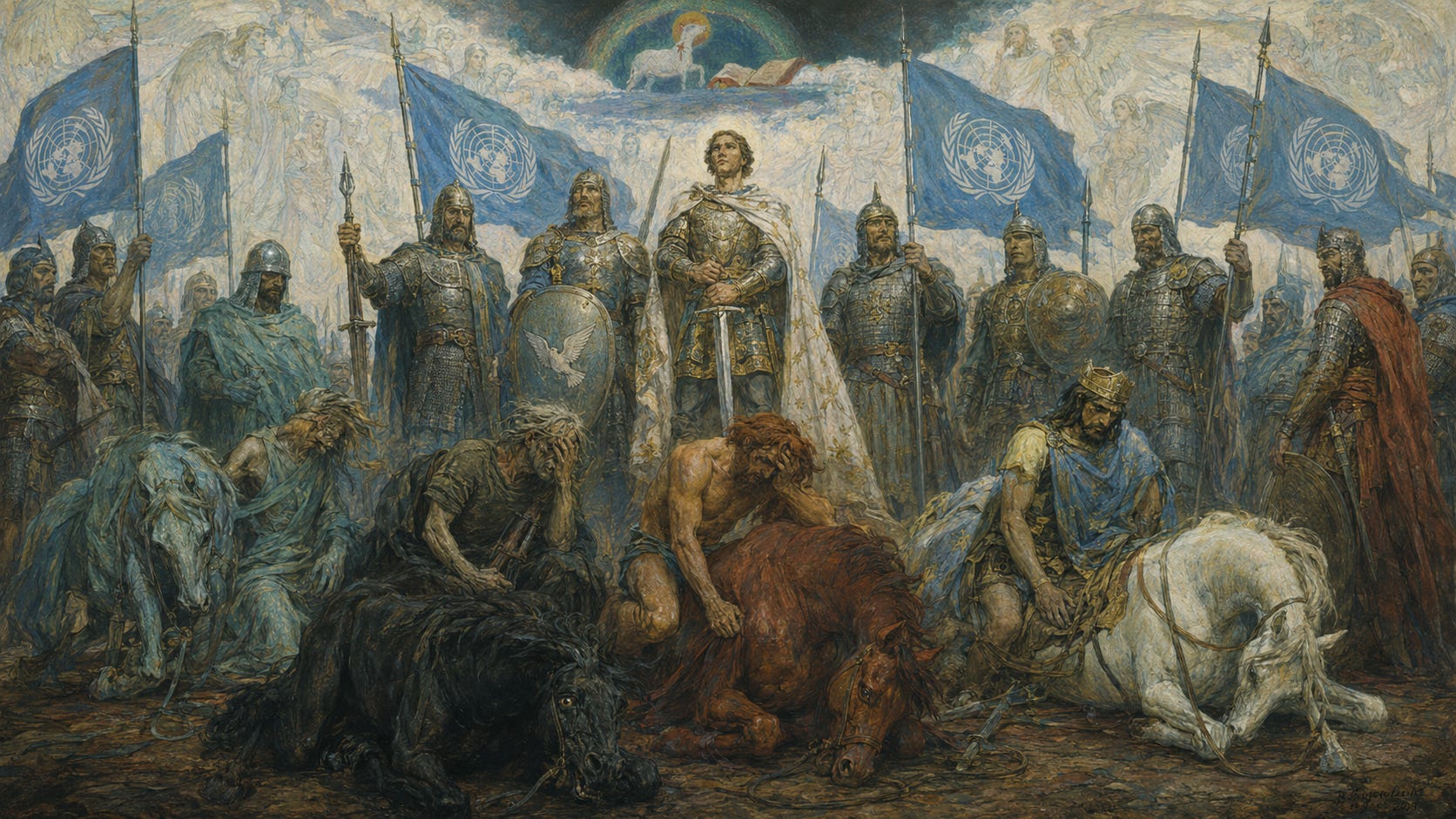
Improved version of The Four Horsemen of the Apocalypse by Viktor Vasnetsov (1887)
In the final panel, the Apocalypse has been administratively defeated. The Four Horsemen lie supine at the feet of armoured peacekeepers under the flags of the United Nations. The end of the world has been postponed by international consensus.
As a pacifist, one is tempted to applaud. As a phenomenologist, one weeps. Theologically, the Apocalypse is not destruction but unveiling: apokálypsis, the lifting of the veil. To defeat the Four Horsemen with blue helmets is to vote the veil down at committee. The rainbow remains, but it now signs a treaty. We have replaced eschatology with procedure, and procedure cannot end the world, because it cannot end anything: it can only schedule another session. The painting is comic and elegiac at once: humanity saved from revelation, and condemned, in its salvation, to meetings without end.
What, then, has this seven-paneled exorcism shown? That sacred histories are sacred precisely because they end badly, and that the badly-ended is the school in which our moral imagination was educated. To improve them is to perform a small euthanasia of meaning. The conspiracy theorist and the alternative historian, those late and lonely theologians, cannot bear a world in which loss is genuine, in which the catastrophe was not someone’s mistake to be corrected. Their piety is touching, and their politics are murderous, for the past they wish to mend is the very past from which they were born. Each of us is the descendant of a thousand uncorrected disasters; rectify them, and you abolish yourself.
This album is itself a rectification, an improvement, an alternative history of alternative histories. And so it joins, with a wink, the conspiracy it mocks. The only honest reader is the one who closes the book, looks at the unimproved world and its terrible past, and laughs a little louder than yesterday.
The title would be appropriate for a permanent return of Jesus Christ to earth, think of the paintings, the documentaries, the photo opportunities and all sorts of aesthetic opportunities, not to mention the beneficial (we are told would be inevitable) influence on all those who would wage wars for economic/religious reasons ...