

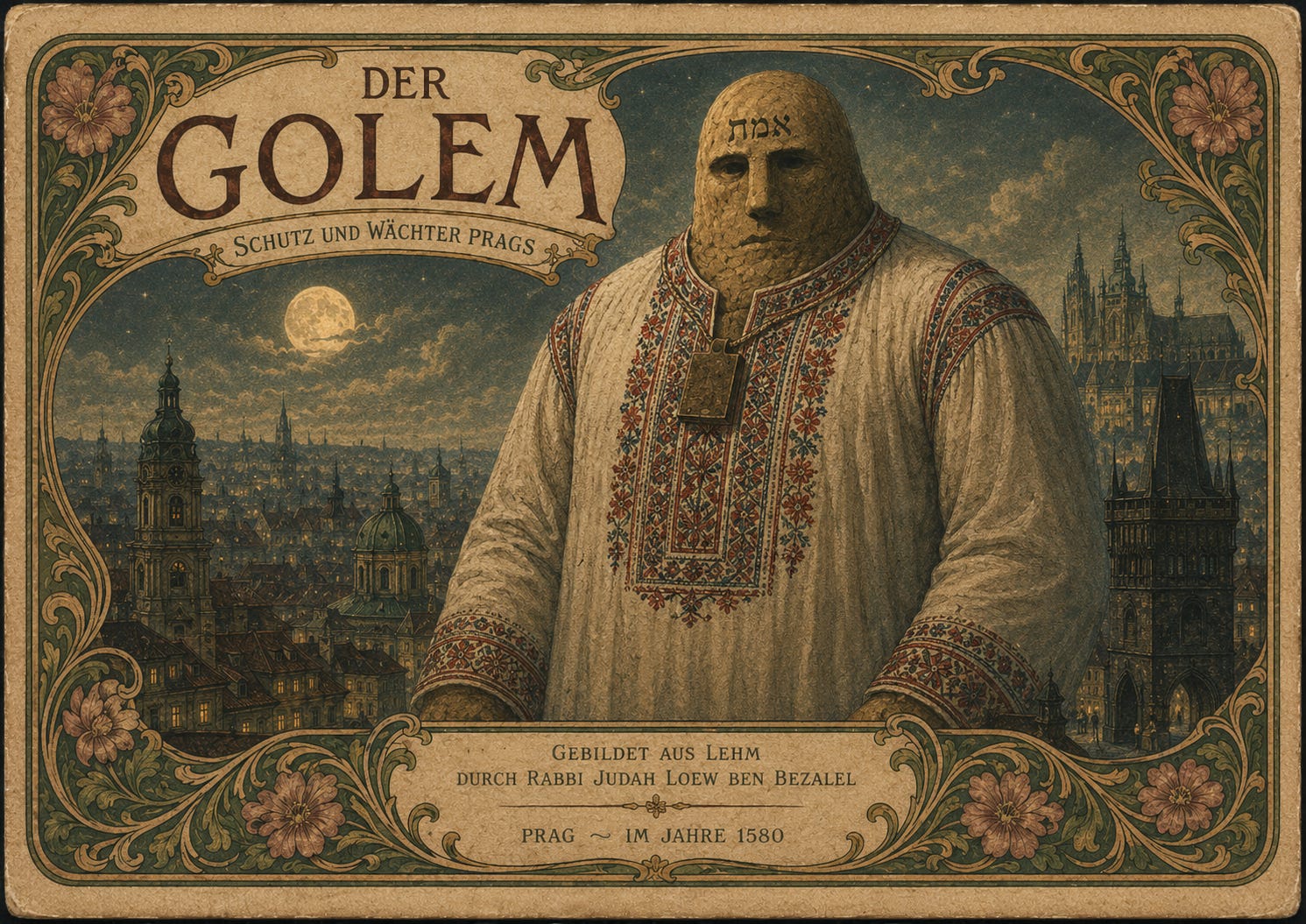
There is a prominent moment in the legend of the Golem of Prague. Rabbi Loew shapes a man out of river clay, presses a magic word into its mouth (or sets the sacred letters on its brow?), and the clay rises. It walks. It obeys. The creature can haul water, carry burdens, keep watch through the hours when the ghetto sleeps and its enemies wake. What it cannot do is begin. It has the figure of a man and none of the freedom of one. It waits for command. And in the old tellings the command fails in the end, because the made thing expands beyond the purpose that called it up. It floods the house, breaks the street, and terrifies the people it was supposed to protect. Then someone has to unmake it by erasing a letter, by withdrawing the word that had mistaken movable clay for real life. Clay, word, obedience, error, and collapse.
We usually pass this story down as a warning about technology. The artifact escapes the maker. The instrument becomes a monster. I want to read it otherwise, and more coldly. The Golem is a portrait that shows a kind of human being that modern civilization has produced in enormous numbers, and still produces, in schools, barracks, statistical offices, resettlement schemes, language policies, youth movements, and the quiet administrative rooms where human plurality is converted into a manageable type.
There is a story about the posthuman that now circulates almost without critical resistance. It says: for the whole length of history the human being was born and therefore given. It entered the world as a riddle, a fact and an unchosen beginning. Then came the gadget, the gene splice, the neural implant, the algorithmic profile, the device that follows the hand and then anticipates the hand, and the system that knows desire before desire finds its own language in human brain (or whatever remains of it). At that point, the human became editable. The species acquired access to its own source code. The born creature became a draft submitted for correction.
What a tidy story! And almost everything in it is misdated.
The posthuman does not belong to tomorrow. It belongs to the day before yesterday. We have lived with it long enough to call it natural. Or political nation.
The violence that makes rather than breaks
Begin with a word we think we understand: violence. Ask anyone what it means and the first image will be simple—the blow, the wound, the smashed window, the broken body, the police boot, or the shell hole. Our moral vocabulary has been built around this. Violence is something done to a self already there to receive it. A fist arrives at a face. A right is trampled. An integrity is breached. Even the more patient theories of the last century kept this basic geometry. Structural violence injures those whom institutions have arranged into vulnerability. Symbolic violence, in Bourdieu’s (2001) sense, works by passing domination off as the natural order of the world. But symbolic violence too presupposes a human subject already standing there, someone available to misrecognize his/her own subjection.
There is another violence, however, less visible because it comes earlier. It does not strike the formed person. It intervenes before the person has gathered into individuality enough to resist. It makes this particular self, narrows him/her, trains him/her into a shape, and closes the door on the other selves that could have emerged. Call it formative violence. It manufactures a self, then presents the product as birth.
The idea is old. Nietzsche (1887/1998) reached it when he asked how nature bred an animal entitled to make promises. His answer was grim and exact: pain, memory burned into the body, and the long discipline that later moral languages would call responsibility. Foucault (1975/1995) reached the same region from the perspective of discipline. The prison, the school, the barracks, the hospital, the timetable, the examination, the rank and the file: these mechanisms do more than restrain bodies that already possess their truth. They produce bodies fit for use. At the end of the process stands that strange object we flatter by calling it a soul. The human, on this reading, is the animal trained into existence. Each of us carries the residue of exercises to which we never consented.
Formation as such is not violence. A child is formed by a mother tongue, by the song over the cradle, by the first gestures of trust, by tasty food, climate, accent, shame, feast days, forbidden words, by the dead whose names are said at the table. This is no assault on freedom or personal integrity. This is the medium in which freedom and integrity first become possible. No one is free and whole in the abstract. Freedom comes in a dialect, in a landscape, in the body of someone’s child, with some remembered graves behind it and some inherited fear in the blood.
Formative violence begins where this given world is seized by rational-instrumental design. It begins when the self’s own slow work upon itself is replaced by the cultivation of some humans by other humans, according to a plan the cultivated never saw, never chose, and could not have refused. It happens at the depth where a child first learns to say I, yes, and no; and precisely there another voice has already spoken for him.
What exactly gets overridden
To see what formative violence destroys, one must first see the thing it attacks.
Hannah Arendt (1958/1998) gave us the word: natality. To be born is to be a beginning. Something enters the world which cannot be deduced from what came before it, cannot be read off from lineage, class, nation, biology, or plan. Human freedom begins here, and nowhere safer. Because each person is a new start, history never becomes the simple execution of a program. Someone, somewhere, can interrupt it. Someone can begin again. The born human is not an instance of a type. It is an origin. Its dignity lies in this unrepeatability.
Yet that origin never arrives naked. It comes wrapped in particulars of the small world we were born into. A proper name, given before the child could be asked, and nevertheless the name from which all later asking will proceed. A first language, learned before grammar, as the sound of nearness and care. A place, perhaps poor and provincial, perhaps broken by war or economic crisis, yet still the first map of the world. A few graves. A few prohibitions. A rite half understood. A family story, often false, yet not therefore meaningless. These do not decorate selfhood after the fact. They hold the first scaffolding in place.
Think of two ancient human practices: lullaby and prayer. In the lullaby, the infant is addressed before it can answer. It becomes a self by being sung to. In prayer, the self turns toward what exceeds every earthly power, and by that turn finds its measure. The lullaby installs the person in tenderness. Prayer cuts power down to size. Remove these two acts, or replace them with their administrative substitutes, and the self gets formed in a non- or post-human way. With administrative formation, the self does not survive whole.
Now formative violence can be named more plainly. It overrides natality. It takes the singular beginning and trades it for a type. It enters the structure of address and replaces the lullaby’s tender you with the engineered you of the collective: member of the politically defined people, unit of the nation, bearer of predescribed destiny, and cell of the state. It teaches the child to feel shame for the tongue in which it was first loved. It teaches the baby to remember the dead as representatives of a constructed past rather than as his own dead. It replaces the living density of inheritance with a curriculum and national pride.
This is why the question of consent becomes dizzy here. One cannot consent to the process that produces the kind of being capable of consent. By the time you stand there to be asked, the decisive work has already been done. The answer has been given in your name, before your name was yours.
Seeing like a nation
Where did this happen, historically, and at what scale? It happened industrially, through the thing we were later taught to treat as the most natural of human belongings. The nation.
James C. Scott (1998), studying why grand schemes to improve the human condition so often end in catastrophe, noticed a simple administrative truth: the modern state cannot govern what it cannot see. Before it taxes, conscripts, educates, disciplines, relocates, or saves a population, it must render that population legible. It needs the census, the map, the standard measure, the permanent surname, the cadastral survey, the official language, the school record, the state church, and the identity paper. Scott gave us a theory of state vision. But look again at the instruments. Surname, census, standardized language, compulsory school, and disciplined prayer. These are tax tools, yes. They are also tools of nation-making. Which means they are tools of posthuman production. Scott described the workshop, though he did not fully name the creature being assembled inside it.
The historians of nationalism then confirm what his essay makes visible. The nation is made. Anderson (2006) called it an imagined community, produced by print, repetition, simultaneity, and the strange intimacy of strangers who learn to picture themselves as one collective body. Gellner (1983) put the matter more brutally: nationalism does not awaken nations sleeping beneath the surface of history; it invents nations where they did not yet exist, and its engines are school and army. Weber (1976) gave the most accurate title to this operation: Peasants into Frenchmen. A peasant speaking a regional patois, bound to locality, parish, trade, kin, and season, was converted over a few decades into a Frenchman. School did some of it. Conscription did some of it. Roads, railways, bureaucracy, shame, and punishment did the rest.
Something was given, something else was taken.
What was taken was not one affiliation exchanged for another. That would be too simple, and far too innocent. What was taken was the plurality of lifeforms itself, the possibility of belonging to several worlds without first translating each of them into the one authorized language of the nation.
Here my argument risks becoming too Western. The same operation looks different on the imperial borderland. In Eastern Europe, and later in the Soviet and post-Soviet spaces, the making of the national human often passed through several machines at once: imperial school, party language, passport nationality, national invention, forced loyalty to fast-changing states. Here, the violence lay in the administrative power that decided which part of the person would be promoted, which tolerated, which ridiculed, which erased.
The political form of the One
The born human is rooted in many places at once. A family, a valley, a city street, a craft, a faith, a dialect, a school humiliation, a grandmother’s word, a university town, a particular arrangement of graves that no state archive can reproduce. Singularity does not lie in any single root. It lives in the tension among them. They pull against each other and keep the person taut. To cut them away in the name of one higher belonging is to impoverish the person while claiming to complete him.
This operation has a very old shape. It is the shape of monotheization: the collapse of a crowded and quarrelsome pantheon into a single sovereign One, after which yesterday’s gods become idols, demons, village nonsense, remnants to be purified. Nationalism is monotheization in the field of belonging. The dialect becomes an idol to be smashed by the standard language. Local memory becomes superstition, to be corrected by official history with its dates, martyrs, and approved heroes. Overlapping loyalties become disorder. The human being must be saved from his own multiplicity.
Those who pass through the process often speak of it as a wound in the soul. What is wounded is the multiplicity by which they were singular. Take the many away, and the one does not become clearer. It becomes thinner.
The manufactured One has an appetite that older plural belonging rarely possessed in such pure form. Because it is made, it is never entirely sure of its own authenticity. It needs proof. The proof is often death. The conscript learns that his/her life is not finally his/her; it is the nation’s property, loaned to you on revocable terms. The war memorial carries out the alchemy in stone: scattered dead are converted into the immortal body of the nation. Like the undying body of Kantorowicz’s king (2014), the nation claims a body politic that outlasts every mortal who composes it, and for that reason demands that mortals die to keep it alive. Kantorowicz, a Jewish WWI veteran of the German Kaiser, knew what he was writing about. One sees this today in the ugly ease with which states call the occupied to die for them, and then count their deaths as evidence of common destiny. Blood becomes an argument. A bad one, but very old.
The first, non-fictional Golem
Now let’s return to the Golem, whose figure loses its innocence.
The Golem is made, not born. It is animated by a formula composed elsewhere, by hands that are not its own. A word is placed in the mouth. A letter is set on the brain. It carries the form of a self, yet cannot be an origin, because the I it pronounces was written for it in advance. It belongs to the will of its maker. And it ends in the way the made creature so often ends: exceeding the design that summoned it, turning against the house it was ordered to guard.
The constructed citizen of the modern nation is a Golem in exactly this sense. Fashioned from the clay of born humans. Animated by the formula of standardized language, official memory, and permitted desire. Fitted with a manufactured unity where a living plurality had been. It walks, works, votes, fights, sings the anthem, denounces the traitors, mourns the correct dead, forgets the incorrect ones. It may even call this freedom, because the vocabulary by which freedom might have objected has already been replaced.
The clearest cases are those that wrote down their intention without embarrassment. Like many social-engineering projects of the last two centuries, Italian Fascism sought, in Mussolini’s own words, to make Italians “spiritually and physically unrecognizable,” to manufacture a new man cleansed of the actual Italian whom history and Destiny had slowly produced (Dagnino, 2016, pp. 131, 139). Youth regiments, mass liturgies, hardened bodies, open-air rituals, the cult of obedience and virility: an explicit anthropotechnics. A training regime for serial production. But the same operation appears in less theatrical forms. The Jacobins stamping out patois. Boarding schools taking Indigenous children from the hearth where the lullaby had been sung. Population transfers moving human beings into their proper national containers, as if the world were a badly arranged cabinet. These operations differ in candor and cruelty, but not in kind.
So the first posthuman did not step out of a hi-tech laboratory wearing a white coat. S/He marched out of Fichte’s schoolroom around 1808, was drilled into posture in a Napoleonic barracks, and was counted in a census whose genealogy still smelled of the book of doom. The decisive gesture of the posthuman, the treatment of the human as raw material to be designed rather than as a beginning to be honored, was performed on a continental scale long before anyone could read a genome, much less edit one.
Our tidy story about the posthuman is therefore wrong in date and wrong in register. It mistakes an old political operation for a new technological emergency. The genome editor and the recommendation engine are not the first instruments of human fabrication. They are late instruments. Their ancestors are the grammar book, the school bell, the barracks roll, the passport, the map, the anthem, the census form. The hardware changed. The older intention remained: a natal, plural, singular human is made legible, then reworked toward a type that serves a design s/he did not author and was never shown.
No technological vigilance alone will save us from this. A society watching only its machines is watching the wrong door. The machine merely inherited danger from the state.
What is needed is a politics of the natal. I do not mean a sentimental politics of childhood, family, or origin. Those words have already been used too often by the very powers that deform what they pretend to protect. A politics of the natal would begin from the fact that the human being is born rather than assembled; that each person arrives as a beginning, bearing plural attachments no sovereign design has the right to simplify; that dignity lies in the capacity to start, to answer, to refuse, and to remember otherwise. True decoloniality acts here, at selfhood, not small collective integrity. Such a politics would defend the conditions under which the given can become freedom, instead of being seized and converted into command.
The Golem is animated by a word it did not speak and bound to a will that is not its own. The born humans are also given things they did not choose: a name, a tongue, a prayer, a lullaby, a place among the living and the dead. The difference is lived in the mouth, in what one dares to say, in the dead one is allowed to mourn, in the language in which fear and hope first become speech. Through these given things, and not by escaping them into some empty forms, the born humans become the authors of their own I, their own yes, and their own no.
We have been making Golems for two hundred years, at least. The new thing is that we are just getting better at it.
References
Anderson, B. (2006). Imagined communities: Reflections on the origin and spread of nationalism. Verso.
Arendt, H. (1998 [1958]). The human condition. University of Chicago Press.
Bourdieu, P. (2001). Masculine domination (R. Nice, Trans.). Stanford University Press.
Dagnino, J. (2016). The myth of the new man in Italian Fascist ideology. Fascism: Journal of Comparative Fascist Studies, 5(2), 130–148. https://doi.org/10.1163/22116257-00502003
Foucault, M. (1995 [1975]). Discipline and punish: The birth of the prison (A. Sheridan, Trans.). Vintage Books.
Gellner, E. (1983). Nations and nationalism. Cornell University Press.
Kantorowicz, E. (2016). The king’s two bodies: a study in medieval political theology. Princeton University Press.
Nietzsche, F. (1998 [1887]). On the genealogy of morality (M. Clark & A. J. Swensen, Trans.). Hackett.
Scott, J. C. (1998). Seeing like a state: How certain schemes to improve the human condition have failed. Yale University Press.
Weber, E. (1976). Peasants into Frenchmen: The modernization of rural France, 1870–1914. Stanford University Press.
Yes, this question is indeed there. Probably, humans are only sporadically autonomous agents...
This was a real pleasure to read. Your writing is unobtrusively captivating. It really bears the reader along. I don't entirely agree with your distinction between formation per se and formative violence. Shame, taboo, corporal punishments...all bear marks of violence. And I'm ok with that. Perfect freedom is a dream and, I think, is ultimately senseless (as the fervent attempts of Bergson and, even more so, Sartre to describe it show). But I deeply appreciate the thrust of your argument, even so. It resonates with me, and I, too, bitterly lament the rise of HR-thinking, identity politics, and branding and the foreclosure of human possibility. You might be interested in this recent post from Faith Against Defense: https://skepticaltheist.substack.com/p/the-levelling-of-being-kierkegaard.