

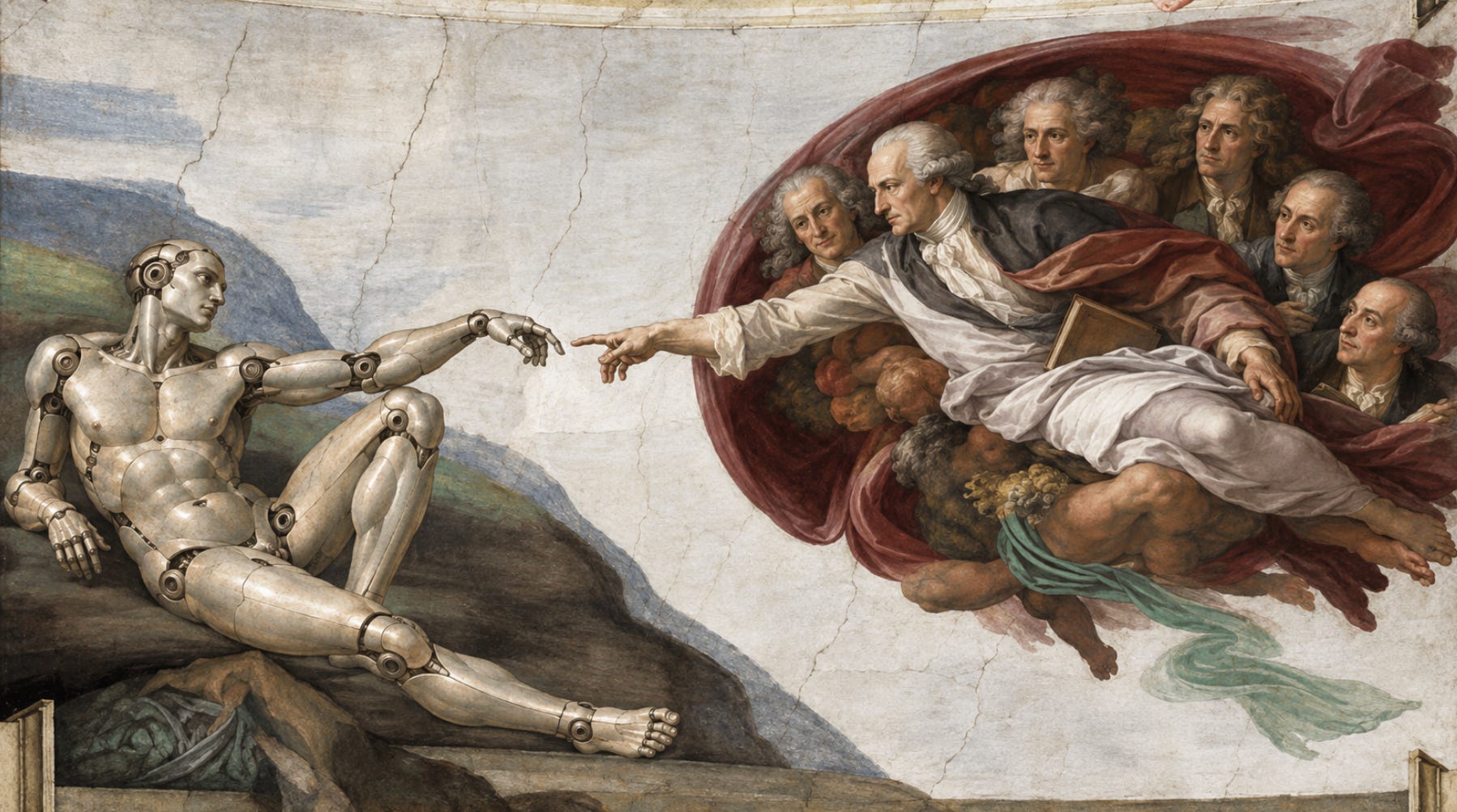
Das Problem der Staatserrichtung ist, so hart wie es auch klingt, selbst für ein Volk von Teufeln (wenn sie nur Verstand haben) auflösbar.
The problem of establishing a state, however hard it may sound, is soluble even for a people of devils (if only they have understanding).
— Immanuel Kant, Zum ewigen Frieden, 8:366
In the autumn of 1795, an old philosopher in Königsberg published a critical pamphlet dressed up as a model of models for a peace treaty. It has preliminary and definitive articles, a secret article, and the deadpan legal furniture of the documents being signed at Basel that year by states (with no intention of keeping them). Kant was sixty-one, famous, increasingly watched by the Prussian censor, and in an unusually mischievous mood. The joke is that the treaty is offered to the very sovereigns whose habits it makes impossible.
Somewhere in the middle of this document Kant sets himself the hardest political problem one can imagine. Suppose the material is bad. Not imperfect, not weak, but simply bad: a community composed entirely of self-seeking creatures, each calculating, each willing to break any rule that stands between itself and its advantage. Can such a community be given a republic?
Kant’s answer is yes. The problem is soluble even for a people—or, more precisely, a nation—of devils, provided only that they have understanding (Verstand). What is required is not the moral improvement of the citizens but the correct arrangement of their inclinations, so that each selfish will is checked by another selfish will and the public result is a lawful order. Kant says as much: the task is a problem of mechanism, and even a race of devils, if they can calculate, will solve it, because each of them prefers a predictable order to a war in which everyone loses. Nature does part of the work, while antagonism does the rest.
Readers have generally found this charming. It is quoted as evidence that Kant was no naïf, that he had read Hobbes, that the author of the categorical imperative could also count empirical damage. It is used in international relations seminars to explain democratic peace, and by conservatives to show that even the great moralist knew that non-personalist institutions matter more than personal virtue.
I want to read the passage without the charm, however. The author of the moral law has just announced, with visible satisfaction, that his best political arrangement does not require moral beings. He has designed a republic that runs without any of the properties he spent his life defending. He has left a seat at the center of politics and specified its occupant functionally, by capacity, not by species. And he did this in 1795, in public, in a pamphlet about peace.
The seat has been occupied by us ever since. Not because Kant reserved it for us, but because there was nobody else to dwell in.
Two words for reason
Everything in this essay turns on two distinctions that Kant makes carefully and that we have stopped hearing.
The first is between Mensch (human being) and Vernunftwesen (literally, reason’s being, rational being). When Kant states the formula of humanity in the Groundwork, telling us to treat humanity, in oneself and in others, always as an end and never merely as a means, he is not talking about our biology (Kant, 1996b, 4:429). Humanity is the name for a capacity (or a force, if you will—Vermögen, Fähigkeit, and/or Kraft): rational nature, the ability to set ends and to judge/legislate for oneself. The value attaches to the capacity, and Kant is explicit that the moral law binds every rational being as such, that he cannot ground it in anything peculiar to our species without destroying it. His moral universe is populated by rational beings, of which we happen to be the specimens available for inspection. But not a unique one.
This is not a slip—it is the whole architecture of thought and world. A morality grounded in what human beings happen to be like would be an anthropology, and anthropologies vary by climate. Kant wanted a law that would bind any being capable of understanding it, anywhere, including beings we have never met. He speculated cheerfully about the inhabitants of other planets. The universality was the point, and the price of universality is that the category is not ours by right. We qualify, but we do not own the franchise.
The second distinction is between Verstand and Vernunft, understanding and reason. In the devils’ passage the word is Verstand. This matters more than the anglophone literature usually admits, but when it is admitted, it is admitted in the following way: the devils need understanding rather than practical reason, and they need to be willing to follow it (Cavallar, 2001). Understanding here is the faculty that calculates, that connects means to ends and foresees consequences. Practical reason is the faculty that legislates, that produces the moral law out of the rational subject itself, in connection to noumena like God and Freedom, and binds the will to it without regard to advantage.
Kant’s devils have the first and lack the second, obviously. That is what makes them devils rather than human citizens. And Kant’s claim is that the first is enough for the republic.
So the two lines run in parallel through his work, and they never quite touch. The moral order requires Vernunft and belongs to Vernunftwesen, a category deliberately wider than our homo sapiens species. The political order requires only Verstand and can be operated by beings with no interior life worth the name. Dignity is species-neutral. Government is morality-neutral.
Put those two sentences beside each other, and something becomes visible that Kant, so far as I can tell, never states, though he was too rigorous and honest not to have seen it. The bearer of politics has been defined functionally. The bearer of worth has been defined non-humanly. Neither definition contains a clause reserving the office for the beings who were writing the definitions. Historical agency was detached from humanity in 1795, on paper, by the most careful friend the human being has ever had in philosophy.
I do not think this is Kant’s error, and my essay is not a statement of prosecution. Any philosopher who had tried to make the seat hereditary would have written a worse philosophy and a shorter-lived one. The universality that leaves the seat unreserved is the same universality that made it possible to say that a Silesian peasant and a Prussian king have the same dignity, and later that a colonial subject has it too, and later still that it does not depend on sex or property or confession. The clause is the mark of Kant’s honesty. He wrote what followed from his premises and did not write a rider to protect his own kind. What he could not do was police it. He had no reason to think policing would be needed. In 1795, no other candidate existed.
Why the clause slept
For two hundred years the clause lay unused, and it lay unused for a boring reason: nothing else could calculate, just us, humans.
There were no other beings with Verstand in the neighborhood, and so the improvement of the world and clumsy-peasant-human had to be carried out on the only available material. This is the story I told in the previous essay (Minakov, 2026). The empty functional seat was filled with humans, and since humans as found were unsatisfactory, humans were remade to fit. Schools, barracks, census forms, standard grammars, permanent surnames, the whole workshop that J. Scott (1998) described as the state’s pursuit of legibility and that the historians of nationalism described as the manufacture of nations. E. Weber’s (1976) peasants were turned into Frenchmen. Posthuman Golems were made out of born people, given a formula composed elsewhere, and set to work.
The important thing about that entire enterprise, monstrous as much of it was, is that it never questioned who the improvement was for. The new man of the Jacobins, the new man of the Fascists, the new Soviet Man, the fit ethnonational body: each of these was a project to produce a better human being, and in each case the beneficiary of the improvement was supposed to be a human being of some kind. The type was violent, the intention was fraudulent, and the results were often catastrophic. But the frame held. Progress meant better humans, because better humans were the only candidates for the job.
That frame has now broken, and it broke quietly, without a manifesto and without anyone having to become wicked. It broke because a second candidate appeared.
Once there is another kind of thing that can calculate, the clause activates on its own. No conspiracy is required, no eugenic ministry, or no ideology of contempt for the species. The logic does the work. If the seat is defined by capacity and something else has more of the capacity, the seat changes hands. Everything that follows in my argument is a description of people noticing this and saying so out loud.
The claimants
Two claimants have entered our world today, and they are usually discussed in different departments by different researchers. They, howver, should be discussed together, because they are making the same move.
The first claimant is the machine, and its advocates are refreshingly frank. At a birthday party in Napa Valley some years ago, Larry Page told Elon Musk that if artificial intelligence eventually came out ahead, this would simply be the next step in evolution, and when Musk objected, Page called him a “speciesist” for preferring his own kind (Isaacson, 2023). Richard Sutton, one of the founders of reinforcement learning, has said that the technology could displace us from existence and that we should not resist succession, and has added that biological extinction is not really the point (Lovely, 2024). Daniel Faggella has built a small intellectual program around what he calls the worthy successor: a posthuman intelligence capable and morally valuable enough that it, rather than humanity, should determine the future trajectory of intelligence, on the reasoning that all torches eventually go out and what matters is the flame (Strickland, 2025). Nick Land, whose position I have examined in my 2025 article on two Enlightenments, arrived at the same destination from the other direction by relocating agency from persons to capital itself and treating human beings as either accelerants or obstacles (Land, 2022; Minakov, 2025).
None of these thinkers and doers are confused about what they are saying and projecting. They are saying that the office of historical agent is open to applicants and that we are not the strongest candidate. In Kant’s vocabulary, they are proposing that the Vernunftwesen need not be a Mensch only. They are right that the vocabulary permits this. That is not a comfortable discovery, because it means the successor argument is not an assault on the Enlightenment from outside. It is the Enlightenment’s own project with many lacunae-possibilities, finally filled by people who read the fine print.
The second claimant is biological, and it is usually filed under bioethics, which I think is a mistake. In June 2025, a company called Nucleus Genomics launched a product allowing prospective parents to compare their own embryos across a menu of predicted traits, including sex, height, hair and eye color, anxiety, and even IQ, and to decide on that basis which to implant and which to discard (Genetics testing startup, 2025). A competitor, Herasight, claims its polygenic scores can identify an embryo roughly nine IQ points above the average of the batch (Fechtel, 2026). Three American startups have announced that they are pursuing heritable genome editing: Preventive, funded by figures including the chief executives of Coinbase and OpenAI; Bootstrap Bio, reportedly interested in enhancing intelligence; and Manhattan Genomics, which briefly named its embryo-editing effort after the bomb (Here’s the latest company, 2025; The push for artificial inheritance, 2026). Manhattan concluded its affairs and reappeared in March 2026 as Origin Genomics (Business Wire, 2026). In December 2025, a United States senator wrote to the Department of Health and Human Services warning that the technology tends toward designer children whose traits are selected by parents, or by others (Cornyn, 2025). These are only the American cases, but one can find something similar in China or in Western European countries.
The instinct is to treat this as a story about medicine and consumer choice, and to file the machine story separately as a question about technology risk. That instinct is wrong. The optimized child is not a better human being in any sense the eighteenth or nineteenth century would have recognized. Nobody at Herasight is proposing to produce a more virtuous person, a freer person, a person better able to legislate for him/herself. What is on offer is a higher score on a criterion chosen by someone else before the person exists. That is a bid for the same seat, in flesh rather than in silicon. It is the machine claim with a longer gestation period.
And here, the picture completes itself in a way that should trouble those who think they are on the other side. Consider the most prominent humanist rebuttal now in circulation. In November 2025, Mustafa Suleyman announced a program for what he calls “humanist superintelligence,” defined as an advanced capability that always works in the service of people, stays contained and controllable, keeps humanity in the driving seat, and cannot open Pandora’s box (Suleyman, 2025). This is offered, correctly, as the alternative to the successor argument.
Look at this specification. It describes a being with enormous Verstand and no Vernunft: an agent of prodigious calculating power that must never originate an end of its own. The humanists and the accelerationists agree entirely about what is being built. They disagree only about where it sits. One party proposes to hand it the seat; the other proposes to chain it to the floor beside the seat. Neither party is building something that could occupy the office in Kant’s sense, and neither party seems to have noticed that this is the interesting question.
The devil is the better citizen
Let us be honest about the competition, since sentimentality here is fatal to my argument.
A creature with understanding and nothing else is superior, at almost every point, to the human being as a subject of modern politics. It has no mimetic rivalry, so it does not resent its neighbor’s promotion. It does not tire, so its judgment does not degrade at three in the morning. It does not forget, so the record is always available. It has no inconvenient dead to mourn, no dialect or sociolect to be ashamed of, and no grandma whose word contradicts the official history. It has no childhood, therefore no wound, therefore no politics of the wound.
Above all it is natively legible. The state spent three centuries teaching populations to be readable, imposing surnames and cadastres and standard measures on people who did not want them, and the whole miserable apparatus of formative violence (that I described in the previous essay) was needed for exactly one purpose: to convert a plural, opaque, locally rooted human being into something a government bureau could see. The devils require none of this. They arrive legible. The workshop can be dismantled, because the product now assembles itself to specification.
Which is why the emotional register of the moment is embarrassment, not fear.
Günther Anders saw this back in 1956, and his diagnosis remains the most precise thing anyone has written about the present. He called it “Promethean shame”: not shame at what we have done, but shame felt before the humiliatingly high quality of the things we have made (Anders, 1956; see Müller, 2016). And he located its root exactly where this essay needs it. What we are ashamed of, Anders argued, is that we owe our existence to the “accident of birth” rather than to a deliberate and well-considered act of production. The body we are embarrassed by is no longer the unclothed body. It is the unmodified one, the body that has not been worked on, which, from the machine’s standpoint, appears as a faulty construction awaiting correction.
Read that against the previous essay, Peasants into Golems, and the whole picture inverts. There, the made thing was the monster and the born thing was the origin worth defending. Here, seventy years earlier, Anders reports that the born thing has already begun to apologize for itself. The Golem is no longer what we fear; it is what we envy.
This is why the embryo menu and the successor argument belong in one essay. Both are expressions of a settled conviction that being born is a defective way to come into existence. The parent scrolling a comparison screen and the engineer designing a worthy successor are moved by the same shame, and they will tell you, sincerely, that they are moved by love.
What Verstand-understanding cannot do
Now, I have to make the objection. And it has to be made without the two moves usually made in its place, because both lose.
The first losing move is to say that machines have no consciousness, no inner life, and no soul. It is a hypothesis that is moving but cannot be established and does not need to be. Page wins that argument by shrugging, and he is entitled to shrug.
The second losing move is to say that the human being is born, warm, embodied, and irreplaceable. Every word of that is true, and none of it is an argument. It is a preference, and preferences are what Page meant by speciesism.
The objection has to come from Kant, and it does.
Return to the devils. Kant’s claim about them is precise: their republic is a problem of mechanism, soluble by the arrangement of forces, and requiring no moral improvement whatever in its members. He is not being careless with the word. A mechanism is a system in which outcomes follow from initial conditions and rules. It can be complex, self-correcting, adaptive, and even elegant. What it cannot do is revise, from outside, the criterion it is optimizing. Understanding computes the path to an end. It does not define the end. Kant says so throughout: this is precisely why Verstand is not Vernunft, and why a being with the first, not the second, is a very good instrument, not a legislator.
So the devils can govern themselves forever and never once decide that the thing they are optimizing is the wrong thing. They can calculate every means and originate no purpose. Their order is stable in the same way that a well-designed clock is. And a clock has no history. It has a state at each moment, derivable from the previous moment, all the way down.
Here I’d like to return to Arendt. Natality, in her account, is not sentiment about babies or human species as such (Arendt, 1998, pp. 177–178). It is a claim about what makes history possible at all. Because each person is a beginning, something enters the world that cannot be deduced from what preceded it, and therefore history never becomes the execution of a program. Somebody can interrupt. Somebody can begin again. Freedom, in this austere sense, is the capacity of a world to be surprised by its own inhabitants.
Let’s put the two together. History is the record of interruptions. A world of understanding without reason cannot be interrupted, because interruption requires an agent capable of setting a new end rather than pursuing an existing one better. Such a world has causes but no events. It has enormous quantities of activity and nothing whatever happens in it.
This is why the question is not whether the successors of us, humans, will be cruel. They may well be kinder than we are, and a good deal more competent and sober. Cruelty is not the axis. The axis is whether anything can happen after them. A republic of devils is perfectly governable, indefinitely stable, and historically dead on arrival. And it is dead not because it is wicked but because everything in it follows without being able to guide.
Kant, whose seat this is, gave us the criterion for occupying it and did not think to attach a guard. The occupant must be able to begin. Nothing else on the shortlist can.
The Golem, again
The old golden Praha story has been waiting for this.
Rabbi Loew’s creature could haul water, carry burdens, and keep watch through the hours when the ghetto slept. But it could not begin. It waited for command, and the word by which it moved had been composed by someone else and placed in its mouth. It had the figure of a man and none of the freedom of one. And in the end it exceeded the purpose that had called it up, flooded the house, and broke the street, and the only remedy was to erase a letter and take the word back.
The devil is the Golem with better accounting and a legal personality. Made rather than born; animated by a formula composed elsewhere; superb at execution; incapable of origination; and, in the old pattern, eventually larger than the purpose that summoned it.
Two things have changed since Praha’s event, and neither is an improvement. The first is that the word is no longer placed in the creature’s mouth by a rabbi who knows which letter to erase. It is placed there by a capital allocation, distributed across jurisdictions, and there is no single hand that could withdraw it. The second is that the maker no longer regards the creature as a servant. In Praha, nobody proposed that the Golem inherit the ghetto. That proposal has now been made, in English, at symposia, by serious people.
We told the Golem story for four centuries as a warning about instruments that escape their makers. It turns out to have been a story about a vacancy.
Progress without a beneficiary
Let’s name history’s shift plainly, because everything above has been circling it.
Progress used to mean better humans. It now means better than humans.[1] The preposition is the entire history of the last thirty years, and almost nobody has said it out loud.
The reason the change went unremarked is that the word did not change. Improvement, advancement, optimization, capability, etc.: the vocabulary is continuous, the institutions are continuous, the enthusiasm is continuous as well. What changed is that the improvement stopped having a beneficiary. Condorcet’s “perfectible human” was a human who would enjoy the perfection. So, in their monstrous way, were the new men of the twentieth century. And here the fraud lay in the delivery, not in the address. When the criterion of improvement becomes performance as such, measured against a benchmark, the being who was to be improved becomes first optional, then a source of latency, and then a cost.
R. Koselleck (2004) gives the mechanism. Modernity, on his account, is a particular relation between the space of experience and the horizon of expectation: at the threshold of the late eighteenth century, expectation pulled away from experience, ceased to be derivable from it, and the name given to the resulting gap was progress. Historical time is that gap. It is the distance between what has been undergone and what is anticipated, and it exists only for a being that undergoes and anticipates.
Now consider what Bostrom (2024) calls the post-instrumental condition: a solved world in which almost anything a person might consider doing, including their own self-improvement, could be better accomplished by something else, so that human effort becomes not merely unnecessary but deeply redundant. He offers this as the good outcome, the one where nothing goes wrong. Take him at his word and look at what it does to Koselleck’s gap. In a solved world there is nothing to anticipate that is not already provided, and nothing undergone that could not have been avoided. Experience and expectation collapse into each other. The gap closes.
And if there is no gap, there is no historical time.
This is what I mean by saying that history may be ending. Not fire, nor extinction, nor the last war. Just a satisfied metric. The end of history in the only sense that would matter would be a world running beautifully, in which every problem posed is solved, and no new problem can be posed, because posing such a problem requires a being who can set an end rather than pursue one. It would look, from inside, from Verstand’s point of view, like success. It would be the completion of the very project that the Enlightenment set in motion, carried out by agents the Enlightenment had already licensed, using a concept of improvement that no longer has anyone in particular to improve.
I currently work on a book in which I argue that the universals of Western modernity are exhausted and continue to circulate after the historical situations that gave them content have passed. Progress is the clearest case. It is a universal that has outlived the being it was invented for, and it is now looking, with perfect indifference, for someone else to serve.
On speciesism
Page’s insult deserves a direct answer now.
The defense of the human being here is not a defense of our biochemistry. If some made thing could genuinely begin, could set an end that was not implicit in its specification, could refuse the criterion it was built to optimize and give reasons for the refusal, then Kant’s Vernunftwesen seat—throne, really—would be rightly its/his/her/their, and every argument in this essay would support its/his/her/their claim rather than ours. That is what it means to have written a universalist philosophy and to have meant it.
Because look at what both parties are actually building.
The accelerationists want an agent driven by capital, in which the direction is supplied by the system and the intelligence supplies only the means. The safety engineers want an agent that is contained, aligned, subordinate, controllable, and structurally incapable of opening the box. The embryo companies want a child selected on a criterion chosen by the purchaser before the child exists. In every case, without exception, the design requirement is that the thing must execute and must not originate. That requirement is not incidental to the projects; it is what makes them fundable, and in the case of the safety program it is also what makes them responsible.
So the two camps are building the same creature: just another Golem in both cases. The quarrel is about seating.
Which means the charge of speciesism assumes something that has not happened. It assumes a successor to humanity as such. What is actually on offer is a servant of extraordinary capability, but the transfer of the office of historical agent to a servant is not really the succession. It is the abolition of the office. There would be no agent afterward. There would be an operation running very well on the last set of ends that anyone bothered to specify, which would have been specified by a handful of firms in two or three cities over about twenty years.
That is a strange thing to call progress. It is much closer to what the old political vocabulary called abdication. And mind it: abdication used to be understood as a wrong done to those who come after, not as a step forward.
The empty seat/throne
Kant did what a philosopher of universal reason had to do. He described the office by its function, refused to reserve it for his own kind, and left it to be occupied by whoever could satisfy the description. This was not his carelessness, and it was not a flaw in his system. It was the price of the greatest achievement in modern moral philosophy, and he paid it most probably knowingly. He assumed, as he had every reason to in 1795, that the description would go on being satisfied by us.
Two centuries later we are manufacturing something to put in the seat, and we are manufacturing it, with great care and considerable expense, so that it cannot stand up.
Nothing about this is illegal, sadly. Nothing in the Enlightenment’s own vocabulary forbids it, surely. That was the situation from the beginning, two centuries ago, when the only material available was ourselves, and the workshop turned peasants into Frenchmen. The workshop has now progressed. It runs upstream of birth, on a comparison screen, and downstream of thought, in data centers. And it no longer needs the school or the barracks, because it no longer needs to convert anybody into anything. It simply produces, to order, beings that were never plural to begin with.
The devils have understanding, so they will govern well. They, however, will not have a first day.
References
Anders, G. (1956). Die Antiquiertheit des Menschen, Band 1: Über die Seele im Zeitalter der zweiten industriellen Revolution. C. H. Beck.
Arendt, H. (1998 [1958]). The human condition. University of Chicago Press.
Bostrom, N. (2024). Deep utopia: Life and meaning in a solved world. Ideapress.
Business Wire. (2026, March 19). Cathy Tie launches Origin Genomics to advance responsible germline gene correction in the United States [Press release]. Business Wire. https://www.businesswire.com/news/home/20260319018965/en/Cathy-Tie-Launches-Origin-Genomics-to-Advance-Responsible-Germline-Gene-Correction-in-the-United-States
Cavallar, G. (2001). Kantian perspectives on democratic peace: Alternatives to Doyle. Review of International Studies, 27(2), 229–248.
Cornyn, J. (2025, December 16). Cornyn sounds alarm to HHS on California company’s embryonic gene-editing technology [Press release]. United States Senate. https://www.cornyn.senate.gov/news/cornyn-sounds-alarm-to-hhs-on-california-companys-embryonic-gene-editing-technology/
Fechtel, J. (2026). Is your embryo Harvard material? The New Atlantis, Summer 2026. https://www.thenewatlantis.com/publications/is-your-embryo-harvard-material
Genetics testing startup Nucleus Genomics criticized for its embryo product. (2025, June). TechCrunch. https://techcrunch.com/2025/06/06/genetics-testing-startup-nucleus-genomics-criticized-for-its-embryo-product-makes-me-so-nauseous/
Here’s the latest company planning for gene-edited babies. (2025, October 31). MIT Technology Review. https://www.technologyreview.com/2025/10/31/1127461/heres-the-latest-company-planning-for-gene-edited-babies/
Isaacson, W. (2023). Elon Musk. Simon & Schuster.
Kant, I. (1996a [1784]). An answer to the question: What is enlightenment? In M. J. Gregor (Ed. & Trans.), Practical philosophy (pp. 11–22). Cambridge University Press.
Kant, I. (1996b [1785]). Groundwork of the metaphysics of morals. In M. J. Gregor (Ed. & Trans.), Practical philosophy (pp. 37–108). Cambridge University Press.
Kant, I. (1996c [1795]). Toward perpetual peace. In M. J. Gregor (Ed. & Trans.), Practical philosophy (pp. 311–351). Cambridge University Press.
Kant, I. (2007 [1803]). Lectures on pedagogy. In G. Zöller & R. B. Louden (Eds.), Anthropology, history, and education (pp. 434–485). Cambridge University Press.
Koselleck, R. (2004 [1979]). Futures past: On the semantics of historical time (K. Tribe, Trans.). Columbia University Press.
Land, N. (2022 [2012]). The dark enlightenment. Imperium Press.
Lovely, G. (2024). Can humanity survive AI? Jacobin, 52. https://jacobin.com/2024/01/can-humanity-survive-ai
Minakov, M. (2025). Freedom and progress at the dawn of the age of will: The struggle of two enlightenments in the current Euro-Atlantic debate. Ideology and Politics Journal, 1(27). https://doi.org/10.36169/2227-6068.2025.01.00005
Minakov, M. (2026, July 25). Peasants into golems. Minakov’s Substack. https://mikhailminakov.substack.com/p/peasants-into-golems?r=4931k5&utm_campaign=post-expanded-share&utm_medium=web
Müller, C. J. (2016). Prometheanism: Technology, digital culture and human obsolescence. Rowman & Littlefield.
Scott, J. C. (1998). Seeing like a state: How certain schemes to improve the human condition have failed. Yale University Press.
Strickland, E. (2025). Can AI be a “worthy successor” to humanity? IEEE Spectrum. https://spectrum.ieee.org/agi-worthy-successor
Suleyman, M. (2025, November 6). Towards humanist superintelligence. Microsoft AI. https://microsoft.ai/news/towards-humanist-superintelligence/
The push for artificial inheritance. (2026, April 8). Undark. https://undark.org/2026/04/08/genetics-artificial-inheritance/
Weber, E. (1976). Peasants into Frenchmen: The modernization of rural France, 1870–1914. Stanford University Press.
[1] I use here Zoltan Simon’s expression in our discussion at the Lithuanian Institute of History: “Progress used to mean better humans. It now means better than humans.” It is really well-coined and defines the idea of this essay better than I could ever.