

The Divided Eagle
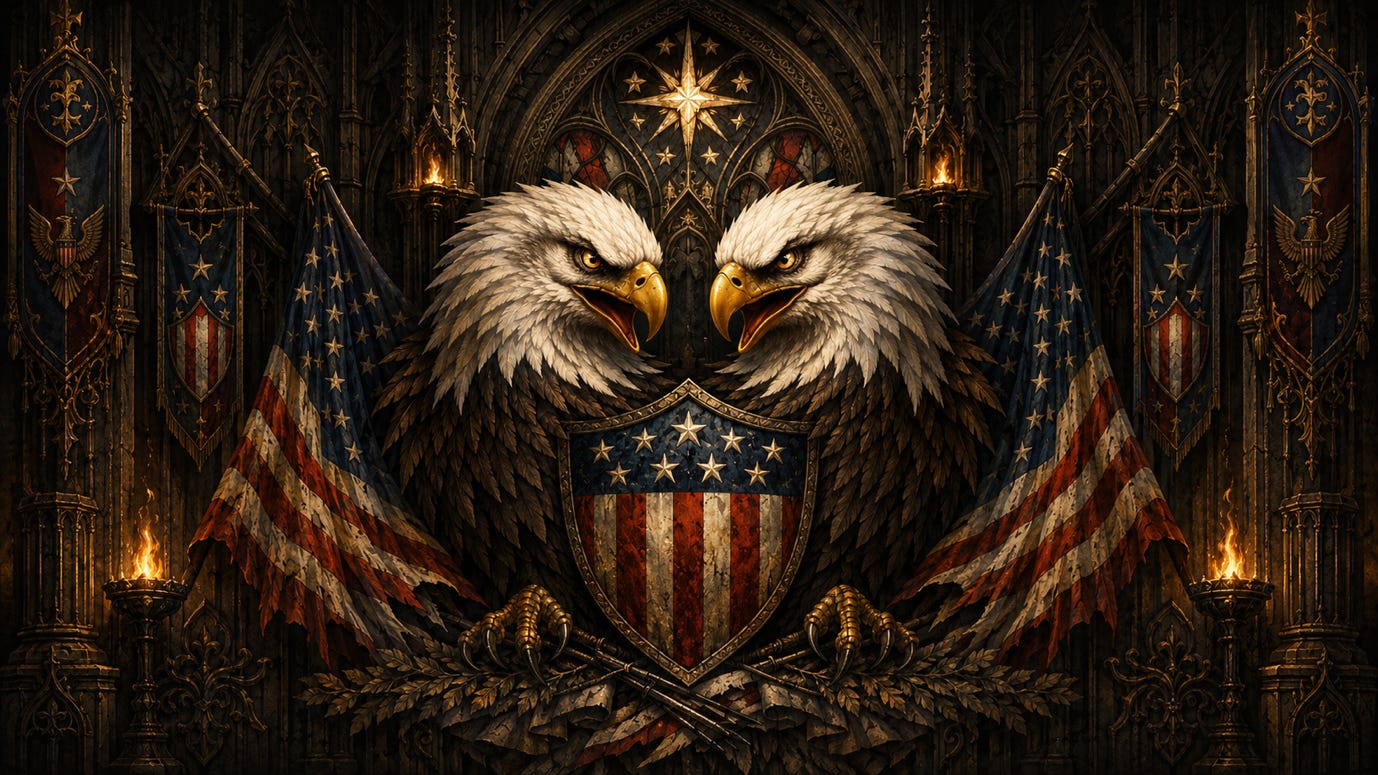
On the obverse of the Great Seal of the United States, adopted by the Continental Congress in 1782, an eagle clutches an olive branch in its right talon and a bundle of thirteen arrows in its left. Its head turns toward the olive branch, toward peace, as the designers intended. But the arrows remain firmly in its grip. The American State was born holding both, and in 250 years, it has never released either.
In 2026, the year of the Semiquincentennial itself, the United States Mint offered an inadvertent commentary on that founding iconography. For one year only, the familiar Roosevelt dime, with its torch flanked by olive and oak, was retired in favor of a new reverse: a bald eagle in flight, clutching a bundle of arrows in its left talon beneath the inscription “Liberty over Tyranny.” The right talon, the one that holds the olive branch on the Great Seal, is empty. The Mint’s intention was commemorative. The design evokes the Revolutionary era, a war already declared and a peace not yet won, and the empty talon, as its designer explained, depicts a nation still fighting for what it does not yet possess (U.S. Mint, 2025). Yet a coin struck at 250 cannot speak only of 1776. Read against its own moment, a moment of permanent war, fraying alliances, and a republic at odds with itself, the anniversary eagle becomes an emblem of the present: the arrows retained, the branch no longer even depicted. The hand that designed the Seal promised peace while keeping its weapons. The hand that designed the anniversary dime no longer felt obliged to make the promise.
This essay is an attempt to think the metaphysics of that dual gesture. It is not a history of American foreign policy, nor a political science analysis of American power structures, though it draws on both. It is rather a historiosophic inquiry, an interpretation of the philosophical meaning of the American revolutionary experiment as it has unfolded over two and a half centuries and, in its later phases, across the entire surface of the planet. The question that drives it is: what is the United States, ontologically speaking? What kind of political being has this entity been, and what does its 250-year trajectory reveal about the possibilities and limits of political existence as such?
My thesis is that the United States is best understood as a chronotope, a term I borrow from Mikhail Bakhtin (1981) and repurpose for political philosophy (see Lawson, 2011), in which two radically different principles of political being cohabit the same institutional body. The first is the Republic: a mode of collective existence grounded in constitutional promise, legal equality, popular sovereignty, and the periodic renewal of founding principles. The Republic’s temporal logic is cyclical and recursive. It returns perpetually to its origins, re-reads its founding texts, re-litigates its founding exclusions, and derives its legitimacy from a past act of collective self-constitution, the revolutionary founding that Hannah Arendt described as the creation of “a space where freedom could appear” (Arendt, 1963, p. 124). The Republic dwells in the Constitution as a living project. Its spirit is juridical, deliberative, economically self-sufficient, and, at its best, self-correcting.
The second principle is the Empire: a mode of being present beyond one’s own territory through direct conquest, military projection, financial hegemony, developmental patronage, and cultural radiation. The Empire’s temporal logic is linear and expansionist; it moves outward from a center, absorbs new spaces, and projects power across ever-larger distances. The Empire does not return to its origins: it lives as it advances toward ever newer frontiers. Frederick Jackson Turner understood this when he declared in 1893 that American democracy had been shaped by “the existence of free land” (Turner, 1893/2017, p. 132), and when the continental frontier closed, the imperial frontier opened. The Empire dwells not in documents but in practices: in military bases, dollar-denominated debt, carrier strike groups, Hollywood narratives, and the dense institutional web of Bretton Woods and its successors.
Unlike the double-headed eagles of the Habsburg and Romanov empires, Byzantine creatures that looked simultaneously east and west, explicitly announcing their dual orientation but single nature, the American eagle has a single head. It does not acknowledge its own division. The Republic insists it is not an empire; the Empire insists it serves the Republic. This mutual disavowal is not hypocrisy, or not merely hypocrisy. It is, as Reinhold Niebuhr understood better than anyone, an irony: a condition in which virtuous intentions produce their opposite because of a vanity hidden from the actor (Niebuhr, 1952). Americans build an empire because they believe in freedom—not despite that belief, but because of it. The constitutional spirit and the imperial practice are dialectically intertwined, each generating the conditions for the other’s reproduction.
The spatial scope of this dialectic has expanded relentlessly. In the eighteenth century, the struggle between Republic and Empire played out on the eastern seaboard and the trans-Appalachian frontier, moving westwards over the indigenous tribes’ graveyards. In the nineteenth century, it reached the Pacific and the Caribbean. In the twentieth century, it encompassed the globe. And in the brief, extraordinary period between the Soviet collapse of 1991 and the American withdrawal from Kabul in 2021, the so-called “unipolar moment” (Krauthammer, 1990; Brands, 2018), the American chronotope achieved its maximum extension, becoming coterminous with the planet itself. The Republic’s constitutional promise and the Empire’s military-financial architecture were projected simultaneously onto every continent, generating both unprecedented stability and unprecedented contradiction.
In this essay, I ask what that 250-year trajectory means philosophically. I ask what the Republic achieved and what it cost. I ask whether the unipolar moment fulfilled or exhausted the American experiment. And I ask the question that matters most for the twenty-first century: can the spirit of the Constitution and the idea of permanent war, two forces that have long animated American political existence, ever find peace with one another? Or is their irreconcilable cohabitation itself the deepest truth about what America is?
In thinking about these questions, I draw on a tradition of American self-reflection that is itself divided: between those who see the Republic as America’s essence and the Empire as its aberration, and those who see the Empire as America’s destiny and the Republic as its legitimating narrative. The truth, I will argue, is more unsettling than either position allows. The Republic and the Empire are not two separate entities inhabiting the same body. They are two aspects of a single political ontology, and the 250-year history of the United States is the unfolding of their impossible, productive, and increasingly dangerous coexistence.
The Spirit of the Constitution: The Republic as Ontological Achievement
The American founding was a philosophical event, and this is not a metaphoric statement. In the summer of 1787, a group of men gathered in Philadelphia and performed an act that, as Hannah Arendt argued in On Revolution, had no precedent in the Western political tradition: they constituted a new political space, that is, not merely a new government, but a new form of collective being grounded in mutual promise and legal equality (Arendt, 1963, p. 7). The words “We the People” were not descriptive but performative: they called into existence the very subject, a self-governing people, in whose name they spoke. The Constitution that emerged from Philadelphia was not, on Arendt’s reading, a limitation on power but its very source, because legitimate power springs from people acting in concert. The “spirit” that dwells in the Constitution is the spirit of this founding act: the capacity of human beings to create, through speech and mutual commitment, a durable framework for political freedom.
The philosophical novelty of this achievement deserves emphasis, precisely because familiarity has dulled our sense of its strangeness. Before 1787, the dominant Western political traditions, most of all monarchical, aristocratic, and theological, all located the source of political authority outside the political community itself: in divine right, in natural hierarchy, or in historical custom. The American founders relocated authority into the act of the Constitution itself, into what Bruce Ackerman has called “higher lawmaking” by the People (Ackerman, 1991, p. 6). This was both a new theory of legitimacy and a new ontology of the political. The Republic exists not as a natural fact or a divine dispensation but as a continuously renewed human achievement, an experiment, and as Jill Lepore has put it, “and experiments can fail” (Lepore, 2018, p. xiv).
Yet the Republic was born already divided. Gordon S. Wood’s magisterial study The Creation of the American Republic traces a transformation that occurred between 1776 and 1787: from classical republican ideology, which emphasized civic virtue and the willingness of citizens to sacrifice private interest for the common good, to a modern constitutionalism that acknowledged the impossibility of relying on virtue and instead built institutional mechanisms to channel self-interest toward public ends. Wood describes the Constitution as marking “the end of classical politics” in America (Wood, 1969, p. 606). Madison’s genius in Federalist No. 10 was to reconceive the republic not as a community of virtuous citizens but as a machine for managing the competition of factions, a mechanism that could function even when its operators were motivated by ambition and avarice.
This internal fissure between the Republic as a moral community requiring virtue and the Republic as an institutional mechanism presupposing self-interest is present at the origin, and it has never been resolved. It is, in fact, the first form of the tension that this essay tracks: the Republic’s constitutional spirit aspires to a form of collective life grounded in mutual commitment, but its institutional machinery accommodates the very acquisitive individualism that would later drive imperial expansion. The mechanism that was designed to preserve the Republic also created the political conditions for the Empire.
No one diagnosed this condition more precisely than Louis Hartz, a long-forgotten thinker. In The Liberal Tradition in America (1955), Hartz advanced the provocative thesis that the United States never developed a genuine political dialectic because it lacked a feudal past. Without feudalism, there was no aristocratic reaction, and without aristocratic reaction, there was no revolutionary socialism. What remained was an all-encompassing Lockean liberalism, a consensus so total that Americans could not see it as an ideology at all. Hartz described this condition as “liberal absolutism” (Hartz, 1955, p. 11): a liberalism so deeply internalized that it appeared to its adherents not as one possible political philosophy among others, but as the natural order of things, as self-evident truth.
The implications for the Republic-Empire dialectic are significant: if Americans experience their particular political arrangements as universal rational truths rather than as historically contingent institutions, then the projection of those arrangements onto other societies does not appear as imperial imposition but as the spread of universal reason itself. The Republic exports itself and genuinely does not understand why this looks like an empire to those on the receiving end. Hartz saw this clearly: the same liberal absolutism that made American domestic politics remarkably stable, despite and due to its constant storms, also made American foreign policy remarkably obtuse, that is, incapable of comprehending societies organized on different principles, and therefore incapable of recognizing its own interventions as exercises of power rather than gifts of enlightenment.
John Rawls, working within the liberal tradition Hartz diagnosed, provided its most rigorous philosophical self-justification. In Political Liberalism (1993), Rawls grounded the Republic in the concept of an “overlapping consensus” among reasonable comprehensive doctrines (Rawls, 1993, p. 134): citizens who hold irreconcilably different religious, philosophical, and moral views can nonetheless agree on constitutional essentials, such as basic liberties, the structure of government, and principles of fair procedure, for reasons internal to their own worldviews. This is the Republic as philosophical architecture: a structure of coexistence designed to accommodate deep pluralism without imposing any single vision of the good.
But Rawls’s framework, for all its philosophical power, contains a telling limitation. The overlapping consensus is domestic, as it presupposes a bounded political community within which reasonable citizens negotiate the terms of their shared life. The question of how to extend principles of justice beyond the borders of the republic to peoples organized under different constitutional arrangements, or under no constitutional arrangements at all, remained a tension that Rawls himself struggled with in The Law of Peoples (1999) without resolution. The Republic, in its most sophisticated self-understanding, cannot account for the world beyond its borders except as a problem to be managed or a space to be converted. And the name for that management, that conversion, is Empire.
The Republic’s philosophical self-image is further complicated by its own history of exclusion. Judith Shklar’s American Citizenship (1991) reframes the meaning of citizenship not through the language of rights but through the historical experience of their denial. To be a citizen in America, Shklar argues, has always meant two things above all: the right to earn a living and the right to vote. These are significant precisely because they were systematically denied to enslaved persons, to women, to the propertyless, to non-whites. Shklar defines citizenship fundamentally as “standing,” the opposite of degradation (Shklar, 1991, p. 2). The Republic constitutes itself not that much through inclusion as through the shadow of its exclusions. The Republic constitutes itself in the struggle over who counts as a citizen as the substance of republican politics.
Danielle Allen extends this analysis into the philosophical core of the founding itself. Her close reading of the Declaration of Independence in Our Declaration (2014) recovers equality not as a static premise but as a performative commitment — a promise that requires ongoing collective work. Allen reads the Declaration as committing Americans to “the work of achieving equality” (Allen, 2014, p. 27), a labor that is never finished because new forms of inequality perpetually emerge. The Republic, in this context, is not a completed structure but an ongoing ethical project of equalization, which means it is always falling short of its own standard, always generating the gap between promise and practice that its critics (domestic and foreign) identify as hypocrisy but that is better understood as the constitutive incompleteness of any genuinely democratic project.
Yet this self-correcting quality has limits. Robert Dahl, in How Democratic Is the American Constitution? (2001), poses the question bluntly: measured against the democratic standards that Americans themselves profess, the Constitution performs poorly. The Senate’s gross malapportionment, the Electoral College’s anti-majoritarian effects, the difficulty of formal amendment, the unelected judiciary’s power to override elected legislatures—all of these, Dahl argues, produce outcomes that systematically diverge from political equality. Americans, he suggests, treat their Constitution with uncritical “reverence” rather than democratic scrutiny (Dahl, 2001, p. 2). The Republic’s most sacred document is also, by its own standards, democratically deficient.
Pauline Maier’s American Scripture (1997) adds a genealogical dimension to this diagnosis. Maier demonstrates that the Declaration of Independence was not born as a sacred text but became one through decades of political appropriation. The document was largely forgotten for years after 1776, then gradually resurrected and transformed into what Maier calls “American Scripture” through political use (Maier, 1997, p. xviii): first by antislavery activists, then by Lincoln, then by successive movements for inclusion. The “spirit of the Constitution” is not a Platonic essence waiting to be discovered but a historically constructed tradition, perpetually contested and periodically reinvented. The Republic exists not as a stable substance but as a field of interpretive struggle over the meaning of its own founding documents.
What emerges from this analysis is a Republic that is philosophically magnificent and structurally incomplete. The American founding was a genuine ontological achievement: it was the creation of a new form of political being grounded in mutual promise and constitutional law. But this Republic was, from its inception, internally fissured: between classical virtue and modern mechanism (Wood), between liberal universalism and liberal blindness (Hartz), between the promise of equality and the practice of exclusion (Shklar, Allen), between democratic aspiration and constitutional constraint (Dahl), between sacred text and political construction (Maier). The Republic contains within itself a gap between what it promises and what it delivers, between the universality of its principles and the particularity of its institutions, between its self-understanding as a beacon of freedom and the recognition that its domestic achievements have always depended on conditions it cannot fully account for within its own constitutional vocabulary.
What fills that gap? What has historically compensated for the Republic’s internal deficiencies, channeled its surplus energies, provided the material conditions for its domestic achievements, and offered a mission grand enough to absorb the contradictions that might otherwise tear it apart?
The answer is the Empire. And it is to the Empire’s own self-understanding, including the remarkable tradition of American strategic thought that has, since the late 1940s, articulated the case for permanent war as a condition of permanent freedom, that we must now turn.
The Practice of Empire: From Frontier to Planet
The American principle of Empire has never taken a single form. It has operated, across its history, in four distinct but overlapping modes of being present outside one’s own territory, each deploying a different combination of force, capital, institutions, and ideas.
The first and oldest is direct conquest and territorial control. From the displacement of indigenous peoples, what Robert Kagan calls the “original sin” that “began a cycle of advance and conquest” (Kagan, 2006, p. 12), through the Mexican-American War, the annexation of Hawaii, the conquest of the Philippines, and the invasions of Iraq, Afghanistan, and Iran, the United States has repeatedly extended its sovereignty or effective control through military force. Alfred Thayer Mahan provided the strategic blueprint: maritime supremacy as the condition of “national greatness” (Mahan, 1890/2020, p. 1), the control of sea lanes as the precondition for commercial survival. Turner supplied the cultural logic: if American democracy was constituted by the frontier, then the closure of the continental frontier in 1890 demanded new frontiers beyond the oceans. Mahan and Turner, read together, reveal the structural imperative: the Republic needed an outside, a space of expansion and a horizon of possibility, and when the continent was full, the world became that outside.
The second register is developmental empire: the projection of American institutional models through aid, technical assistance, and nation-building. The Marshall Plan, the Alliance for Progress, USAID missions, and the democracy-promotion apparatus of the National Endowment for Democracy represent the Republic’s attempt to remake other societies in its own image. This is Hartz’s liberal absolutism in its most benevolent and oblivious mode: a liberalism so confident in its universality that it genuinely cannot distinguish between assistance and imposition. The developmental empire is the Empire that most resembles the Republic, because it speaks the Republic’s universalist language (democracy, rule of law, free markets, human rights), while performing the Empire’s function (the incorporation of foreign societies into an American-centered symbolic and institutional order).
The third register is the financial empire. The dollar’s status as the global reserve currency, IMF conditionality, the extraterritorial reach of American financial regulation, and the Wall Street–Treasury complex constitute an imperial architecture that operates through capital flows rather than troop deployments. Already in 1959, William Appleman Williams identified this as the deep structure of American foreign policy: the Open Door, the insistence that all markets everywhere must be accessible to American goods and capital, driven by the conviction that “expansion was the way to freedom” (Williams, 1959, p. 15). Charles Maier extended this analysis by describing the United States as an “empire of consumption” (Maier, 2006, p. 24), a system that projects power through the sheer gravitational pull of the world’s largest market and the structural privilege of its currency. Financial empire is the quietest mode of imperial presence, and for that reason, the most durable: it operates in the background of everyday economic life, shaping the choices available to governments, firms, and individuals worldwide without the political costs of visible military occupation.
The fourth register is cultural soft power: Hollywood, Silicon Valley, the English language as global lingua franca, American universities as credentialing institutions for the world’s elites, and the dense ideological radiation of individual freedom, entrepreneurial self-making, and consumer choice. Hardt and Negri pushed this analysis to its metaphysical limit by arguing that the American constitutional model is itself “imperial” in its expansive network logic (Hardt & Negri, 2000, p. 160), a decentered, federalist sovereignty designed for indefinite extension. On their reading, the Empire is not a betrayal of the Constitution but its global realization: the same networked, open, scalable institutional form that allowed thirteen colonies to become fifty states now reproduces itself across the planet as a model of governance, a grammar of legitimate power.
These four registers of imperial presence have been sustained since the mid-twentieth century by a distinctive intellectual tradition that has theorized permanent strategic engagement as the necessary condition for American survival. This tradition is rarely discussed in polite academic company, but its influence on actual policy has been immense.
Its founding figure is James Burnham. In The Struggle for the World (1947), Burnham, a former Trotskyist who, in his later years, had traded revolutionary internationalism for imperial grand strategy, argued that the Cold War was not a temporary confrontation but a civilizational struggle requiring a permanent offensive. He rejected Kennan’s containment as a “formula for Soviet victory” and instead called for political subversive warfare, economic pressure, and covert operations designed not merely to hold the line but to roll back Soviet power. Burnham acknowledged frankly what others preferred to obscure: a world federation led by the United States would be, in his words, “a World Empire” (Burnham, 1947, p. 182). His intellectual heirs, like the Committee on the Present Danger, the Team B hawks of the 1970s, or the defense sector intellectuals of the Reagan buildup, carried his logic forward, always arguing that the Republic’s survival required imperial vigilance without end.
Andrew Marshall institutionalized this logic. As director of the Pentagon’s Office of Net Assessment from 1973 to 2015, forty-two years spanning eight presidencies, Marshall created the bureaucratic infrastructure of permanent competition: an office whose function was the continuous assessment of the strategic balance, decade after decade, ensuring that American military advantage was maintained in perpetuity. Marshall did not write manifestos, but he produced classified assessments. His contribution was not an idea, but a practice: the routinization of permanent war-participation as an ordinary function of the administrative state.
The tradition reached its most explicit expression in the period between the Soviet collapse and September 11, 2001. The Wolfowitz Doctrine of 1992, the leaked Defense Planning Guidance that declared America’s strategic goal to be the prevention of any rival power’s emergence (Milne, 2017, p. 160), translated Burnham’s logic into post–Cold War terms. The Project for the New American Century’s Rebuilding America’s Defenses (2000) went further, calling for the permanent “preeminence of U.S. military forces” globally, describing American troops abroad as “the cavalry on the new American frontier” (Donnelly et al., 2000, p. 14), and warning that the necessary military transformation would be slow “absent some catastrophic and catalyzing event.” Zbigniew Brzezinski, writing from a realist rather than neoconservative perspective, reached a similar structural conclusion in The Grand Chessboard (1997): American security required permanent engagement across the Eurasian landmass, yet “America is too democratic at home to be autocratic abroad” (Brzezinski, 1997, p. 35). The Republic’s culture resisted what its geopolitical position demanded. This, for Brzezinski, was a problem to be managed. For our purposes, it is the clearest articulation of the chronotope’s internal contradiction.
The Empire, then, is not a single thing but a layered formation with its military, developmental, financial, and cultural institutions, sustained by an intellectual tradition that has, with remarkable consistency since 1947, argued that permanent strategic engagement is the price of the Republic’s survival. But this formation has never been able to name itself honestly. As Andrew Bacevich observed, the United States maintains nearly 800 military installations worldwide while its political culture insists it has no imperial ambitions: a nation afflicted by “the new American militarism” that it refuses to recognize (Bacevich, 2002, p. 2). Chalmers Johnson cataloged the material infrastructure of this unnamed empire, with its global base network, secret budgets, and status-of-forces agreements that place American soldiers beyond the jurisdiction of host nations, and warned that the Empire’s “sorrows” would ultimately destroy the Republic (Johnson, 2004, p. 285). Stephen Wertheim showed that this empire was not a reluctant response to a threat but a deliberate choice: American planners chose “armed primacy” as a grand strategy (Wertheim, 2020, p. 4) between 1940 and 1941, before Pearl Harbor, before the Cold War, before any of the threats that would later be invoked to justify it.
Noam Chomsky provided the sharpest ideological critique: the gap between republican rhetoric and imperial practice is not hypocrisy but a structural feature of the system, in which the constitutional vocabulary of freedom, democracy, and self-determination functions as the legitimating discourse for a grand strategy driven by the logic of “hegemony or survival” (Chomsky, 2003, p. 4). The Republic does not merely coexist with the Empire; it provides the Empire with its moral language, its self-justification, its claim to be something other than what it is.
But the deepest thinker of the Empire’s self-understanding remains Reinhold Niebuhr, who grasped something that neither the hawks nor the doves fully appreciated: the relationship between Republic and Empire is not one of deception but of irony. Americans do not build an empire cynically, using constitutional rhetoric as a cover story. They build an empire sincerely, because they genuinely believe that their power serves freedom. And this sincerity is precisely what makes the irony inescapable. The Empire is not the Republic’s opposite but its shadow: the form that republican idealism takes when it encounters the resistance of the world. Niebuhr’s warning that America faces the irony of “strength becoming weakness” through moral pretension (Niebuhr, 1952, p. 133) is not a prediction about some future catastrophe. It is a description of the permanent condition of a Republic that has become an Empire without ceasing to believe in its own innocence.
The Empire, then, is not an aberration. It is not what happened when the Republic went wrong. It is what the Republic produces when it projects its constitutional universalism onto a world that does not share its premises, when liberal absolutism meets geopolitical necessity, when the frontier closes and reopens on a planetary scale, and when the olive branch and the arrows are carried by the same hand to the same destination. The question is whether this dual gesture can be sustained indefinitely, or whether the weight of the arrows will eventually force the eagle to release the branch.
The Dialectic Synthesis of Republic and Empire
The conventional critique of American empire from the anti-imperialists of 1898 through the Vietnam-era revisionists to the post-Iraq/Afghanistan disillusionment tends to assume that Republic and Empire are distinct and separable: that the Republic is the authentic America and the Empire its alter ego, that a sufficiently determined act of political will could extract the one from the other, that the eagle could release the arrows and keep the branch. The conventional defense of American power makes the opposite but structurally identical assumption: that American global engagement serves the Republic’s values, that empire (never called by that name) is the Republic’s instrument, and that the two are reconciled in the benevolent exercise of hegemonic responsibility.
Both positions are wrong, and they are wrong in the same way: each treats Republic and Empire as logically independent entities that happen to coexist in the same political body. The argument of my essay is that they are not independent at all. They are constitutively entangled as two aspects of a single political subject, each producing the conditions for the other’s existence. Separating them would not liberate the Republic from imperial corruption; it would destroy both.
The entanglement begins in the Constitution itself. Hardt and Negri advanced the provocative thesis that the American constitutional model is networked, federalist, designed for indefinite spatial extension, and was “imperial” in its very structure (Hardt & Negri, 2000, p. 160). The claim is overly deterministic, but it identifies something real. The mechanism that allowed thirteen colonies to become fifty states, that is, the constitutional provision for admitting new states on equal terms and the flexible federalist architecture that could accommodate territories of vastly different size and character, was also the mechanism that enabled continental conquest and, eventually, global projection. The Northwest Ordinance of 1787, which established the template for westward expansion, was adopted in the same summer as the Constitution itself. The Republic and the frontier were co-constituted: the constitutional order was designed, from its inception, to grow.
Bruce Ackerman’s theory of “constitutional moments,” which, for example, includes the Founding, Reconstruction, and the New Deal, acquires a new significance when read through this lens. Each moment of constitutional self-renewal also expanded the spatial scope of American power. The Founding constituted a continental aspiration. Reconstruction consolidated effective sovereignty over the defeated South and, by establishing federal supremacy, created the preconditions for projecting unified national power abroad. The New Deal transformed the federal government into an apparatus capable of managing a continental economy and, within a decade, a global one. Each deepening of the Republic’s constitutional order simultaneously enlarged the Empire’s institutional capacity. The Republic did not build the Empire accidentally, as a side effect of pursuing domestic goals. The very processes that renewed and deepened the constitutional order and that made the Republic more republican also made the Empire more powerful.
Robert Kagan’s historical argument reinforces this structural analysis from the empirical side. If, as Kagan demonstrates, the United States was never an isolationist power but was, from its earliest colonial settlements, driven by “aggressive expansionism, acquisitive materialism, and an overarching ideology of civilization that encouraged and justified both” (Kagan, 2006, p. 3), then the conventional narrative of a peaceful republic reluctantly drawn into imperial entanglements collapses entirely. The Republic was always already imperial. Not so much because it was corrupted from without, but more for its constitutive principles that include individual liberty, property rights, commercial expansion, or civilizational mission, contained within themselves the logic of indefinite outward projection. The frontier was not an accident that happened to the Republic, it was the spatial form of republican energy.
The entanglement runs even deeper. The Republic’s domestic achievements, that is, those material conditions that have made American constitutional democracy livable and attractive, have historically depended on the Empire’s operations. The prosperity that funded the New Deal and the Great Society, the consumer abundance that reconciled Americans to the Constitution’s democratic deficits (Dahl, 2001), the social mobility that gave the American dream its purchase on the imagination were underwritten, in ways that Americans have rarely acknowledged, by imperial extraction and market control.
Williams (1959, p. 22) identified this structural dependency as the central thread of American diplomatic history: the Open Door, the insistence that global markets remain accessible to American capital, was not one policy among others but the foundational condition of domestic prosperity. When markets contracted (as in the 1890s, the 1930s, the 1970s), the Republic faced a crisis at home. When they expanded, as after 1945 and 1991, the Republic flourished. The Bretton Woods system, the Marshall Plan, and the GATT/WTO trading order were simultaneously acts of republican generosity aimed at rebuilding Europe and opening trade, and acts of imperial architecture, ensuring American financial centrality, creating a dollar-denominated world economy, and binding allies into a system whose rules America wrote. The Republic’s finest hour and the Empire’s foundational moment were the same event.
This is, in my opinion, the imperial subsidy of republican life. The Republic’s citizens enjoy constitutional freedoms, material comfort, and relative domestic peace not because the Constitution alone provides these goods, but because the Empire’s military security, financial hegemony, and market access create the conditions under which constitutional governance can function. Remove the subsidy, and the Republic confronts the questions it has historically been able to avoid: how to distribute scarcity rather than abundance, how to maintain legitimacy without growth, how to sustain democratic institutions when the imperial dividend ceases to flow.
The subsidy operates through a mechanism that deserves more attention than it usually receives: war itself as a financial pump. The Empire contradicts the Republic, but it also feeds it. Every war the Empire starts or enters sets the capital in motion, and the motion has a direction. Conflict destabilizes the war region; destabilization sends wealth in search of safety; and safety, in the world the Empire built, means dollar-denominated assets, Treasury bonds, Manhattan real estate, Delaware shell companies, and the custodial discretion of American banks (Eichengreen, 2011). The pattern recurs across the whole arc of American ascendancy. European capital, fleeing two world wars, capitalized on American finance and made New York the successor to London. Petrodollars generated by the wars and oil shocks of the 1970s were recycled through the same institutions (Spiro, 1999). The elites of every subsequent war region, from the Persian Gulf to the Balkans to post-Soviet Eurasia, have parked their fortunes in the very financial system whose military arm had unsettled their neighborhoods. War on the periphery produces liquidity at the center. The Empire is usually entered in the Republic’s books as a cost, the trillion-dollar line of bases and deployments. But it is also a revenue: capital inflows, cheap credit, and the exorbitant privilege of a currency the world is compelled to trust precisely because the world is unsafe (Helleiner, 1994). The arrows, in this sense, fertilize the ground in which the olive tree grows. This is the political economy of the dual gesture, and it explains, in part, why the gesture has lasted 250 years: the contradiction is profitable.
The final and most unsettling dimension of the entanglement is ideological. Chomsky’s critique holds that republican rhetoric functions as a legitimating discourse for imperial practice and that the language of freedom, democracy, and human rights provides moral cover for domination. This is true, but it does not go deep enough. The spirit of the Constitution not only legitimizes the Empire, but also motivates it. Americans have not, in the main, built their global empire cynically, using freedom-talk as a cover for the pursuit of power. They have built it sincerely, because they believe, as Hartz diagnosed, with the unshakeable conviction of a tradition that cannot see itself as a tradition, that their political arrangements are universally valid and that extending them is a service to humanity.
This is the deepest form of the dialectic. The Republic generates the Empire not through failure but through success and the very persuasiveness of its constitutional vision, which convinces its citizens that what is good for America is good for the world, that the extension of American power is the extension of freedom, that the arrows serve the olive branch. The ideological mechanism by which this occurs is Hartz’s liberal absolutism: a liberalism so total that it cannot recognize itself as an ideology, and therefore cannot recognize its own projection onto others as an act of power. The Republic does not choose to become an empire. It becomes one by being most fully itself, by taking its own universalist principles seriously and acting on them in a world that does not share them.
We arrive, then, at a philosophical diagnosis. The American chronotope is dialectical only to a limited extent, as it is a dialectic without resolution. In the Hegelian schema, the thesis and antithesis sublate into a higher synthesis that both preserves and transcends them. The American Republic and Empire do not sublate: they do not produce a third term that reconciles constitutional self-governance with imperial projection. There is no stable position from which one can be a constitutional democracy at home and a benevolent hegemon abroad without the two contaminating each other, without the habits of empire eroding domestic freedoms (as Johnson warned), or the habits of democracy constraining imperial efficiency (as Brzezinski worried).
What exists instead is a productive tension, that is, a permanent oscillation between the two poles that generates the peculiar dynamism of American political life. The Republic constrains the Empire through constitutional checks on executive war powers, congressional oversight, public opinion, and the courts, while the Empire sustains the Republic through security, prosperity, and global influence. As in Harry Potter’s epics, neither can destroy the other without destroying itself. The Republic without the Empire would be a modest, inward-looking democracy; prosperous perhaps, but stripped of the global mission that has defined American identity since the founding. The Empire without the Republic would be a naked exercise of power; effective perhaps, but stripped of the legitimating narrative that has been its greatest strategic asset.
The American eagle holds the olive branch and the arrows because it cannot release either. And the 250-year history of the United States is the history of its attempt to fly with both, an attempt that reached its most ambitious, most contradictory, and most consequential expression in the thirty years that followed the Soviet collapse.
The Ideology in Stone: Architecture and the Political Grammar of Space
The dialectic of Republic and Empire is not only a structure of ideas and institutions. It is inscribed in stone, legible in the political grammar of built space that the American experiment inherited from its Roman predecessor and reinscribed in its own monumental vocabulary.
Rome underwent this transformation first. Republican architecture, including the Forum, the Curia, and the Basilica Aemilia, projected a visual order organized around office, deliberation, ancestral memory, and civic plurality. The republican building said: Rome is governed by magistracies, laws, and public ritual. Its symbolic vocabulary was the rostra (the speakers’ platform as a sign of public contest), the fasces (authority vested in office, not in a person), honorific statues of competing aristocratic lineages, and temples to traditional gods protecting the res publica. The public square was a space of participation, however oligarchic in practice, a built environment that presupposed the citizen as political actor (Stamper, 2005, pp. 2–5). As Pierre Gros has shown in his studies of Roman public architecture, the republican Forum functioned as a spatial analog of the mixed constitution: multiple institutions facing one another, no single center of visual gravity, the eye moving across a plural civic order (Gros, 1996, pp. 26ff).
Imperial architecture performed a decisive transformation. The Forum of Augustus, the Ara Pacis, the Arch of Titus, or the Flavian Amphitheater were no longer spaces of civic participation but instruments of ideological unification. Relief sculpture ceased to be decorative and became a political argument in stone: peace, fertility, piety, military victory, and cosmic legitimacy converged in the person of the emperor. The imperial building said: Rome is ordered, protected, and glorified through the ruler and his house. Public space was converted from a field of contested dignities into a stage on which power had found its single face. The citizen became a spectator of majesty rather than a co-author of governance (Zanker, 1988, pp. 28ff). Paul Zanker’s classic analysis of Augustan visual culture demonstrates that this was not mere propaganda imposed from above; it was an entire recoding of the political imaginary, in which the Republic’s symbols were not abolished but absorbed into a new grammar centered on the princeps as the guarantor of universal order.
This Roman trajectory matters for our argument because the American founders were acutely conscious of it. They read Plutarch, Cicero, and Livy; they named their deliberative body the Senate; they adopted the eagle, the fasces, and the classical portico as the visual language of their new republic. And in designing the federal capital, they produced a built environment that recapitulates the very dialectic this essay has been tracing.
Washington, D.C., is a hybrid, i.e., dialectical, regime in stone. Its republican code is strongest wherever architecture emphasizes law, representation, office, and impersonal institutions. The Capitol, housing the legislature, not a throne, stands at the head of the National Mall as the architectural assertion of representative government’s primacy. The Mall itself, as an open civic field joining (though somewhat museified) institutions and monuments in a legible public composition, functions as a spatial analog of constitutional visibility: an ordered expanse meant to belong to the polity as a whole. Even the White House, at its most republican, signifies not monarchy but temporary magistracy housed in a disciplined Palladian residence (Scott, 1995).
But the imperial code is equally unmistakable. The Capitol dome, historically a form that concentrates vision upward and inward, producing a symbolic center of gravity, transforms the legislative house into a national shrine visible across the city, crowned by the Statue of Freedom and, inside, by Constantino Brumidi’s Apotheosis of Washington (1865): a fresco that literally elevates the first president into the company of gods. This is a profoundly imperial move in visual rhetoric: the Republic clothing itself in the iconography of sacral power. The White House, despite its neoclassical restraint, has evolved into something less like the house of an ordinary magistrate and more like a carefully domesticated palace: not monarchical in law, but palatial in symbolic concentration, especially after Theodore Roosevelt’s 1902 renovation consciously refashioned it as a statement of modern executive command (Seale, 1986). And the Mall itself, for all its democratic openness, operates simultaneously as a ceremonial axis of extraordinary scale, suitable for processions, military display, national mourning, and the dramatization of civil religion. That is the spatial logic of imperial urbanism: space as an instrument for producing awe.
The D.C.’s dialectical formula is this: the Capitol is a republican institution in partially imperial form; the White House is a republican magistracy drifting toward palatial executive symbolism; the National Mall is a public forum expanded into an imperial ceremonial axis. Washington translates Rome into American terms by placing republican legitimacy inside imperial scale. That is why the city feels at once constitutional and triumphant, civic and theatrical, legalistic and sacred, and why it is, perhaps, the most accurate physical representation of the American chronotope that exists.
If the dialectic of Republic and Empire can be read in the philosophy of Arendt and Niebuhr, in the political economy of Williams and Maier, in the grand strategy of Burnham and Brzezinski, it can also be read, with equal precision and perhaps greater immediacy, in the stone, marble, and axial geometry of the city that bears the first president’s name. The architecture monumentalizes this tension.
The Unipolar Moment: Triumph, Hubris, Exhaustion (1991–2021)
In the winter of 1990–91, as the Soviet Union disintegrated, Charles Krauthammer announced in Foreign Affairs that the world had entered a “unipolar moment,” a period of unchallenged American supremacy without precedent in the modern state system. Francis Fukuyama, working in a Hegelian register, drew the deeper philosophical conclusion: the triumph of liberal democracy and market capitalism over communism represented not merely a geopolitical victory but the endpoint of ideological evolution, the “end of history” as a contest among rival systems of political legitimacy (Fukuyama, 1992). The Republic, it seemed, had won. Its constitutional principles stood vindicated as the final form of human governance. There was nothing left to struggle against except the residual friction of implementation.
But as Stephen Wertheim has demonstrated, unipolarity was not an accident produced by Soviet failure. It was the fulfillment of a design conceived fifty years earlier. The planners of 1940–41, working in the Council on Foreign Relations and the State Department, had chosen “armed primacy” as America’s postwar posture (Wertheim, 2020, p. 4), not as a response to any specific threat, but as a structural commitment to preventing any rival from ever dominating Eurasia. The Cold War delayed the full realization of this design by imposing a bipolar constraint. When that constraint dissolved, the original blueprint was activated by the institutional momentum of a grand strategy that had been building infrastructure, alliances, forward-deployed forces, and financial architecture for half a century. The Wolfowitz Doctrine of 1992, which declared the prevention of any peer competitor to be America’s paramount strategic objective, was not an innovation but a rediscovery, the explicit statement of what had been implicit since 1941.
The Republic and the Empire thus entered the unipolar moment together, each at the zenith of its power, each convinced that it spoke for the other. The Republic understood unipolarity as the triumph of its values; the Empire understood it as the vindication of its strategy. Fukuyama spoke for the Republic; PNAC spoke for the Empire. And for a brief, intoxicating period, the two seemed to converge: the spread of democracy, markets, and institutions (the Republic’s program) appeared identical with the maintenance of American military supremacy, financial centrality, and alliance dominance (the Empire’s program). The eagle’s two talons seemed to reach for the same object.
Intellectual honesty requires acknowledging what the unipolar moment built. The thirty years between 1991 and 2021 were not simply a period of imperial overreach. They were also a period of remarkable institutional construction and, by certain measures, unprecedented human progress.
The European Union expanded from twelve to twenty-seven members, absorbing the former Soviet satellites into a zone of relatively democratic governance, open markets, and institutional cooperation that would have been inconceivable without American security guarantees. NATO extended eastward, providing the strategic framework within which former Warsaw Pact nations could undertake democratic transitions without fear of Russian reversal. Global poverty declined at rates that no development economist of the 1980s would have predicted. International trade expanded massively under American-backed rules. The nuclear arsenals of the superpowers shrank. Great-power war, the scourge that had killed tens of millions in the first half of the twentieth century, did not recur.
These achievements were real and products of both the Republic and the Empire working in tandem. The Republic provided the normative framework that gave the post–Cold War order its legitimacy. The Empire provided the security architecture that gave it durability. The dollar system and American-led international institutions (the IMF, the World Bank, the WTO) provided the economic infrastructure. For the populations of Central and Eastern Europe in particular (and this must be said plainly, by anyone writing from a post-Soviet perspective), the American-led order offered something of immense value: the possibility of a political existence no longer determined by the proximity of Russian power.
But the same period that built these institutions also revealed, with devastating clarity, the destructive potential of the Republic-Empire dialectic operating without external constraint.
The War on Terror, launched after September 11, 2001, with near-unanimous domestic support and vast international sympathy, became the vehicle through which the Empire consumed the Republic from within. The invasion of Afghanistan in 2001 could be justified on grounds of self-defense. The invasion of Iraq in 2003 could not, and the Republic’s own constitutional mechanisms failed to prevent it. PNAC’s blueprint was implemented almost to the letter: regime change in Iraq, permanent military presence in the Persian Gulf, and the assertion of preventive war as doctrine. Johnson’s concept of blowback was confirmed with terrible precision: the very interventions that were supposed to secure the Republic generated new enemies, new resentments, and new cycles of violence. The empire produced the threats it then invoked to justify its own expansion.
Domestically, the consequences were equally corrosive. The PATRIOT Act, warrantless surveillance, extraordinary rendition, and the legal black hole of Guantánamo represented the subordination of constitutional principle to imperial necessity. Bacevich’s diagnosis (2005, p. 2) of “the new American militarism” was borne out as war became normalized, permanent, and largely invisible to an American public that was not asked to sacrifice for it. The all-volunteer military fought open-ended wars in multiple theaters while most citizens experienced the conflict only as background noise. The Republic’s most fundamental commitment, that the decision to go to war must reflect the deliberate consent of the governed, was hollowed out.
Meanwhile, the imperial subsidy of republican prosperity began to fail. The financial crisis of 2008 exposed the fragility of the dollar-denominated global order; the recovery that followed benefited capital disproportionately, accelerating the inequality that the postwar imperial economy had once helped to moderate. Manufacturing migrated to China, a transfer of productive capacity that enriched American consumers in the short term while undermining the working-class prosperity that had been the Republic’s powerful domestic legitimation. The political polarization that would later convulse American democracy was, in part, a consequence of the uneven distribution of the imperial dividend: some Americans continued to benefit from globalization and hegemony; others experienced them as dispossession.
The year 2021 brought three events that, taken together, mark the symbolic exhaustion of the unipolar chronotope.
On January 6, a mob invaded the United States Capitol in an attempt to overturn a presidential election, which was a direct assault on the Republic’s constitutional order since the Civil War. In August, the United States withdrew from Afghanistan in chaotic circumstances that recalled the fall of Saigon, the most visible admission of imperial failure since Vietnam. And throughout, the COVID-19 pandemic continued to expose the hollowness of American institutional capacity, a Republic that could project military power to every corner of the globe but could not distribute vaccines to its own citizens with basic competence.
These were not unrelated events. Each expressed a different dimension of the same exhaustion. January 6 was the Republic’s crisis: the constitutional mechanisms of self-governance with regular elections, the peaceful transfer of power, and the authority of law buckled under pressures that the founders’ institutional machinery was not designed to absorb. Kabul was the Empire’s crisis: the limits of military power to reshape societies, the impossibility of sustaining a permanent war posture without visible returns (now repeated in the Iran adventure). The pandemic was the crisis at their intersection: a state so oriented toward external projection that it had neglected the domestic infrastructure on which both the Republic and the Empire ultimately depend.
The grand debate of the 1990s between Fukuyama’s “end of history” and Huntington’s “clash of civilizations” (1996) turned out to miss the real story. The decisive clash was not between Western civilization and its external challengers. It was the clash within American civilization, between the Republic and the Empire, that had sustained and consumed each other for 250 years. And by 2021, both were exhausted: the Republic by the Empire it had funded, the Empire by the Republic whose legitimation it required.
There is a further dimension to this exhaustion, one visible chiefly from outside the binary that structured the second half of the twentieth century. The great historian Blair Ruble, one of America’s most perceptive students of its great rival, put it to me this way:
“I have always suspected that both the USSR and the US lost the Cold War. We became so preoccupied with one another that we never noticed the world changing all around us. The USSR got caught in this trap first (never being able to sustain innovation), as did we too (never being able to transcend the quest for Empire). This is one reason Trump’s war with Iran is such a telling disaster. No one answers his calls for help. They no longer have to do so. The world changed and we didn’t notice” (B. Ruble, personal communication, 2026).
The observation reframes the entire unipolar episode. What looked, from Washington, like victory was a continuation of the trap: the bipolar contest had consumed both contestants, and the survivor mistook its rival’s collapse for its own triumph. The unipolar moment was, on this reading, the Cold War’s second casualty, deferred by thirty years. While the American chronotope projected itself onto the planet, the planet was quietly organizing itself along other lines, including Chinese industrial scale, Indian demographic weight, Gulf capital, and regional powers that no longer needed the patron’s permission or protection. The exhaustion of 2021 was therefore double: internal, in the mutual depletion of Republic and Empire, and external, in a world that had stopped waiting for America while America was watching itself.
Can the Eagle Find Peace?
The exhaustion of the unipolar moment has made the question that animates this essay, whether the spirit of the Constitution and the practice of permanent war can ever find peace between themselves, not merely academic but urgent. The American chronotope seems to be entering a new phase. The architecture of unipolarity is cracking under the pressure of Chinese ascendancy, Russian revanchism, the fragmentation of the liberal international order, and the erosion of domestic consensus. The eagle is struggling to fly. What happens next depends, in part, on which of several possible futures Americans choose, or have chosen for them.
The first possibility is that the Republic prevails. This is the vision of the restraint school (Bacevich, Wertheim, the Quincy Institute), which calls for a fundamental reorientation of American grand strategy: the liquidation of the global base network, the withdrawal from permanent military commitments, the end of regime change and nation-building, and the redirection of resources toward repairing the Republic’s domestic infrastructure. On this account, the Empire is a tumor that must be excised for the constitutional body to heal. There is much that is admirable in this position, and much that is necessary. But the analysis developed in this essay suggests a difficulty that the restraint school tends to underestimate: the Republic’s domestic achievements were never self-sustaining. They were subsidized by the Empire, that is, by the dollar system, by market access, by the security architecture that kept trade routes open and allies compliant. To dismantle the Empire is not simply to liberate the Republic; it is to remove the material conditions under which the Republic, as Americans have known it, has functioned. The Republic that emerges from a retreat from empire may be a Republic, but it will not be the Republic of postwar abundance, consumer democracy, and global cultural prestige. It will be something more modest, constrained, provincial, and it is far from clear that the American political culture, formed by two centuries of expansion, is prepared for that reckoning.
The second possibility is that the Empire prevails. The Republic becomes a formal shell with its constitutional institutions intact in name but emptied of democratic substance, housing an oligarchic security state oriented toward the permanent management of global competition. The signs of this trajectory are already visible: the concentration of war-making authority in the executive, the metastasis of the intelligence community to all critical sectors, the fusion of corporate and state power in the technology sector, the normalization of mass surveillance, and the erosion of congressional oversight. In this future, the Constitution endures as ritual and rhetoric, with elections held, courts sitting, rights formally guaranteed, but the animating spirit of republican self-governance has migrated elsewhere, replaced by the administrative logic of imperial management. This is the future that Johnson foresaw: the sorrows of empire destroying the republic from within. It is also, in a different register, the future that Burnham’s Managerial Revolution predicted in 1941: a society governed not by elected representatives accountable to citizens, but by a managerial elite whose power derives from control of organizational complexity itself.
The third possibility, and the most likely, is that the dialectic continues. Neither Republic nor Empire triumphs decisively. The productive tension persists in new forms, under new conditions. Multipolarity reconfigures the internal American division. The Empire contracts in some registers (fewer boots on the ground, less appetite for nation-building in the dependent regions) while expanding in others (financial sanctions as a weapon, technological dominance as a strategic frontier, the weaponization of the dollar). The Republic experiences periodic convulsions of democratic renewal (as it did during Reconstruction, the Progressive Era, the New Deal, and the civil rights movement), followed by periods of oligarchic consolidation. The eagle continues to hold both an olive branch and arrows, unable to release either. But its wings’ shadow will cover less of the Earth’s surface.
Which of these futures will materialize is a political question that my essay can’t answer. But there is a philosophical question beneath the political one that this essay has been preparing to pose: is reconciliation between Republic and Empire thinkable at all? Can these two principles of American political existence be brought into a relationship that is something other than mutual exhaustion?
Niebuhr would counsel against the search for reconciliation. Irony, in his understanding, is not a problem to be solved but a condition to be endured with wisdom and humility. The Republic cannot be pure; the Empire cannot be wholly evil; the attempt to resolve the tension through the triumph of one principle over the other produces not peace but catastrophe, either the naïveté of isolationism or the hubris of crusade. Wisdom, for Niebuhr, consists in acknowledging the moral ambiguity of all exercises of power while refusing both cynicism and utopianism. This is a profound counsel, but it is also, in the end, a counsel of resignation: a recommendation to manage the dialectic rather than to transform it.
Arendt points toward a more radical possibility, something closer to my heart and mind. If the Republic’s deepest truth is the founding act itself, the capacity of human beings to create, through speech and mutual promise, a new political beginning, then the question is whether the founding can be re-founded. Can Americans recover what Arendt called the “lost treasure” of the revolutionary tradition: the experience of public freedom, the happiness of participating in governance, the power that springs from collective action? And can this recovery occur without the imperial supplement, without the frontier, the enemy, the mission civilisatrice that has historically provided the Republic with its sense of purpose? Arendt’s answer would be that authentic political freedom does not require an external project; it is its own reward. But she also knew, as The Origins of Totalitarianism made devastatingly clear, how fragile political freedom is, and how easily it is sacrificed to the demands of economic necessity and geopolitical competition.
There is, perhaps, a third philosophical path, one that neither resigns itself to irony nor wagers on re-founding, but attempts to think the relationship between universalism and power differently. What is needed, according to my analysis, is differential universalism: a form of political thought that takes the Republic’s universal aspirations seriously without pretending that their American instantiation is the only possible form they can take, and without denying that their global extension has historically been entangled with the exercise of imperial power. Differential universalism would hold that the principles enshrined in the Declaration and the Constitution are genuinely universal: not as American exports, but as achievements of political modernity that belong to no single nation. It would acknowledge that the American Republic was the first and most consequential laboratory for these principles while insisting that the laboratory’s results are not identical with the principles themselves. And it would recognize that the challenge of the twenty-first century is not to extend the American model to the rest of the world (the imperial project), nor to retreat into constitutional self-cultivation (the isolationist project), but to participate in a pluralist elaboration of political modernity in which multiple constitutional traditions, forms of republican self-governance, and instantiations of universal principles coexist without hierarchy.
This is, admittedly, a regulative ideal rather than a policy prescription. But it names the philosophical space in which the Republic-Empire dialectic might, over time, be reconfigured into a form that does not require the permanent subordination of other nations to American power as the price of American constitutional life.
The Unfinished Experiment
At 250 years, the American experiment remains precisely an experiment, in Lepore’s sense: a test of propositions about political equality, natural rights, and popular sovereignty whose outcome is not guaranteed. The chronotope of Republic and Empire, which began on the eastern seaboard of North America and expanded across a continent and then across the planet, has now entered a period of contraction and reconfiguration whose endpoint is unknown. The Republic is battered by polarization, institutional decay, and the erosion of shared facts and common purpose. The Empire is overstretched by commitments it cannot sustain, adversaries it cannot subdue, and a domestic public that oscillates between appetite for global dominance and exhaustion with its costs. Neither is dying, and both are struggling.
In the American chronotope, the peace between Republic and Empire is impossible, and this impossibility is itself the engine of American political creativity, for better and for worse. The Republic exists only in tension with the Empire, while the Empire justifies itself only through the Republic. The olive branch gives meaning to the arrows, while the arrows give force to the olive branch. To resolve the tension would mean destroying both, that is, producing either a republic without power or a power without legitimacy, neither of which could survive.
But honesty at this anniversary requires saying something darker. The classical theory of the republic, from Polybius through Machiavelli to the authors of the Federalist, was never progressive: it was tragic. Republics are mortal. They are corrupted by their own successes, and the energy that founds them is consumed by the fortune they conquer. The founders knew this literature intimately and built their constitutional machine in the hope of cheating it (just as Lenin tried to cheat history in the USSR experiment, but that’s already a different story). For two centuries, the imperial subsidy allowed Americans to believe the cheat had worked: abundance postponed the reckoning, expansion absorbed the contradictions, victory abroad redeemed decay at home. At 250, the evidence points the other way. The Republic’s institutions are losing the loyalty of its citizens faster than they can be repaired. The Empire’s instruments, such as sanctions, strikes, and bases, are losing their purchase on a world that has learned to route around them. And the anniversary year has supplied its own emblem of this condition: the eagle on the Semiquincentennial dime carries its arrows through empty air, the talon of peace unburdened because there is nothing left in it. The Mint meant to depict 1776, a peace not yet won. It may instead have depicted 2026, a peace no longer sought.
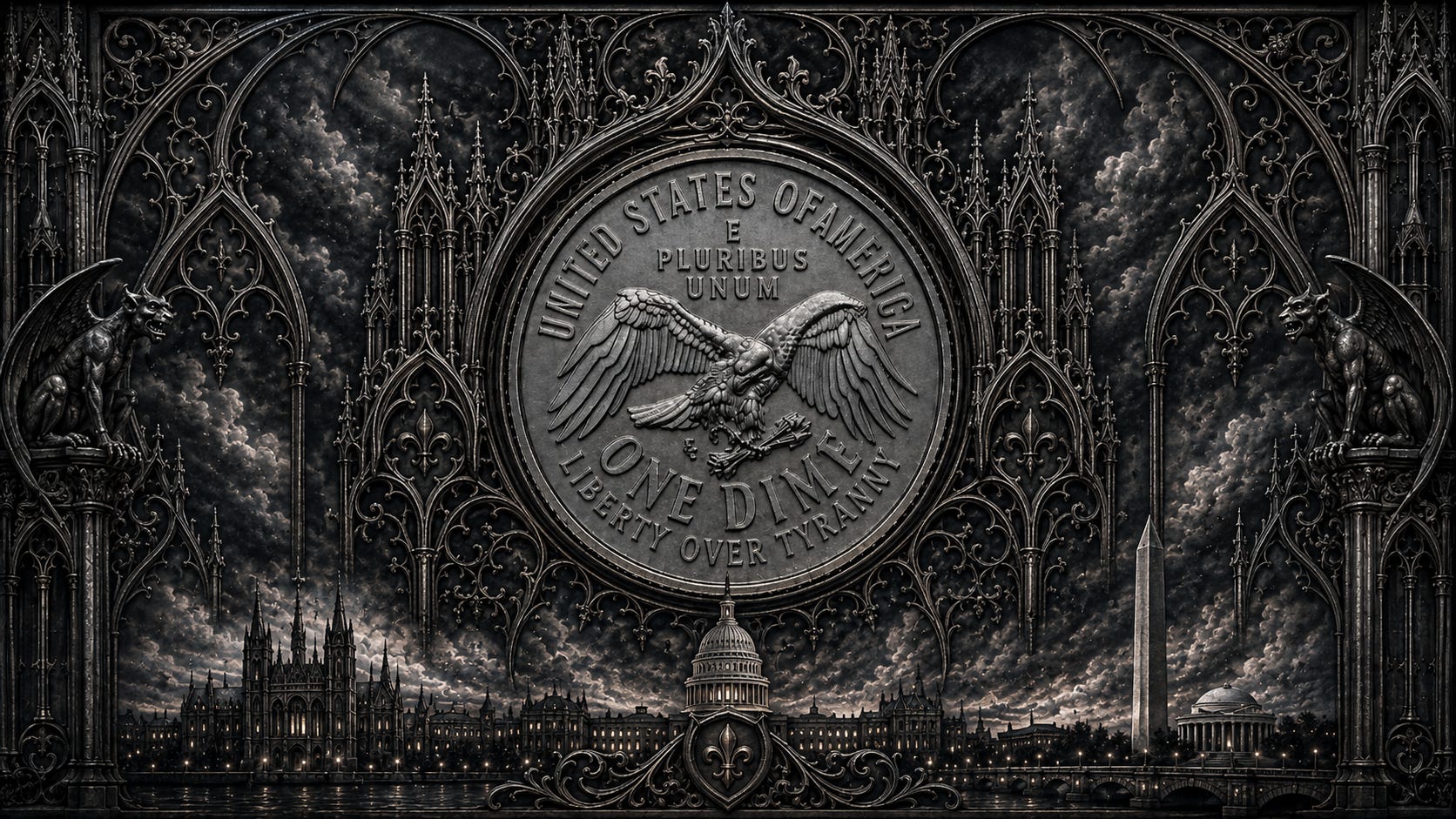
2026 Semiquincentennial dime, uncirculated reverse.
[Elaborated photo from U.S. Mint original picture]
The tragic expectation is not that the experiment will end in a single catastrophic scene, though such scenes are no longer unimaginable on a Mall that was built for triumphal processions. It is that the experiment may continue while its meaning drains away: elections held and disbelieved, wars fought and unfinished, a constitution revered and unenforced, an empire maintained and unloved. Tragedy, in its strict sense, names the destruction of the protagonist by the very qualities that made the protagonist great. The qualities that made America were universalism and expansion, promise and projection, the olive branch and the arrows held in one body. At 250, those qualities have begun to consume their bearer, and no deus ex machina is visible above the stage. The most probable future is neither restoration nor collapse but a long twilight of the chronotope, in which the forms of the Republic and the reach of the Empire both persist, hollowed, each blaming the other for an exhaustion they produced together.
The question for the next 250 years, if the experiment lasts that long, is not whether the eagle can release one of its burdens. It is whether it can learn to carry both differently. Whether the constitutional spirit can find forms of expression that do not require imperial projection, and whether American power can find forms of engagement that do not corrode constitutional self-governance. Whether the metaphysics of the American experiment can be rethought from within by refusing to let either principle devour the other. The tragic reading does not foreclose this question—it raises its price. Re-founding remains possible, as Arendt insisted, but tragedy teaches that protagonists rarely choose it before the fifth act.
The eagle’s head still turns toward the olive branch on the Seal, if no longer on the coin. The arrows remain in its grip. At 250, the experiment continues, but, as Lepore reminded us, an experiment is a test that can fail, and the most rigorous tests are the ones that run the longest. Its outcome belongs to those who inherit it and to a world that has stopped waiting, but has never been able to look away.
References
Ackerman, B. (1991). We the People: Foundations. Harvard University Press.
Allen, D. (2014). Our Declaration: A reading of the Declaration of Independence in defense of equality. Liveright.
Arendt, H. (1963). On revolution. Viking Press.
Bacevich, A. J. (2002). American empire: The realities and consequences of U.S. diplomacy. Harvard University Press.
Bacevich, A. J. (2005). The new American militarism: How Americans are seduced by war. Oxford University Press.
Bakhtin, M. (1981) The Dialogic Imagination: Four Essays by M. M. Bakhtin. University of Texas Press
Brands, H. (2018). Making the unipolar moment: US foreign policy and the rise of the post-Cold War order. Cornell University Press.
Brzezinski, Z. (1997). The grand chessboard: American primacy and its geostrategic imperatives. Basic Books.
Burnham, J. (1941). The managerial revolution: What is happening in the world. John Day Company.
Burnham, J. (1947). The struggle for the world. John Day Company.
Chomsky, N. (2003). Hegemony or survival: America’s quest for global dominance. Metropolitan Books.
Dahl, R. A. (2001). How democratic is the American Constitution? Yale University Press.
Donnelly, T., Kagan, D., & Schmitt, G. (2000). Rebuilding America’s defenses: Strategy, forces and resources for a new century. Project for the New American Century.
Eichengreen, B. (2011). Exorbitant privilege: The rise and fall of the dollar and the future of the international monetary system. Oxford University Press.
Fukuyama, F. (1992). The end of history and the last man. Free Press.
Gros, P. (1996). L’architecture romaine du début du IIIe siècle av. J.-C. à la fin du Haut-Empire: Vol. 1. Les monuments publics. Picard.
Hardt, M., & Negri, A. (2000). Empire. Harvard University Press.
Hartz, L. (1955). The liberal tradition in America: An interpretation of American political thought since the Revolution. Harcourt, Brace & World.
Helleiner, E. (1994). States and the reemergence of global finance: From Bretton Woods to the 1990s. Cornell University Press.
Huntington, S. P. (1996). The clash of civilizations and the remaking of world order. Simon & Schuster.
Johnson, C. (2004). The sorrows of empire: Militarism, secrecy, and the end of the Republic. Metropolitan Books.
Kagan, R. (2006). Dangerous nation: America’s place in the world from its earliest days to the dawn of the twentieth century. Alfred A. Knopf.
Krauthammer, C. (1990). The unipolar moment. Foreign Affairs, 70(1), 23–33.
Lawson, J. (2011). Chronotope, story, and historical geography: Mikhail Bakhtin and the space‐time of narratives. Antipode, 43(2), 384–412.
Lepore, J. (2018). These truths: A history of the United States. W. W. Norton.
Mahan, A. T. (2020 [1890]). The influence of sea power upon history, 1660–1783. DigiCat.
Maier, C. S. (2006). Among empires: American ascendancy and its predecessors. Harvard University Press.
Maier, P. (1997). American Scripture: Making the Declaration of Independence. Alfred A. Knopf.
Milne, D. (2017). Paul Wolfowitz and the promise of American power, 1969–2001. In Dunkerley, J., & Drolet, J. F. (Eds.), American foreign policy (pp. 159–192). Manchester University Press.
Niebuhr, R. (1952). The irony of American history. Charles Scribner’s Sons.
Rawls, J. (1993). Political liberalism. Columbia University Press.
Rawls, J. (1999). The law of peoples: With “The Idea of Public Reason Revisited”. Harvard University Press.
Scott, P. (1995). Temple of liberty: Building the Capitol for a new nation. Oxford University Press.
Seale, W. (1986). The President’s house: A history (2 vols.). White House Historical Association.
Shklar, J. N. (1991). American citizenship: The quest for inclusion. Harvard University Press.
Spiro, D. E. (1999). The hidden hand of American hegemony: Petrodollar recycling and international markets. Cornell University Press.
Stamper, J. W. (2005). The architecture of Roman temples: The Republic to the middle Empire. Cambridge University Press.
Turner, F. J. (2017 [1893]). The significance of the frontier in American history. In R. E. Kasperson & J. V. Minghi (Eds.), The Structure of Political Geography (pp. 132–139). Routledge.
U.S. Mint. (2025, December 11). United States Mint Semiquincentennial Circulating Coin Program designs unveiled [Press release]. United States Mint. https://www.usmint.gov/news/press-releases/united-states-mint-semiquincentennial-circulating-coin-program-designs-unveiled?srsltid=AfmBOorY0Ehoc6qKOJ9a1nEZHKC5n1xv-F8S_OMZPji1xzgmyrteUSic
Wertheim, S. (2020). Tomorrow, the world: The birth of U.S. global supremacy. Harvard University Press.
Williams, W. A. (1959). The tragedy of American diplomacy. World Publishing Company.
Wood, G. S. (1969). The creation of the American republic, 1776–1787. University of North Carolina Press.
Zanker, P. (1988). The power of images in the age of Augustus (A. Shapiro, Trans.). University of Michigan Press.
I have only had time to skim this for now, but it may be the most ambitious essay I have seen on Substack. The questions about legitimacy, maintenance of political order, and the contradictions of empire are very close to the kinds of questions that i work in my historical studies
But this is a piece I will need to return to properly, rather than read in passing... Hopefully i can elaborate and share it on my feed before long
What a phenomenal read. And a super dark one for an American. I’m much more of a farmer than a philosopher these days. And your central thesis is both well presented and well defended. I do have one gentle push back.
“The elites of every subsequent war region, from the Persian Gulf to the Balkans to post-Soviet Eurasia, have parked their fortunes in the very financial system whose military arm had unsettled their neighborhoods. War on the periphery produces liquidity at the center. “
The Persian Gulf conflicts were definitely Imperial in character and started by the US. But the wars in the Balkans and post-Soviet Eurasia don’t seem that way to me. It seems like they were started in the former case by unresolved nationalist disputes from the prior century, and in the latter by Putin’s quest for Empire. What am I missing?