

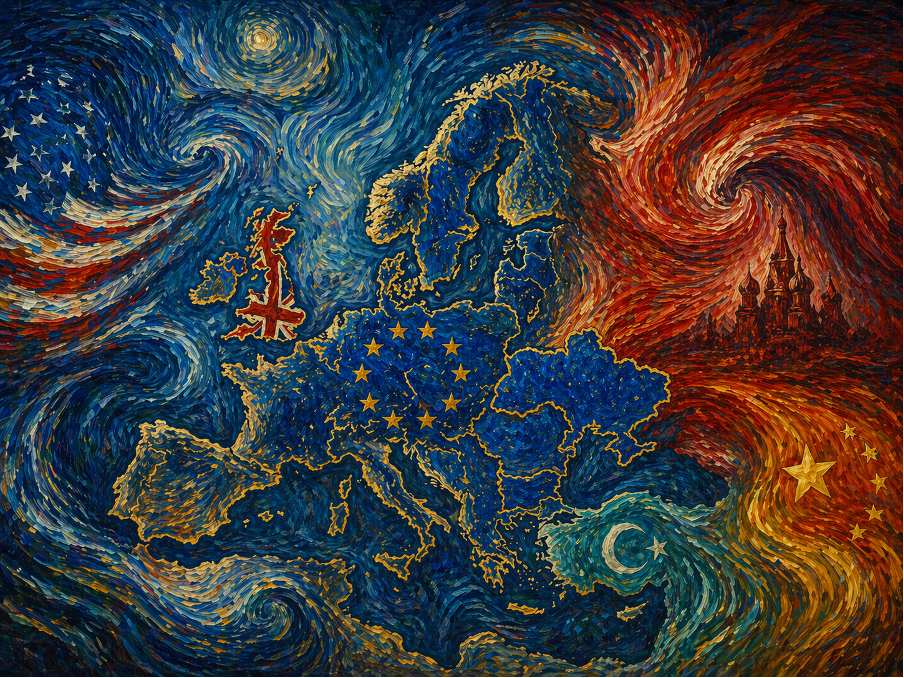
Since Donald Trump’s second inauguration in January 2025, European policymakers have come to recognize the shadow cast by major-power politics. Russia’s continuing war against Ukraine, China’s hardening global posture, and the American turn toward the open coercion of allies have together rendered obsolete the strategic environment of the preceding eight decades. Gesine Weber’s recent assessment of Brussels’ response is cautiously affirmative: the Union has accelerated its trade diplomacy, concluded agreements with India and Mercosur, established Security and Defence Partnerships with eleven partners, and begun, however haltingly, to conceive of itself as a participant in, rather than a recipient of, global order; “Brussels is stepping up its game,” she writes, “and that can be a good thing” (Weber, 2026).
This paper takes Weber’s statement as its point of departure and extends her analysis in a direction she does not pursue. I share her judgment that the Union requires a new strategic grammar, and I share her cautious welcome of the recent partnership instruments. Yet I contend that the prospects of this order-building effort are shaped less decisively by the external pressures than by a set of internal contradictions that Brussels has yet to confront openly. External instruments, however well-designed, rest on a domestic foundation whose fissures are structural rather than transient.
Four such contradictions organize the analysis that follows. The first is the tacit equation of the European continent (or Europe) with the EU, an analytically costly conflation that obscures the fact that the European continent is itself a contested strategic space inhabited by several European actors (the EU and its member states, the United Kingdom, Ukraine, Belarus, Mildova, the Russian Federation, non-yet-EU Balkan states, Turkey, and Kazakhstan) and two non-European major powers (the United States and China). The second is the mismatch between the EU’s universalist institutional architecture and the particularist requirements of geopolitical action, a mismatch already implicit in the promise of a “geopolitical Commission” (European Commission, 2019). The third is the divergence between Brussels and the member states, compounded by the sustained presence of sovereigntist political forces within the Union itself; most recently, this is visible in the contrasting trajectories of the April 2026 elections in Hungary and Bulgaria. The fourth is the anomalous status of Ukraine, the EU’s de facto eastern frontier, which no serious geopolitical actor can indefinitely sustain without formal integration.
This paper is conceptual rather than polemical. Weber’s paper serves as its principal interlocutor but not its only one. Its aim is neither to dismiss the geopolitical turn in Brussels nor to celebrate it prematurely, but to specify the conditions under which it might become sustainable.
The European Continent as a Multi-Actor Space
The first conceptual move concerns the subject of geopolitical analysis itself. Weber’s essay, in common with much contemporary Brussels-facing commentary, treats “Europe” and “the EU” as effectively coextensive, such that a European response to major-power pressure becomes, in practice, an EU response. This elision, in my opinion, is analytically costly. Europe is not a pre-constituted actor awaiting articulation in Brussels. It is a plural political terrain and a deeply divided continent on which several actors operate. Some of these actors are aligned with the Union, some are external to it, and some are actively hostile. And their interactions shape the European continental environment within which the Union must act.
A minimally realistic inventory must distinguish four European actors and two extra-European major powers whose presence is felt across the continent. The EU is, to be sure, the largest and most institutionally dense of the European actors. The United Kingdom, notwithstanding its departure from the Union, remains strategically European: a nuclear weapons state, a permanent member of the UN Security Council, and a pillar of continental security through NATO and through the bilateral defense arrangements it has multiplied since 2023. Turkey, a long-standing NATO member and perennial EU non-member, conducts a foreign policy that is simultaneously European, Eurasian, and Middle Eastern, and whose autonomy from both Brussels and Washington has grown markedly over the past decade. The Russian Federation is a European power as well, geographically, historically, and, in the terms of its own self-understanding, even as its current government has positioned this state as the EU’s principal hostile actor and a “Eurasian civilizational state.”
Two further major powers inhabit Europe’s strategic space without being European. The United States, after eight decades as the security guarantor for the western and central parts of the continent, has entered a phase of uneven disengagement whose trajectory may, however, reverse under some future administration. The People’s Republic of China is pursuing its agenda in the opposite direction, though also unevenly: primarily through trade, infrastructure, and selective political investment, it pursues continental influence without, so far, seeking the responsibilities of hegemony.
Two analytical consequences follow. The first is that EU order-building does not occur on a blank continental canvas. It occurs amid competing European projects. Some of them, such as the British, are broadly compatible. Others, such as the Russian or Turkish, are structurally antagonistic. And the EU establishes its geopolitical stand amid two extra-European powers whose strategic interests only partially align with Brussels’. The second is that the Union’s aspiration to speak for the entire Europe is constitutively incomplete. Brussels may coordinate, anchor, and amplify a central continental posture, but it cannot substitute for one. Any claim that the EU is the geopolitical expression of Europe overstates its reach and understates the independent agency of other continental actors whose cooperation, or, at a minimum, whose neutralization, will be indispensable to any order the Union aspires to build.
Russia, the EU, and the Limits of “Normative Power”
Weber’s operative typology distinguishes three major powers on the continent, in addition to the EU, namely the United States, China, and Russia. She classifies Russia as a revisionist actor with nuclear weapons rather than a great power proper, and describes the EU as a normative rather than geopolitical presence. Each of the three elements merits refinement.
On Russia, the revisionist-power designation captures something essential but telescopes two distinct phenomena. Russia is indeed the weakest of the contemporary great powers, and it is under sustained structural pressure, be it demographic, economic, or technological, to decline into the status of a middle power that happens to retain nuclear weapons, like Britain. Yet its revisionism is not purely material: it is, equally, normative. The Russian project, articulated since the mid-2000s, is a sovereigntist counter-order to the universalist, rights-based norms embedded in European and transatlantic institutions by the post-1989 Western settlement (Minakov, 2021). Viewed in this light, the war against Ukraine appears as both territorial revisionism and ideological, normative confrontation: a kinetic expression of a more fundamental contest between two normative orders, universalist-liberal on one side, sovereigntist-statist on the other. To characterize Russia as a revisionist power tout court is therefore accurate but incomplete. It is a declining great power whose revisionism is ideational as well as military, and whose residual capacity to shape continental politics derives as much from the portability of its sovereigntist template as from its arsenal.
On the EU, the normative-power designation deserves its own reconsideration. The concept, elaborated by Manners (2002) in extension of Duchêne’s (1972) earlier notion of civilian power, was formulated for a comparatively benign international environment in which the projection of norms did not require the backing of strategic instruments. In a world of major-power competition, normative power without such instruments risks devolving into a rhetorical posture. Von der Leyen’s promise, on the eve of her first mandate, to lead the Commission as a geopolitical actor (European Commission, 2019) was itself an acknowledgment of this gap. The difficulty is that the promise has generated a new problem: a universalist institution has been asked to defend particularist regional interests, a mismatch that we return to in the next section.
On the EU’s actor-type, we require a category that Weber’s taxonomy, and indeed the standard literature, does not quite supply. The Union is neither a great power nor a middle power. It is a sui generis composite actor in the global interstate system, at once a proto-power endowed with supranational institutions and an alliance of predominantly middle and small states whose foreign-policy preferences frequently diverge. This in-between status is analytically uncomfortable but empirically accurate. It reframes the question of what strategy the Union should adopt in the face of hostile majors by supplementing it with another: what kind of actor must the Union first become if any strategy it adopts is to have the coherence to pursue?
Universalism Versus Particularism
The deepest of the Union’s unresolved tensions is the mismatch between its institutional constitution and the operational logic of geopolitical action. The EU’s institutional architecture with the Commission, the EU Parliament, the acquis communautaire, the single market, and the Court of Justice, is universalist in structure and disposition. Its legitimacy derives from the impartial application of rules. Its external action has long mirrored this internal grammar: enlargement through conditionality, trade through liberalization, partnerships through human-rights clauses. Normativity is not an adjunct to the Union’s functioning: it is the mode of its being.
Geopolitical action, by contrast, is intrinsically particularist. It requires choosing friends over rivals, prioritizing regional security over global rules, and, on occasion, privileging one’s own farmers, industries, and borders over abstract commitments to which all members are nominally subscribed. Geopolitics, in its minimal sense, is the preference for one’s own. The promise of a “geopolitical Commission,” therefore, embodies a category mismatch: an institution whose authority rests on impartial rule-application is being asked to behave as a strategic actor making partisan choices.
The contradiction manifests itself operationally in at least three domains. The first is trade. Weber (2026) rightly identifies the recent wave of agreements with India, Mercosur, Indonesia, and the convergence with the CPTPP as a genuine advance. Yet the Union’s self-description as a champion of rules-based free trade sits uneasily alongside the geopolitical purposes these agreements increasingly serve, and, more awkwardly still, alongside the instruments Brussels has quietly adopted in recent years: the Carbon Border Adjustment Mechanism, the Foreign Subsidies Regulation, the Anti-Coercion Instrument. These are, by any honest accounting, particularist instruments. The Mercosur agreement illustrates the political cost: a geopolitically defensible deal that generates acute grievances among rural constituencies across France, Poland, Ireland, Austria, and Italy, and feeds the parties that campaign against Brussels and the EU at large. A genuinely geopolitical Union will need to speak more plainly about whose interests its trade policy serves and to engage in dialogue with the domestic constituencies that bear the adjustment costs.
The second manifestation concerns the member states themselves. France, Germany, Italy, Poland, and, across the Channel, the United Kingdom remain geopolitical actors in their own right, with foreign policies that frequently diverge from any common line. “The EU,” acting on the world stage, is, in operational terms, a partially aligned and intermittently rivalrous set of national policies coordinated through a Brussels architecture. This is not a pathology to be cured, since it is the constitutional condition of the Union. But it sets real limits on the coherence of any geopolitical posture articulated from the Commission alone, and it renders illusory any account of EU foreign policy that abstracts from the preferences of its largest member states.
The third manifestation is the sustained presence of sovereigntist political forces within the Union. Two recent events illustrate the volatility. In Hungary, the April 12, 2026, parliamentary elections delivered a supermajority to Péter Magyar’s Tisza party, ending sixteen years of Orbán’s rule and appearing to return Budapest to the universalist camp. The appearance is partial: Magyar has campaigned against arms deliveries to Ukraine and conditioned Kyiv’s eventual EU accession on a Hungarian referendum (International Crisis Group, 2026; Samorukov, 2026). A week later, Bulgaria’s April 19 parliamentary elections produced a landslide for Rumen Radev’s Progressive Bulgaria, a coalition critical of military aid to Ukraine and open to renewed ties with Moscow (CNN, 2026). Slovakia under Fico and the sustained pressure of sovereigntist movements in France, the Netherlands, and elsewhere complete a picture in which sovereigntism is not a residual phenomenon but a structural feature of EU politics, as well as of the continental ideological landscape. The implication for Brussels is not that these forces should be appeased, but that a geopolitical Commission that lacks the institutional capacity to converse with them is operating on an unstable political foundation.
The universalism–particularism contradiction cannot be dissolved once and forever. It can, however, be managed through honest articulation: acknowledging when the Union acts on behalf of values, when on behalf of interests, and, most often, on the negotiated mixture that actually governs its decisions.
The Security Contradiction
Weber (2026) concedes that the Union is not yet a fully-fledged security actor and welcomes the Security and Defence Partnerships as an incremental step. The concession is correct, and the welcome is warranted. Yet the Union’s security question has a specific geographical name that her analysis does not foreground: Ukraine.
Ukraine is the EU’s de facto eastern frontier and its de jure non-member. It is neither a formal ally nor an integrated territory, and yet the Union’s own security depends, to a degree that every Brussels official privately acknowledges, on Ukrainian arms. This is a contradiction that a serious geopolitical actor cannot indefinitely sustain. A polity whose external security rests on a neighbor it neither fully integrates nor formally defends has outsourced its eastern frontier to a country whose statehood remains institutionally fragile under wartime pressure and whose political system is still governed by patronal dynamics that complicate rapid institutional convergence (Hale, 2014; Minakov, 2023).
The SDP format, while a meaningful innovation, does not resolve this. Eleven bilateral partnerships scattered geographically from Canada to South Korea constitute a network, not a bloc. Networks disperse commitments; blocs concentrate them. For the Union’s eastern security specifically, what is required is closer to consolidation: an EU security architecture in which Ukraine is positioned as an integral participant rather than a grateful supplicant. Thus, the SD partnerships are useful global instruments. They are still not a substitute for the proximate institutional work needed by a great geopolitical power.
A further consideration concerns timing. The American pivot toward the Indo-Pacific is unlikely to reverse in any meaningful way with the 2028–2029 presidential transition. Some recalibration of the US-EU relations is possible, but the prudent assumption is that the transatlantic configuration of 1949–2024 is no longer the baseline. The principal risk attendant on this assumption is not external abandonment, which European publics are already processing, but internal fragmentation. So long as Washington served as a benevolent peace guarantor among the European NATO allies, intra-EU rivalries were muted by a shared external reference point. Its withdrawal, however, removes that gravitational pressure. The question of whether Paris, Berlin, Warsaw, and, outside the Union, London will treat one another as allies or as competitors becomes, for the first time in two generations, genuinely open.
Ukraine is the test case for this question. Its eventual status—full member, associate, indefinite buffer—will indicate more reliably than any strategic document whether the Union’s geopolitical ambition is substantive or declarative.
Partnerships, Trade, and Order-Building
Having laid out the internal contradictions, it is appropriate to return to Weber’s analysis and indicate, with some specificity, where we concur and where we part company. The engagement is instructive not because her argument is deficient—it is, in my view, one of the more lucid recent accounts of the Union’s external turn—but because its points of incompleteness correspond closely to the internal questions this paper has raised.
The agreements are substantial. Weber (2026) is right that the Union has accelerated its partnership-building under the dual pressure of American unilateralism and Chinese assertiveness. She is right that the Security and Defence Partnerships, while modest, are a meaningful institutional innovation. She is right to caution against the fantasy that Brussels might replace the World Trade Organization or link disparate free-trade zones into a single architecture. And her concluding observation that these partnerships cannot substitute for a benevolent United States, but may become critical precisely because the benevolent hegemon is likely past captures the strategic mood with precision.
Three points of disagreement emerge nonetheless. The first concerns the Union’s addressees. Weber frames Brussels as a potential broker among middle powers. The framing understates the scope of the challenge in two directions. Brussels must also broker among the small powers within its own membership (as well as those waiting for the one), whose interests diverge from one another and from the Commission’s preferred line, and it must do so while those same small powers are themselves exposed to the sovereigntist pressures traced in the previous section. The broker, in other words, is simultaneously the object of brokerage. This recursive quality of EU foreign policy is easily lost when the Union is treated as a unified actor in interactions with external partners.
The second concerns the ambition embedded in the partnership format. Weber reads the SDPs as a modest but constructive instrument; I agree. But the logic of her own argument that the benevolent hegemon is unlikely to return points beyond the partnership idiom toward something more consolidated. Partnerships diversify relationships; they do not generate strategic gravity. If the Union and its closest allies are indeed to operate without the stabilizing pressure that Washington previously provided, the appropriate horizon is not a wider network of bilateral agreements but the patient construction of a bloc with its own center of attraction.
The third concerns the rhetorical framing of trade. Weber presents the Union’s international trade posture as a championing of rules-based commerce. The framing is increasingly difficult to sustain. The acts I mentioned above, i.e., Carbon Border Adjustment Mechanism, the Foreign Subsidies Regulation, or the Anti-Coercion Instrument, each adopted in the past five years with broad political support, are avowedly particularist instruments. They protect the Union’s industries, environmental standards, and strategic autonomy; they do not champion a neutral global order. A more exact vocabulary would acknowledge that the Union’s trade policy is, already, what it needs to be: geopolitically interested rather than normatively universal. Retiring the universalist framing would not weaken the Union’s credibility with its partners. It would strengthen it by closing the gap between what Brussels says and what Brussels does.
A Sui Generis Actor on a Divided Continent
So, four contradictions have organized my analysis. Europe is not the EU: the continent is a multi-actor space in which Brussels is the largest but not the only player. The Union’s universalist institutional architecture sits uneasily with the particularist requirements of geopolitical action. Some member states remain geopolitical actors with divergent preferences, and sovereigntist political forces within the Union are a structural rather than residual presence. Ukraine, the de facto eastern frontier, occupies a status that no serious geopolitical actor can sustain indefinitely. None of these contradictions is fatal to the Union’s external ambition. Each, left unaddressed, is load-bearing.
The implication is neither defeatism nor resignation. It is a call for institutional self-awareness. The Union’s realistic geopolitical future lies neither in imitating great powers nor in retreating to the normative-power vocabulary of an earlier international moment. It lies, rather, in articulating what a sui generis composite actor can credibly do: broker among its own small and medium members before brokering among external middle powers; integrate Ukraine into a continental security architecture before multiplying partnerships elsewhere; conduct openly particularist trade policy while preserving the rule-based internal coherence that gives the Union its distinctive character; and build, from the SDP network, something with the consolidating logic of a bloc.
This is a less romantic account than the one offered by the geopolitical-Commission vocabulary, and a more demanding one than the normative-power literature accustomed the Union to expect of itself. But it corresponds more closely to the historical shape of European integration, which has always advanced incrementally, through negotiated compromise, and in reluctant acknowledgment of its own internal heterogeneity. Brussels is indeed stepping up its game. Whether it can sustain the effort will depend less on the behavior of the major powers than on its willingness to confront, and not paper over, the contradictions under its own roof.
References
CNN. (2026, April 20). Bulgaria’s Kremlin-friendly ex-president wins election in landslide. CNN. https://www.cnn.com/2026/04/20/europe/bulgaria-election-radev-wins-pro-russian-intl
Duchêne, F. (1972). Europe’s role in world peace. In R. Mayne (Ed.), Europe tomorrow: Sixteen Europeans look ahead (pp. 32–47). Fontana.
European Commission. (2019, November 27). Speech by President-elect von der Leyen in the European Parliament Plenary on the occasion of the presentation of her College of Commissioners and their programme. https://ec.europa.eu/commission/presscorner/detail/en/speech_19_6408
Hale, H. E. (2014). Patronal politics: Eurasian regime dynamics in comparative perspective. Cambridge University Press.
International Crisis Group. (2026, April). Orbán’s defeat lifts block on EU support for Ukraine, but frictions remain. https://www.crisisgroup.org/anb/europe/hungary-ukraine/orbans-defeat-lifts-block-eu-support-ukraine-frictions-remain
Manners, I. (2002). Normative power Europe: A contradiction in terms? Journal of Common Market Studies, 40(2), 235–258. https://doi.org/10.1111/1468-5965.00353
Minakov, M. (2021). The sovereigntist turn: Sovereignty as a contested concept again. Ideology and Politics Journal, 1(17), 87–112. https://www.ideopol.org/wp-content/uploads/2021/04/1.5.-ENG.-Minakov-Article.pdf
Minakov, M. (2023). War, De-Oligarchization, and the Possibility of Anti-Patronal Transformation in Ukraine. In Madlovics, B., Magyar, B. (eds.). Ukraine’s Patronal Democracy and the Russian Invasion: The Russia-Ukraine War. Vol. 1. Budapest: CEU Press, 141–166. DOI: 10.7829/jj.3985461.9
Samorukov, M. (2026, April). Will Hungary’s new leader really change EU policy on Russia and Ukraine? Carnegie Endowment for International Peace. https://carnegieendowment.org/russia-eurasia/politika/2026/04/russia-hungary-no-orban
Weber, G. (2026, April 20). EU order-building in the shadow of major power politics. Geopolitical Europe.
