
Europe’s Sentimental Geometry

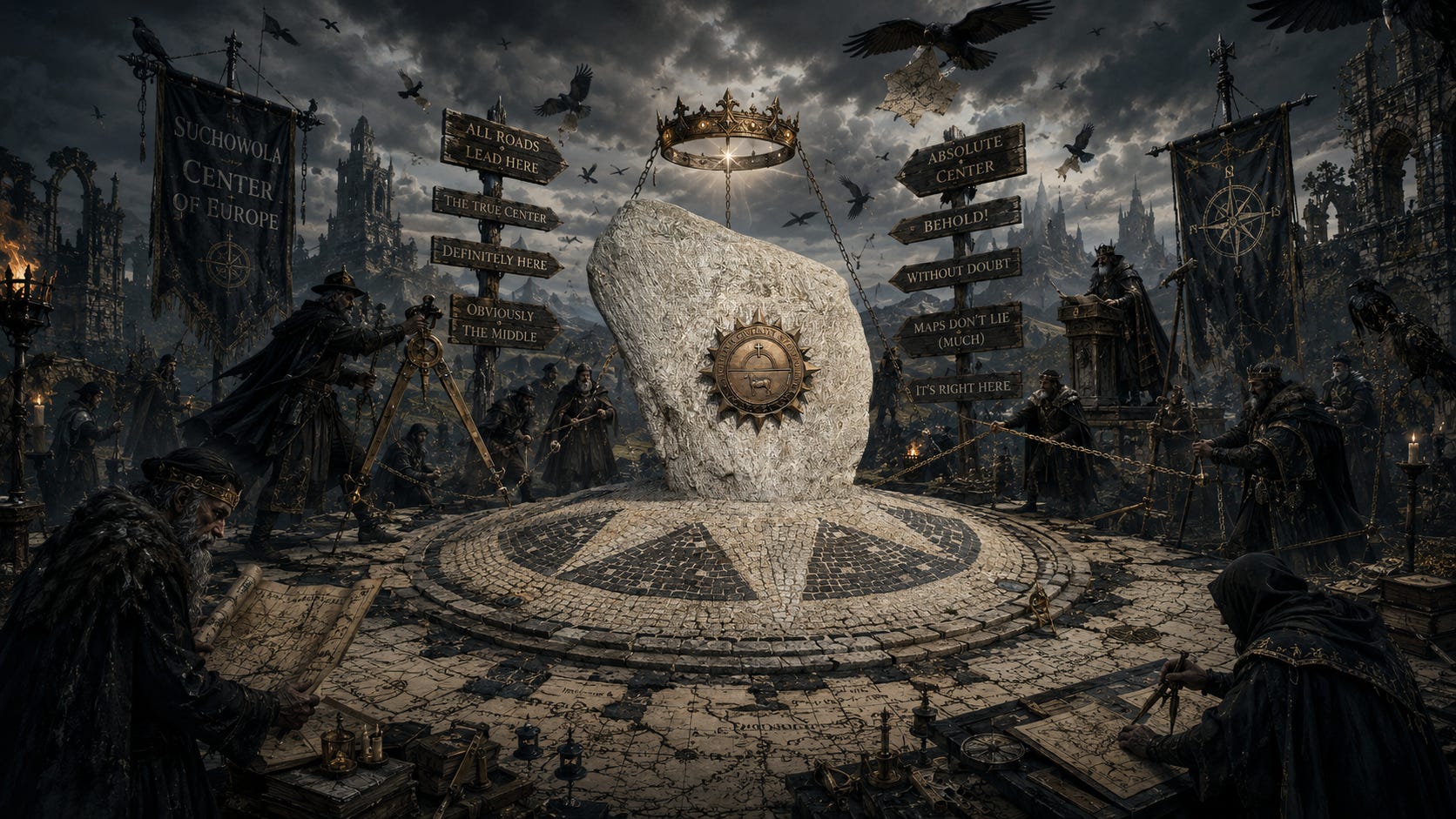
Europe, that old schoolmaster of mankind, has never been able to agree on where its own middle lies. This would be merely amusing if Europe had not spent several centuries explaining to other continents where they stood in history, usually somewhere behind the lecturer’s desk. The continent that gave the world the enlightened grammar of civilization and backwardness, progress and delay, metropolis and province, now finds itself multiplied into a dozen geographic middles: a boulder in Poland, a church wall in Slovakia, a monument in Lithuania, a marker in Ukraine, a patriotic square in Belarus, a phoenix in Hungary, an astronomical coordinate in Czechia, an island village in Estonia. Each says, with charming solemnity: here, finally, is the center. One can admire the confidence. One can also wonder whether the center of Europe is less a place than a nervous condition.
This condition grows not from mathematics alone. Mathematics, after all, is innocent until administered by a municipality. It grows worse when a coordinate calculation becomes a destiny, when a measured point becomes a civilizational argument, when a village discovers that it has not been peripheral at all but secretly axial. Here geography enters the realm of imagination, and imagination enters the realm of provincial revenge. The old West’s hierarchy had said: Europe has centers and margins, masters and pupils, capitals and waiting rooms. The new Europe’s plaque replies: measure again. Perhaps the humiliation was a clerical error. Yet the reversal does not abolish the hierarchy; it imitates it. The periphery does not say, “Let us live without centers.” It says instead, “We too can be the center.” This is how centralism survives its critics: by persuading even the offended to dream in its categories.
There is, then, a small but durable human folly at work here, and it deserves affectionate severity. Human collectives are rarely satisfied with being somewhere. They wish to be necessary, important, and better than neighbors. Give them a coordinate, and they will eventually extract from it a metaphysics. A stone becomes an argument; a plaque becomes a passport; a tourist sign becomes an ontological promotion. The center promises orientation, rank, innocence, and compensation. It tells a town, a region, sometimes a nation: you were not late, forgotten, provincial, or merely adjacent to history; you were the hidden middle all along. This is the sentimental cruelty of geographic imagination. It heals the wound by preserving the weapon that caused it.
Suchowola, in northeastern Poland, gives us the Enlightenment version of the joke. In 1775, a royal astronomer calculated that this small town lay at the center of Europe, equidistant from the continent’s extremities. It is a lovely eighteenth-century scene: reason sharpens its instruments, takes the measure of the world, and leaves behind a boulder. The mind of the Enlightenment wanted clarity, proportion, emancipation from superstition; the town, quite understandably, wanted a monument. In Suchowola, universal reason descends into the municipal park and becomes local pride with a stone surface. This is abstraction’s natural desire to be pictured, to join the reality of simulacra. The Enlightenment promised that measurement would free us from myth. It did not foresee that measurement itself would become myth as soon as it could be inscribed, commemorated, and added to a tourist itinerary.
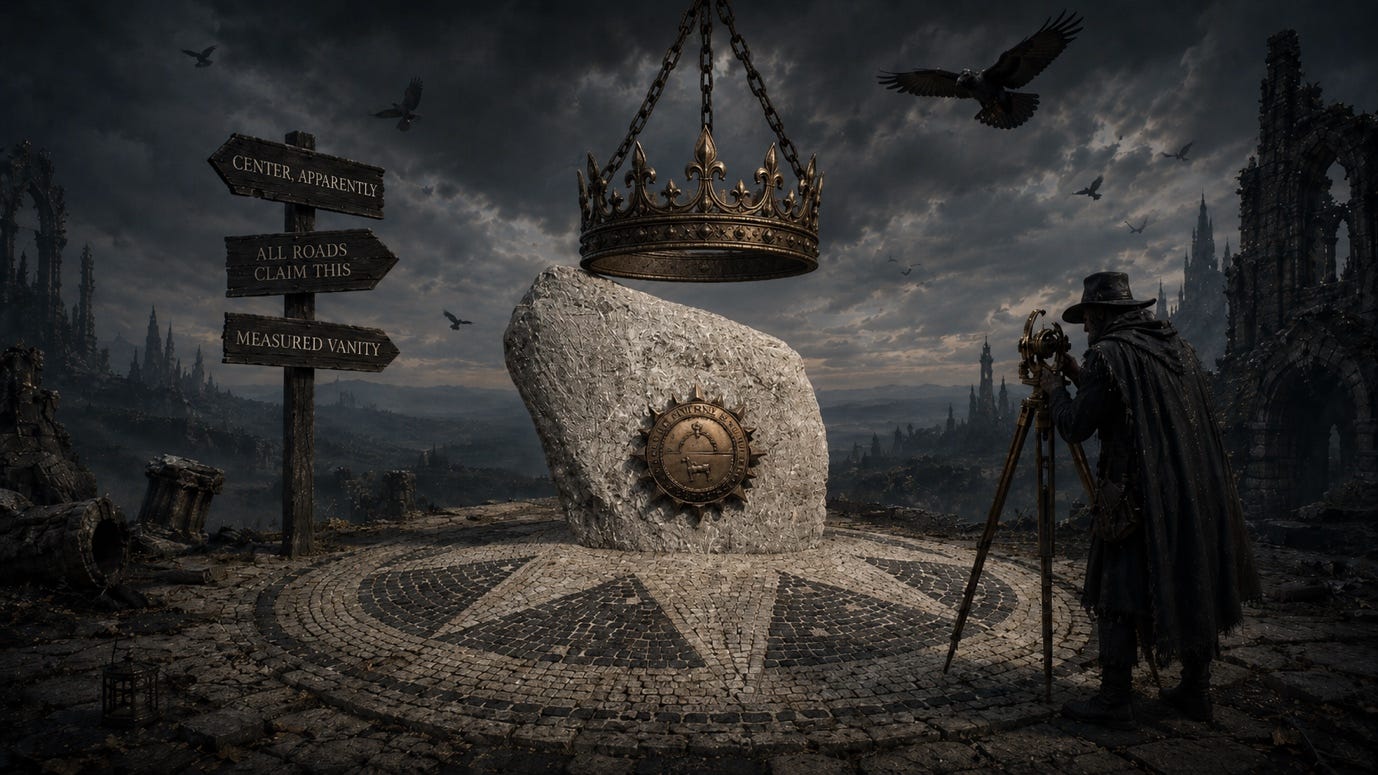
Geographic center of Europe boulder in Suchowola (original photo)

Slovakia offers a more ecclesiastical arrangement. Near Kremnické Bane, beside the Church of St. John the Baptist, stands another true center of Europe, as if the continent, tired from its wars, councils, partitions, and eternal peaces, had finally decided to rest against a church wall. This is a more ancient form of centrality, less mathematical than sacramental. The place seems to say that Europe’s middle is not only a coordinate but a blessing, or at least a blessing with a parking area. Europe has always needed churches, stones, relics, borders, and anniversaries to persuade itself that geography is more than soil. After all the metaphysics of Christendom, the dialectics of modernity, and the bureaucratic ecstasies of integration, the continent’s middle turns out to be a modest marker near a small Slovak church. Perhaps this is fitting. Every civilization eventually becomes smaller than its self-description.
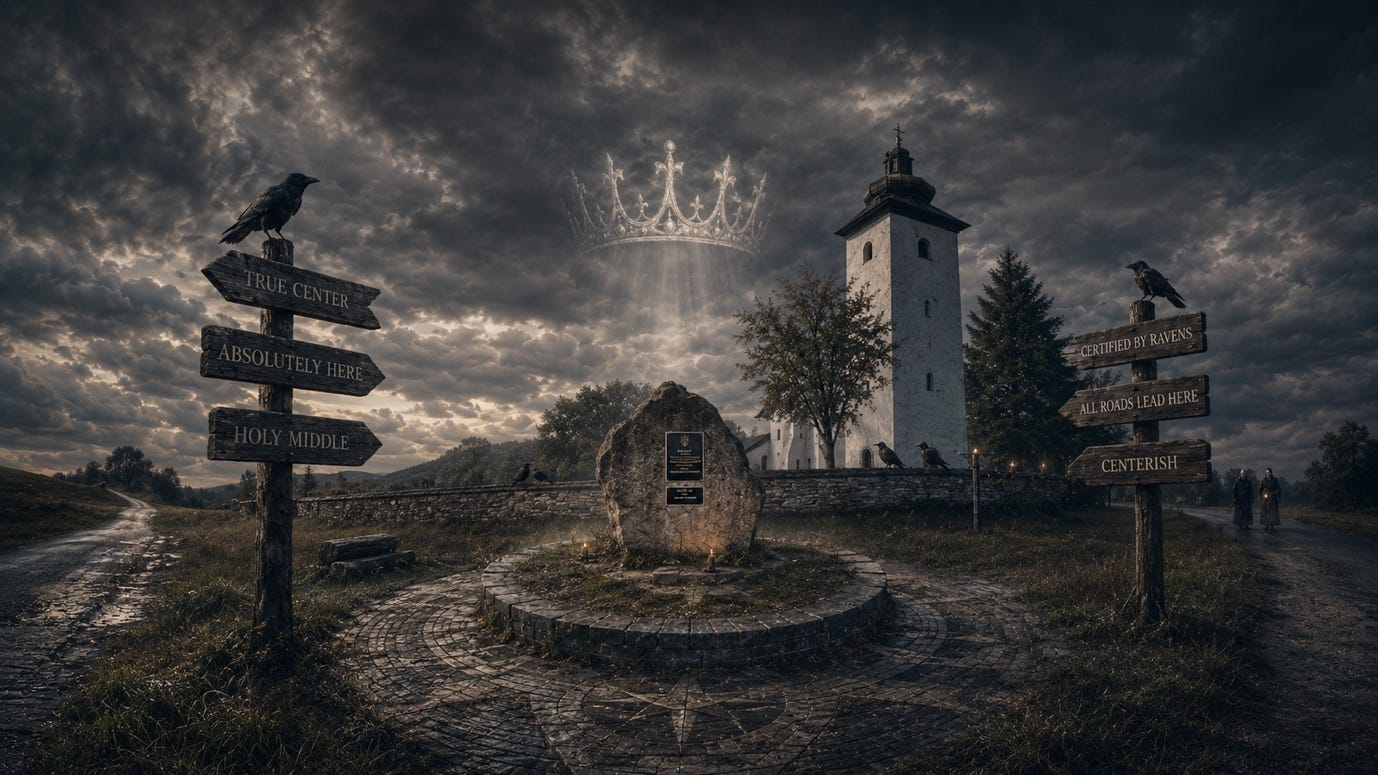
Europe’s middle in Kremnické Bane (original photo)

Ukraine’s claim near Dilove, close to Rakhiv in Zakarpattia, has the melancholy elegance of imperial afterlife. The site is associated with Austro-Hungarian geodetic work from the late nineteenth century, when the imperial state measured its territories with the calm confidence of a power that believed measurement and possession were cousins. The surveyor arrived as an agent of order. He probably did not imagine that his calculation would one day become a post-imperial argument on behalf of the measured. The borderland, so often treated as remote, mixed, picturesque, or administratively inconvenient, inherits the instrument of imperial classification and turns it into dignity. Vienna measured the periphery; the periphery kept the receipt. A century later, the borderland could say: you thought we were at the edge, but perhaps you were merely standing too far from the truth.
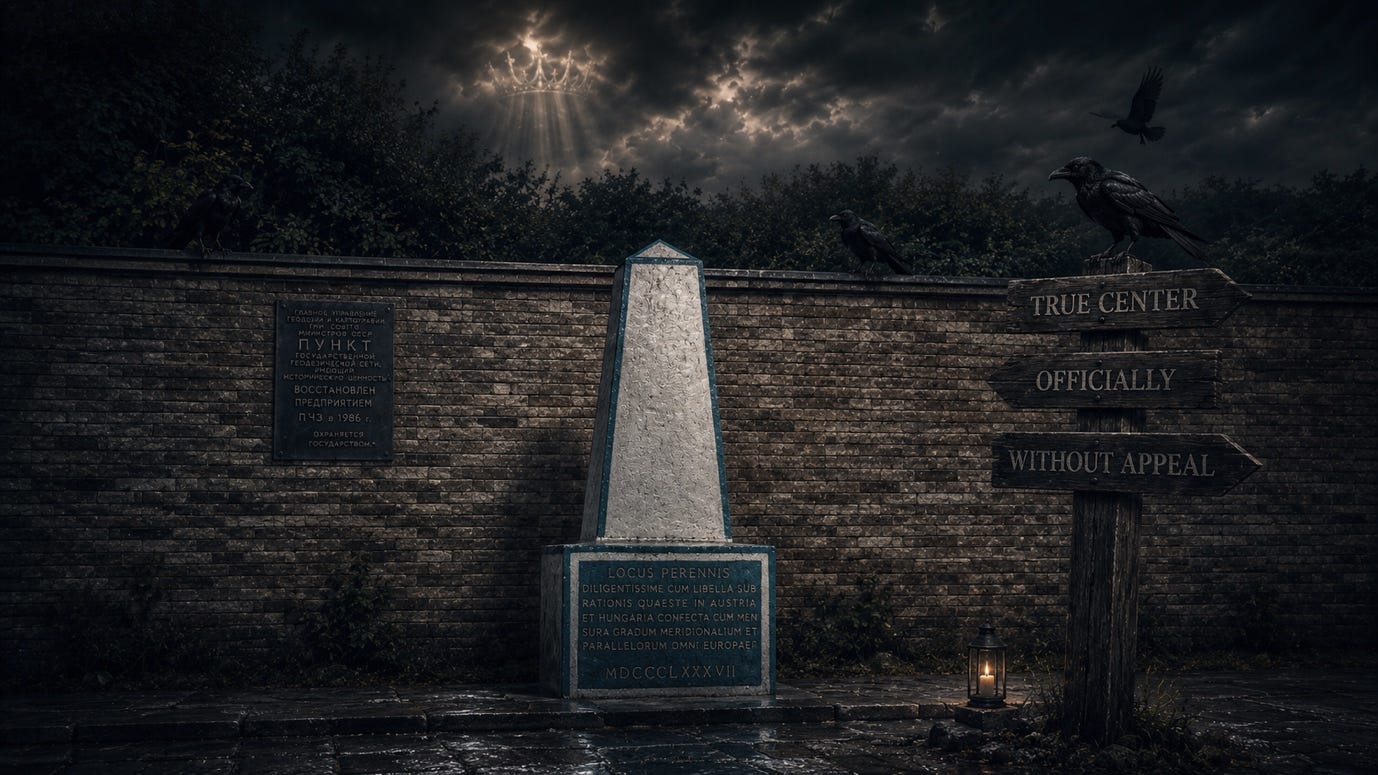
Rakhiv’s center of Europe (original photo)
.jpg/2)
Lithuania gives the story its most poignant modern variation. In 1989, French geographers identified a point north of Vilnius, near Purnuškės, as the geographical center of Europe. The date matters as much as the coordinate. This was the year when the old Soviet geometry began to crack, when Eastern Europe ceased to be merely a geopolitical waiting room and began again to imagine itself as Europe not by petition but by right and practice. Lithuania’s center is therefore more than a scientific claim. It is a sentence in historical grammar: we were not outside Europe; Europe had been misdescribed around us. There is something moving in this, and something witty as well, because liberation here arrives with a French attestation. The return to Europe receives a certificate from Paris, and the certificate says, in effect, congratulations, you were central all along. Few documents have better captured the mixture of dignity and dependency that has so often shaped Eastern Europe’s relation to the West.
Geographical Centre of Europe in Girijos Village, Vilnius District (original photo)

Belarus turns the human comedy colder. Polotsk, and in some calculations, the area near Lake Sho, offers another center of Europe, this time in a country whose political order has made Europe into a controlled substance. The monument can stand, while the citizen must be careful. Geography is allowed a kind of symbolic freedom denied to current public life. This is the authoritarian genius of the center: it can be celebrated harmlessly, because a coordinate does not organize, protest, publish, or vote. The Belarusian claim exposes the difference between geographic Europe and political Europe with almost indecent clarity. A place may stand at the middle of the continent while its civic imagination is pushed toward the margins. Europe’s center can be officially marked even where Europe’s freedoms have been administratively postponed. Here, the plaque commemorates not only a calculation: it measures the distance between location and liberty.
Commemorative sign “Polotsk – the geographical center of Europe” (original photo)

Hungary gives the competition a vinous dignity. In Tállya, in the Tokaj region, Europe’s geometric center is marked with a phoenix, which is already more symbolism than most coordinates can safely bear. The choice is splendid. A boulder reports: something was calculated here. A phoenix utters: something has burned, risen, and now expects cultural recognition right before a new burn. Hungary has long suffered from the anxieties of misplaced centrality: too Eastern for some Western imaginations, too Western for some Eastern ones, too historically grand for its contemporary borders, too wounded by history to accept a merely local fate. Tállya answers all this with the quiet audacity of geometry. The nation need not argue if the measuring tape has spoken. And since the claim stands in wine country, the metaphysics improves with each next glass. One begins to suspect that many geopolitical doctrines would have been less murderous had they first been fermented properly.
Tállya’s middle of Europe (original photo)
Kouřim, in Czechia, offers a more elegant joke: the astronomical center of Europe, born from the intersection of the fifteenth meridian east and the fiftieth parallel north. This is cartography’s version of providence. Two invisible lines, invented for the convenience of measurement, meet near a town, and suddenly the landscape acquires metaphysical promotion. No mountain moved, no river changed course, no angel descended with a theodolite. Longitude met latitude, and local destiny followed. Yet Kouřim’s claim has a certain intellectual honesty, because it makes visible the fiction at the heart of the exercise. Every center depends on the lines we have drawn, the limits we have chosen, the islands we have included or forgotten, the eastern borders we have pushed toward or away from the Urals according to civilizational mood. Kouřim simply lets the imaginary lines do their work in public. It is less a fraud than a demonstration.
Kouřim astronomical center of Europe (original photo)
Dyleň, or Tillenberg, near the Czech-German border, brings the most Central European of paradoxes: the center as borderland. The claim is almost too symbolically efficient. Central Europe has rarely been a simple middle. It has been a corridor, a seam, a translation error, a battlefield with good music, a place where empires met one another with maps in their hands and minorities in the way. To find Europe’s center near a border is therefore not absurd. It is exact in the deeper, historical sense. The middle of Europe is not where identity becomes pure, but where it becomes difficult. It is where language hesitates, memory changes uniforms, and the village cemetery knows more about history than all the ministries. A borderland that claims to be the center may sound like a contradiction. In Central Europe, it is practically a definition.
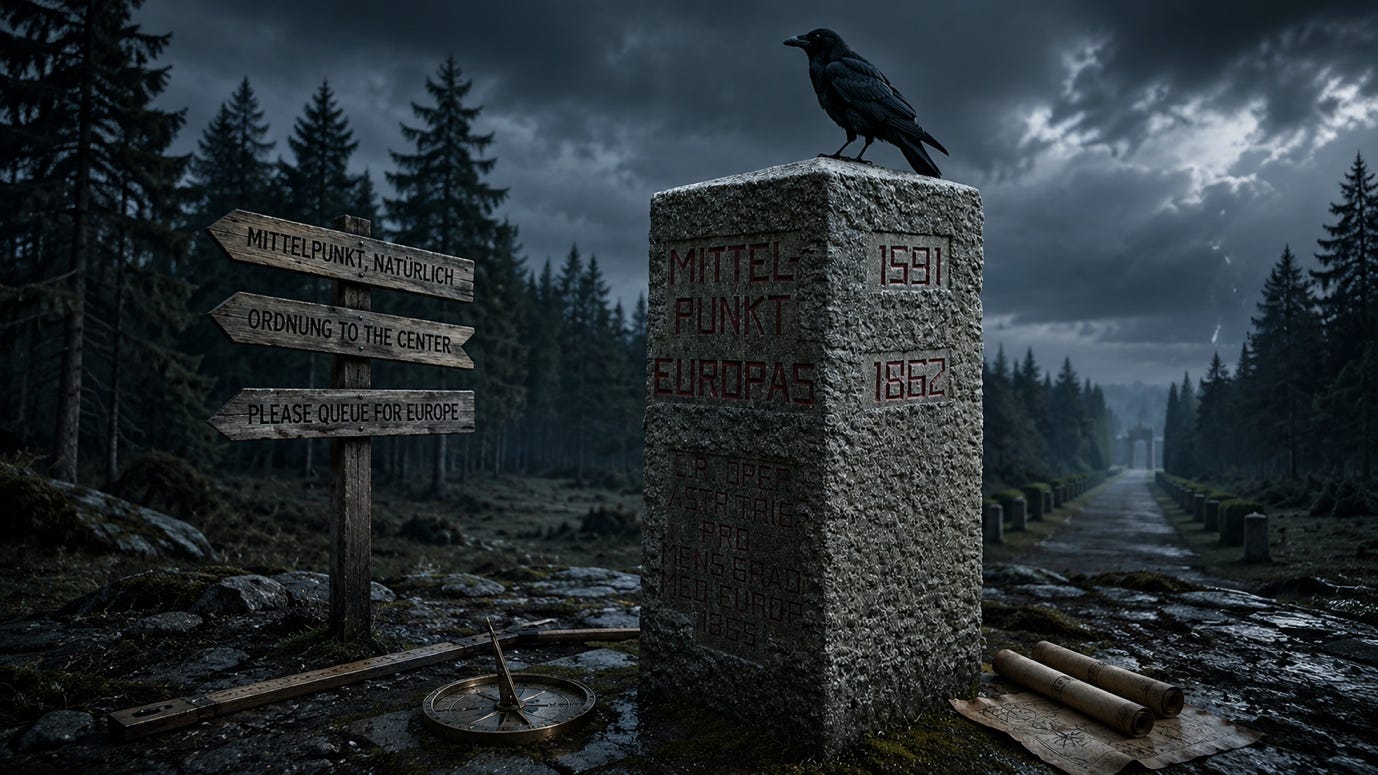
The Czech-German middle of Europe (original photo)

Pňovany, another Czech claimant, lowers the temperature of grandeur. Here, the center of Europe appears less as destiny than as local possibility. It is the democratization of centrality, the small-shareholder model of civilizational vanity. Why should only famous villages, imperial surveyors, French institutes, and church walls enjoy the right to metaphysical elevation? If Europe’s center is partly a calculation, partly a definition, partly a plaque, and partly municipal confidence, then the field is open. Pňovany reminds us that centrality, once released into the public imagination, behaves like inflation. Each new marker reduces the miracle value of the previous one but raises the general happiness of cartographic entrepreneurship. The continent becomes a polite marketplace of middles, each one asking not to be believed too literally, only photographed respectfully.
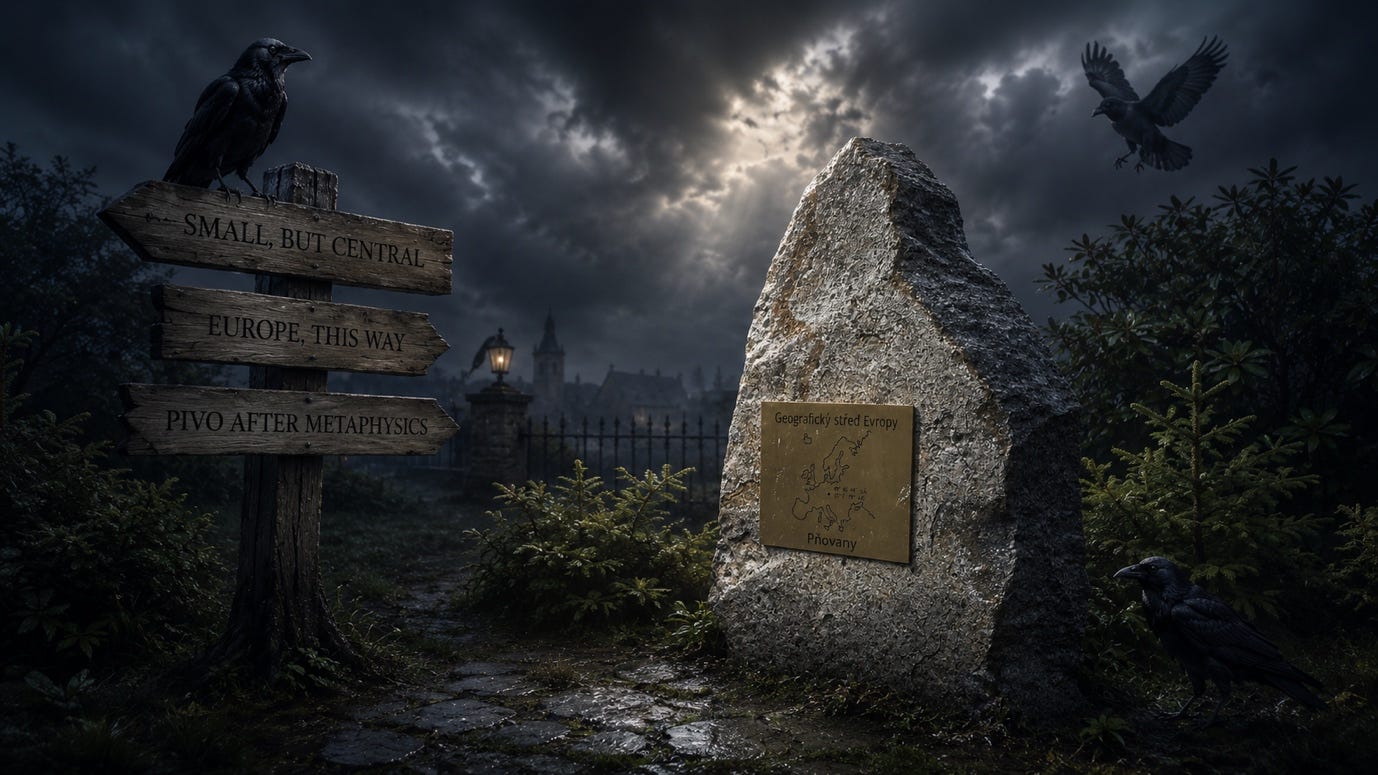
Pňovany Europe’s center (original photo)

Then comes Havlíčkův Brod, with the intervention of Jára Cimrman, the fictional Czech genius whose imaginary achievements form one of Central Europe’s finest defenses against solemn stupidity. This center is openly playful and, paradoxically, therefore more truthful than several of its competitors. Cimrman understands what the others sometimes conceal: the center of Europe is not only a matter of geodesy but of narrative appetite. A place becomes central when a story can be made to stand there without falling over. The fictional center does not discredit the serious ones, revealing their family resemblance to fiction. It says aloud what the monuments only whisper: we are all, to some degree, invented. In a continent ruined so often by men who took their maps too seriously, the fake center performs a public service. It returns measurement to comedy before comedy has to be restored by catastrophe.
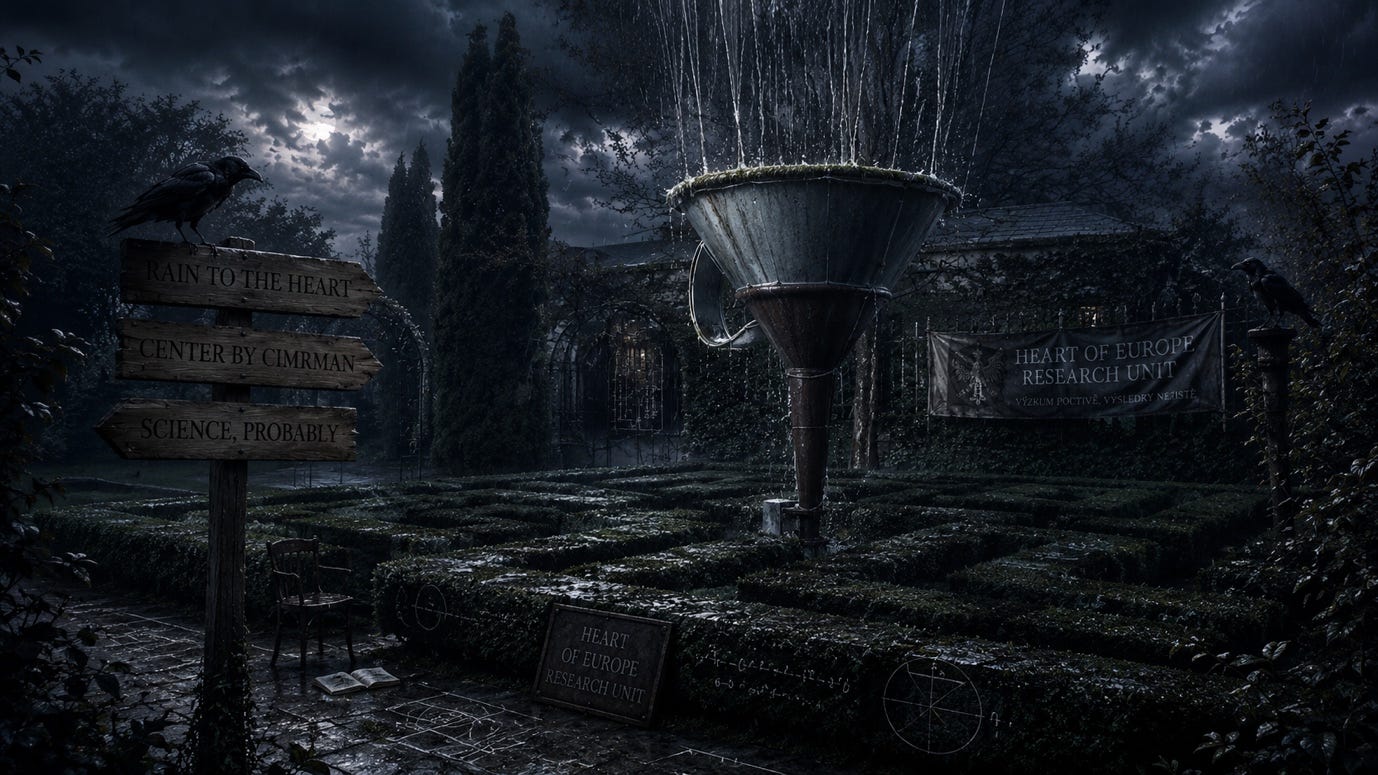
Cimrman’s center of Europe (original photo)

Melechov belongs to the melancholy class of minor centers, those local claims that never quite enter the international mythology of Europe’s middle. For me, there is something touching in this. Even centrality has its periphery. There are first-class centers of Europe with official brochures and respectable photographs; second-class centers with regional websites and determined signage; and almost-centers remembered chiefly by walkers, local historians, and the occasional stubborn enthusiast. Some plaques travel better. Some coordinates have better PR. The lesson is that declaring oneself central is not yet to be heard. The world, even when laughing at geography, still asks for marketing.
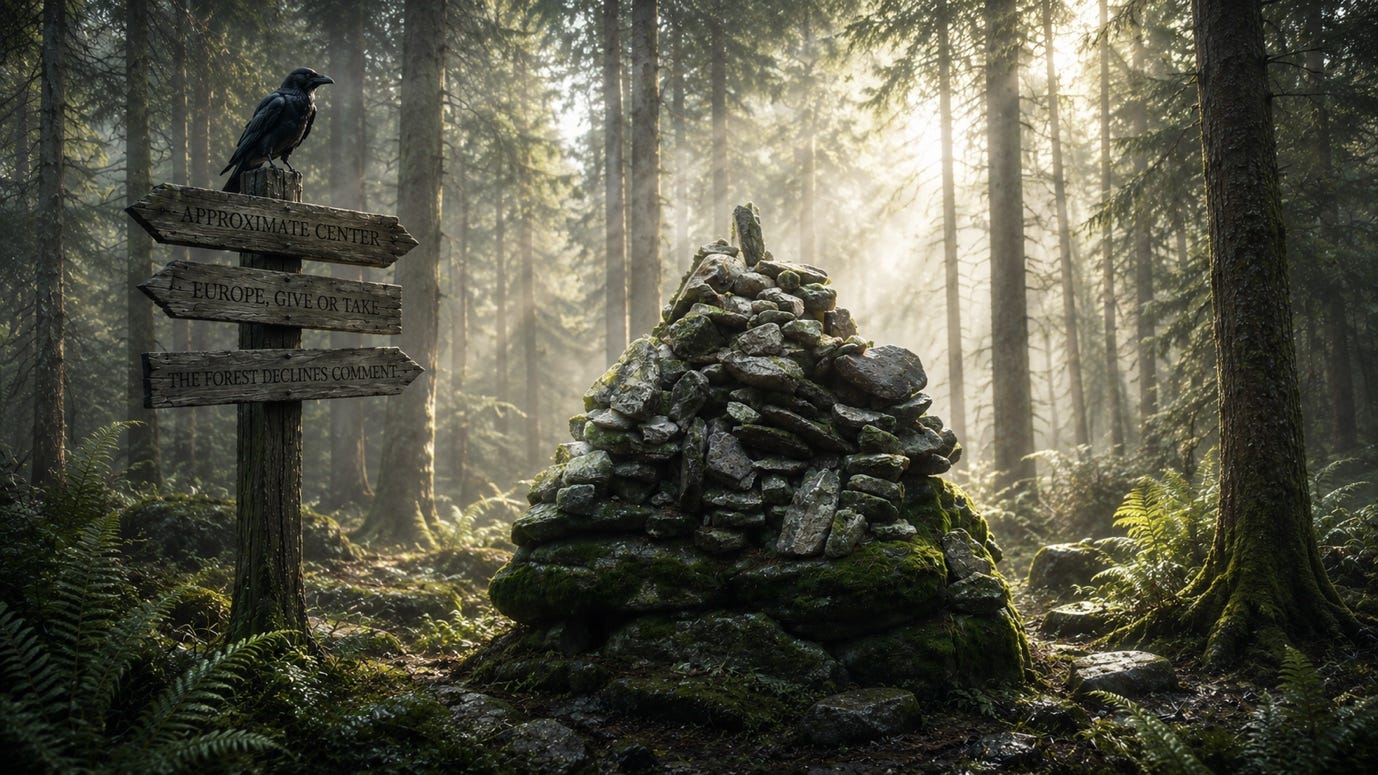
Europe’s middle in Melechov (original photo)
Finally, Saaremaa, in Estonia, changes the game by bringing in the islands. Include Europe’s islands fully, and the center begins to move northward, toward the Baltic, toward a village landscape that mainland metaphysics might otherwise forget. This is the most subversive of the claims because it exposes the violence hidden in definitions. Before one finds the centre of Europe, one must decide what Europe is. Does it include its islands as equal members of the body, or as decorative fragments scattered around the continental torso? Does the map remember Ireland, Iceland, Crete, Malta, the Azores, Saaremaa? Or does it quietly trim Europe into a manageable shape and let mathematics take the credit? Saaremaa enters like a polite island with a devastating question. If the margin is included, the centre moves. This may be the whole political philosophy of geography in one sentence.
Saaremaa insular center (original photo)
Europe’s middle comedy is tender and cruel at once. The periphery’s hunger for the center is not ridiculous because peripheral places are ridiculous. It is ridiculous because the hierarchy that wounded them continues to speak through their false cure. The old European imagination said that history had capitals and waiting rooms, advanced peoples and belated peoples, luminous centers and instructive margins. The new local monument replies, with touching sincerity: perhaps we were the capital after all as well. But this does not end the grammar of humiliation since it only changes the subject of the sentence. To become the center is still to believe in the moral architecture of centrality. It is still to accept that dignity descends from a central, that is, superior, position.
There is a darker lesson here about Europe itself. The continent’s obsession with measuring its middle is not an innocent geographical pastime. It is one small symptom of a larger civilizational illness: the habit of mistaking one’s own coordinate system for the structure of the world. Europe invented many noble things and many lethal ones, often in the same century, sometimes in the same sentence. It gave humanity rights, criticism, universities, constitutions, museums, camps, colonies, racial taxonomies, and philosophical excuses for violence. Its center, therefore, cannot be innocent. Every claim to be central echoes a longer history in which Europe imagined itself as humanity’s measure and then punished the world for failing to resemble it.
Yet the joke also weakens the disease. If Europe has so many centers, then perhaps it has none in the old imperial sense. The multiplication of middles turns centrality into farce. The continent becomes less a pyramid than a quarrel among plaques. No single stone can command obedience when another stone, a church wall, a phoenix, a forest marker, and an island village all raise competing claims. The hierarchy collapses not by philosophical refutation but by overproduction. Europe’s metaphysical center dies of crowding.
The better conclusion, then, is not that we must finally identify the true center. That would only continue the illness with better instruments. The better conclusion is that the need for a center is itself suspicious. Human beings love centers because centers promise orientation without freedom, dignity without equality, belonging without uncertainty. A center tells us where to stand and, more dangerously, who stands farther away. A decent political imagination should learn to live without this comfort. It should prefer plurality to hierarchy, and laughter to measurement.
Perhaps the most humane Europe would be a continent that stops asking where its center is. Or, more realistically, a continent that keeps asking and laughs at every answer. We are foolish enough to make metaphysics out of a midpoint. We are also, occasionally, wise enough to notice and appreciate the joke.
We Eastern Europeans, are burdened with so much historical "baggage" that, even after nearly 40 years, we still can't move on from our inherited traumas and our constant need to prove that, as the Bulgarian poet Ivan Vazov said, "We too have given something to the world." I suppose it has something to do with the hypocrisy of the West as well, but that's an entirely different discussion.
Thanks for this very original take on our collective need for recognition.
Don't we have something in Bulgaria that claims to be a centre too? Perhaps the centre of the Balkans? The centre of Europe would be a bit of a stretch, though. 😉