

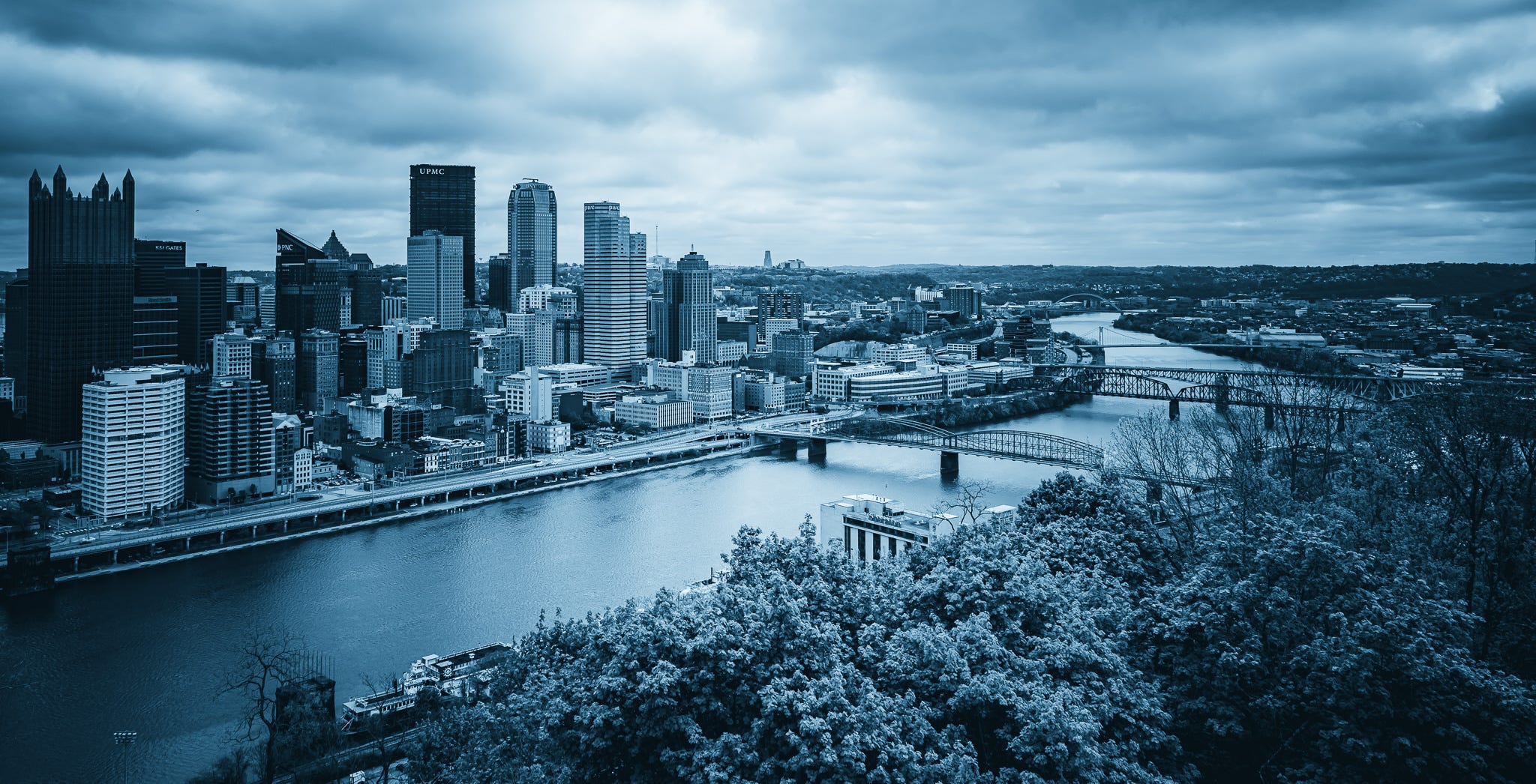
Pittsburgh’s downtown, from Mount Washington
(my photo)
With dedication to Nancy and Randall,
who made me love Pittsburgh.
Some cities ask to be interpreted; others hide from understanding altogether. Pittsburgh does something rarer. Half-expected, when I arrived, to be an American cousin of my native Zaporizhzhia, it turned out, despite their shared industrial sin, to be a stranger of its own kind, and more seductively, it asks first to be loved.
It does not arrive in the manner of imperial capitals, which place themselves before the visitor as completed arguments. It appears instead as an improvisation in matter: water, steel, hillside, bridge, brick, smoke remembered in stone, and citizen habits. One does not so much enter Pittsburgh as get folded into it. The rivers do not frame the city; they seem to have taught it how to think. The bridges do not merely connect its parts; they reveal that this place was never meant to possess the calm unity of a city laid out on a plain. Pittsburgh had to be composed in the face of difficulty: it had to persuade geography to allow civic form.
That, perhaps, is why affection comes so quickly here. The city does not flatter the eye by pretending to have been easy. Its beauty has the moral interest of effort. One feels, almost immediately, emerging from the tunnel onto the view of downtown, that Pittsburgh was not given to itself in one piece. It had to be wrested from topography, from industry, labor, fire, from the long twentieth century and its appetite for men and metals. Even now, the elegant skyline has the air not of serenity but of a settlement that survived its own making.
Plenty of industrial cities survived the change and have little to show for it but the grey exhaustion of the Rust Belt. Pittsburgh did something more dangerous: it became charming. It learned to turn its burdens into atmosphere, its wounds into urban character, its former brutality into an almost irresistible intelligence of place. The postindustrial age here did not simply erase the industrial one; it draped itself over it like a better-tailored descendant who has inherited the family jawline and the family curse. The mills may have receded, but they have not disappeared. They remain in the city’s posture, in its heavy elegance, in its refusal to become merely picturesque.
This is why Pittsburgh invites metaphysics. Its visible form is too saturated with conversion to be taken as merely urbanistic. Ore became steel and smoke. Steel became bridges. Smoke became memory. Ethnic parishes became repositories of moral history. A working city became a university city. A provincial birthplace produced Andy Warhol, who translated industrial repetition into the liturgy of image. Pittsburgh is a city of transfigurations, but dark ones: not the innocent transfiguration of light overcoming matter, but the harder, more modern kind, in which matter itself rises into new forms without ever being purified of the violence from which those forms emerged.
If New York is the city of appetite and Chicago the city of force, Pittsburgh seems to be the city of sublimation. Material heaviness is ceaselessly persuaded to become spirit: knowledge, art, scholarship, memory, style. The Cathedral of Learning dominates Oakland not merely as a building but as a proposition that the smoke of the mills did not vanish into thin air, but ascended, chastened and re-costumed, into intellect. The city’s universities, museums, and research institutions are the afterlife of its industrial past.
To love such a city is to accept an unusual compact. One cannot love Pittsburgh by loving only its scholars, museums, and handsome modesty. One must also love the density of its past, the way its beauty remains answerable to labor, contamination, class, and sacrifice. Its charm is ethically entangled. One admires it, and almost immediately feels obliged to ask what made this admiration possible (at least, I did). The question of what a city’s beauty costs, and how a city remembers the cost, is the beginning of philosophy in Pittsburgh. The darkness here is mixed into the very process by which the city became lovable. Pittsburgh’s current radiance is not despite its darkness; it is, in part, condensed from it.
A lesser place would be consumed by its history or trivialize it into heritage. Pittsburgh does neither. It bears its past with a kind of grave tact. Its scholars do not seem accidental. Its bridges do not seem decorative. Its churches do not seem quaint. Its museums do not seem imported. Everything here feels like a second form of something older, rougher, more burdened. The present shines, but the past has not gone dark enough to disappear.
What follows is an attempt to understand Pittsburgh as a city of dark transfiguration: a place in which labor becomes symbol, smoke becomes atmosphere, and knowledge rises cathedral-like over the mills without severing itself from them.
Arrival at the Confluence
Pittsburgh’s first gesture is not assertion but convergence. One does not encounter it as a city laid out with Cartesian confidence, spread flat before the eye. One encounters it as a meeting that has been underway for centuries: rivers meeting rivers, hills interrupting intention, bridges stepping in where topography has declined to cooperate. The city seems less built than negotiated. It is the kind of place that makes geometry feel a little vain.
That is part of its charm. Many cities are handsome; fewer are persuasive. Pittsburgh persuades. It persuades one that difficulty can become form, that obstruction can acquire style, that a place can be assembled without becoming blandly unified. The three rivers do not frame the city from a safe aesthetic distance; they behave more like its first intelligence. At the point where the Allegheny and the Monongahela join to become the Ohio, Pittsburgh seems to discover a principle that it then repeats in stone, steel, and civic habit: things here become themselves by meeting what resists them.
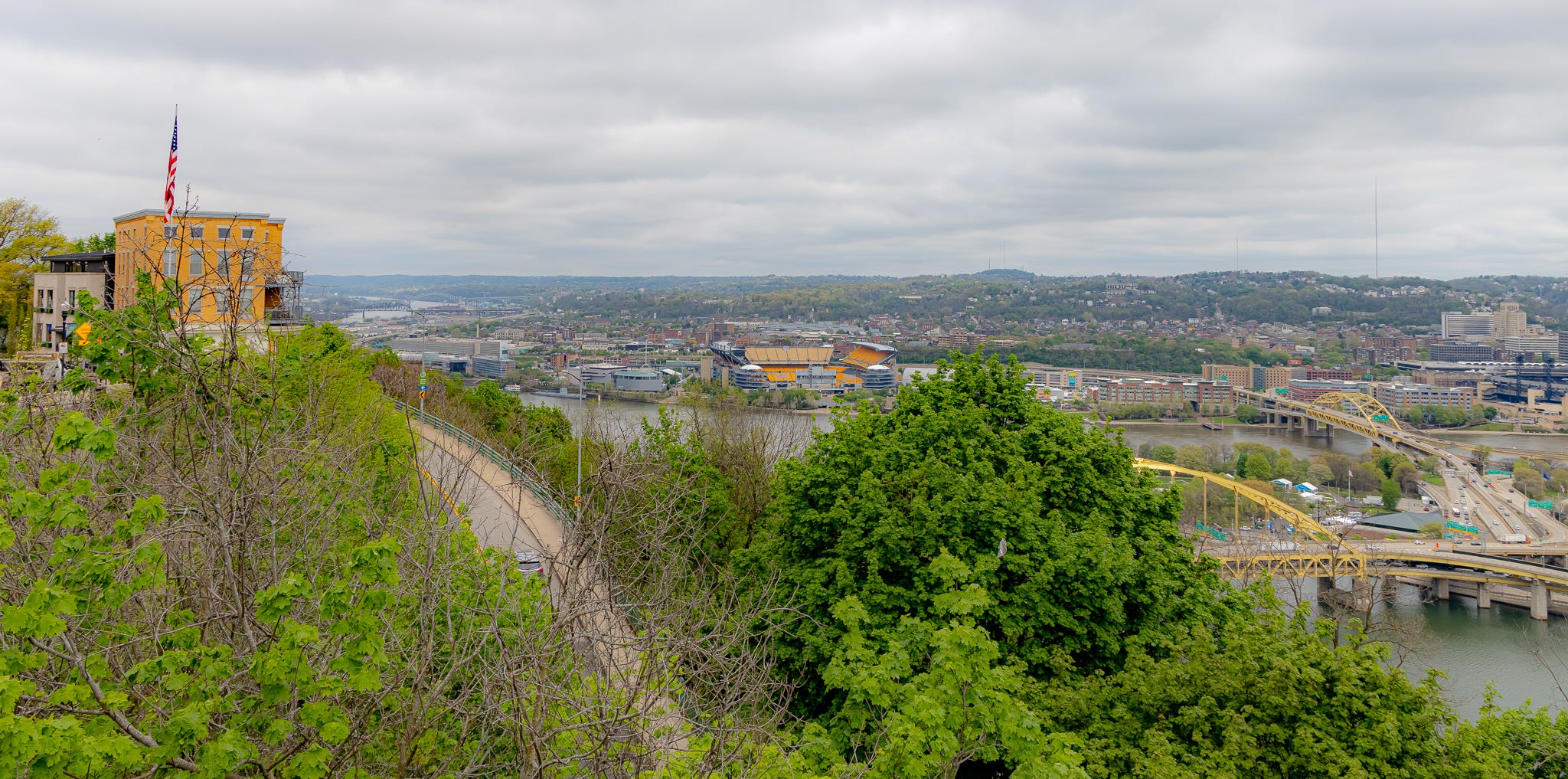
The Allegheny meets the Monongahela, and the Ohio begins
(my photo)
This makes arrival peculiarly involving. One leaves the new airport, which is too large, too megalithic, the kind of building a region builds when it wants to persuade itself of something, and then, almost at once, Pittsburgh begins to do its work: the tunnel swallows the car, the tunnel releases it onto a bridge, and the city opens downtown-first, shining, already in mid-sentence. A bridge interrupts a view only to complete it. A hillside hides a neighborhood only to make its emergence more intimate. Downtown does not dominate the landscape so much as gather itself within it. Even the skyline, which elsewhere might advertise triumph, feels here like a settlement reached after argument.
Pittsburgh’s bridge culture is constitutive of a preexisting urban unity. The Pittsburgh History & Landmarks Foundation treats the bridges as central to civic identity. Not because there are many of them, but because they tell the truth about the place: a city whose coherence had to be engineered across separation (Pittsburgh History & Landmarks Foundation, n.d.). The density of spans is an ontological confession: unity here is not original; it is achieved.
This is one reason Pittsburgh feels unusually hospitable to thought. In flatter and more imperious cities, urban space often implies that order descends from a center, radiating outward in calmer degrees. Pittsburgh suggests something subtler and, to my mind, truer. Order here composes: it emerges from crossings, accommodations, and repeated acts of relation. The city is less a sovereign diagram than a durable coalition. If one wanted an urban allegory for a philosophy in which relation precedes totality, one could do much worse than begin at the confluence.
And yet the confluence is not innocent. Rivers are not merely beautiful; they are useful. They carry ore, coal, barges, ambitions. Pittsburgh did not rise at this meeting of waters because destiny had literary tastes. It rose because geography offered industrial leverage. The same rivers that now lend the city its meditative beauty once made it a logistical masterpiece of extraction and manufacture. Even at its most picturesque, Pittsburgh never quite lets one forget that beauty here was sharpened by utility, and that one’s admiration of its improbable loveliness is immediately shadowed by the question of what such loveliness cost.
Perhaps that is why one falls in love with it. Pittsburgh is not lovable because it is pure; it is lovable because it has learned, with unusual sophistication, how to live after impurity. Things can meet without dissolving into sameness, and what survives the meeting may acquire a depth no innocence could ever have produced.
The Ontology of Smoke
If the rivers taught Pittsburgh’s relation, smoke taught its interiority.
There are cities whose atmospheres are metaphors added later by poets. Pittsburgh, for a very long time, had no need of such embellishment. Its atmosphere was an industrial fact. Smoke here was not merely weather with an economic backstory. It was the city’s most democratic medium, settling on mansions and row houses alike, entering curtains and lungs, staining façades with remarkedly small windows, disciplining habits of cleanliness, and teaching an entire urban population that prosperity could arrive in the same breath as suffocation. Early twentieth-century accounts of Pittsburgh’s “smoke nuisance” are not nostalgic curiosities; they are records of a city living inside the visible consequences of its own productive genius (Tarr, 2003).
This matters philosophically because smoke is a peculiarly revealing substance. It is neither stable matter nor pure immateriality. It is a matter in a state of troubled ascent. It rises, but not into freedom. It expands, but only by obscuring. It is the perfect emblem of a civilization that transforms the world while darkening the conditions of perception. In Pittsburgh, smoke became more than an industrial byproduct; it became the city’s historical form of self-knowledge. The place produced magnificently, and in producing, it veiled itself with impenetrable smog.
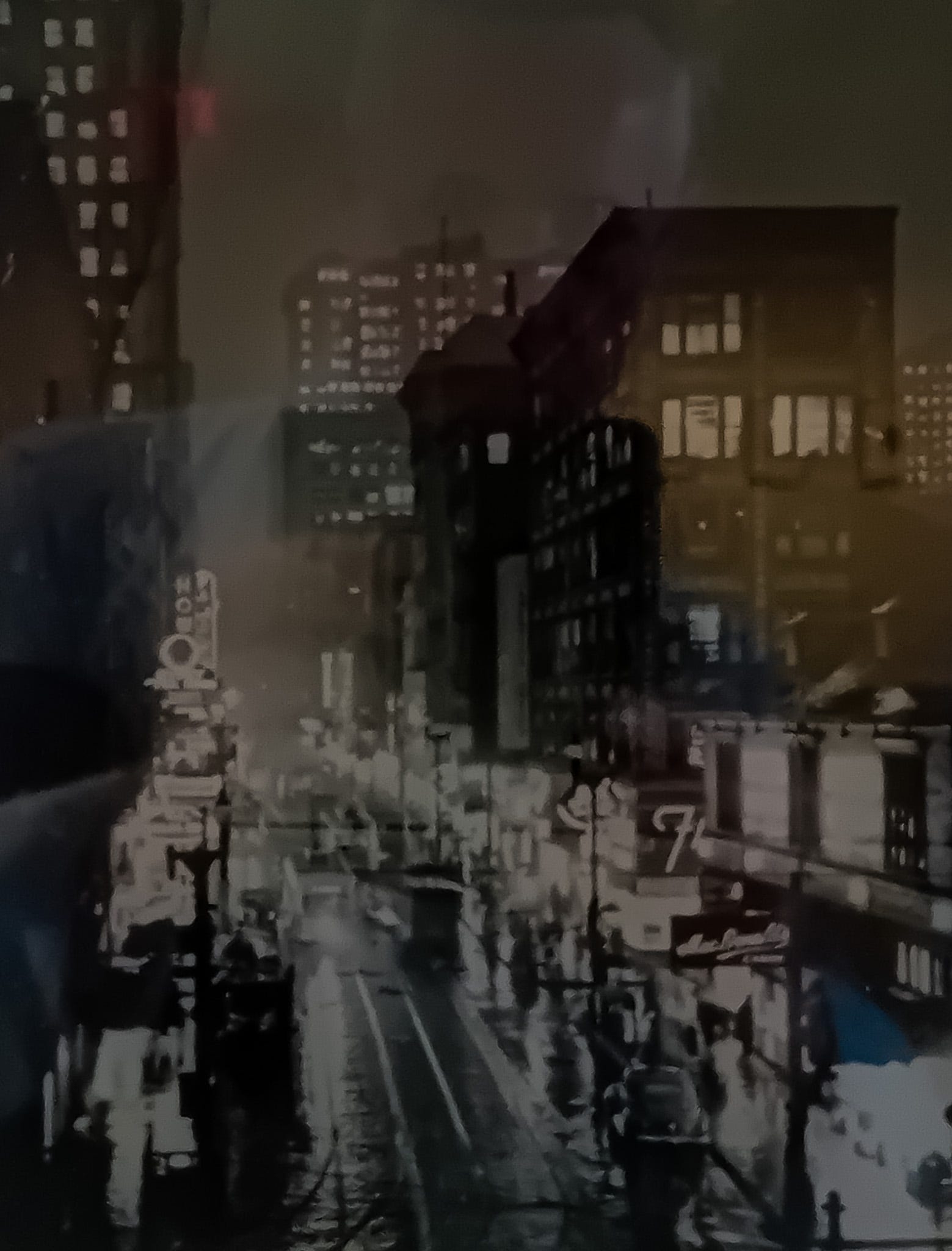
Noon in industrial Pittsburgh
(my photo of a photograph in the Warhol Museum)
One begins to see why such a city could not develop a naïve metaphysics. Pittsburgh was not allowed the luxury of believing that making and clarifying naturally go together. Here, production clouded vision. Wealth blackened stone. Civic pride came wrapped in residue. I feel something almost theological in the condition: man remakes the earth and, in so doing, covers creation with a second, darker atmosphere of his own design. One begins to understand, too, why Pittsburgh historically cultivated an indoor life of unusual density, a sociability evolved under atmospheric pressure, its old rhythm of thickened interiors (bars, kitchens, churches, union halls, and ethnic clubs) conducted against a sky that could not always be trusted. Smoke both altered the appearance of the city, and it redistributed intimacy in it.
I have no wish to sentimentalize this, though, as a Zaporizhzhia child who grew up with smog-caused bronchitis and recurring pneumonias, I could claim the license. Smoke did not create character the way travel essays like to pretend that adversity creates wisdom. It created costs, illnesses, dirt, shortened vistas, and whole regimes of premature decay. But history is rarely courteous enough to leave moral injuries without cultural consequences. In Pittsburgh, industrial pollution seems to have impressed itself not only on buildings and bodies but on sensibility. The city acquired a heavy elegance, as though it had learned early that refinement is never more serious than when it must defend itself against corrosion.
One can still feel that inheritance. Long after the worst of the smoke has lifted, Pittsburgh carries itself as a place that once knew how near civilization stood to grime. Buildings that might elsewhere seem merely handsome acquire here the pathos of survival. Stone looks as though it has been through something. The urban fabric does not radiate the complacency of places that have been beautiful without interruption, as in many small Italian cities. Yet it gives off a subtler effect: recovered dignity.
And yet smoke is only the most visible chapter in a longer material afterlife. The postindustrial landscape still bears the imprint of contamination in land use, redevelopment, and environmental repair. EPA documentation of brownfield investment in greater Pittsburgh shows how thoroughly the city’s second life has had to negotiate with damaged ground (U.S. Environmental Protection Agency, 2022). If the confluence gave Pittsburgh the possibility of becoming a manufacturing city, smoke revealed the price of that possibility in daily life, while the brownfields reveal its duration across generations. Nothing produced at scale disappears when it leaves the smokestack. Some part of it settles.
This is where Pittsburgh becomes especially interesting as a city of dark transfiguration. Many places seek rebirth by performing amnesia, marketing renewal as though the new life of a city had nothing to do with the terms on which the old one exhausted itself. Pittsburgh is more intelligent than that. Its museums, riverfronts, campuses, and renovated neighborhoods may be charming, but they are not innocent. Their very success gains definition against what came before: soot, slag, labor, contamination. Today’s city’s liveliness is therefore not a triumph over matter but a second arrangement of it. Smoke still hangs over Pittsburgh, though now in conceptual rather than atmospheric form. It survives as memory, as the dark background that lends contemporary brightness its seriousness. With it, Pittsburgh becomes moving.
Bridges, or the Metaphysics of Relation
If smoke taught Pittsburgh that production obscures, the bridges taught it the more cheerful lesson that separation need not be fatal. Cities, like peoples and empires, are always in danger of imagining that unity is their natural state. Pittsburgh has never had that luxury. The land refused it and the rivers insisted otherwise. The ravines and slopes, with geological sarcasm, made sure civic coherence would have to be earned the hard way.
The result is one of the rare urban landscapes in which infrastructure rises to the level of metaphysics. Bridges are practical things: they carry commuters, buses, trucks, anxieties, impatience, and the occasional illusion that one is late because one is important. But in Pittsburgh they are also the city’s most eloquent philosophical statement. They make visible a truth many modern polities prefer to hide under the carpeting of administrative language: a community is not a given, it is a labor of connection.
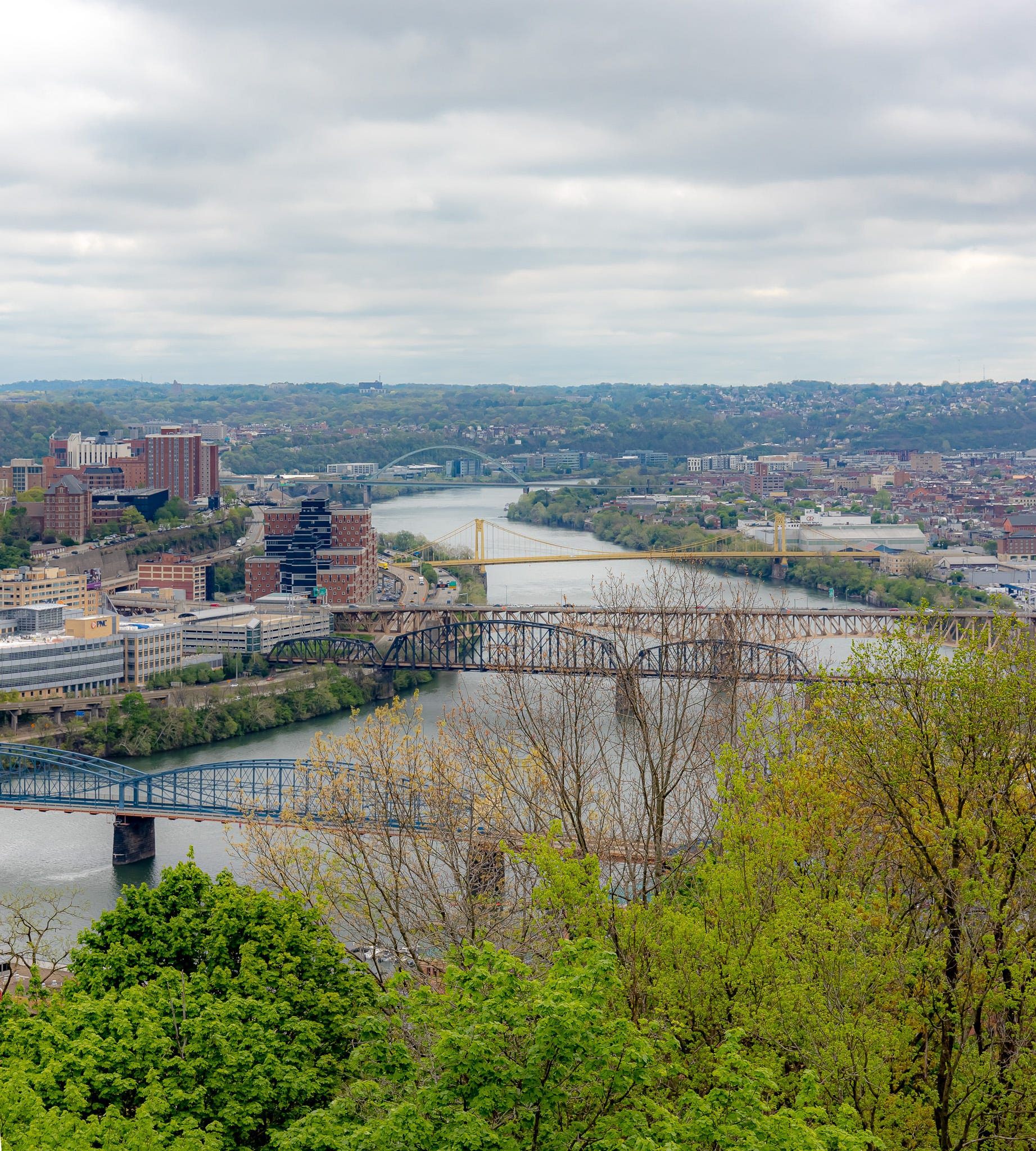
A fragment of Pittsburgh’s bridgescape
(my photo)
The City of Pittsburgh notes, almost touchingly, that it owns 143 active bridges, which together link dozens of distinct neighborhoods into one working community (City of Pittsburgh, n.d.). The structures span space, converting plurality into a workable civic fact. They are the city’s daily refusal of fragmentation.
That phrase, unified community, deserves a little suspicion, if only because Pittsburgh itself is too interesting to be reduced to municipal harmony. Its neighborhoods remain singular, sometimes stubbornly so. They keep their accents, topographies, loyalties, and inherited moods. One has the sense, moving through the city, that the bridges preserve the difference under conditions of contact. They permit most neighborhoods to remain themselves without becoming inaccessible fiefdoms. In that respect, Pittsburgh offers a wiser image of political order than most theory does. It is indeed the art of durable adjacency.
This may be why the bridges are so moving. One does not generally expect to be stirred by steel on principle. Yet Pittsburgh’s bridge culture has long attracted something close to civic tenderness, a local tradition of treating the spans not as mere infrastructure but as familiar benefactors that carry ordinary life over extraordinary difficulty. The language is a little grand for our suspicious age, but it remains apt. Pittsburgh’s bridges do feel beneficent. They spare the city from the solipsism its terrain would otherwise encourage. And they convert necessity into style. Elsewhere, infrastructure tends to apologize for itself. In Pittsburgh, it is allowed a certain theatricality. A bridge here can be practical and still know how to make an entrance. Steel here was never merely concealed strength; it was a public language. The mills may have darkened the sky, but they also trained the eye to recognize beauty in tension, support, and span. A Pittsburgh bridge, in the end, is never only a way across. The city’s celebrated abundance of bridges, which totals up to 446, is the one often repeated in preservation literature, drawn from Bob Regan’s The Bridges of Pittsburgh (Regan, 2006), matters not only quantitatively but symbolically. Pittsburgh has made relation visible on a heroic scale. Here, being (das Seyn) is bridged: a neighborhood is itself, yet not enough unto itself; a river divides, but not conclusively; coherence emerges through repeated acts of crossing, not through the elimination of obstacles.
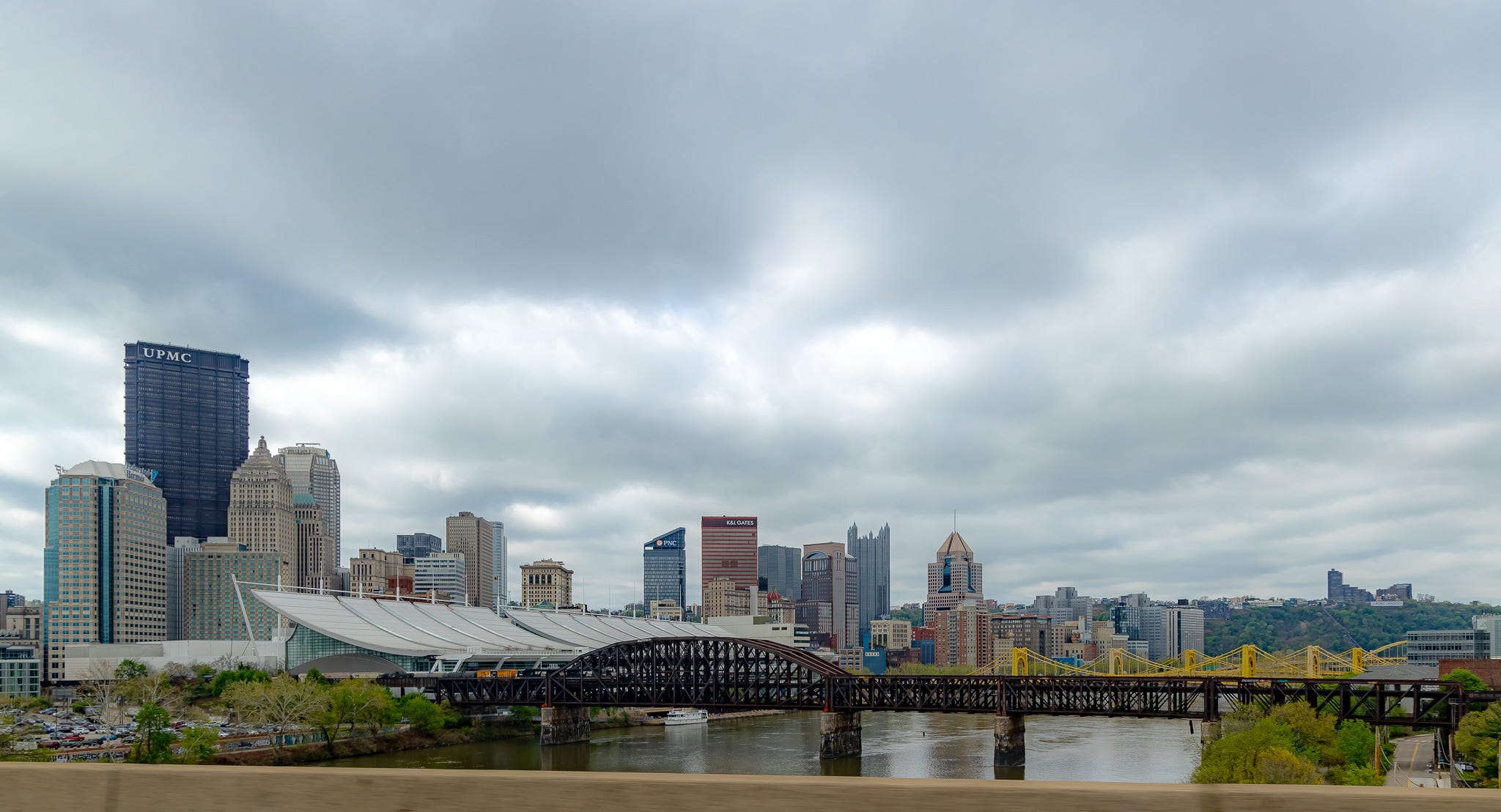
Where das Seyn is bridged
(my photo, through Randall’s car window)
Bridges are symbols of connection, but also admissions of fracture. One does not build a bridge unless something has made simple continuity impossible. This is why Pittsburgh’s grace is never innocent. The city’s loveliness depends on the visibility of what interrupts it. The river must remain a river; the valley must remain a drop; the hill must continue to object. Only then does the bridge acquire its peculiar dignity. Pittsburgh’s urbanism civilizes resistance, not abolishes it.
Scholarship, too, is a bridging activity: taking what is separated (disciplines, schools, epochs) and bringing it into living relation without pretending it was always one. Pittsburgh’s bridges are the urban equivalent of footnotes at their noblest: spans between otherwise discontinuous regions, and acts of trust thrown over an abyss. And yet there is nothing merely cerebral about them. Their beauty and ugliness (and many American bridges are ugly to my European taste) depends on weight, stress, and fatigue. They must be maintained, inspected, repaired. Pittsburgh knows this with painful clarity after the collapse of the Fern Hollow Bridge on 28 January 2022, a structural failure that the National Transportation Safety Board would later trace to years of unheeded maintenance warnings (National Transportation Safety Board, 2024). A relation is never free of material risk. Even metaphysics, Pittsburgh reminds us, has to pass inspection.
Brownfields and Cursed Ground
Every city has a past. Pittsburgh has it in the form of geology of consequences.
This is the point at which urban affection is asked to grow up. It is easy to admire the skyline, the rivers, and the campuses. It is harder to ask what sort of ground permits such admiration. Pittsburgh’s second life, with its museums, parks, research corridors, and luminous talk of renewal, has had to be built not upon neutral land but upon worked, damaged, and often contaminated ground. If the bridges reveal Pittsburgh’s philosophy of relation, the brownfields reveal its philosophy of memory: what has happened here settles into the soil and does not stay politely in the past.
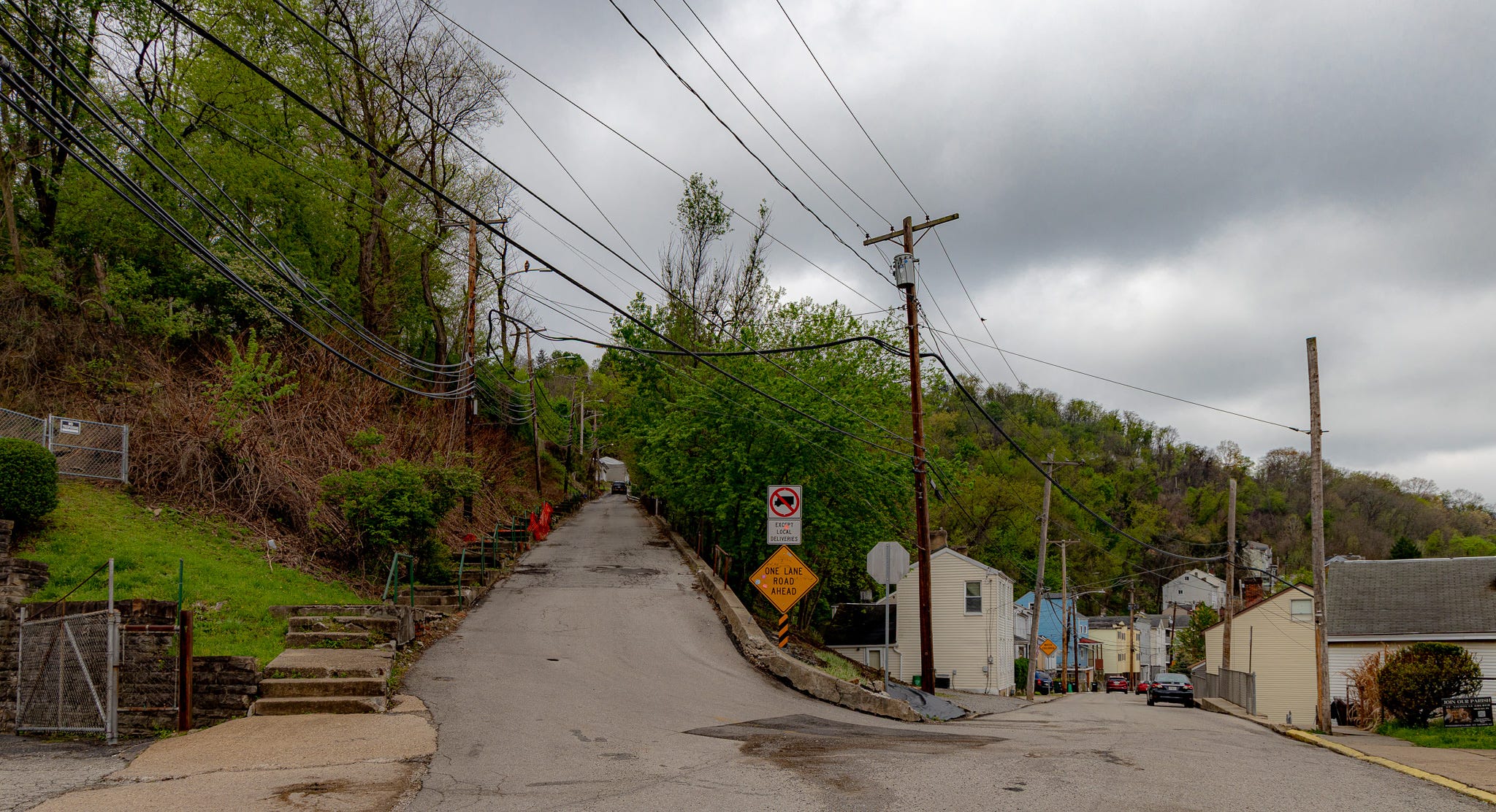
A workers’ district, outliving its work
(my photo)
The Urban Redevelopment Authority describes the redevelopment of former industrial sites as a critical component of the city’s transformation (Urban Redevelopment Authority of Pittsburgh, n.d.). That characteristically American sentence, which is brisk, optimistic, and managerially bossy, nevertheless tells the essential truth. Pittsburgh’s transformation has not consisted in turning away from its industrial lands, but in returning to them under altered conditions. The city’s future has repeatedly had to negotiate with its almost Lovecraft-ishly dangerous leftovers.
Brownfield is itself one of those euphemisms that deserve a brief philosophical pause. The term sounds almost pastoral, as though the land had merely aged into a less fashionable shade. In reality, brownfields are sites where capital has departed, but lasting environmental consequences have remained. They are the afterimages of production. The mills have shut, the furnaces cooled, the payrolls vanished, and yet the ground continues to hold a long, unsentimental memory of the bargain once struck between labor, industry, and place.
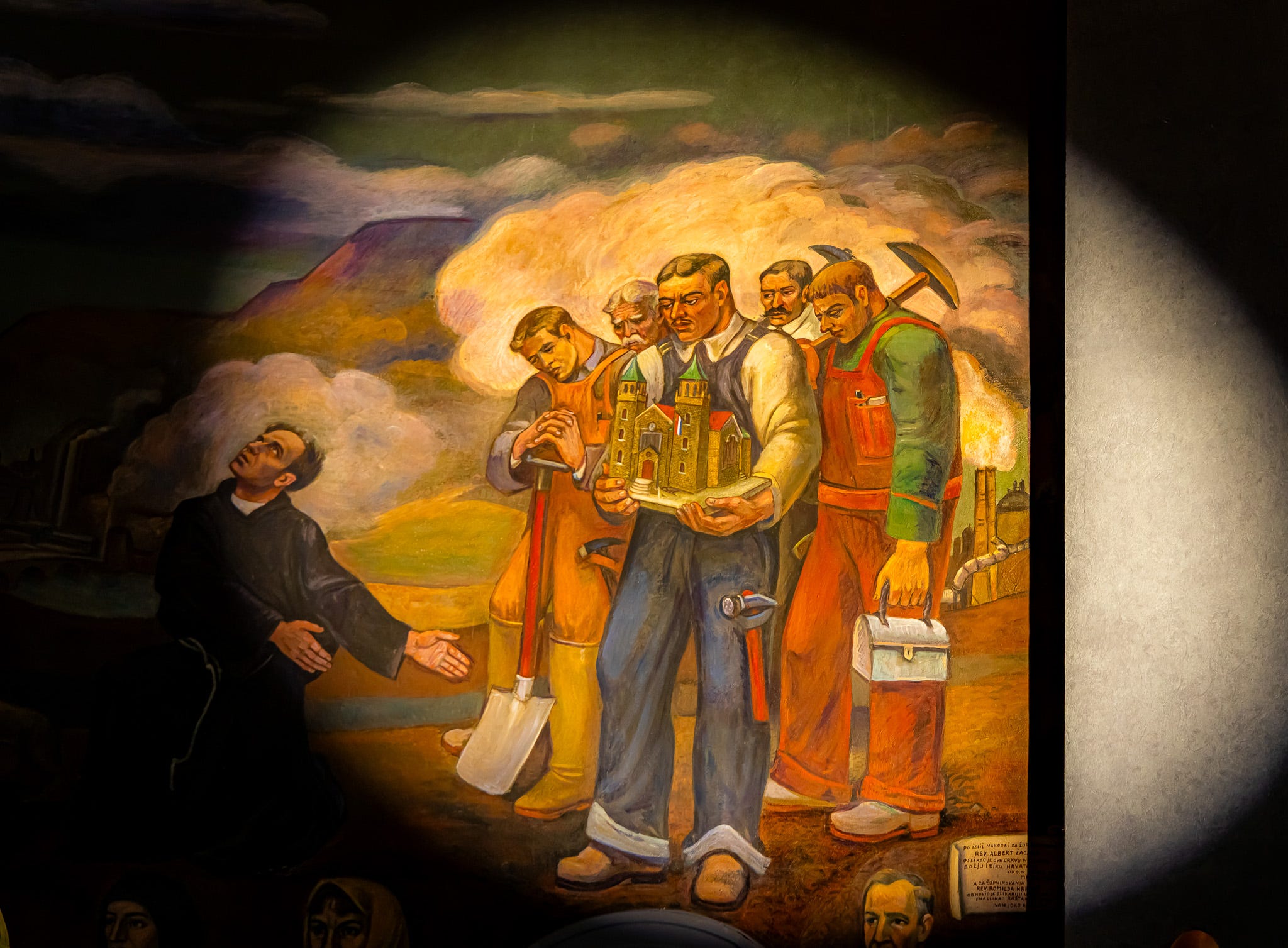
Old country and new, in one frame.
Maxo Vanka, ‘Croatian Workers,’ St. Nicholas Church, Millvale
(my photo)
The Environmental Protection Agency is admirably explicit on this point. In 2022, EPA officials toured formerly contaminated sites in Pittsburgh to highlight how federal brownfields funding had helped transform idle or blighted land into community assets (U.S. Environmental Protection Agency, 2022). The official rhetoric is one of resurgence and accelerated reuse. Beneath it lies a less cheerful premise: these places had to be assessed, cleaned, and made safe because the industrial city had fundamentally altered them.
This is where Pittsburgh becomes morally more interesting than the rare postindustrial success story. The city’s damaged ground resists narrative vanity. It insists that renewal is not a costume change but a technical, legal, ecological, and political labor. Environmental reports, remediation plans, assessment grants, and capping strategies are the city’s hidden grammar.
Sometimes the evidence defeats euphemism. In 2025, the URA announced remediation work for the Swisshelm Park Solar Project, describing the need to cap exposed steel slag so the site could be returned to “safe, productive use” (Urban Redevelopment Authority of Pittsburgh, 2025). Safe for whom? Productive according to what chronology of damage? Turning a post-industrial slag brownfield into a solar site has an almost allegorical neatness, but the allegory only works because Pittsburgh is still living with the physical residues of steelmaking in the present tense. Slag is what remains after value has been extracted, the ugly companion of miracle in metallurgical alchemy. The city’s powers of transfiguration do not abolish residue; they reorganize it, and sometimes they reach further down, into Mendeleev’s elements themselves. A humanity, in the end, is perhaps nothing more than a biological system for rearranging what the Earth was made of.
Scientific research has sharpened this picture. University of Pittsburgh researchers have found that historical coking and smelting dispersed toxic metals into city soils, with particularly notable impacts in parts of eastern Pittsburgh (National Science Foundation, 2022). The steel city blackened the air for a season, but it also deposited a chemical afterlife into the ground itself. Industry does not end when smokestacks stop smoking.
This persistence gives Pittsburgh’s beauty its ethical depth. A lesser city would try to convert such facts into guilt, innocence, denial, or marketing, depending on the decade. Pittsburgh, at its best, lives among them. I feel that the city has learned to speak of renewal without adopting the triumphant vulgarity that so often accompanies redevelopment. The past, instead of being denied, is managed, studied, capped, repurposed, and, seemingly, turned into the very condition of a different future.
So, Brownfields are not romantic ruins, nor opportunities for reinvention with a pleasing rust-belt aesthetic. They are reminders that industrial civilization externalizes costs into landscapes with astonishing efficiency. Pittsburgh’s dark side is open to your face; it is stratigraphic. And this is one reason the city can be loved. Pittsburgh is lovable because it continues to metabolize its history.
Certain lands in scripture are blessed; others are marked, burdened, or cursed. Not because the soil itself is evil, but because history has saturated it with consequence. Pittsburgh’s brownfields belong to a secular version of that tradition. Yet the city’s answer has been the slow, more exacting virtue of remediation. That may be Pittsburgh’s darkest and finest transfiguration: it has learned, on damaged ground, how not to confuse redemption with erasure.
The Cathedral after Steel
Every serious city eventually produces an image of what it would like to think of itself. Paris has its boulevards, Washington its Mall, New York its habitual vertical impatience. Pittsburgh, with a Gothic audacity that now feels both improbable and perfectly correct, produced a Cathedral of Learning.
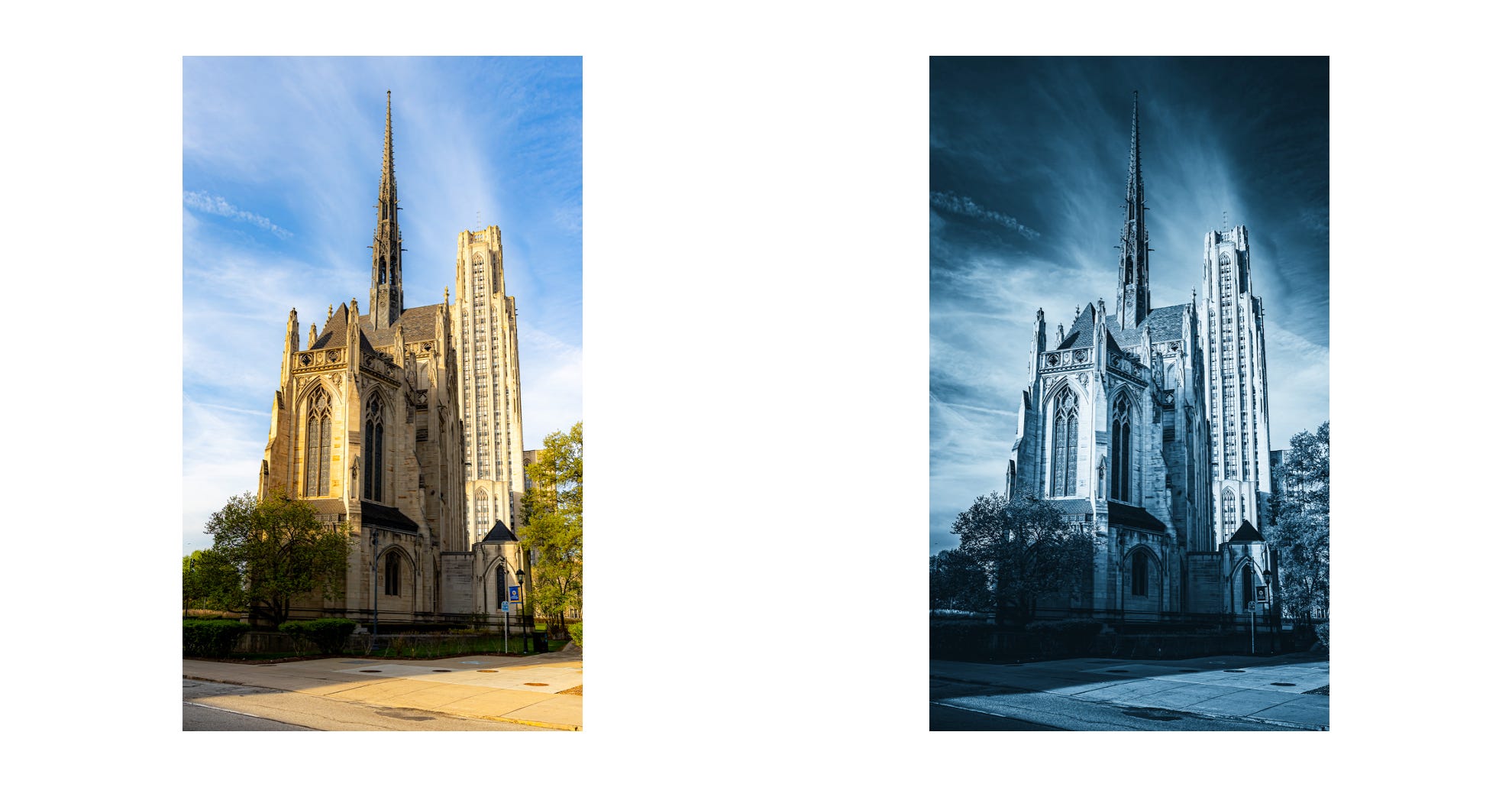
Reproduction of a reproduction:
Pittsburgh’s neo-Gothic, à la Warhol
(my photos)
The name alone sounds as though someone had allowed metaphor too much administrative authority. One imagines a committee, in the more innocent reaches of the twentieth century, deciding that if knowledge were important enough, it ought to dress ecclesiastically. Yet the building survives the danger of its own title because Pittsburgh, of all places, had earned the right to such seriousness. The Cathedral is campus whimsy a bit, but much more it is the city’s most concentrated act of self-interpretation.
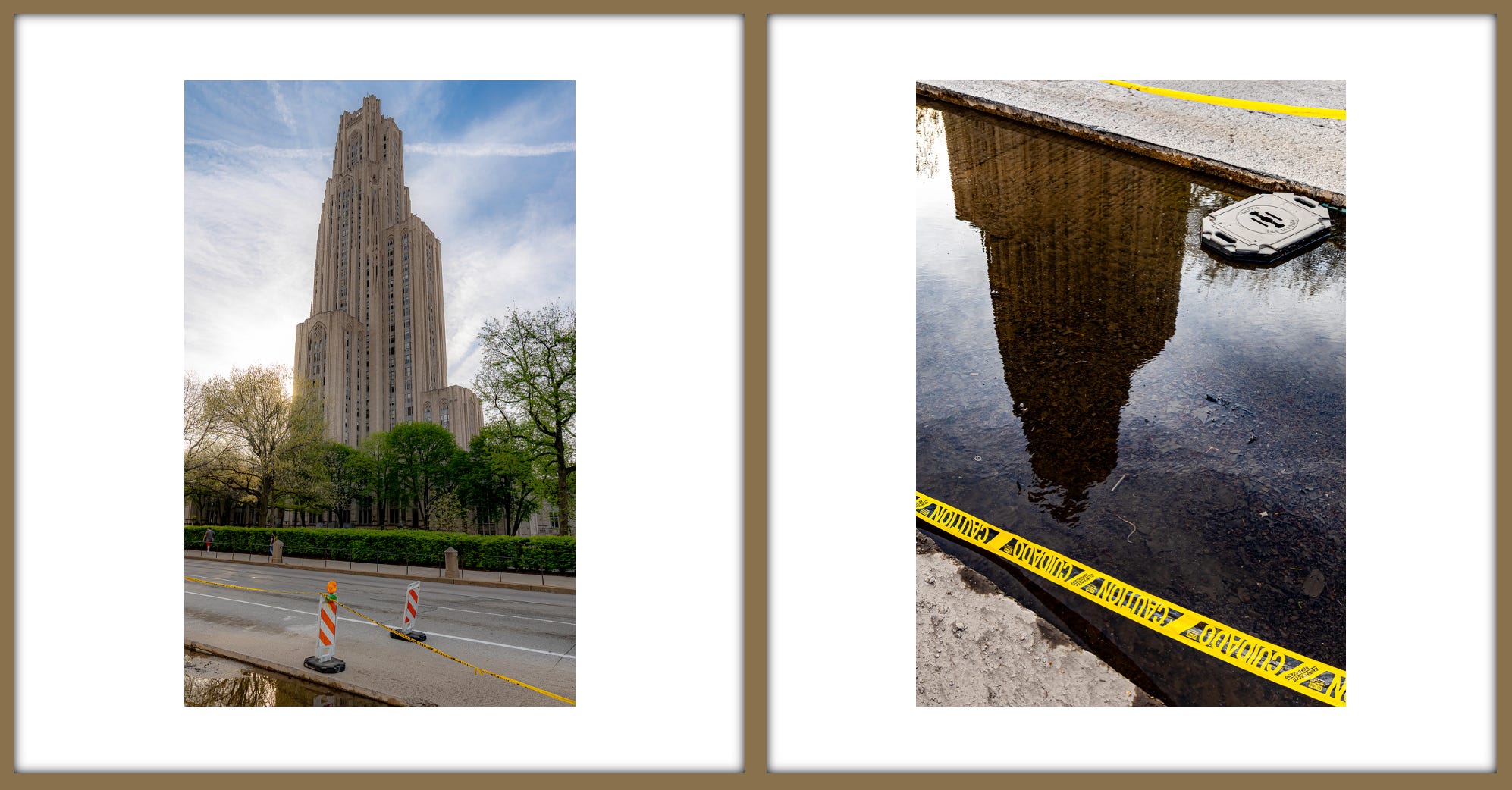
The Cathedral of Learning: the city’s self-interpretation and its reflection
(my photo)
The University of Pittsburgh’s own materials are refreshingly unapologetic. The Cathedral of Learning is a forty-two-story Late Gothic Revival landmark, the tallest educational building in the Western Hemisphere and, after the main building of Moscow State University, the second-tallest university building in the world (University of Pittsburgh, n.d.-a). More interesting than the superlative is the story the university tells about the building’s restoration: in 2007, on the seventieth anniversary of its dedication, trustees approved a major project to clean and restore the structure, including scrubbing the limestone exterior of industrial grime. It is difficult to imagine a more Pittsburgh narrative. The city’s great educational monument had to be literally washed free of the residue of the world that made it possible.
The building’s social meaning becomes clearer on its first floors, where the Nationality Rooms turn the Cathedral from a monument into a civic allegory. These rooms are described by the university as both museum-quality classrooms and expressions of the traditions of the region’s many ethnic communities, designed in collaboration with those communities to reflect their heritages (University of Pittsburgh, n.d.-b). The Gothic tower is therefore not merely a temple of abstraction. It is a structure within which immigrant and ethnic communities were invited to deposit versions of themselves into the university’s architectural body. The tower is a dialectical temple: it proclaims universality, while the Rooms insist on particularity. One could hardly ask for a more exact architectural image of the city’s moral ambition: to convert industrial pluralism into a form of cultured common life without pretending that difference has been dissolved.
This may also explain why the Cathedral feels less arrogant than it ought to. By rights, a forty-two-story Gothic educational tower should be intolerably pompous. There is, to be sure, a little American grandiosity in the whole enterprise: that wholesome conviction that if learning matters, it should also be visible from several zip codes away. But the building is saved by the city beneath it. In Manhattan, such vertical seriousness might become merely competitive. In Pittsburgh, it becomes metaphysical. The tower does not seem to bully the skyline; it seems to answer it, and to answer, in particular, the old problem of smoke. If the industrial city was organized around a horizontal economy of extraction, transport, and combustion, the Cathedral introduces a vertical counterimage: the city’s assertion that something can rise from this ground besides exhaust.
It is tempting, standing in Oakland beneath that tower, to say that Pittsburgh became post-industrial here. But that would be too simple. Nothing in the Cathedral suggests clean succession; it suggests conversion. The industrial city did not die and get replaced by the knowledge city. It reappeared in a higher register, carrying much of its old weight with it. The tower’s limestone may be scrubbed, but it is still the limestone of a city that once blackened stone as a civic habit. Even its height echoes the mills’ older logic: if material power once dominated the landscape, then intellectual power must now do the same, though with better manners.
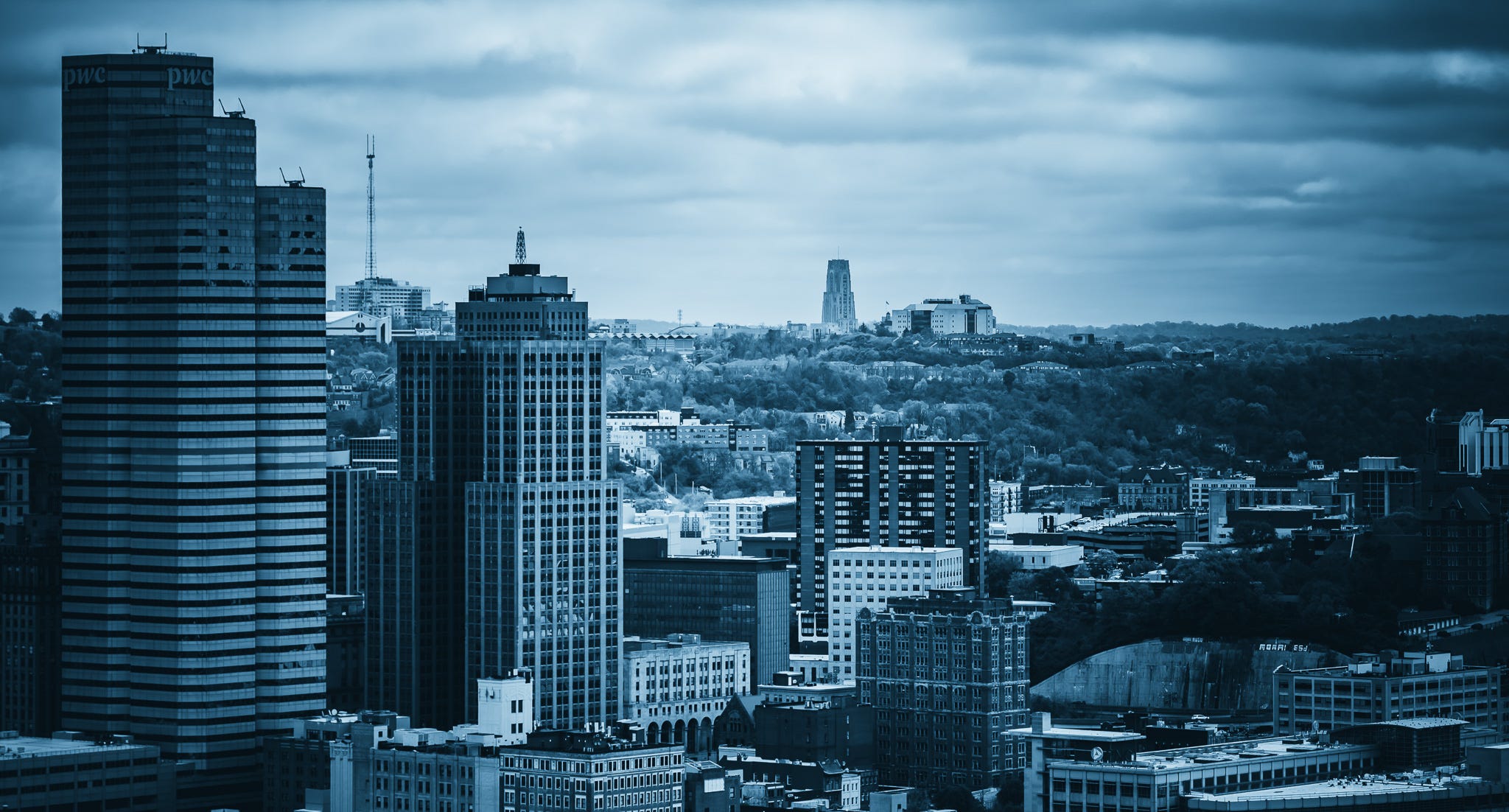
Learning’s spire, capital’s spire
(my photo)
The Cathedral of Learning was conceived in an era that still believed civilization could be confidently monumental. We, who live among politicly-correct utterances, institutional disclaimers, and prefabricated humility, no longer trust such confidence. And yet there it stands, not ridiculous but persuasive, the afterimage of a harder proposition: that a city marked by labor, soot, ethnic fragmentation, and material severity might still lift knowledge into public form and call that aspiration by its proper sacred name. The Cathedral over the mills is not a metaphor imposed on Pittsburgh from the outside. It is Pittsburgh’s own syntax made vertical.
Maxo Vanka and the Theology of Workers
If the Cathedral of Learning is Pittsburgh’s official dream of transfigured intelligence, the Maxo Vanka murals are the city’s more disturbing revelation: that no transfiguration worthy of the name can leave labor’s wounds outside the sanctuary.
St. Nicholas Croatian Catholic Church in Millvale does not initially advertise the magnitude of what waits inside. In cities shaped by immigrant labor, the deepest things often occur in buildings that maintain a studied modesty toward the street. The old ethnocatholic parish has never needed the swagger of downtown architecture. Then one enters, and the walls begin to speak in a language far more severe and inventive than ecclesiastical decorum usually permits.
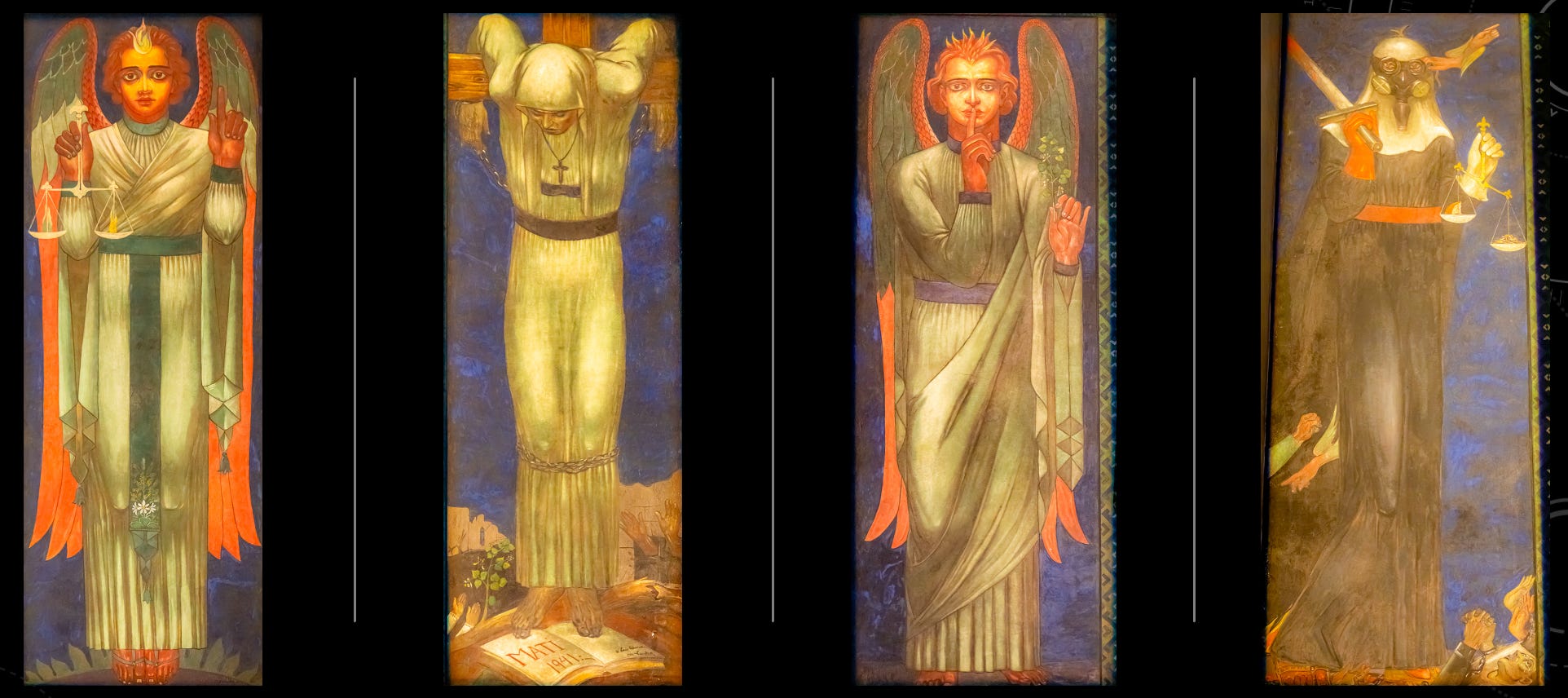
A moral grammar of 1941: Justice, the crucified Mati, Silence, Injustice.
Maxo Vanka, Millvale
(my photos, collage)
Maxo Vanka, a Croatian immigrant artist, came to Millvale in 1937 to paint the first cycle of murals at St. Nicholas, centered on the Croatian immigrant experience. He returned in 1941 to add a second cycle with a pacifist theme (Society for the Preservation of the Maxo Vanka Murals, n.d.). The art historian Barbara McCloskey has described these cycles as a distinctive contribution to the American mural movement of the 1930s and 1940s (McCloskey, 2013). The Society that now cares for the murals speaks of them, with deliberate warmth, as a gift to America, a lovely phrase, though one should hear the steel hidden inside its politeness. America, in these murals, is gifted judgment. Vanka does not paint immigrant Catholic life as a sentimental annex to the nation’s cheerful self-image. He paints it as an apocalypse in the older sense of an unveiling and revelation. The worker is burdened. The immigrant is displaced, vulnerable, morally exposed. War, which caused emigration, is an organized violation. And religion is the vocabulary by which injustice becomes visible without becoming normal.
This is why the murals matter so much in my travelogue about Pittsburgh. They disclose the city’s dark transfiguration at the point where labor, ethnicity, violence, and transcendence become inseparable. In the Cathedral of Learning, Pittsburgh universalizes itself through knowledge. In St. Nicholas, it particularizes itself through suffering. The first building says: This city can rise. The second asks: at whose cost, and under whose gaze?
The answer Vanka gives is not Marxist, though one can feel the social anger humming beneath the iconography. Nor is it merely devotional. It is something rarer: a theology of workers. Catholic imagery, immigrant memory, anti-war witness, and class consciousness fuse into a sacred visual order that refuses to let the laboring body become invisible. In Pittsburgh, where industrial civilization had every incentive to convert workers into function, unit, output, and eventually nostalgia, Vanka reverses the conversion. He drags labor into the sanctuary and places it under eschatological light.
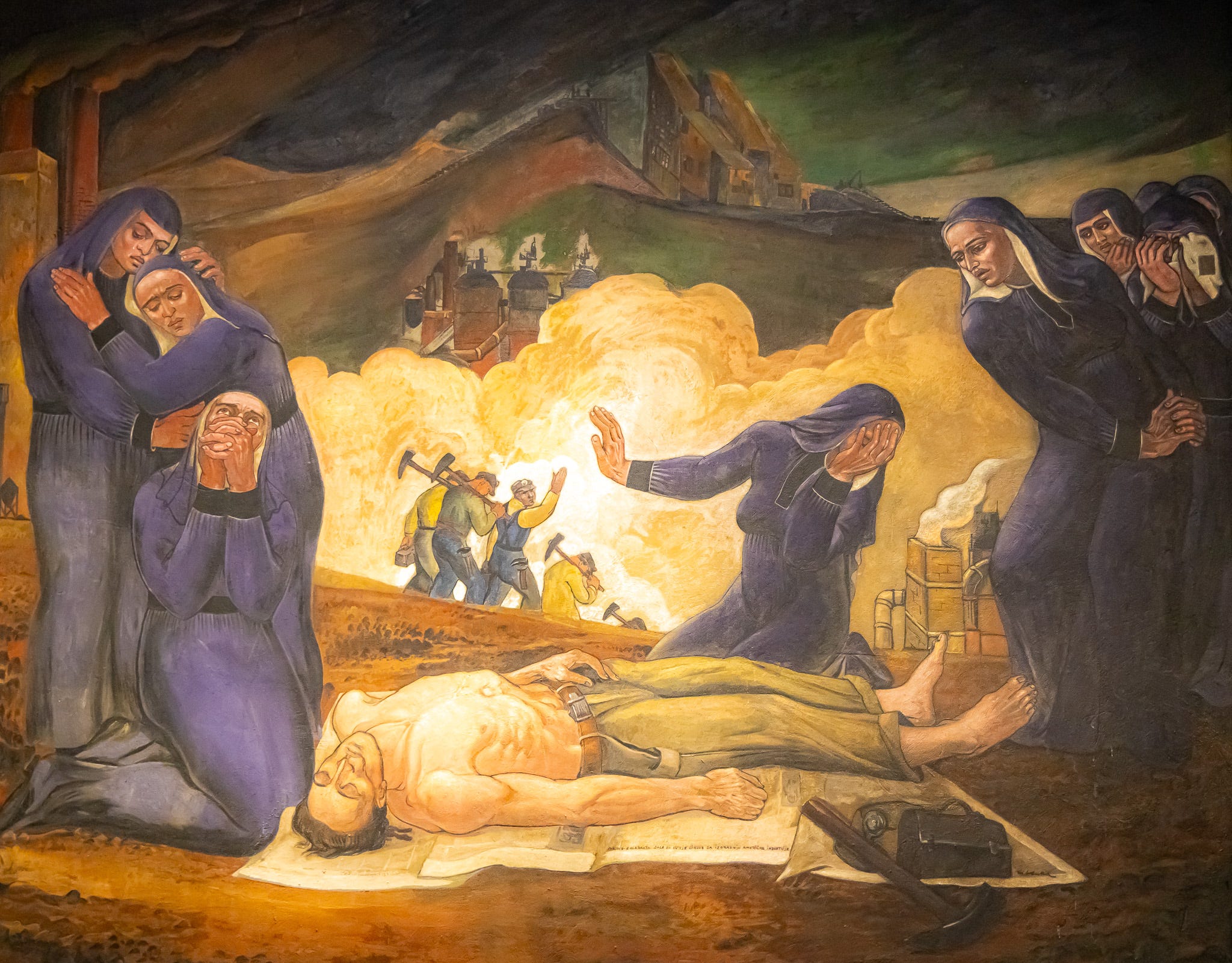
Sons raised in the old country for industries in the new:
Maxo Vanka, ‘Immigrant Mother Raises Her Sons for American Industry,” Millvale, 1941
(my photo)
The workers who helped build industrial Pittsburgh did not receive, in their time, the public monumentalization reserved for wealth or industry. Yet in a Croatian parish church just outside the city’s more official centers, they received better treatment: iconographic seriousness. They were painted not as sociological data, not as smiling ethnics in a municipal pageant of diversity, but as souls caught in history. The church becomes, in a way, a counter-cathedral. If Oakland sacralizes learning, Millvale sacralizes wounded labor.
The Nationality Rooms in the Cathedral of Learning tell one story about immigrant Pittsburgh: of communities contributing memory and craftsmanship to a common civic order. Vanka tells another story: he shows what immigrant life looked like before such contributions could be safely celebrated. He demonstrates toil, homesickness, vulnerability, militarized masculinity, women burdened by grief, and faith enlisted as a language of endurance. These are successive registers of the same city, but Vanka’s is the darker and, in certain moods, the truer. His walls also complicate any lazy distinction between religion and critique. We post-moderns are forever imagining that prophetic social consciousness begins only once faith recedes. Vanka proves otherwise: the sacred may be one of the last places where industrial society can still be judged in fully human terms. The liturgical space restores scale; it places labor, war, gendered suffering, and immigrant life inside a moral cosmos vast enough to render them neither banal nor inevitable.
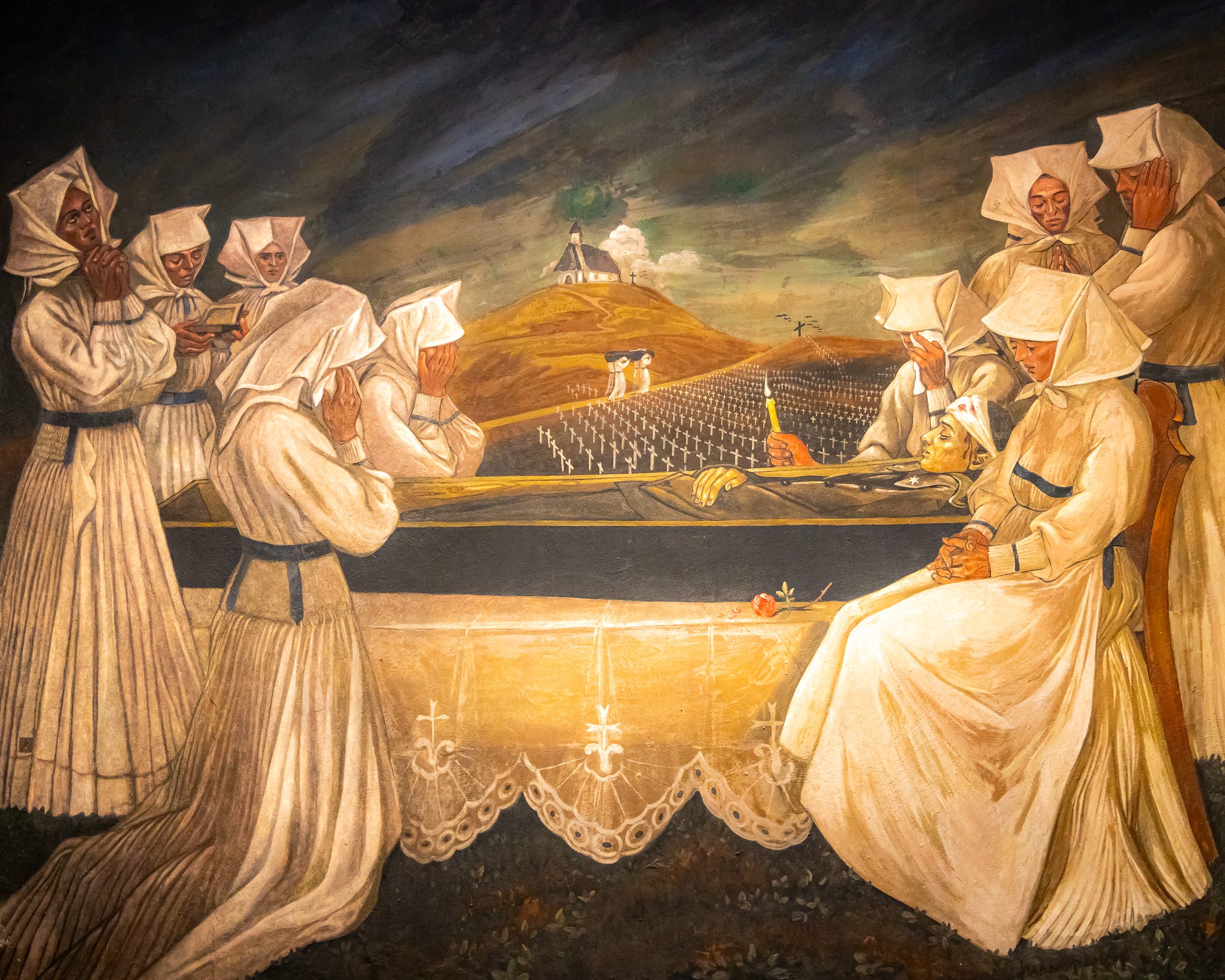
Migration does not save the son; it relocates the altar.
‘Croatian Mother Raises Her Son for War,’ Maxo Vanka, Millvale, 1937
(my photo)
This is where Pittsburgh’s dark side ceases to be merely atmospheric and becomes theological. Smoke, bridges, brownfields, and even the Cathedral of Learning express the city’s history in material or institutional forms. Vanka gives that history a spiritual face. And yet the murals are not nihilistic. His world is wounded, but not emptied of transcendence. The work says that the sacred must descend into history deeply enough to remain worthy of belief. It refuses both the pieties of religion without justice and the pieties of critique without grace.
A city can survive industrialization in many ways: by forgetting it, aestheticizing it, or turning it into an alibi for present virtue. Pittsburgh has done something more layered: it has preserved spaces in which its former worlds remain morally active. The Vanka murals keep the worker inside the city’s soul, reminding the scholar, the curator, the planner, and the visitor that the beautiful second life of Pittsburgh rests on lives that were not lived beautifully. In the presence of those painted walls, Pittsburgh’s transfiguration becomes darker, truer, more complete. The city is not only a place where matter rose into culture. It is also a place where suffering demanded an image, and found one bright enough to wound memory into honesty.
Warhol, or the Soul as Reproduction
Every industrial city eventually produces a child who appears to have escaped it, only to discover, decades later, that he had been carrying its logic all along. Pittsburgh’s most dazzling example is Andy Warhol.
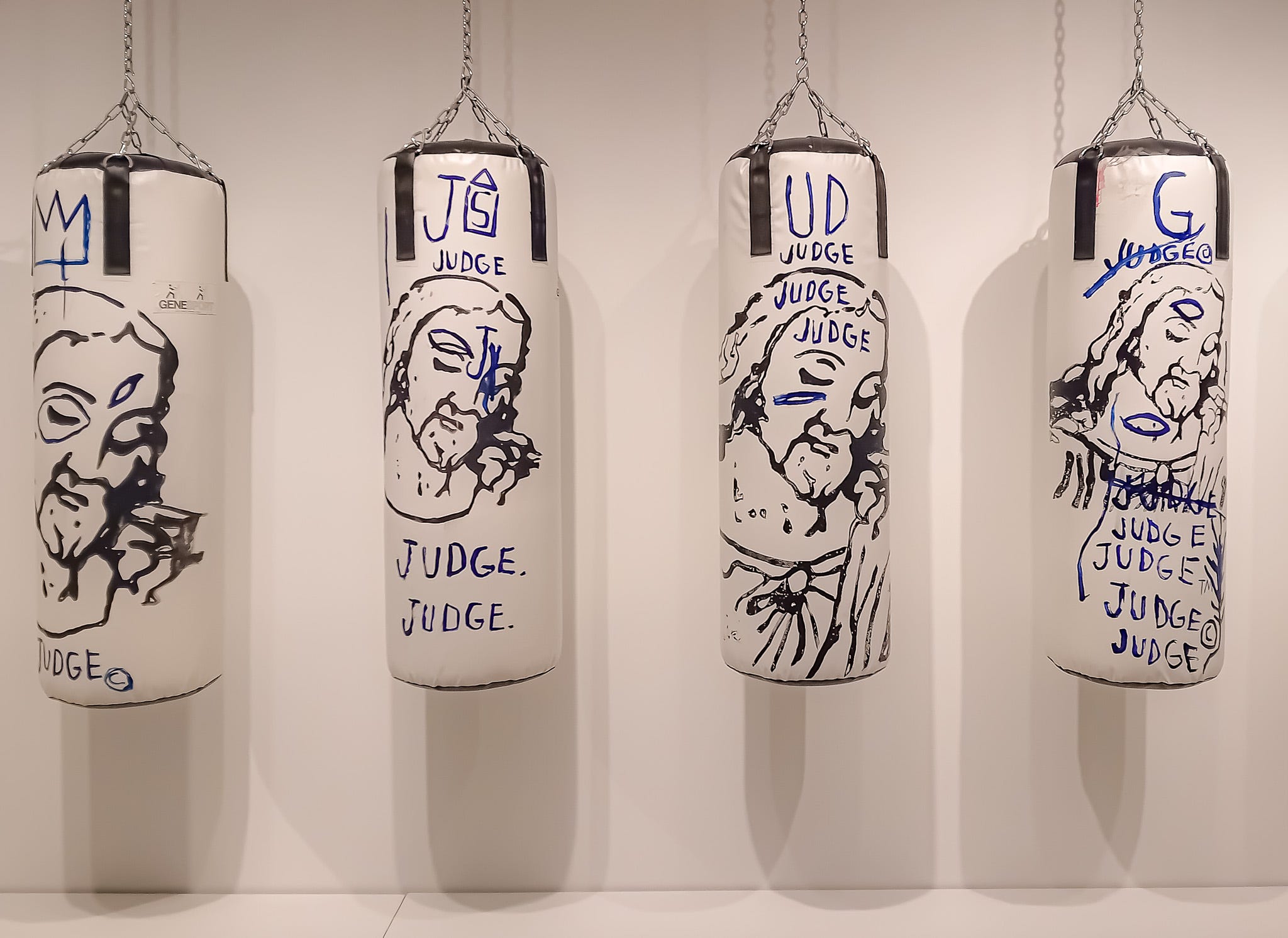
Christ as judged and as judge:
Warhol and Basquiat, ‘Ten Punching Bags (Last Supper),’ 1985–86
(my photo)
The sentimental version is familiar: a working-class son of immigrants (Slovaks and Ukrainians still fight, from where they were) leaves Pittsburgh, goes to New York, invents a new visual language for celebrity, consumption, repetition, and surface, and is then, after death, returned to his city of origin in the form of a museum. All true, and yet the outline is almost too neat. Life seldom respects the geometry of such redemption. Still, Pittsburgh has managed something close to it. The Andy Warhol Museum, in the city of his birth, holds the largest collection of Warhol’s works and archival materials and describes itself as one of the most comprehensive single-artist museums in the world (Andy Warhol Museum, n.d.). Born Andrew Warhola in 1928 to immigrant parents who settled in a working-class Pittsburgh neighborhood, Warhol entered modern art carrying the grammar of the steel city, whether he knew it or not.
That detail is the philosophical key. Warhol has often been read as the apostle of postwar American surface, the amused and terrifying diagnostician of commodity culture, glamour, seriality, and the exhausted soul of abundance. All of that remains true. But to view him from Pittsburgh is to notice something else: he did not invent repetition out of nowhere. He inherited a world already organized by it. The mills repeated. The production lines repeated. Industrial modernity repeated. Even ethnic piety, with its icons, embroidery, and rituals, knew something about the power of reiterated image. Warhol’s genius lay in translating the world’s grammar from matter into appearance.
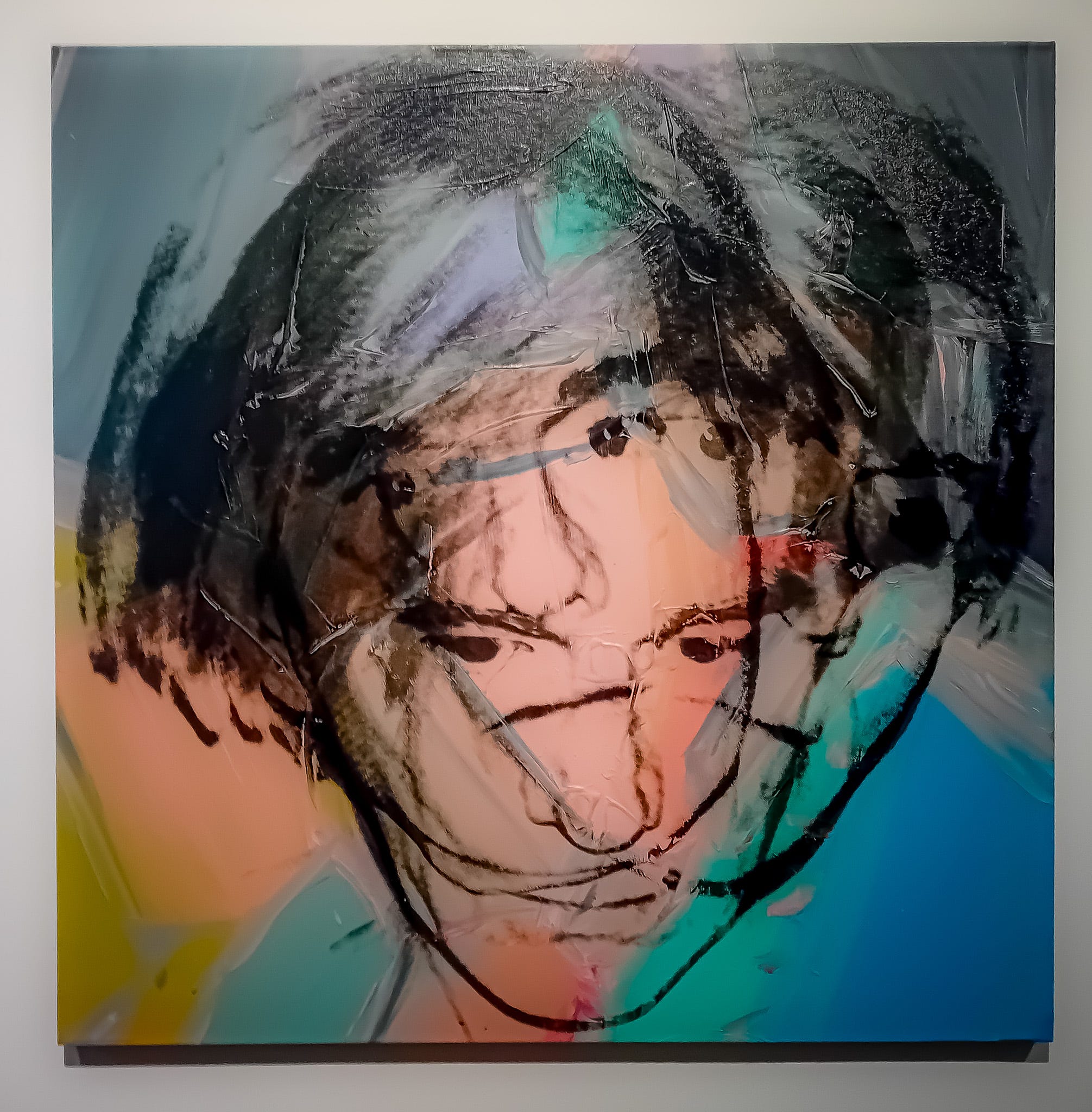
Warhol, returned to his own face,
The Andy Warhol Museum
(my photo)
One sees the elegance of that translation most clearly in the city that reclaimed him. The Warhol Museum is a retrospective homecoming staged as civic self-recognition. Pittsburgh looks upon Warhol and discovers that one of its most local children had turned out to be its most universal mirror. He had taken the industrial city’s deep structure with its reproducibility, its fascination with standardization, its commerce in mass objects, and its tension between anonymity and fame, and had refined it into art.
I feel quite some irony here. Pittsburgh was often imagined as the city of substance and Warhol as the prophet of surface, as though the former forged steel while the latter merely decorated soup cans. That contrast is too flattering to philosophy and too insulting to art. Surface, in Warhol, is not superficiality; it is ontology under modern conditions. The repeated face, the repeated object, the repeated image, the “time capsules”: these are signs that reality has entered a phase in which what circulates most powerfully is no longer the thing but its reproducible appearance. Pittsburgh, as well as Zaporizhzhia, understood this earlier than it might have, because industrial civilization had already taught the cities that value can be produced through seriality.
In this sense, Warhol is Pittsburgh’s metaphysician of second-order being. The steel city extracted, processed, formed, and distributed. Warhol did the same to images. He took what was already seen and made it more visible. If the mills taught matter how to become a commodity, Warhol taught the commodity how to become an icon. It is difficult to imagine a more Pittsburgh transformation.
New York, which loves Warhol as the great notary of coolness, risks leaving him suspended in the glamorous vacuum he so well diagnosed. Pittsburgh returns him to weight. Here he reacquires a mother, a parish background, an ethnic origin, a working-class district, a material childhood, as well as his first artistic and gay probes. He becomes less abstractly “Pop” and more historically legible in his mother town. A man who made surface immortal is shown to have emerged from a world in which surfaces were never free of labor, migration, and damage. Pittsburgh, in bringing him home institutionally, has performed its own Warholian gesture: repeating him, archiving him, exhibiting him. The museum is itself a Warholian mausoleum: a machinery of return, display, post-death eternity, and controlled aura.
A city with Pittsburgh’s history could have remembered Warhol as a pleasant local success story and a brand, as Americans like to do. Instead, it made him into a shrine of transformation. One descends through the museum floors and follows a life moving from local craft to global image, from Pittsburgh boyhood to worldwide iconography, from hand and line to screen and seriality. This journey has the form of spiritual descent, though the spirit is distinctly modern: nervous, bright, ironic, transfixed by fame, repulsed by depth, yet unable to stop producing symbols of depth’s disappearance.
This is why Warhol belongs so centrally in Pittsburgh’s dark transfiguration. The city did not merely produce steel and then, much later, produce art. It generated a thinker in images who carried the industrial logic of repetition into the regime of media and celebrity. In Warhol, Pittsburgh’s soul made matter reproducible.
Pittsburgh Written: Wilson, Chabon, Dillard
A city reveals its official face in monuments and institutions. But as the son of philologist parents, I know that a city’s inward truth is revealed in its literature.
Pittsburgh is fortunate to possess several literary self-images, and they do not agree. Cities become shallow when they can be summarized by a single genre. Pittsburgh resists that reduction. In August Wilson, it becomes a historical drama of race, class, inheritance, and endurance. In Michael Chabon it becomes initiation, erotic uncertainty, and post-adolescent bewilderment. In Annie Dillard it becomes the school of perception itself, a place where consciousness learns to notice the world with almost religious intensity. I had read Chabon and Dillard years before; only on this trip did I learn to read Pittsburgh through Wilson.
I start with Wilson because philosophical seriousness requires it. He grew up in Pittsburgh’s Hill District, the lively, poor neighborhood that became the setting for nearly all the plays of his Century Cycle, ten works, each set in a different decade of the twentieth century, nine of them in the Hill District (Elam, 2004). Taken together, they form a history. Wilson used Pittsburgh as a moral and temporal archive. In his work, the Hill District is not merely a place on the map. It is a theater of Black American striving, dispossession, wit, memory, improvisation, and grief.
What Wilson gives Pittsburgh is density. He restores to the city a social scale that no skyline can provide. In his dramatic world, which I barely scratched from my home reading, streets remember, rooms thicken with unfinished claims, ordinary speech accumulates metaphysical weight, and the past is never truly past because it keeps entering the present disguised as habit, debt, inheritance, rumor, song. If one wanted to know whether Pittsburgh’s beauty could bear moral scrutiny, Wilson is the writer who asks without flinching. Pittsburgh is also the Hill District: not as branding, not as heritage district, but as lived Black history.
Then comes Chabon, with a different instrument entirely. The Mysteries of Pittsburgh (1988), his debut novel, is a story of sexual awakenings and existential meanderings during a young man’s first summer out of college. Chabon’s Pittsburgh is not the morally thunderous city of Wilson. It is a city of drift, intelligence, fathers, gangsters, eros, and the comic grandeur of not yet knowing who one is. The place functions as a theater of becoming: half provincial, half mythic, full of corners where innocence and self-invention can still embarrass each other. Chabon catches an aspect of the city that official civic narratives often miss: its aptitude for ambiguity. His Pittsburgh is sternly historical and curiously permissive toward inward wandering, with just enough gravity to keep youth from floating away and just enough intimacy to let confusion feel almost companionable.
And then Dillard, perhaps the most quietly radical of the three. An American Childhood (1987) is her autobiographical narrative of growing up in postwar Pittsburgh, an account of the coming-into-being of consciousness. Dillard’s Pittsburgh is neither primarily historical like Wilson’s nor initiatory in Chabon’s manner; in my opinion, it is phenomenological. The city becomes the medium through which attention learns its vocation. Streets, weather, winter light, household order, neighborhood energy—everything appears not simply as remembered setting but as material for an education in noticing. Industrial and postindustrial cities are often written either sociologically or nostalgically (I know this perfectly well from Soviet Russian and Ukrainian literature, yes). Dillard offers a third possibility: ontological astonishment at the ordinary. Before the city becomes an object of critique, it is a world entering perception. One cannot have a serious philosophy of place without first having had the shock of seeing that a place is there.
Put these writers together and the picture of Pittsburgh becomes richer, stranger, and harder to sentimentalize. Wilson says: history is here, embodied and speaking. Chabon says: identity wanders here before it congeals. Dillard says: consciousness wakes up here. One could add Warhol and say: image reproduces here. One could add Vanka and say: suffering judges here. One could add the Cathedral and say: knowledge ascends here. Pittsburgh is one of those rare cities in which no single vocabulary can exhaust the truth. It requires drama, memoir, novel, mural, museum, bridge, and brownfield report. It is, in the best sense, overdetermined.
That is perhaps why the city remains so involving. It can neither be reduced to its industrial past nor purified into its postindustrial present. Literature keeps reopening the case. Pittsburgh is not one thing that changed into another; it is a layered city in which multiple moral climates continue to coexist: labor and scholarship, race and ethnicity, damage and charm, repetition and revelation, memory and self-invention. A flatter place would have become legible long ago. Pittsburgh keeps producing new readings because it never quite stops being plural.
The Difficult Grace of Transfiguration
So, what, finally, is Pittsburgh?
One is tempted to answer with a string of elevated nouns that I used above: confluence, industry, bridges, universities, murals, museums, memory. I did so to accumulate these themes, amounting to metaphysical clarity. But cities are not improved by philosophical solemnity alone. Pittsburgh seems to me too lightly ironic to tolerate being embalmed in noble abstractions. It is also a place where people go to work, drink beer, fight in bars, teach seminars, repair things, argue about neighborhoods, and inhabit the ordinary with a competence that philosophy, if it were decent, would envy.
Still, something in Pittsburgh invites a larger verdict. The city seems to have staged with unusual elegance one of modernity’s more embarrassing problems: what becomes of a place after its material greatness has revealed its moral costs? Many cities answer badly (look at DC, Moscow, or Rome). Some cling to the mythology of industry long after industry has ceased to sustain them (look at Milan and Kyiv); they become museums of their own masculine self-image and feminine deep-structure. Others perform reinvention so aggressively that one suspects they would redevelop memory itself if zoning permitted. Pittsburgh has done neither. It remembers the mills, but the mills do not explain everything forever. It has seemingly learned a harder art: how to let a past remain authoritative without becoming tyrannical.
That is probably the deepest meaning of its dark transfiguration. Pittsburgh has risen, but not by floating free. Its second life with the scholarly, artistic, medical, technological, and cultivated modi vivendi remains answerable to smoke, labor, migration, racial history, and damaged ground. If there is grace here, it is the grace not of innocence, but of metabolized burden.
This is why the city reminds me, with an intimacy not reducible to analogy, of my native Zaporizhzhia. The two places are not twins (nor they are with Donetsk, a former formal twin-city). History would laugh at such laziness: their/or states, empires, nations, wars, languages, and political fates are radically different. Yet there is a kinship of soul that only steel cities seem to understand. Zaporizhzhia, too, knows what it is to be organized by furnaces, by metallurgical destiny, by the strange pact between labor and magnitude. It knows that industrial cities produce a certain anthropology: tough nerves, infrastructural imagination, a refusal of decorative frivolity, an almost metaphysical respect for what has been made under pressure. It recognizes the type.
Pittsburgh, though, offers a version of the steel soul after its first great historical form has already passed. It is what a metallurgical civilization looks like when it has learned to sublimate itself into scholarship, art, and reflective urbanity without entirely losing its old temperature. Zaporizhzhia, for me, belongs to a more immediate register: harsher, less mediated, closer to the furnaces, and now, under the pressure of war and history, burdened by fresh forms of existential seriousness. Pittsburgh shows what such a soul can become when it survives long enough to acquire museums, theories, and a certain cultivated modesty. Zaporizhzhia reminds me of what gave that soul its force in the first place.
Cities spend enormous effort trying to become unlike the conditions that made them. They wash the limestone, plant the riverfront, restore the warehouse, fund the museum, recruit the scholars, and hope that posterity will mistake transfiguration for absolution. Pittsburgh is too subtle to make that mistake. The mills have become invisible, but they have not disappeared. They persist in its musculature, its seriousness, its bridges, in the way even its intellectual life seems to prefer weight to cleverness.
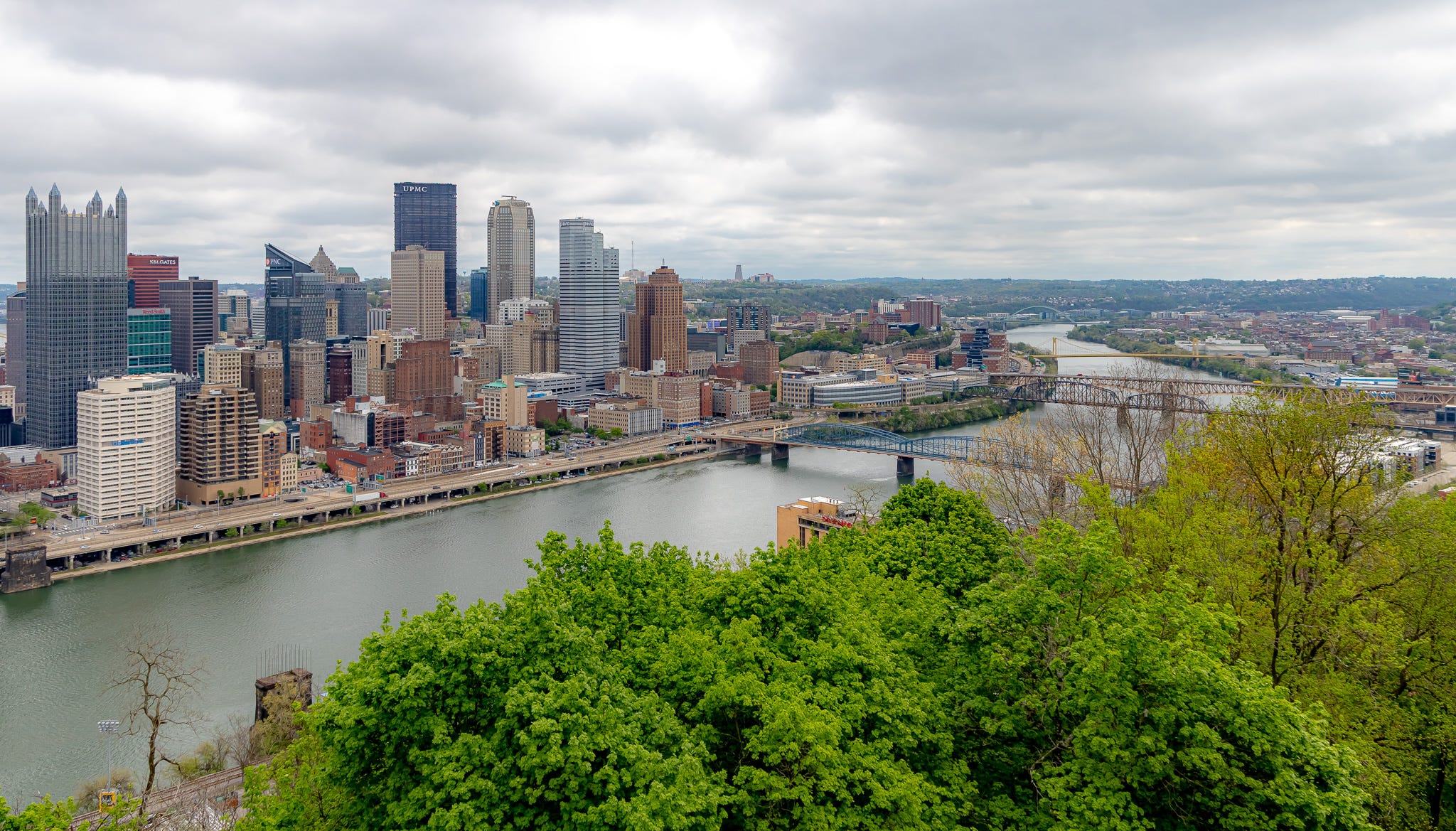
Pittsburgh as its own collage:
Gothic, industrial, corporate, learning under one sky
(my photo)
And this is why I responded to this city’s demand for love. Not because it transcended its darkness, but because it did not cheapen transcendence by confusing it with escape. Pittsburgh knows that spirit, if it is real, must connect with matter without lying about their connection. The Cathedral must stand over the mills, but not as though the mills had been a regrettable misunderstanding. The murals must carry labor into sacred form. The museum must return Warhol to immigrant Pittsburgh. The bridges must keep teaching the city how relation is made. The brownfields must remain as reminders that history is a chemistry.
A lesser essay would end by calling Pittsburgh resilient. Cities are always being called resilient, usually by people who do not have to live inside the nouns they assign to others. Pittsburgh deserves a better word. It is dialectical in stone, steel, and neighborhood form. It knows that the sublime and the contaminated may share an address. It knows that beauty, in an industrial civilization, is often what matter looks like after conscience has begun to work on it. It knows, above all, that a city may retain a steel soul long after the furnaces have ceased to define the skyline.
A steel soul is not the same thing as an industrial economy. It is a way of holding form under pressure, of carrying memory without collapse, of allowing hardness to become structure rather than brutality. Pittsburgh has such a soul still. Zaporizhzhia, in another register and under graver skies, has it too. One city shows the afterlife of steel; the other reminds me that steel is a discipline of collectively-localized being, and never only a material.
Pittsburgh remains in the mind as a city unusually complete in its incompleteness: dark, charming, scarred, articulate, postindustrial but not post-material, scholarly without self-delusion, wounded without melodrama. A city that had the good taste to become philosophical only after first having been forged.
References
Andy Warhol Museum. (n.d.). About the museum. Carnegie Museums of Pittsburgh.
https://www.warhol.org/
City of Pittsburgh, Department of Mobility and Infrastructure. (n.d.). Bridges. https://pittsburghpa.gov/domi/bridges
Elam, H. J., Jr. (2004). The past as present in the drama of August Wilson. University of Michigan Press.
McCloskey, B. (2013). Maxo Vanka’s murals: An American mural movement. Society for the Preservation of the Maxo Vanka Murals.
National Science Foundation. (2022). Geologists map how metal pollutants have traveled across the city of Pittsburgh [Research highlight]. https://www.nsf.gov/news/geologists-map-how-metal-pollutants-have-traveled
National Transportation Safety Board. (2024). Collapse of the Fern Hollow Bridge, Pittsburgh, Pennsylvania, January 28, 2022 (Highway Investigation Report HIR-24/02). https://www.ntsb.gov/investigations/AccidentReports/Reports/HIR2402.pdf
Pittsburgh History & Landmarks Foundation. (n.d.). Pittsburgh bridges walking tour. https://phlf.org/wp-content/uploads/2018/02/bridges-tour-2018.pdf
Regan, B. (2006). The bridges of Pittsburgh. The Local History Company.
Society for the Preservation of the Maxo Vanka Murals. (n.d.). The murals.
https://www.vankamurals.org/
Tarr, J. A. (Ed.). (2003). Devastation and renewal: An environmental history of Pittsburgh and its region. University of Pittsburgh Press.
U.S. Environmental Protection Agency. (2022). EPA officials tour Pittsburgh-area brownfields redevelopment sites [News release]. https://www.epa.gov/newsreleases/epa-officials-tour-pittsburgh-redevelopment-sites-where-brownfield-funding-supports
University of Pittsburgh. (n.d.-a). Cathedral of Learning. https://www.tour.pitt.edu/tour/cathedral-learning
University of Pittsburgh. (n.d.-b). Nationality Rooms and Intercultural Exchange Programs.
https://www.nationalityrooms.pitt.edu/
Urban Redevelopment Authority of Pittsburgh. (2025). Swisshelm Park Solar Project. https://www.ura.org/pages/swisshelm-park-solar
Urban Redevelopment Authority of Pittsburgh. (n.d.). Brownfields redevelopment. https://www.ura.org/pages/brownfield-projects