

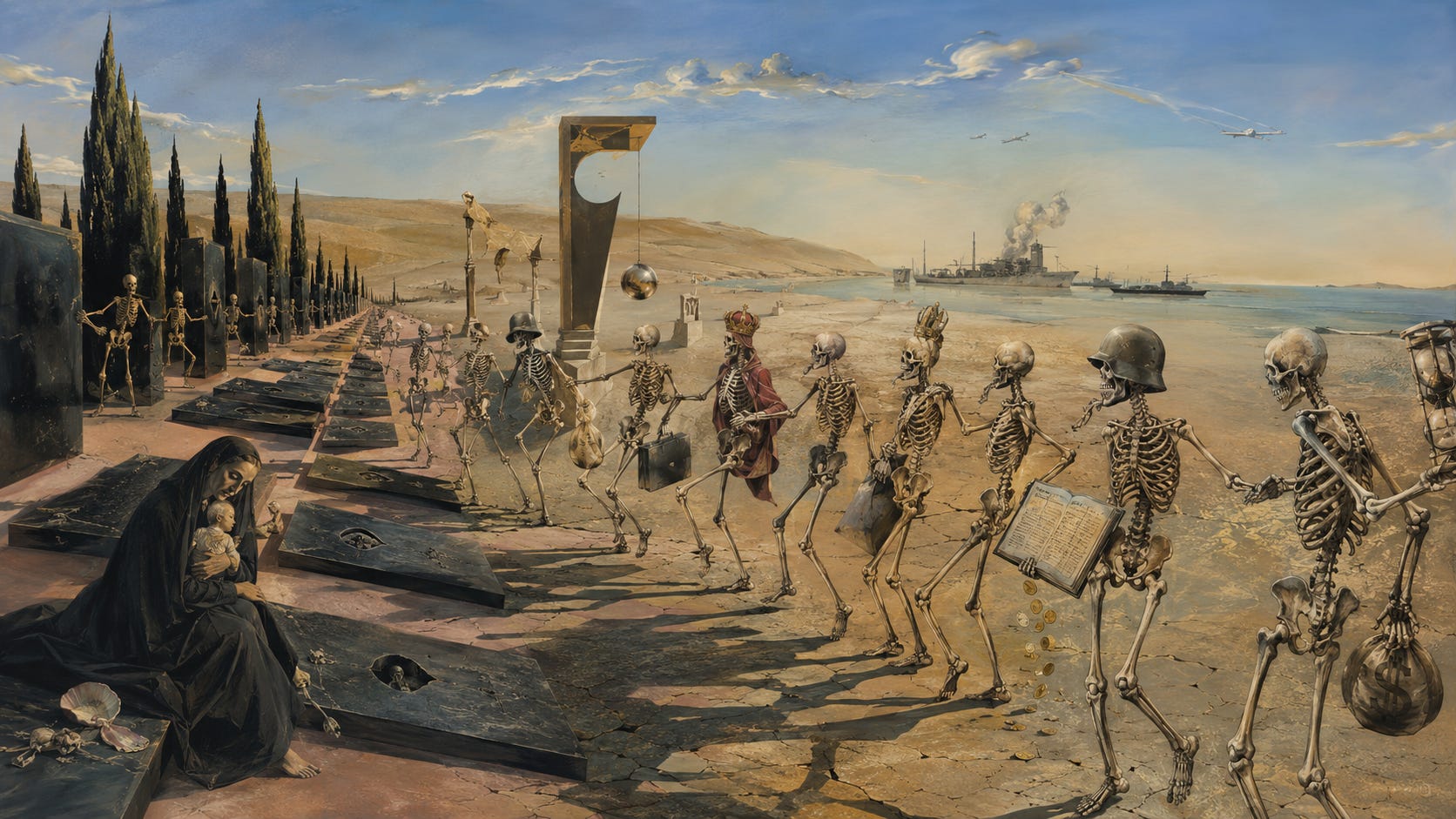
In Baku, Azerbaijan, there is a long avenue of polished stone called the Alley of Martyrs. It climbs a hill above the bay, and from its upper terraces you can see the whole city and the tankers waiting offshore. The graves are black granite, the portraits etched into them young, the inscriptions martial. The state tends this place with the care it gives to nothing else. And in the autumn of 2018, a small group of women came here wearing black surgical masks on which a single word had been written in Azerbaijani: sus. Quiet. They were the mothers of men buried in that soil, and they had come to ask, in the only register left to them, for money the state had promised and not paid: a modest sum, set by presidential decree, owed to the families of the dead (The World, 2018). Moreover, the relatives’ grief had an economic-political form.
Consider the arrangement. A state spends extravagantly on the dead with marble monuments, eternal flames, and the liturgy of the nation in stone, while withholding the cash it pledged to the living who survive them. And the mothers, standing among the very graves that legitimate the regime, were reduced to wearing their silence as a costume. The dead were loud; the living were ordered quiet.
This is the scene I want to hold throughout what follows because it contains, in compression, almost everything I mean by necrocapitalism. But there is a further turn the photograph cannot show. The war these men died in had, by then, not yet been won. It would be won two years later. And once it was won, once the territory of Nagorno-Karabakh was retaken and the victory consecrated, the apparatus that had priced and enshrined those deaths did not dissolve. It remained intact, fed, and looking for what might come next. The question that organizes this essay is the one that scene poses without answering: what does a death-economy do once it has won?
What capital learned to hold
Begin with a recent correction of what capital is, following Thomas Piketty. His work, Capital in the Twenty-First Century, is a claim about the long arithmetic of wealth: that the return on capital tends, over time, to outrun the growth of the economy as a whole, so that accumulated fortune compounds faster than wages can catch up (Piketty, 2014). The deeper lesson, however, is simpler in a philosophical context. After Piketty it is hard to speak of capitalism as though it were mainly about making things. Capital reappears as what it always was beneath the factory smoke: an accumulated claim on the future, the power of property over time, over labor, and over the institutions that arbitrate both.
Hold that definition still for a moment, because everything turns on it. Capital is command over future income. Financial capital refines this: it is command over future abstraction, the capitalized right to revenue that need not pass through any particular thing at all. An investment is a hook into future income. A bond is a promise about time. A derivative is a promise about a promise. Time is capital’s locus.
Now ask a question that sounds, at first, merely grim, and turns out to be structural. What happens when the future income stream is attached neither to land, nor to rent, nor to financial abstraction, but to the human exposure to death?
Let’s call the answer necrocapital: command over the priced future exposure of life to death. Not capital that incidentally kills but capital whose very asset is the calculated likelihood that specific bodies will be destroyed, maimed, or used up, and whose income is drawn from organizing, insuring, compensating, and renewing that destruction.
The word is not mine to coin. Subhabrata Bobby Banerjee (2008) gave it academic shape, defining necrocapitalism as the forms of accumulation that subjugate life to the power of death, with an eye chiefly to the colonial corporation. I want to push it somewhere he did not: toward the modern state, whether metropoly or colony, core or periphery, that does not merely permit deadly accumulation but administers it as a permanent line of business.
To see how strange this is, set it beside Karl Marx, who is unavoidable here. Capital, for Marx, is dead labor, congealed past work, that lives, vampire-like, by drawing on the living labor of the present. The image is exact and was meant to disturb, to call for revolutionary action. But necrocapital performs an inversion Marx did not need to name. It not only sets dead labor to feed on the living. It prices the living in advance, according to the probability of their death (Marx, 1867/1976, p. 342; see also Neocleous, 2003, pp. 669–670, 680–681). The wage no longer buys your hours, but the odds against your return from a war.
There is a tidy way to mark the mutation. Michel Foucault described how modern power abandoned the old sovereign prerogative “to take life or let live” in favor of a biopolitics that “makes live and lets die,” a power that counts populations, tends their health, manages their fertility, and their length of days (Foucault, 2003, pp. 241–247). Achille Mbembe radicalized this into “necropolitics”: sovereignty as the capacity to decide who must die, to manufacture what he called death-worlds (Mbembe, 2003, pp. 11, 39–40). The sequence can be stated almost as a formula. Biopolitics “counts” life, necropolitics “distributes” death, and necrocapitalism “prices” and “stocks” it.
Capital, by its nature, must reproduce itself in growth; a capital made of priced death must therefore reproduce death and increase it. It cannot be satisfied by a single, short war, because a death-economy with no future deaths to price has no income stream. This is not so much a moral observation, but an accounting one. And it is the reason necrocapitalism cannot remain a passing emergency. It tends, structurally, toward permanence.
Why is this the end of politics
Aristotle thought the city existed not merely to keep its members alive but to let them live well: that the difference between a polis and a herd was that citizens spoke to one another about the good, and that this speech, this deliberation and cooperation among equals about how to live, simply was politics (Politics 1252b27–30). Strip the speech away, and you do not have worse politics. You have something else: administration, command, coercion, extortion, and the management of bodies. Let’s call it, to give it a name, the potestary order from potestas, sheer power-over, as distinct from the give-and-take of citizens.
The potestary order does not argue. It allocates. It does not ask what the good life requires. It asks how many recruits this region can yield, what a death is worth to a household, how long an injured man will draw on the budget, and how the mourning should be staged. Its grammar is recruitment, compensation, insurance, enshrinement, and silence.
Necrocapitalism is the economic engine of the potestary order, and the relation between them is not accidental. Here is why. You cannot deliberate the good life with a person whose life has already been entered in a ledger as a priced risk and a hierarchy of military rank. Once mortality is an asset, the human being ceases to appear in public as a citizen with a view about the common world and appears instead as a holder or an object of mortality-value—someone to be hedged, recruited, indemnified, or enshrined. The shared world that politics presupposes, the world citizens argue about, quietly evaporates. There is nothing left to deliberate, only positions to be managed.
So necrocapital does not win the political argument. It removes the floor the argument stood on. And because it must reproduce, because the books must keep showing future deaths to price, it has a permanent interest in keeping that floor removed. A polity that could genuinely deliberate might, after all, decide to stop: to end the war, retire the apparatus, or refuse the next mobilization wave. An economy of priced death cannot allow stopping to be on the table. The end of politics is therefore not a side effect of necrocapitalism. It is its precondition.
What follows are three ways a society solves the problem of keeping that floor removed, three country-case answers to the question of how a death-economy reproduces itself.
America: the sector that pays for itself
The American form is the coolest and, for that reason, the most instructive. Here, necrocapital is neither the whole of the economy nor a fever that grips the state in wartime. It is a sector, that is, a mature, capitalized, and congressionally renewed line of business whose function is to sustain a condition of long, if not permanent, wars (Duncan & Coyne, 2013; Melman, 19790; Thorpe, 2014).
Beneath it lies an actuarial substrate so ordinary that Americans have stopped noticing it. The federal government routinely puts a dollar figure on a human life. The Department of Transportation values a statistical life at about $13.7 million, a figure used to determine whether a given safety rule is worth its cost (US Department of Transportation, 2024). The Department of Health and Human Services carries a central estimate of $13.1 million (HHS, 2024). These are not cynical numbers. They are, in their way, humane, the instruments by which a regulator decides how many guardrails to build. But notice what they install at the foundation of public reason: the premise that a life is a magnitude, commensurable with asphalt and audited against a budget. Death is not the limit of the calculation. Death is one of its variables.
On that substrate, the war sector rests. The point is not that the USA fights; states do fight all the time. The point is that America has solved the reproduction problem. It has made its military operations almost permanent and fiscally normal, which is a self-renewing flow of appropriations, suppliers, basing agreements, and the lobbyists who tend them, such that the apparatus no longer depends on any particular enemy (Duncan & Coyne, 2013, pp. 219–2021). The enemy is a variable, too. When one war winds down, the sector does not contract; it re-tasks. Death here is not mobilized in passion. It is budgeted. And around its edges cluster the adjacent death-economies that Ruth Wilson Gilmore taught us to read as a single system: the carceral complex, which she defined through racism as the state-sanctioned production of “group-differentiated vulnerability to premature death” (Gilmore, 2007, p. 28); the opioid trade, death sold retail and settled, years later, in class-action billions. The citizen, meanwhile, is invited to privatize his own end through life insurance, becoming, individually, a small securitizer of his own mortality. The common dissolves into a portfolio: each person privately hedged, the polity reduced to an aggregate of priced risks and a defense budget no one is permitted to call a death-economy.
There is a warning folded into the American case that Europe should read carefully. The welfare states of the European Union were built on a wager opposite to necrocapital’s: that the surplus of a society should be spent keeping people alive with pensions, public medicine, unemployment insurance, and the long peace dividend that let the continent treat security as something purchased cheaply from across the Atlantic. As the United States withdraws its guarantee from the continent and Europe is told to arm itself, the temptation will be to fund rearmament out of the very surplus that sustains the welfare state, to convert the institutions that keep people alive into institutions that prepare them to die. Should that conversion proceed, Europe would not merely spend more on defense. It would begin to acquire a sector with its own appetite, its own suppliers, its own interest in permanence, and the slow logic of necrocapital would take root in the one part of the world that had most nearly escaped it.
The danger is not a bigger army. It is that the army becomes a major creditor against the foundations of common life.
Russian capital: From betrayed freedom to unresisted hyper-exploitation
If America shows necrocapital matured into a sector, Russia shows how it is born through a mutation in the very meaning of capital across the post-Soviet decades. The story has three movements, and they must be told in order, because the horror of the third depends on the betrayal of the second and the promise of the first.
The promise came first. In the years after 1991, capital arrived in the post-Soviet world dressed as freedom’s ally. Privatization was to be liberation; the market was to be the school of citizenship; private property was to raise up an independent middle class that would, in turn, anchor a democratic order. Capital and liberty were said to ride together in new Belarus, Russia, or Ukraine. To own was to be free.
Then the betrayal. What capital actually became, across the transition, was the friend of oligarchy and the enemy of political freedom. This is the burden of an argument I made in The Post-Soviet Human (Minakov, 2024) and the precise point on which Vasilii Zharkov pressed me—rightly, I now think. I had described how the post-Soviet person was formed by the collision of inherited Soviet structures and the new market. My today’s sharper conclusion is that capital, in this formation, did not free the post-Soviet human at all. It subordinated him. The property that was supposed to make citizens made patrons and clients instead. The autonomy the middle class was promised was precisely what capital, fused with the state, hollowed out.
And then, in the war, the mutation completes itself. Capital becomes the engine of a hyper-exploitation that meets no resistance whatsoever, and the reason it meets none is that the second movement had already destroyed the autonomous social forces that might have resisted. Russia’s war economy is the spot market of necrocapital in its purest form. The state prices the body at enlistment and pays forward: signing bonuses that, by 2024, federal authorities had doubled, urging regions to match them, so that a soldier’s first-year pay could exceed the average Russian wage several times over (Reuters, 2024). It offers debt relief to recruits and their spouses, converting personal insolvency into a reason to risk death. It pays the family on the corpse. It drains its poorer regions and its prisons for manpower, turning the most disposable populations into the most reliable supply. Independent estimates put Russia’s spending on wartime manpower in the first half of 2025 at something over two trillion rubles, on a trajectory toward four trillion a year if the killing and replenishment continued (Re:Russia, 2025).
Here, death is liquid, current, transactional: priced now, paid forward, settled on the body. And there is no autonomous middle class, no independent press, no civic association left standing to say no because the long betrayal of the transition had already cleared the field. The market in mortality flourishes in the silence that the capital itself produced. And the army’s survivors, the veterans, enter the ranks of the bureaucracy and the power elite.
Azerbaijan: the death-economy after victory
Return now to Baku, and to the women in their masks, because Azerbaijan supplies the twist the whole argument has been moving toward.
For three decades, the Azerbaijani state pursued a single, patient dynastic project: to reverse the humiliation of the first Karabakh war and retake the territory it had lost. Petro-rents made the patience possible, and on that foundation the regime built something more than an army. It built a moral and fiscal infrastructure of death. The martyr, the şəhid, became the keystone. The dead were enshrined as the spiritual capital of reconquest. The Alley of Martyrs was its temple. Compensation to the bereaved was the promised settlement of the nation’s debt to those who paid in blood. The whole apparatus pointed at one horizon: victory.
And then, in 2020, and conclusively after, victory came. The territory was retaken. The project that had organized the death-economy for thirty years was complete.
This is the predicament necrocapitalism cannot resolve, and Azerbaijan is now living it in real time. A death-economy that has achieved its purpose confronts a structural void: no future deaths to price, no war to sustain the apparatus, and yet an apparatus too large, too capitalized, too central to the regime’s legitimacy to simply retire. Read the mothers’ silence in this light. The withheld compensation is not only bureaucratic meanness. It is what it looks like when a death-economy cannot bring itself to settle accounts because to pay the debt in full, to close the books on the war that was won, would be to admit that the apparatus has no further work, and an apparatus with no further work must either dissolve or find new work. The order sus, then, is the sound of a victorious necrocapitalism that has not yet decided which.
The logic points one way. A death-economy cannot retire. Having won, it must seek the next project to feed on. And here, Azerbaijan and America rhyme across their enormous differences. America long ago institutionalized the answer: permanent participation in military operations as a sector that never needs to win because it never needs to end. Azerbaijan has won, and now faces the question America answered decades ago: what to do with an engine built to consume war once the war is over. The most chilling possibility is the most rational one: that the engine will simply require a new war to justify its continued existence.
The potestary order entire
Set the three cases side by side, and they resolve into three solutions to a single problem: how does a capital made of priced death keep finding death to price?
America institutionalized the answer, making war a permanent sector with no need to conclude. Russia cleared the answer of obstacles, dissolving across the long transition every autonomous force that might have resisted, so that the hyper-exploitation of mortality could proceed in perfect quiet. Azerbaijan has reached the answer’s hardest point: it has won, and must now decide whether a death-economy can survive its own victory, or whether it must manufacture the next war to go on living. Three temporalities of priced death—budgeted, marketized, enshrined, and deferred—and in each the same dissolution of the common.
For the constant across all three is the conversion of the citizen into a holder or object of mortality-value. The American hedges his own end and votes for a defense budget he is taught not to name. The Russian sells his life forward to the one buyer who pays reliably. The Azerbaijani mother is enshrined in silence beside the grave of the son whose death the nation has already spent. In none of these is there a public square where equals deliberate the good life, because in none of these does the human being appear as anything but a position in a ledger of exposure. Politics has not been defeated. It has been priced out of existence.
And this, finally, is why the reproduction problem and the end of politics are the same problem seen from two sides. A polity that could deliberate might choose to stop. A death-economy cannot afford to stop being thinkable. So, it does not argue against politics; it removes the conditions under which politics could occur, and then it presents the result as prudence, or patriotism, or the simple way the world goes round. A world in which death has become an internal medium of economic circulation is a world that has lost the outside, that is, the limit, the boundary, or the not-yet-priced, against which a common life might be measured and a common decision made.
The reopening of the books
I do not want to end in the easy place, which is pacifism, or the easier place, which is the lament that everything has a price now. Some wars must be fought, like the defensive ones. The horizon worth wanting is not a world without force. It is the restoration of politics as the sphere where life appears as the condition of common action rather than as a priced asset held against its own extinction and, more concretely than that, the recovery of a polity’s power to stop wars, to apply the forbidden art of diplomacy.
Necrocapitalism’s deepest move is to make stopping unthinkable: to keep the books closed, the apparatus humming, military industry working, and the next war already half-budgeted before the last one is buried. Its instrument is silence: the mothers told sus, the defense line item no one is allowed to call by its true name, or the autonomous middle class quietly folded into the command structure. For silence is not incidental to a death-economy. It is the mechanism by which the books stay closed.
Which tells us, exactly, where politics begins again. It begins where the priced dead are permitted to be spoken. Where the ledger is reopened, and a society recovers the standing to ask whether the next war is necessary, and the freedom to answer no. The women on the hill in Baku understood this better than any theorist. They were ordered to be quiet precisely because their speech would have reopened the ledger, and a reopened ledger is a war that might be allowed to end, a debt that might be paid and closed, an apparatus that might be told it has done enough. The state did not fear their grief. It feared their accounting.
So, the task is not to abolish the price of life, which cannot be done, but to reclaim the right to read the books aloud. The whole of politics, what little of it necrocapitalism has left us, lives in the recovery of the one word the potestary order cannot abide—not the silence it demands, but the answer it dreads.
No.
References
Aristotle. (1998). Politics (C. D. C. Reeve, Trans.). Hackett Publishing Company.
Banerjee, S. B. (2008). Necrocapitalism. Organization Studies, 29 (12), 1541–1563. https://doi.org/10.1177/0170840607096386
Duncan, T. K., & Coyne, C. J. (2013). The origins of the permanent war economy. The Independent Review, 18(2), 219–240.
Foucault, M. (2003). “Society must be defended”: Lectures at the Collège de France, 1975–1976 (D. Macey, Trans.). Picador.
Gilmore, R. W. (2007). *Golden gulag: Prisons, surplus, crisis, and opposition in globalizing California*. University of California Press.
HHS. (2024). Standard values for regulatory analysis, 2024. Office of the Assistant Secretary for Planning and Evaluation. US Department of Health and Human Services. https://aspe.hhs.gov/sites/default/files/documents/cd2a1348ea0777b1aa918089e4965b8c/standard-ria-values.pdf
Marx, K. (1976 [1867]). Capital: A critique of political economy (Vol. 1; B. Fowkes, Trans.). Penguin Books.
Mbembe, A. (2003). Necropolitics (L. Meintjes, Trans.). Public Culture, 15(1), 11–40. https://doi.org/10.1215/08992363-15-1-11
Melman, S. (1970). Pentagon capitalism: The political economy of war. McGraw-Hill.
Minakov, M. (2024). The post-Soviet human: Philosophical reflections on social history after the end of communism. ibidem Verlag.
Neocleous, M. (2003). The political economy of the dead: Marx’s vampires. History of Political Thought, 24(4), 668–684.
Piketty, T. (2014). Capital in the twenty-first century (A. Goldhammer, Trans.). Harvard University Press.
Re:Russia. (2025, July 9). From Living Force to Dead: Total expenditure on providing Russia’s offensive with manpower amounts to more than 2 trillion roubles in the first half of 2025. Re:Russia Net. https://re-russia.net/en/analytics/0320/
Reuters. (2024, July 31). Putin doubles signing bonuses for volunteers to fight in Ukraine. Reuters. https://www.reuters.com/world/europe/putin-doubles-signing-bonuses-volunteers-fight-ukraine-2024-07-31/
The World. (2018, December 20). Azerbaijani mothers demand promised compensation for their fallen sons. The World. https://theworld.org/stories/2018/12/20/azerbaijani-mothers-demand-promised-compensation-their-fallen-sons
Thorpe, R. U. (2014). The American warfare state: The domestic politics of military spending. University of Chicago Press.
US Department of Transportation. (2024). Departmental guidance on valuation of a statistical life in economic analysis. US Department of Transportation. https://www.transportation.gov/office-policy/transportation-policy/revised-departmental-guidance-on-valuation-of-a-statistical-life-in-economic-analysis
Thank you, Anne!
Would this be necro enterly added to capitalism, then this would be inaccurate. However, as a sector, it is, I think, is just to the reality.
So in the end, the word capitalism coupled with 'necro' does not suit. It is no longer capitalism at all, with its basic modus operandi, i.e. free markets and personal enterprise without obstacles (however flawed the execution has always been). Here the necro capitalism you analyze is 'confined' to the military establishment, admittedly affecting a large part of the population in terms of employment, yet something which by definition is the prerogative of the State, including a democratic one, to generate and manage according to supposedly popular will embodied in elected representatives. Perhaps this should also be looked at in a more focused sociological analysis of a phenomenon which, whether we like or not, (and I certainly don't) has found a way to relate to a certain kind of human longing, not just for violence, that would be too easy, but for collective violence against something, without the necessity to identify against what, rather than collective action, violent or not, in favor of an aim that does not need to be identified either. Superb article as usual anyway. A.K.