

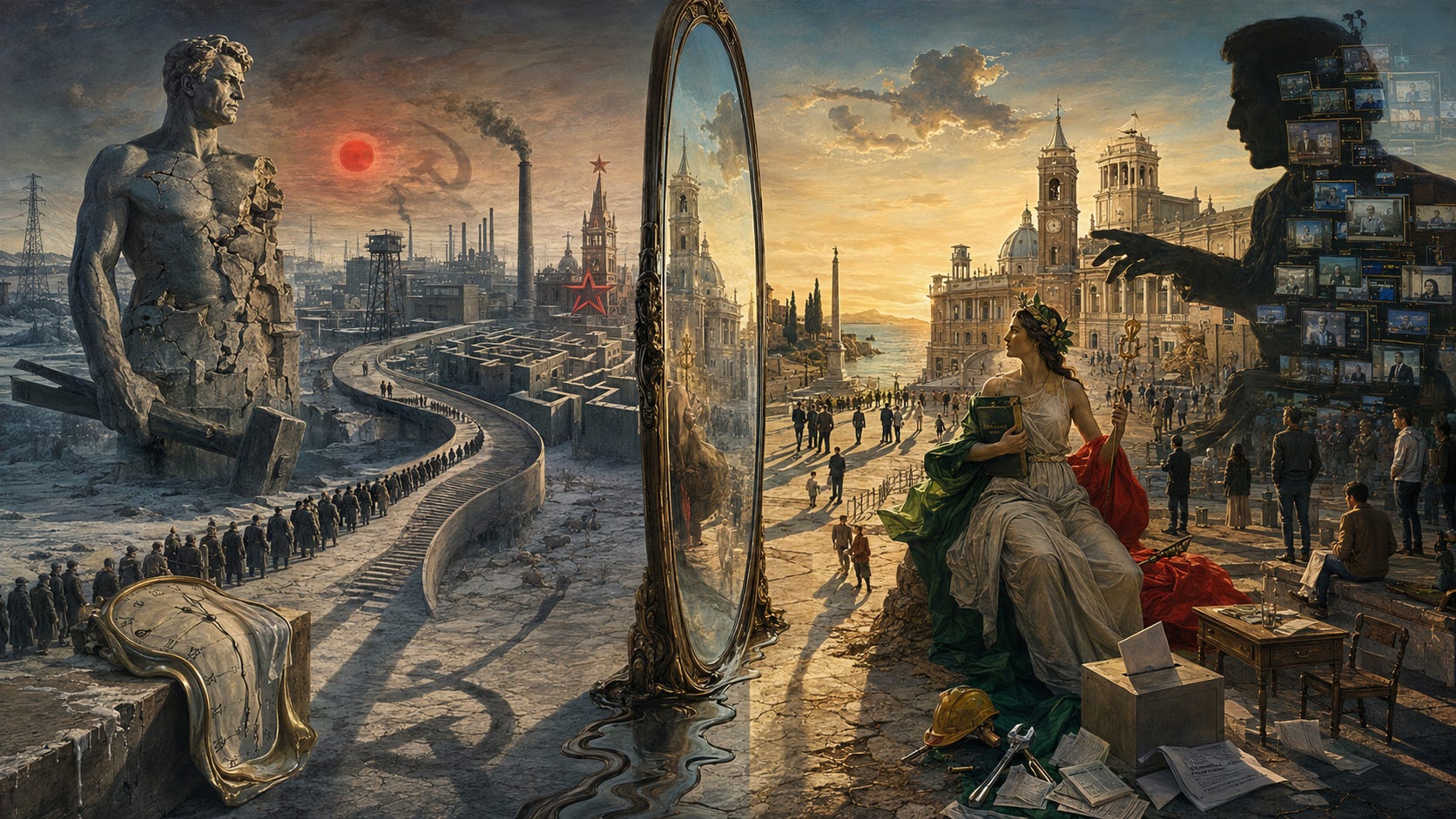
Two republics keep time in me, and they keep it differently.
The first lasted seventy years and then, one December, was gone. I was young enough to believe its disappearance was a beginning rather than a wound, and old enough to remember the particular quality of the silence that followed, the silence of a thing that had insisted on its own eternity right up to the morning it ceased to exist. The Soviet Union had been, among other things, a theory of permanence and futurity. It fell in the time it takes a long marriage to end.
The second republic turns eighty today, and I am its citizen. I married into Italy on the Cesenate hills, learned to love it, and, somewhere along the way, acquired the documents that make belonging official. But I came to it carrying the first republic inside me, the way one carries a language learned in childhood: not as information but as a reflex, a set of expectations about how states live and how they die. And so I cannot look at the Italian Republic the way a born Italian does. I look at it the way someone looks at a house who has watched a similar house burn.
What I want to say, on this anniversary, is something an Italian might find strange and a post-Soviet citizen would find boringly obvious. The Italian Republic was built as a machine against a temptation that I have watched ruin a dozen states. It was designed, with a precision that its own citizens may have stopped noticing, to prevent the people from ever becoming a single body with a single face. And the question that hangs over its eightieth birthday is whether that design still holds, whether the Republic can still refuse the thing it was made to refuse.
The democratic temptation
Let me name the temptation, because I have a name for it, and because I earned that name the hard way.
When the Soviet system collapsed, the states that emerged from it wanted freedom. This is the part the West tends to remember, and it is true. But freedom is an abstraction, and abstractions, when they are urgently needed, look for a body to inhabit. What the post-Soviet peoples reached for, again and again, was not the slow architecture of mediated self-rule but the immediate satisfaction of incarnation: a strong president, a national will made visible in a single man, a “managed democracy” in which the people’s sovereignty was real on paper and exercised by proxy in practice. They wanted freedom, and they built, with their own hands and their own votes, the apparatus of its capture.
I have spent much of my working life reflecting on the result, and I have a vocabulary for it. These polities are flickering states, not consolidated democracies, not stable autocracies, but oscillating things that switch between the two faster than our theories can track, so that the same state can hold a free election on Sunday and gut a court on Monday without experiencing any contradiction. The great emancipatory words like democracy, rights, and the demos arrived in the post-Soviet space already worn thin, already half-hollow, available to be filled with almost any content. And I have come to believe that incarnation is not the opposite of democratic desire. It is one of its native temptations: the longing for the people to have a single body, a single voice, and a single will is not a betrayal of the wish for self-rule. It is one of the shapes that a wish takes when it is frightened, impatient, or tired.
This is the lens I bring to Italy. I am not an Italianist correcting the historical record. I am rather a survivor of one political experiment looking at another, and what I notice first is the thing the Italians built that my part of the world did not: a constitution that treats incarnation not as an aspiration but as a danger.
The mediated people
The Italian Constitution of 1948 was written by men and women who had just watched what happens when a people is persuaded to become one body. Fascism had been, before it was anything else, a metaphysics, a claim that the nation was a single organism, that it had a single will, and that this will could be made flesh in a leader who did not represent the people so much as embody them. The whole apparatus of representation, with its delays and its mediations and its irritating plurality, was precisely what fascism promised to overcome. Mussolini did not offer to speak for Italians. He offered to incarnate Italy.
The constitutional drafters answered this with a document that makes sovereignty real but refuses to let it be simple. “Sovereignty belongs to the people,” the first article declares, and then, in the same breath, hedges it: the people exercise that sovereignty “in the forms and within the limits of the Constitution.” The phrase is easy to read past. It is one of the most radical sentences in twentieth-century political thought. It says that the people are sovereign and that they may never act as a single unmediated mass; that their power is genuine precisely to the degree that it is channeled through political forms, namely, through Parliament, parties, unions, courts, a President who reigns without governing, and a Constitutional Court that can tell the people’s majority no.
And the Constitution does not stop at procedure. Its opening articles bind the Republic to labor, bind rights to solidarity, and define equality not as a formal sameness before the law but as a substantive task: the Republic is obligated to remove the obstacles that in fact prevent citizens from being free and equal (Cotta & Verzichelli, 2020). This is the part that the proceduralist reading misses. The 1948 settlement does not merely scatter power so that no one can seize it. It gives the people a material existence in work, social dignity, and the concrete conditions of a shared life precisely so that they will never need to seek their existence in a face.
Here, the contrast with my part of the world becomes almost painful. The post-Soviet constitutions, written in the same hopeful idiom of rights and peoples, enshrined strong presidencies (that reign and govern and micromanage) in their founding texts, as though stability could be purchased by concentrating power at the top. They built the cathedral around the throne. The Italians, having seen the throne up close, built a cathedral with no throne in it at all, a structure of naves and side chapels and load-bearing walls, designed so that the eye would never come to rest on a single figure. Freedom, in the Italian design, was not freedom from mediation. It was freedom through it.
How the single face came back
A constitution is a machine, but a machine must be run by people who still believe in what it does, and belief is the part that wears out or mutates first.
The First Republic (1948–1992, in Maurizio Cotta’s terms) held the people in its mediations for nearly half a century, mostly by means of parties so dense and so total that they organized not just politics but identity, leisure, faith, and memory. Then, in the early nineties, the machine seized. The corruption investigations known as Tangentopoli dissolved the party system almost overnight; the old polarity of Christian Democrats and Communists, which had given Italian politics its shape and its limits, evaporated together with the Cold War that had sustained it. Into the vacuum stepped a man who understood, earlier than almost anyone, that the people could be reached more directly than the parties had ever reached them.
Silvio Berlusconi did not so much found the Second Republic (1994–2011) and a party as broadcast them. The political scientist Mauro Calise gave the phenomenon its name: the personal party, an organization that is an extension of a single person rather than a structure that person inhabits (Calise, 2006). The Second Republic never became formally presidential, as its formal constitution was the same anti-incarnation document as before. But its practice drifted toward personalization, toward a politics in which authority had to be made visible in a face, and the people were reconceived as an audience—a public that acclaims rather than a plurality that deliberates.
I want to resist the reflex that treats this as a peculiarly Italian decadence, because from where I stand, it looks like something much larger. The televisual sovereign, the leader who governs by appearing, was not invented in Italy. My own region produced cruder and more dangerous versions of the same figure, men and women who understood that a camera could do the work that the secret police used to do, and do it with the people’s enthusiastic consent. The personalization of politics is a late-modern form, a way that mass democracies under the pressure of media and markets tend to resolve their own complexity into the reassuring simplicity of a human on a screen. Italy was not behind the curve here. If anything, it was ahead of it. What had been a national peculiarity in the nineteen-nineties became, in the decades after, something close to the global default.
The temptation legislated, the people’s refusal
Which brings me to the present, and to a paradox I do not think I could have noticed six months ago.
For several years, it has been possible to discern, behind the noise of the Italian Third Republic (since 2013), the outline of a third figure of the people: neither the party-mediated citizen of the First Republic nor merely the televisual audience of the Second, but something more impatient than either. Call it the plebiscitary people: a public that distrusts not only parties but parliaments, not only politicians but judges, journalists, experts, European constraints, and constitutional vetoes. It wants immediacy. It wants the majority’s will to translate without friction into the executive’s action. It wants, in a phrase, to be told that because the people have chosen, the institutions must now obey.
This figure found its constitutional expression in the proposed reform known as the premierato: the direct popular election of the prime minister, joined to an electoral law guaranteeing the winning coalition fifty-five per cent of the seats in both chambers and to a requirement that the two chambers be elected at the same time as the premier. The legal scholar Nicola Lupo has observed that the result would be a form of government largely unknown in other democracies, a directly elected premier armed with a guaranteed majority, which is to say an executive leader fused with the legislature rather than checked by it (Lupo, 2025). It was marketed, as these things always are, in the language of stability: an end to Italy’s revolving-door governments, a premier who could finally finish a sentence. The irony, which a careful survival analysis of Italian cabinets has made precise, is that the reform would most likely reduce the slow churn of mid-term cabinet reshuffles only to increase the risk of outright early elections (Pedrazzani & Zucchini, 2025). Incarnation sold as order, and volatility delivered as the bill.
The premierato is the post-Soviet temptation in Italian dress. It is the wish to give the people a body, to collapse the distance between the majority’s will and the state’s action, to dissolve the irritating mediations that the 1948 Constitution so deliberately built. I recognized it instantly, the way one recognizes a face from another life.
And then something happened that I did not expect.
In March of 2026, Italians were asked to ratify a different constitutional reform, the Nordio reform of the judiciary, which would have separated the careers of judges and prosecutors, split the body that governs them, and created a new disciplinary court partly chosen by lot. The government framed it as modernization. The opposition framed it as one more step in the concentration of power, more mediation weakened, and more checks loosened. The vote became, as everyone understood it would, a referendum on the leader herself. And the people refused. By roughly fifty-four to forty-six, on a turnout near fifty-nine per cent (remarkably high for an Italian referendum), the electorate voted NO (Lattanzi & Martinico, 2026). The prime minister conceded and declared she would not resign. The premierato, observers now suggest, may quietly slip off the agenda until the next general election.
Here is the paradox I want to hold, without resolving it too quickly. In the very same weeks that Italians went to the polls to refuse a reform that would have weakened their courts, the V-Dem Institute released its annual report and, for the first time, listed Italy among the world’s autocratizing states, citing the government’s security legislation and its pressure on independent institutions (Nord et al., 2026, pp. 4ff). So which is true? Is Italy a democracy eroding from above, filed alongside the cautionary cases by the people who keep the world’s ledgers of freedom? Or is it a democracy defending itself from below, a people who walked into the voting booth and declined, by a clear margin, to hand over one face?
Both are true. That is precisely the condition I have spent my life trying to describe. This is the flicker: erosion legislated from above and refusal expressed from below, in the same state, in the same season, neither one canceling the other. A theory that can only see the autocratization will miss the fifty-nine per cent turnout. A theory that can only see the refusal will miss the security laws and the international verdict. The honest thing—the only thing that matches what is actually happening—is to hold both and to understand that a republic is not a fixed condition but a contest that is being lost and won at once.
The fading of the founding no
There is a subtler danger here than the one the indices measure, and the Italian philosophers Nadia Urbinati and Gianni Pedullà have given it an indispensable name. They call the emerging condition afascist democracy, not the return of fascism in costume, not blackshirts in the piazza, but a democracy that remains fully electoral while quietly cutting the cord that once tied it to its anti-fascist origins (Urbinati & Pedullà, 2024). The machinery of voting continues. What fades is the founding NO: the constitutive refusal of the one-body politics and the living memory of why the mediations were built in the first place. Today, the Republic seems to keep its procedures and to forget its foundational negation.
I know this condition from the other side. In my part of the world, the anti-totalitarian energy of 1989–1991 was a universal emancipatory word that everyone could feel the weight of, that could fill a square and topple a statue. And then it exhausted itself. The founding NO became a ceremony, then a cliché, then an embarrassment, and then a resource that ambitious men could mock to prove their authenticity. Once the negation that founded a state becomes merely decorative, the state is available to be refilled, and what tends to flow back into it is the oldest content of all: the dream of unity, of one people and one will and one leader and one enemy. Anti-fascism in Italy is an exhausted universal in exactly this sense—not false, not unimportant, but worn to the point where it can be archived as heritage rather than lived as vigilance. It needs refueling.
The danger, then, is not that Italians will suddenly admire a new Mussolini. It is that the distinction his defeat established: the defeat in a struggle between a freedom that lives in mediated plurality and a unity that lives in a single embodied will, that will come to seem like an old quarrel or something one’s grandparents cared about. When that distinction goes soft, the premierato stops looking like a danger and starts looking like common sense. Why shouldn’t the people choose their leader directly? Why should a court be able to overrule the majority? These questions answer themselves only as long as the founding NO is still alive to answer them.
Freedom and equality, or neither
I have said that the 1948 Constitution gave the Italian people a new material existence so that they would not have to seek their existence in a single face. This is the deepest part of the Republic’s design, and the part most exposed today, so let me be exact about it.
The Italian founders refused a choice that most political traditions accept as natural: the choice between freedom and social equality. The liberal tradition tends to protect freedom and let equality fend for itself. The various socialisms tend to pursue equality and treat freedom as a luxury to be rationed. The 1948 document refuses the split: it grounds the Republic in labor, binds rights to solidarity, and makes equality a substantive obligation rather than a formal guarantee. Freedom and equality are meant to hold each other up, and the wager is that a people secure in both will never be desperate enough to want a savior.
The wager is under pressure from both sides. A freedom that loses its social ground decays into mere formalism, that is, into a bundle of rights held by citizens who no longer experience the Republic as a material home, who are free in law and abandoned in fact. And here the territorial reality matters, because Italy is so much a multitude: the persistent myriad divisions between the productive north and the long-neglected south mean that the “people” the plebiscitary politician invokes in the singular does not actually exist as a singular thing. It lives in plurality: in marvelously diverse regions, in sadly unequal life chances, in several Italies that a single elected face can never represent without erasing the multitude. Meanwhile, an equality pursued without freedom curdles into the securitarian paternalism that the V-Dem analysts flagged: order delivered as protection, protection delivered as control, and further on to a new duce.
The genius of 1948 was to see that these are not two problems but one. A people kept materially whole does not hunger for incarnation. A people abandoned to formal freedom and substantive abandonment will eventually go looking for a body to belong to—and will find one, because there is always someone willing to offer his own.
What the older republic knows
So I return, on this anniversary, to the disproportion I began with. Seventy years and eighty years of experiments. The republic that promised permanence and dissolved; the republic that promised only limits and endures.
I do not offer my part of the world’s experience as a universal prophecy, and certainly not as despair. I offer it as instruction, in the old sense, as something learned at cost that might spare someone else the tuition. What the bitter post-Soviet experience taught me is that a people can want freedom with their whole hearts and build, out of that very wanting, the cage that holds them. The desire for self-rule and the desire for a master are not necessarily opposites. They are neighbors, and under enough pressure, they trade places. The strong president, the “managed democracy,” the leader who is the nation—these were not imposed on my region’s nations against their will. Many of them were chosen, freely, by people who believed they were choosing freedom.
That is why the Italian counter-lesson of this March moves me more than the international ledgers do. A people can also walk into the voting booth and decline a face. The fifty-nine per cent who turned out, the fifty-four per cent who said no—they were not defending an abstraction. They were keeping faith, perhaps without quite naming it, with the founding NO of 1948: the refusal to let sovereignty be liberated from the forms that make it democratic. They were behaving as a constitutional plurality rather than a majoritarian mass, which is the one thing the plebiscitary politician can neither command nor counterfeit.
The Republic at eighty is not safe. The flicker is real. The erosion is real. The founding negation is wearing thin, and the temptation to incarnation has been written into a bill that may yet return. But the Republic is also not lost, and the reason it is not lost is the reason it was built in the first place. It was made by people who knew, because they had just watched it happen, that the most dangerous thing a free people can do is to find itself a single body, a single face. They built a temple with no throne in it. The miracle, and after my own region’s experience, I do not use the word lightly, is that, eighty years on, enough Italians still know better than to build one.
References
Calise, M. (2006). La Terza Repubblica: Partiti contro presidenti. Laterza.
Cotta, M., & Verzichelli, L. (2020). Il sistema politico italiano (4th ed.). Il Mulino.
Lattanzi, U., & Martinico, G. (2026, April 11). Neither what Italy needed, nor what it deserved: The 2026 constitutional referendum and the rejection of the Nordio reform. Verfassungsblog. https://doi.org/10.17176/20260411-173427-0
Lupo, N. (2025). The constitutional reform providing for direct election of the Prime Minister: The so-called ‘premierato.’ Contemporary Italian Politics, 17(2), 192–206.
Nord, M., Altman, D., Fernandes, T., Good God, A., & Lindberg, S. I. (2026). Democracy report 2026: Unraveling the democratic era? University of Gothenburg, V-Dem Institute. https://www.v-dem.net/documents/75/V-Dem_Institute_Democracy_Report_2026_lowres.pdf
Pedrazzani, A., & Zucchini, F. (2025). The potential impact of the Italian ‘premierato’ reform on cabinet durability: the increased risk of early elections. South European Society and Politics, 30(3), 351–385. https://doi.org/10.1080/13608746.2025.2588561
Urbinati, N., & Pedullà, G. (2024). Democrazia afascista. Feltrinelli.